

Yes. Cognitive behavioral therapy and Christian faith can integrate ethically and effectively for many believers seeking mental health care. A peer-reviewed systematic review of religion-adapted CBT found that faith-integrated approaches perform at least as well as standard CBT for religious clients, and sometimes better when clients want their faith woven into treatment. A manualized protocol called Religiously Integrated CBT (RCBT) has already been tested in patients dealing with depression and chronic illness.
If you are weighing this path, here is where to start:
- Look for a faith-integrated therapist who explicitly offers Christian counseling rather than someone who simply identifies as Christian personally.
- Ask direct questions in your first call about how they blend scripture, prayer, and clinical technique.
- Try one safe self-help practice, like pairing a thought record with a relevant scripture passage, before your first session.
A practice like Prism Counseling & Coaching in Phoenix builds sessions around exactly this model: standard cognitive tools paired with a client's own spiritual language, never imposed from the outside.
Key Takeaways
Faith-integrated CBT works because it applies proven cognitive techniques to a client's own religious beliefs instead of asking them to set faith aside during treatment.
| Point | Details |
|---|---|
| Evidence supports integration | Peer-reviewed reviews show R-CBT performs as well as standard CBT, sometimes better for clients who want faith included. |
| Therapist belief is not required | Skill in using a client's faith content matters more than the clinician's personal religious identity. |
| Techniques are concrete | Scripture-based thought records, prayer-linked activation, and memorization are standard, not vague encouragement. |
| Know the red flags | Watch for imposed theology, missing informed consent, or no crisis plan when evaluating a therapist. |
| Prism models client-led integration | Prism Counseling & Coaching structures Christian counseling around each client's own preference for explicit or implicit faith integration. |
Table of Contents
- What Is CBT and Christianity Integration in Clinical Terms?
- Does Faith-Integrated CBT Actually Work Better Than Standard CBT?
- What Techniques Do Therapists Actually Use in Session?
- What Does a Typical Session and Homework Schedule Look Like?
- Do Theological Objections to CBT Hold Up?
- When Is Faith-Integrated CBT Not the Right Fit?
- How Do You Find a Therapist Who Integrates Faith Well?
- What Does This Look Like at a Faith-Based Practice?
- A Clinician's Honest Take on Faith and CBT
- Start Faith-Integrated Counseling With Prism
- Frequently Asked Questions
- Sources
What Is CBT and Christianity Integration in Clinical Terms?
Religion-adapted CBT, often shortened to R-CBT, is not a separate therapy invented for church settings. It is standard cognitive behavioral therapy with one deliberate shift: the client's own religious beliefs, scriptures, and practices become raw material for cognitive restructuring and behavioral activation. A peer-reviewed review of R-CBT techniques describes it as patient-centered by design. The therapist does not bring a theology into the room. They draw out the one already living there.
That single distinction changes almost everything about how sessions run. Standard CBT challenges a distorted thought with logic, evidence, and reframing drawn from general cognitive science. Christian-integrated CBT does that same work, but it also asks: what does scripture say about this belief, and where does it contradict the lie you are telling yourself?
Standard CBT vs. Christian-integrated CBT, in practice:
- Standard CBT identifies cognitive distortions using neutral evidence and logic; Christian-integrated CBT adds scripture-based counter-evidence to the same distortion.
- Standard CBT builds behavioral activation around general values (relationships, hobbies, work); Christian-integrated CBT often includes faith community involvement and prayer practices as activation targets.
- Standard homework assignments are journaling or exposure exercises; Christian-integrated homework can include scripture memorization tied directly to a specific automatic thought.
- Standard assessment covers mood, history, and functioning; Christian-integrated assessment adds a spiritual domain, asking how faith currently helps or hinders coping.
Here is a small but common example. A client tells herself, "I'm worthless because I failed again." In standard CBT, the therapist might ask her to list evidence for and against that belief. In Christian-integrated CBT, the therapist might do the same, then invite her to sit with Romans 8:1, "There is therefore now no condemnation for those who are in Christ Jesus," as a direct counter to the shame narrative.
Therapists do not need to share a client's faith to deliver this work well. What matters, according to the research, is skill in using the client's own religious content respectfully and accurately, not the clinician's personal belief system.
That single fact removes a common barrier for Christians who assume they must find a believer with a license. A skilled, respectful clinician of any faith background can deliver R-CBT competently, provided they ask good questions and follow the client's lead.
Does Faith-Integrated CBT Actually Work Better Than Standard CBT?
The short answer: it holds its own, and for some clients, it edges ahead. A systematic review published through the National Institutes of Health synthesized multiple randomized controlled trials and found that religion-adapted CBT is generally as effective as standard secular CBT for symptom reduction. Several of the reviewed studies showed a meaningful edge for clients who explicitly wanted their faith included in treatment, not tacked on as an afterthought.
That finding matters because it undercuts a common assumption in both directions. Secular skeptics sometimes assume faith content dilutes clinical rigor. Devout clients sometimes assume only a fellow believer can deliver real healing. Neither assumption holds up against the data.
What the evidence actually shows:
- Efficacy appears largely independent of the therapist's own religious identity, based on outcomes across the reviewed trials.
- Manualized R-CBT protocols exist for major depression in medically ill patients, with structured session content built around scripture and prayer as clinical tools, detailed in a peer-reviewed treatment description.
- A broader review of R-CBT techniques documents multiple adapted protocols across religious traditions, not just Christianity, suggesting the underlying mechanism generalizes.
The nuance worth sitting with: study sizes in this field vary considerably, and protocols are not standardized across every trial. Some studies test a fully manualized RCBT curriculum; others test looser, therapist-led integration with far less structure. A broader index of published research in this area spans years of work, but heterogeneity across protocols means no single number captures "how much better" faith integration performs. Reviewers are careful to distinguish explicitly religious integration, which uses specific doctrinal content like scripture, from more generic spirituality-based approaches that reference meaning and purpose without doctrinal specificity. Those are not the same intervention, and lumping them together muddies the evidence.
For a reader deciding whether to pursue this path, the practical implication is straightforward. If you already hold Christian belief and find comfort or clarity through scripture and prayer, faith-integrated CBT gives you a therapy that speaks your language rather than asking you to set that language aside for fifty minutes a week. The research base, while not massive, is real, peer-reviewed, and growing steadily rather than resting on anecdote.
What Techniques Do Therapists Actually Use in Session?
Faith-integrated CBT is not vague spiritual encouragement layered on top of therapy talk. It uses specific, recognizable clinical tools with a Christian adaptation built into the structure.
Common techniques you might encounter:
- Scripture-based cognitive restructuring, where a distorted thought is directly paired with a counter-passage rather than a generic reframe.
- Modified thought logs, sometimes called renewal journals, which add a column for the scripture or faith resource used to challenge the thought.
- Prayer-linked behavioral activation, where prayer or contemplative practice becomes one of the scheduled activities used to combat avoidance or low mood.
- Scripture memorization, assigned as a form of cognitive rehearsal so a counter-thought becomes automatic under stress.
- Faith-community engagement, where church involvement functions as a behavioral activation target, similar to how a secular therapist might prescribe reconnecting with friends.
A typical adapted thought record includes the standard columns: situation, automatic thought, emotion, evidence for and against. Christian-integrated versions add one more: the scripture or faith resource used to counter the thought. A client might log "I am unloveable" as the automatic thought, then record 1 John 3:1 as the counter-evidence, alongside the standard cognitive challenge.
Pro Tip: If you're trying this on your own before or between sessions, keep your thought log simple. One distorted thought, one scripture counter, one sentence about how it lands emotionally. Overloading the exercise with five verses per thought usually causes people to abandon the practice within a week.

Therapists distinguish between implicit and explicit integration, and this distinction matters more than most articles mention. Implicit integration uses a client's values and worldview to shape session tone without direct scripture quotation, useful for clients who are spiritually private or still working out their beliefs. Explicit integration brings scripture, prayer, and doctrinal language directly into the room, which fits clients who want overt faith content. Neither approach is more legitimate than the other. The right choice depends entirely on what the client wants, which is why informed consent around faith integration is not optional.
A related clinical review describes this ethical stance clearly: integration should be client-driven from the first session, not introduced as a surprise once trust is established. A therapist should ask directly, early on, how much religious content the client wants in their care, and should revisit that question as treatment progresses. Some clients want scripture in every session. Others want it reserved for moments of real spiritual crisis. Both preferences deserve respect.
What Does a Typical Session and Homework Schedule Look Like?
A faith-integrated CBT session follows a familiar rhythm, with faith content woven through rather than bolted on at the end. Most sessions open with a brief check-in on mood and the past week, move into a short spiritual assessment (how has faith been helping or straining you lately), transition into whatever CBT skill is on deck for that week, and close with collaborative homework planning. Some clients request a brief closing prayer; plenty do not, and a well-trained therapist follows that lead without assuming.
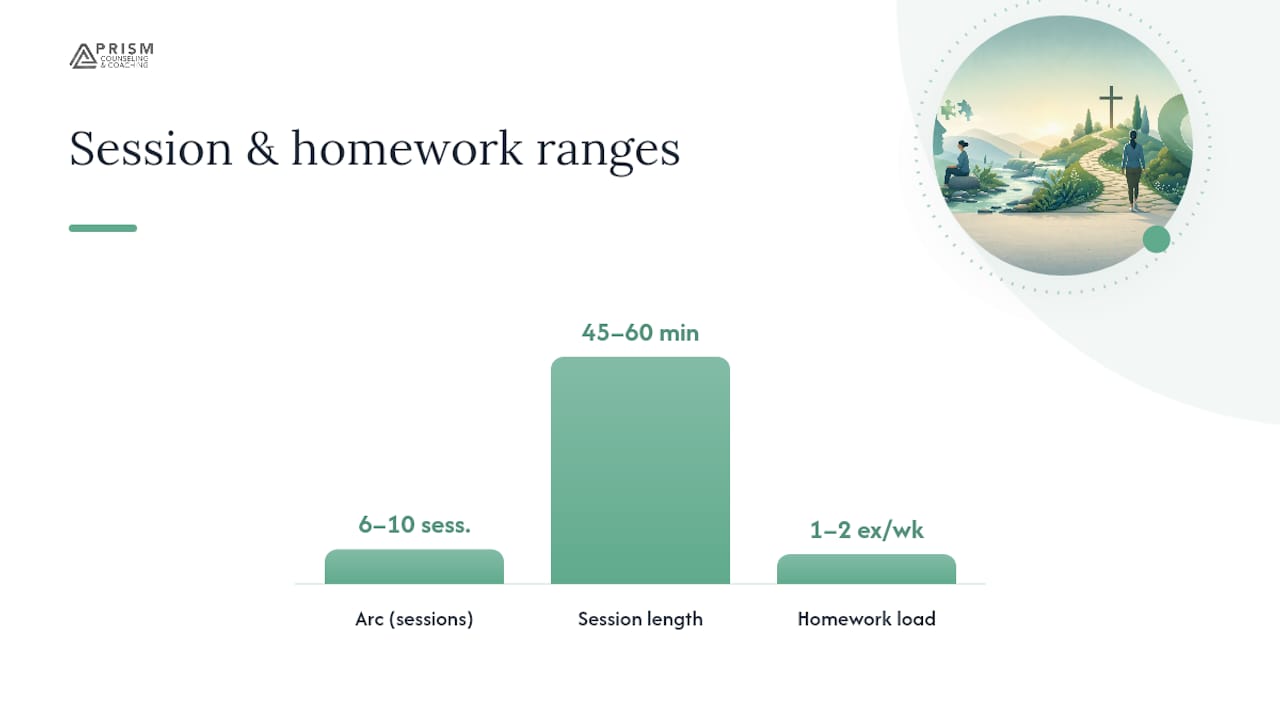
A common six to ten session arc looks something like this:
- Intake and spiritual assessment, establishing history, symptoms, and how much faith content the client wants.
- Psychoeducation on the CBT model and how thoughts, feelings, and behavior connect.
- Behavioral activation, often including faith-community involvement as a scheduled activity.
- Cognitive restructuring introduced, paired with scripture-based counter-thoughts.
- Deeper thought-record practice, refining the client's own scripture and evidence pairings.
- Addressing core beliefs, often the deepest and slowest work, tied to identity in Christ or similar doctrinal anchors.
- Relapse prevention planning, building a personalized toolkit for future setbacks.
- Review and closing, including a plan for maintaining gains.
Homework examples clients commonly practice between sessions:
- Scripture memorization tied to a specific recurring automatic thought, reviewed at the start of the next session.
- A faith-based behavioral experiment, such as testing a feared social situation at church and recording the actual outcome against the predicted one.
- Prayerful journaling that follows a thought-record structure but frames the closing reflection as a short written prayer.
Session length runs the standard 45 to 60 minutes most clients already expect from any talk therapy. Homework load varies by therapist, but a reasonable starting point is one or two exercises per week rather than a stack of worksheets. If a therapist is assigning more than that consistently, it is fair to ask them to scale back.
Do Theological Objections to CBT Hold Up?
Some Christians worry that therapy quietly competes with pastoral care, or that leaning on psychology suggests scripture alone is not sufficient. These concerns deserve a real answer, not dismissal.
The most common objections, and how they hold up:
- "Therapy replaces pastoral care." In well-run integration, it does not. A therapist handles clinical symptom reduction using structured technique; a pastor or spiritual director handles discipleship and communal faith formation. The two roles complement rather than compete, and many faith-integrated therapists actively coordinate with a client's church leadership when appropriate.
- "Psychology conflicts with biblical sufficiency." CBT does not claim to replace scripture as a source of truth. It offers a structured method for identifying and correcting distorted thinking, a process scripture itself describes in Romans 12:2, urging believers toward the "renewal of your mind." The clinical tool and the biblical mandate point the same direction.
- "Prayer is enough." For some seasons of struggle, prayer alone brings real relief. For clinical depression, trauma, or anxiety disorders, most pastors and clinicians agree that structured treatment alongside prayer serves people better than either alone.
Scripture passages commonly used in integrated sessions include 2 Corinthians 10:5, on taking every thought captive, and Philippians 4:8, on dwelling on what is true and honorable. Clinically, these passages give language to what cognitive restructuring is already doing: catching a distorted thought and replacing it with something accurate.
Pro Tip: If a therapist ever presents their theological interpretation as the only correct one, or pressures you toward a specific doctrinal position you have not raised yourself, that is a sign to pause. Good integration follows your framework. It never imposes one.
Denominational tradition shapes how integration feels in the room. A client from a liturgical background might want structured prayer and sacramental language woven into sessions. A client from a nondenominational or charismatic tradition might expect more spontaneous prayer and direct scripture application. Neither is wrong, and a good therapist adjusts rather than defaulting to one style for everyone.
When Is Faith-Integrated CBT Not the Right Fit?
Faith-integrated CBT is a strong option for many believers, but it is not a substitute for higher-level psychiatric care in every situation.
Seek immediate psychiatric or emergency care rather than starting outpatient talk therapy if you are experiencing:
- Active suicidal ideation with a plan or intent.
- Symptoms of active psychosis, including hallucinations or delusions.
- Severe substance dependence requiring medical detox.
A systematic review of R-CBT is clear that this therapy model was studied for conditions like depression and anxiety in stable outpatient populations. It was not designed or tested as a stand-alone treatment for acute crises.
Ethical practice, at minimum, should include:
- Informed consent specifically covering how faith will be used, obtained before integration begins, not assumed.
- A firm non-proselytizing stance, meaning the therapist never uses sessions to convert or correct a client's theology.
- Clear boundaries around scope of competence, with prompt referral to a psychiatrist or higher level of care when symptoms exceed outpatient talk therapy.
- Standard confidentiality protections, identical to any licensed counseling relationship.
Watch for therapist-imposed theology, pressure to adopt beliefs you have not chosen, or a complete absence of any conversation about what happens if you experience a crisis between sessions. If you encounter any of these, you are within your rights to end the relationship and seek a second opinion. A licensing board complaint is also appropriate if a therapist has crossed a genuine ethical line rather than simply being a poor personal fit.
How Do You Find a Therapist Who Integrates Faith Well?
Start with sources built specifically for this search rather than a general directory. Denominational counseling networks, faith-based private practices, and clinical directories that let you filter for spiritual integration all narrow the field quickly. A referral from your own church can also work well, though it is worth verifying licensure independently rather than assuming a referral guarantees clinical competence.
Ten questions worth asking before you book a first session:
- Do you offer explicit or implicit faith integration, and can you explain the difference?
- How do you decide how much scripture or prayer to include in a session?
- Will you ask my preferences before adding faith content, or do you assume it?
- What is your process for informed consent around spiritual integration specifically?
- What is your referral process if I need medication evaluation or psychiatric care?
- How do you handle a client in crisis between scheduled sessions?
- What are your confidentiality policies, and do they meet standard licensing requirements?
- What are your fees, and do you accept insurance or operate as private-pay?
- What is your training or experience specifically in faith-integrated approaches?
- How do you handle a situation where my theology and yours differ?
Red flags to watch for in the answers:
- Vague or evasive answers about informed consent for faith content.
- Language that frames sin as the sole cause of your symptoms without any mention of clinical assessment.
- No clear plan for crisis situations or after-hours support.
- Any hint of pressure toward a specific doctrinal position during the initial call.
A short phone screen or email exchange usually reveals most of this before you commit to a first paid session. If a provider dodges direct questions about their process, that hesitation is worth taking seriously.
What Does This Look Like at a Faith-Based Practice?
Consider a composite example, not a specific client record. A woman in her thirties comes to counseling carrying chronic guilt over a past decision, alongside diagnosed anxiety. Her therapist begins with a spiritual assessment, learns she wants explicit scripture integration, and builds a treatment plan around cognitive restructuring paired with grace-centered passages addressing shame and forgiveness. Homework includes a modified thought record and a weekly scripture memorization assignment tied directly to her recurring guilt narrative. Over several sessions, her anxiety symptoms decrease alongside a shift in how she talks about her past.
At Prism Counseling & Coaching, this kind of client-led integration is standard practice, not a special add-on. Tres, one of the practice's counselors, brings experience working specifically at the intersection of clinical technique and spiritual formation with Christian clients in the Phoenix area.
- This example is illustrative, not a record of an actual client.
- Always verify a therapist's credentials, licensure, and specific experience before starting care, whether at Prism or elsewhere.
A Clinician's Honest Take on Faith and CBT
Faith-integrated CBT works best when it stays genuinely collaborative rather than becoming a script the therapist runs on autopilot. The clients who benefit most tend to be the ones willing to say plainly what they want from scripture and prayer in session, rather than assuming the therapist will guess correctly. That honesty takes courage, especially for clients used to keeping their doubts private from church community.
Therapy is not a replacement for your relationship with God, and no ethical clinician should ever present it that way. It is a structured partnership, one where clinical skill and your own faith work together rather than in competition. Before starting with anyone, faith-integrated or not, check their credentials and ask how they handle informed consent. That single conversation tells you almost everything about whether the fit is right.
Start Faith-Integrated Counseling With Prism
Prism Counseling & Coaching offers Christian counseling built around exactly the client-driven model described throughout this piece, with online sessions available for clients who prefer to meet from home. As a small, private-pay practice, Prism typically offers new client openings within days rather than the weeks-long waits common with insurance-based care.
If your needs exceed outpatient talk therapy, including active crisis symptoms or a need for medication management, Prism's counselors will refer you to appropriate psychiatric or emergency resources rather than attempting to manage that alone. That transparency is part of ethical practice, not a limitation to hide.
Ready to talk with someone who takes both your faith and your clinical needs seriously? Visit the Christian counseling page to see current openings, or explore online counseling options if remote sessions fit your schedule better.
Frequently Asked Questions
Is CBT compatible with Christian beliefs? Yes, for most clients. Research on religion-adapted CBT shows the model integrates well with Christian doctrine because cognitive restructuring parallels the biblical concept of renewing the mind, and the therapy does not require abandoning any theological position.
Do I need a Christian therapist for faith-integrated CBT to work? No. Studies show effectiveness depends more on the therapist's skill in respectfully using your religious content than on the therapist sharing your specific faith.
What is the difference between CBT and Christian CBT? Standard CBT uses general logic and evidence to challenge distorted thoughts. Christian-integrated CBT adds scripture, prayer, and faith-community involvement as specific tools within that same cognitive framework.
Can faith-based CBT help with guilt and shame related to past sin? Yes, this is one of its more common applications. Therapists often pair cognitive restructuring with scripture on grace and forgiveness to directly address guilt-driven distorted thinking, though ongoing pastoral support alongside therapy is often valuable too.
How do I know if a counselor practices ethical faith integration? Ask directly about informed consent for spiritual content, their referral process for crisis situations, and how they handle differences in theology. Vague answers or unrequested doctrinal pressure are warning signs.
Sources
- Religion-Adapted Cognitive Behavioral Therapy - PMC - NIH
- Religion-Adapted Cognitive Behavioral Therapy: A Review and Description of Techniques - PMC
Bring these sources to your own therapist or pastor if you want to discuss integration in more clinical depth. For a broader look at how CBT treats anxiety and depression outside a faith framework, this overview of common therapy modalities offers a useful comparison point.
Recommended
- Christian Counseling Resources | Articles, Videos, and Podcast Resources by Topic - Prism Counseling & Coaching | Faith-Based Counseling and Spiritually-Integrated Therapy in Peoria and Phoenix AZ
- My Journey Through Conversion Therapy | A Pastor and Counselor's Experience - Prism Counseling & Coaching | Faith-Based Counseling and Spiritually-Integrated Therapy in Peoria and Phoenix AZ
- Responding to Those Deconstructing - Prism Counseling & Coaching | Faith-Based Counseling and Spiritually-Integrated Therapy in Peoria and Phoenix AZ