

A pastoral care specialist is a licensed counselor or therapist who provides faith-integrated, client-led clinical care, not chaplaincy. This means your beliefs shape the therapy, but a trained clinician still leads with evidence-based treatment for anxiety, depression, grief, or trauma. Practices like Prism Counseling & Coaching offer this kind of care, weaving spiritual conversation into licensed counseling rather than replacing it.
TL;DR:
- Faith-integrated counseling is led by licensed clinicians who incorporate spirituality only when the client desires, using evidence-based methods like CBT and EMDR.
- Effective care addresses specific, measurable goals such as reducing panic attacks or improving sleep, typically within four to eight sessions.
- Verification of licensure, clear treatment methods, optional faith discussion, and transparent fees are essential before booking with a faith-based provider.
- Severe psychiatric conditions, active psychosis, or medical issues require referral to psychiatric or medical professionals rather than sole reliance on spiritual counseling.
- Trustworthy providers will explicitly distinguish between exploring faith and directing it, and collaborate with medical teams when necessary for comprehensive care.
Table of Contents
- What Does a Pastoral Care Specialist Actually Do?
- Who Benefits Most From Faith-Integrated Counseling?
- What to Ask Before You Book a Session
- What Early Sessions Look Like and How Progress Gets Measured
- Ethics, Training, and What Keeps This Care Safe
- Training and Certification Pathways for This Specialty
- How This Role Differs From Other Mental Health Professionals
- Where Pastoral Care Specialists Practice
- Finding and Choosing the Right Specialist for You
- When Pastoral Care Alone Is Not Enough
- Why the "Faith or Therapy" Framing Gets This Wrong
- How Prism Counseling & Coaching Can Support Your Search
- Where to Read More
- Sources
- FAQ
What Does a Pastoral Care Specialist Actually Do?
A pastoral care specialist is a licensed counselor or therapist trained in the same evidence-based methods any clinician uses, cognitive behavioral therapy, EMDR, family systems work, but who also knows how to invite your faith into the room when you want it there. That "when you want it" part carries real weight. The American Counseling Association's guidance on integrating religion and spirituality describes this work as inclusive and culturally responsive, adapting proven counseling methods to fit a client's religious or spiritual perspective rather than the other way around.
The Association for Spiritual, Ethical, and Religious Values in Counseling, known as ASERVIC, sets the competencies most licensed counselors train under when they add this specialty. Those standards ask counselors to know their own beliefs well enough to keep them out of your treatment plan, and to bring genuine cultural humility to every session.
In practice, this looks less dramatic than people expect. A counselor might:
- Ask whether you want prayer woven into a session, and honor a simple "no" without follow-up questions
- Reframe a cognitive behavioral exercise using language from your own faith tradition instead of secular self-help phrasing
- Refer you to scripture, meditation, or a faith community as an adjunctive support alongside, never instead of, clinical treatment
- Explore how a spiritual struggle, like feeling abandoned by God during grief, connects to your symptoms
Pro Tip: Ask a prospective counselor how they would handle it if you said you did not want faith discussed in a particular session. Their answer tells you more about their training than almost anything else you could ask.
Who Benefits Most From Faith-Integrated Counseling?
Faith-integrated care tends to help most when spiritual questions sit at the center of someone's pain, not at the edges of it. Grief that includes anger at God, trauma that shakes a person's sense of divine protection, or depression tangled up with feelings of unworthiness before a faith community all respond well to this approach.
Common presenting concerns include:
- Anxiety and chronic worry, especially when tied to fear-based religious upbringing
- Depression, including the isolation that can come with feeling spiritually "stuck"
- Grief and bereavement, particularly when mourning includes theological questions
- Spiritual distress, such as a crisis of faith following illness or loss
- Relationship and marital conflict where values or religious practice diverge
- Trauma, where spiritual integration often works best as a support alongside trauma-specific treatment
A randomized trial found spiritually integrated interventions reduced PTSD symptoms most clearly when a client's distress involved their relationship with a Higher Power specifically. That is a narrower, more useful finding than "faith helps trauma." It means fit matters more than faith alone. When trauma symptoms are severe or someone needs medical stabilization, a pastoral care specialist should coordinate with psychiatric providers or chaplains rather than working in isolation.
What to Ask Before You Book a Session
Before scheduling with anyone who calls themselves a spiritual care provider, run through a short verification process. A surprising number of self-described "faith-based" providers cannot clearly answer basic licensing or safety questions, which is exactly the gap worth checking for before you commit time and money.
- Confirm active licensure. Ask for their license number and check it against your state licensing board. A real counselor will give this without hesitation.
- Ask which treatment methods they use. Listen for named approaches like CBT or EMDR, not vague language about "healing" or "wholeness."
- Clarify how faith enters sessions. It should sound optional and client-led, never assumed or required.
- Confirm fees and payment structure. Ask about sliding scale options, superbills for insurance reimbursement, and telehealth availability.
- Ask about their cancellation policy. Most private-pay practices charge a missed-appointment fee, and you deserve to know that upfront.
- Ask how they handle a crisis. A clinician should describe a concrete safety plan, not a general reassurance.
Watch for red flags: proselytizing instead of listening, discomfort naming their license, or reluctance to collaborate with a medical or psychiatric provider when your situation calls for it.
Statistic Callout: A 2011 systematic review found religion-accommodative psychotherapy performed at least as well as standard psychotherapy for depression and anxiety, though the researchers noted the evidence base remains limited in size and scope.
What Early Sessions Look Like and How Progress Gets Measured
Your first session or two will likely cover more clinical ground than spiritual ground, and that is by design. A thorough intake includes your mental health history, current symptoms, safety screening, and a brief spiritual history, often using a structured tool like FICA or HOPE to understand how faith functions in your life without turning the intake into a theology exam.
From there, a good counselor sets goals that can actually be tracked over time:
- Fewer panic attacks per week, measured against a baseline
- Improved sleep, tracked through a simple log
- Safer, calmer communication patterns in a marriage
- Reduced avoidance behaviors tied to grief or trauma
Spiritual growth matters, but it should never replace these measurable markers. The VA's clinical guidance on spirituality is direct about this: religion and spirituality can be protective or harmful depending on the specific belief or behavior involved, so counselors need to track real functional change, not just report a client "feels closer to God." Most clients notice movement on concrete goals within four to eight sessions, though timelines vary with the severity of what brought them in.
Ethics, Training, and What Keeps This Care Safe
Counselors integrating faith into treatment are expected to examine their own beliefs first, so those beliefs never quietly steer a client's care.
That expectation comes directly from ASERVIC and ACA training standards, which require cultural humility alongside clinical competence. The line between ethical integration and proselytizing is simple to state and easy to violate: integration follows the client's lead, proselytizing pushes an agenda. A licensed counselor stays inside their scope of practice, refers out for medical or psychiatric needs, and never presents personal theology as clinical fact.
Some small, private-pay counseling practices report openings within days rather than the weeks-long waitlists common with insurance-based counseling. That same structure supports the kind of individualized attention faith integration requires, since sessions are not rushed to fit an insurance company's clock.
Pro Tip: If a counselor cannot explain, in plain language, the difference between "exploring your faith" and "directing your faith," keep looking.
Training and Certification Pathways for This Specialty
Every legitimate pastoral care specialist starts as a licensed mental health clinician first, whether that is a Licensed Professional Counselor, Licensed Clinical Social Worker, or licensed Marriage and Family Therapist. Faith integration is a specialization layered on top of that license, not a substitute for it.
Most counselors build this competency through graduate coursework in spirituality and counseling, supervised clinical hours where a faith-integrated approach is practiced under review, and continuing education tied to ASERVIC's published competencies. Some pursue additional reading through texts like the ACA's Integrating Spirituality and Religion Into Counseling, which walks through specific in-session interventions and the ethical guardrails around them.
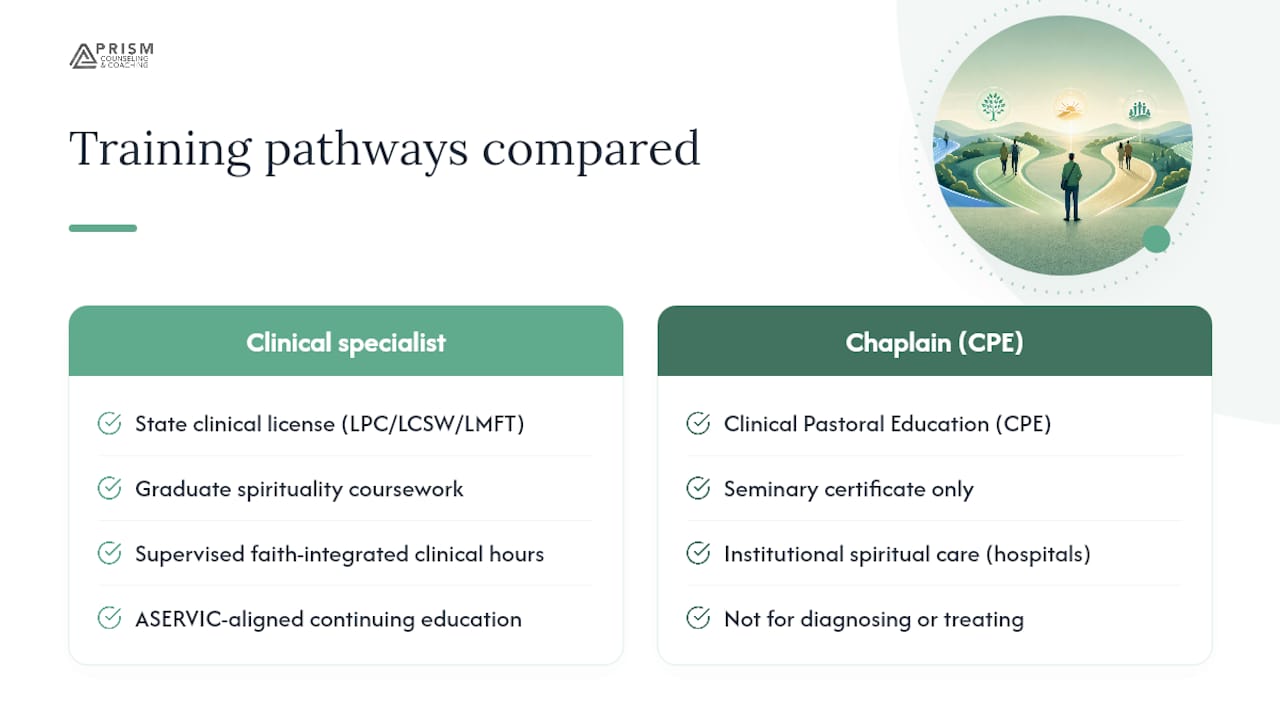
This differs sharply from chaplaincy training, which typically runs through Clinical Pastoral Education programs and prepares someone for spiritual care in hospital or institutional settings rather than for diagnosing and treating mental health conditions. A pastoral care specialist in the clinical sense holds a state-issued counseling license; that license, not a certificate from a seminary alone, is what allows them to bill as a therapist and treat diagnosable conditions.
How This Role Differs From Other Mental Health Professionals
The clearest distinction is scope, not skill. A general licensed therapist and a pastoral care specialist often hold identical credentials and use identical treatment methods. The difference is that the pastoral care specialist has added training in exploring spiritual and religious material safely, and actively offers to include it when a client wants that.
A chaplain, by contrast, typically works within an institution, hospital, hospice, military unit, and provides spiritual support without diagnosing or treating mental illness. A psychiatrist prescribes medication and manages diagnoses but rarely provides talk therapy sessions themselves. A general secular therapist may be excellent at treating your depression but untrained, and sometimes uncomfortable, discussing your relationship with God as part of that treatment.
None of these roles is better across the board. A person managing bipolar disorder needs a psychiatrist in the picture. Someone processing a terminal diagnosis in a hospital bed needs a chaplain's presence more than a 50-minute outpatient session. But someone whose depression is entangled with feeling forsaken by their faith community often needs exactly what a pastoral care specialist offers: clinical skill that does not require leaving faith at the door.
Where Pastoral Care Specialists Practice
Faith-integrated counselors work across more settings than most people expect. Hospital and hospice systems sometimes employ them alongside chaplains, particularly for patients who want ongoing clinical treatment rather than a single supportive visit. Faith communities increasingly host licensed counselors on staff or through referral partnerships, giving congregants a warm handoff from pastoral staff to clinical care.
The most common setting, though, is a private counseling practice. Independent, private-pay practices tend to offer more flexibility for genuine faith integration because they are not constrained by insurance panels that may limit session length or dictate treatment protocols. Community counseling centers and university counseling services round out the landscape, often serving clients who specifically request a counselor comfortable discussing religious identity.
Telehealth has widened access considerably. A client in a small town with no local faith-integrated counselor can now work with a specialist licensed in their state through video sessions, which matters most for people whose specific faith tradition is not well represented locally.
Finding and Choosing the Right Specialist for You
Start with a direct search for faith-integrated counseling, spiritual guidance counselor, or pastoral counseling services combined with your state, since licensure is state-specific and matters for both legal and insurance reasons. Denominational directories, referrals from your own faith community, and licensing board searches all work better than generic therapist directories that do not let you filter for spiritual integration specifically.
Once you have a short list, the verification checklist earlier in this guide becomes your filter. Pay attention to how a counselor describes their approach on an initial call. Someone confident in ethical integration will talk about your beliefs shaping the work; someone drifting toward imposition will talk about what they believe you need to accept.
Fit matters as much as credentials. A counselor who shares your specific faith tradition is not automatically the better choice over one who is respectful and skilled but from a different background. What matters is whether they listen well and adapt to you, which the ACA's own framing of integration treats as the actual professional standard, not a nice extra.
When Pastoral Care Alone Is Not Enough
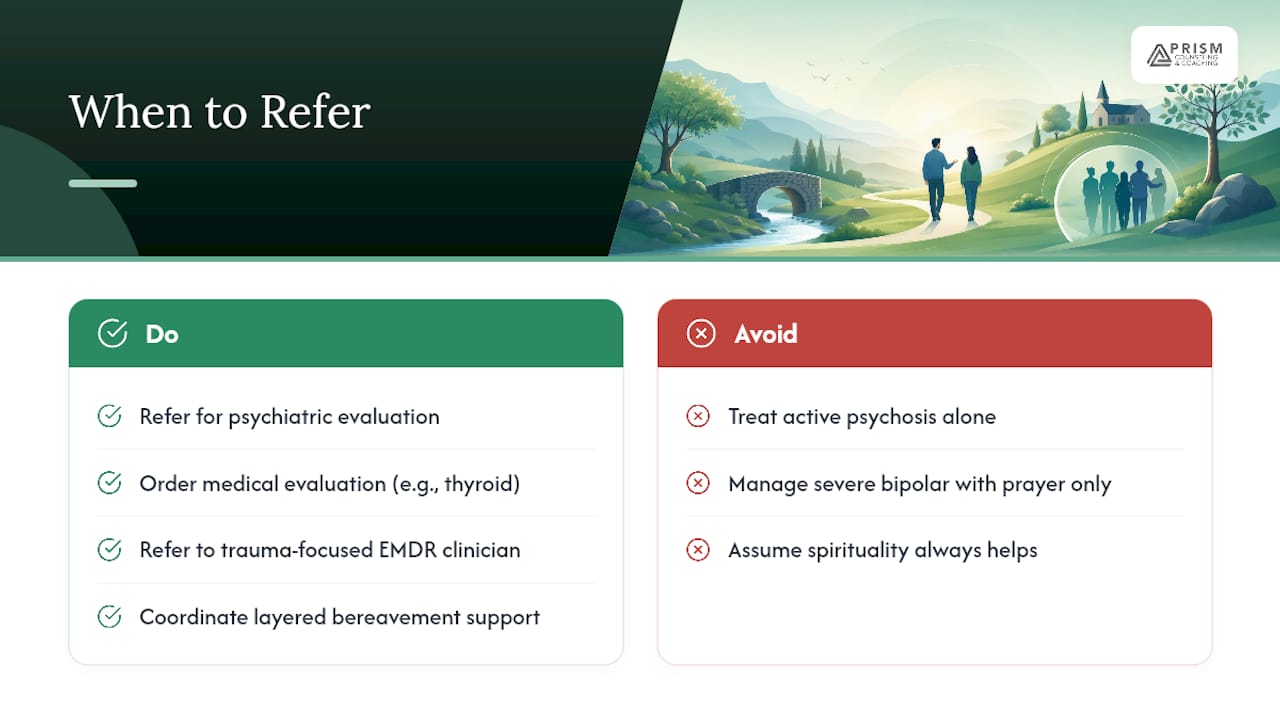
Faith-integrated counseling is not the right primary treatment for every situation, and a competent pastoral care specialist should say so plainly when that is the case. Severe psychiatric conditions, active psychosis, uncontrolled bipolar episodes, or serious suicidal crisis, need psychiatric evaluation and possibly medication management first. A counselor who tries to handle these alone with talk therapy and prayer is operating outside their scope.
Complex trauma sometimes needs specialized modalities like EMDR delivered by a trauma-focused clinician before spiritual processing can do much good; the VA's own guidance is careful to note that spirituality can be protective or harmful depending on the specific belief involved, which is exactly why a clinician needs to assess rather than assume. Medical conditions with psychological symptoms, thyroid disorders mimicking depression, for instance, need a physician's evaluation before counseling of any kind will help much.
The right referral pattern runs in both directions. A pastoral care specialist should refer out when a case exceeds their training, and a chaplain or medical provider should refer toward pastoral counseling when a patient's ongoing struggle is clearly more clinical than situational. Good care for the bereaved, in particular, often benefits from this kind of layered support rather than any single provider trying to cover everything alone.
Why the "Faith or Therapy" Framing Gets This Wrong
Most conventional advice treats faith and clinical therapy as a choice you have to make, pick the church counselor or pick the licensed therapist. That framing has it backwards. The actual research points toward integration, not selection: religion-accommodative psychotherapy performs as well as standard psychotherapy for depression and anxiety, and spiritually integrated care shows particular strength for trauma tied to a person's relationship with a Higher Power.
What gets underestimated is how much the ethics matter here. Plenty of providers market themselves as faith-based without being able to explain their crisis protocol or their license status, and that gap should worry you more than whether a counselor shares your exact denomination. The reader's real priority should be verification first, comfort second. Ask about licensure and treatment methods before you ask about theology. A counselor who welcomes that scrutiny is telling you something important about how they practice.
— Tres
How Prism Counseling & Coaching Can Support Your Search
If you have read this far, you already know what to look for: licensure, evidence-based methods, and faith integration that follows your lead. Some counseling practices are built around a small, private-pay structure that can allow new clients to get an appointment within days rather than waiting weeks for an opening.
Services include faith-based counseling and spiritual direction, individual and couples counseling, and specialties like EMDR and LGBTQ+ affirming counseling. If cost is a concern, sliding scale appointments run $100 to $165 per session, while a standard 50 minute session is $195. Before your first appointment, jot down what brought you in and whether you want faith actively discussed. That single note will help your counselor build an intake around what actually matters to you. Visit Prism Counseling & Coaching's rates page to review current fees and request an appointment.
Where to Read More
- ACA's guidance on integrating religion and spirituality into counseling covers the professional standard for client-led integration.
- The UMN-hosted randomized trial on spiritually integrated PTSD care details condition-specific outcomes.
- VA clinical guidance on spirituality and resilience explains when faith helps and when it does not.
- Prism's own page on what a pastoral counselor is offers a plain-language definition and next steps.
- Prism's counseling resource library has articles and podcasts for ongoing reading.
Sources
- Integrating Religion and Spirituality into Counseling | Counseling Nexus (ACA digital press)
- Spiritually integrated care for PTSD: a randomized controlled trial (UMN experts page)
- VA: Spirituality, resilience, and guidance for clinicians
- Systematic review: religion-accommodative psychotherapy for depression and anxiety (VA HSR abstract)
FAQ
Is a pastoral care specialist the same as a chaplain?
No. A pastoral care specialist in this sense is a licensed counselor or therapist who integrates faith into clinical treatment, while a chaplain typically provides spiritual support within an institution like a hospital without diagnosing or treating mental health conditions.
Do I have to talk about religion in every session?
No, faith integration is client-led and optional, meaning you decide session by session how much spiritual content, if any, belongs in the conversation. Practices like Prism Counseling & Coaching build sessions around your stated preferences rather than a fixed spiritual curriculum.
How much does faith-integrated counseling cost?
At Prism Counseling & Coaching, a standard 50 minute session is $195, with sliding scale appointments available from $100 to $165 depending on financial need. Other providers set their own rates, so ask directly before booking.
Can faith-integrated counseling help with trauma?
Yes, particularly when a trauma survivor's distress connects to their relationship with a Higher Power. A randomized trial found spiritually integrated care reduced PTSD symptoms in that specific circumstance, though severe trauma often benefits from trauma-focused modalities like EMDR alongside spiritual integration.
What should I check before booking a session?
Verify the counselor's active license through your state board, ask which evidence-based methods they use, and confirm that faith integration sounds optional rather than assumed. Also ask about fees, sliding scale options, and their cancellation policy before your first appointment.