

Christian couples counseling pairs biblical aims, such as repentance, forgiveness, and worship-shaped goals, with licensed clinical methods to improve communication, trust, and intimacy. If you or your spouse are in immediate danger, call 988 (Suicide & Crisis Lifeline) or the National Domestic Violence Hotline before anything else. If you are ready to begin faith-integrated care, booking an intake with a licensed counselor is your next step.
- In crisis now: Call 988 or 1-800-799-7233 (National Domestic Violence Hotline)
- Substance or mental-health crisis: Contact the SAMHSA National Helpline at 1-800-662-4357
- Ready to start: Request an intake with a licensed faith-integrated counselor, such as Prism Counseling & Coaching in Phoenix/Peoria
Research from Harvard T.H. Chan School of Public Health finds that spiritual practices are often associated with stronger patient engagement and can positively influence health-related outcomes, which is one reason faith integration in couples therapy tends to support lasting change.
Key Takeaways
Faith-integrated couples therapy pairs biblical goals with licensed clinical methods, and choosing a credentialed counselor who can explain how those two things connect is the single most important selection decision you will make.
| Point | Details |
|---|---|
| Crisis comes first | Call 988 or 1-800-799-7233 before booking counseling if safety is a concern. |
| Verify credentials | Look for LPC, LMFT, LCSW, PsyD, or PhD plus specific couples training before committing. |
| Faith integration is explicit | A good counselor can explain how each technique serves a biblical goal, not just a clinical one. |
| Realistic timeline | Most couples see meaningful progress within 6–12 sessions; deeper work may take longer. |
| Prism Counseling & Coaching | Licensed, faith-integrated couples counseling in Phoenix and Peoria with openings typically within days. |
This article is general information, not a substitute for advice from a qualified doctor. Consult a qualified healthcare professional about your own circumstances before acting on anything here.
Table of Contents
- What is Christian couples counseling and how does it differ from secular therapy?
- What methods and exercises will you encounter in sessions?
- When does counseling help, and what are its limits?
- How do you choose the right Christian couples counselor?
- What should you expect in the first sessions?
- Crisis, safety, and community resources in the U.S.
- What are the confidentiality rules in faith-based counseling?
- How does individual Christian counseling differ from couples counseling?
- What we have learned about faith-integrated care
- Prism Counseling & Coaching: faith-integrated care for couples in Phoenix
- Sources
What is Christian couples counseling and how does it differ from secular therapy?
At its core, faith-based couples therapy addresses the same presenting issues as secular couples work: chronic arguments, emotional withdrawal, infidelity, parenting conflict, and life-transition stress. The difference is that Scripture, prayer, and gospel-shaped goals are not optional add-ons. They shape the entire therapeutic frame.
A secular therapist might help you communicate more clearly. A Christian counselor helps you communicate more clearly because you are called to love one another as Christ loved the church (Ephesians 5:25). That "why" changes how couples receive feedback, how they define forgiveness, and how they measure success.
Licensed clinicians, holding credentials such as LPC, LMFT, LCSW, PsyD, or PhD, still provide the care. Faith integration does not replace clinical competence; it sits alongside it. Couples facing infidelity, spiritual disagreement, premarital uncertainty, or long-standing unresolved conflict all find a place in this model.
What methods and exercises will you encounter in sessions?
Christian relationship counseling draws from several evidence-based frameworks and layers faith practices on top of them.
Therapeutic models commonly used:
- Gottman-informed skills: soft-start conversations, repair attempts, and turning toward bids for connection
- Emotionally Focused Therapy (EFT) principles: identifying attachment needs and de-escalating negative cycles
- Cognitive-behavioral techniques: restructuring distorted beliefs about a spouse's motives or character
Faith-integration practices:
- Scripture reading and application to the couple's specific conflict patterns
- Prayer in session, when both partners agree and the counselor judges it appropriate
- Structured confession and forgiveness scripts grounded in biblical language
- Church-community supports woven into the treatment plan
Gratitude practices deserve a special mention. UCLA Health links consistent gratitude to improved emotional well-being, and a Frontiers in Psychology review associates gratitude interventions with improved well-being across multiple studies, though effects vary by context. Weekly spiritual check-ins and gratitude exchanges are low-burden exercises couples can practice between sessions to shift their positive-to-negative interaction ratio.
Pro Tip: Ask your counselor directly: "How does this technique connect to a biblical goal?" A good faith-integrated clinician can explain how a Gottman skill like gentle start-up serves a gospel aim like humility and honor. Common-grace tools are servants of Scripture's purposes, not replacements for them.
When does counseling help, and what are its limits?
Therapies like EFT and Gottman-informed approaches have a meaningful evidence base for improving communication and reducing conflict escalation in couples. Spirituality, as Harvard's public-health research notes, often supports engagement with care, which matters because couples who stay in therapy long enough to practice new skills are the ones who tend to see lasting change.

Realistic success looks like: calmer repair attempts after arguments, a healthier ratio of positive to negative interactions, and shared spiritual practices that feel connective rather than obligatory. These are observable, measurable goals, not vague hopes.
Counseling has limits, though. When one partner is actively abusing substances, living with untreated PTSD, or using coercive control, weekly outpatient sessions alone are rarely sufficient. Those situations call for specialized referrals, sometimes running parallel to couples work. Domestic violence, in particular, requires a safety-first approach before any joint counseling begins.
How do you choose the right Christian couples counselor?
Choosing well takes more than a Google search. Here is a practical sequence:
- Verify licensure. Look for LPC, LMFT, LCSW, PsyD, or PhD credentials. A pastoral counselor without clinical licensure may offer valuable support but cannot provide the same level of clinical care.
- Confirm couples-specific training. General therapy training does not automatically include couples work. Ask whether the counselor has completed specific training in EFT, Gottman, or another couples model.
- Ask about faith integration directly. "How do you incorporate Scripture?" and "Do you offer prayer in session?" are fair first-contact questions. A counselor who is vague or dismissive here is not the right fit.
- Clarify the payment model. Many faith-integrated counselors operate on a private-pay basis. Sessions typically run about an hour. Short-term progress often becomes visible within several sessions, though deeper work may take longer.
- Discuss confidentiality and mandated reporting. Licensed counselors are legally required to report certain disclosures (child abuse, imminent danger). Ask how that works in their practice before your first session.
Red flags to watch for:
- A counselor who minimizes or spiritualizes away abuse concerns
- Pressure to pray or read Scripture when one partner has not consented
- No clear licensing information on their website or intake paperwork
- Promises of guaranteed outcomes or rapid "healing" timelines
What should you expect in the first sessions?
The first one to three sessions are investigative, not prescriptive. Your counselor will gather relationship history, assess safety, and clarify what each of you hopes to gain. Expect intake questionnaires and a goal-setting conversation that covers both relational and spiritual aims.
From there, the next 6–12 sessions typically focus on skill building and repair work, with periodic reviews every 4–8 weeks to assess progress. Faith is woven in early: clarifying spiritual goals, gaining consent for prayer or Scripture use, and identifying how your church community can support the work.
For couples in acute crisis, multi-day intensive formats of several days offer deeper focus without the interruptions of daily life. Programs like Hope Restored describe this format as particularly useful when both partners can step away and commit fully to the process.
Crisis, safety, and community resources in the U.S.
If you or your spouse are in danger, counseling is not the first call. These resources are:
| Resource | Contact | Best for |
|---|---|---|
| 988 Suicide & Crisis Lifeline | Call or text 988 | Suicidal crisis, acute mental-health emergencies |
| National Domestic Violence Hotline | 1-800-799-7233 | Domestic abuse, safety planning, local referrals |
| SAMHSA National Helpline | 1-800-662-4357 | Substance use and mental-health crisis referrals |
| Emergency Services | 988 | Immediate physical danger |
Signs of coercive control, escalating threats, or physical violence mean safety comes first. Seek emergency services and a domestic-violence specialist before any joint counseling session. Local churches can offer community support, but vet them for confidentiality practices and make sure any pastoral counselor they provide is not also your spouse's accountability partner.
What are the confidentiality rules in faith-based counseling?
Licensed counselors, regardless of their faith orientation, operate under the same legal confidentiality standards as any other clinician. What you share in session is protected. There are three standard exceptions: imminent danger to self or others, suspected child abuse or neglect, and court orders.
Faith-based settings add one nuance worth discussing upfront: some practices have relationships with churches or pastoral staff. Ask your counselor directly whether any information is shared with church leadership, under what circumstances, and in what form. A licensed clinician should be able to answer that clearly and in writing.
How does individual Christian counseling differ from couples counseling?
Individual Christian counseling focuses on one person's interior life: their patterns, wounds, beliefs, and relationship with God. The therapeutic alliance is between counselor and client alone, and confidentiality is straightforward.
Couples counseling holds the relationship itself as the client. Both partners are present, the counselor manages the dynamic between them, and confidentiality becomes more complex. Some counselors will not hold secrets from one spouse that the other shares privately; others set clear rules about individual contact between sessions.
Sometimes both formats run in parallel. One partner may need individual work on trauma or attachment wounds while the couple also meets jointly. That combination is common and often more effective than couples sessions alone when one person carries significant unresolved history.
What we have learned about faith-integrated care
There is a temptation in Christian counseling circles to treat Scripture and therapy as competing authorities. We have seen the opposite prove true: when a counselor holds Scripture as the diagnostic and redemptive frame, and uses clinical tools as servants of that frame, couples tend to engage more honestly and stay longer. The Biblical Living Center's framework for biblical communication in marriage captures this well: common-grace techniques like Gottman's soft start-up are not secular intrusions; they are tools that, under Scripture's authority, help couples do what the gospel already calls them to do.
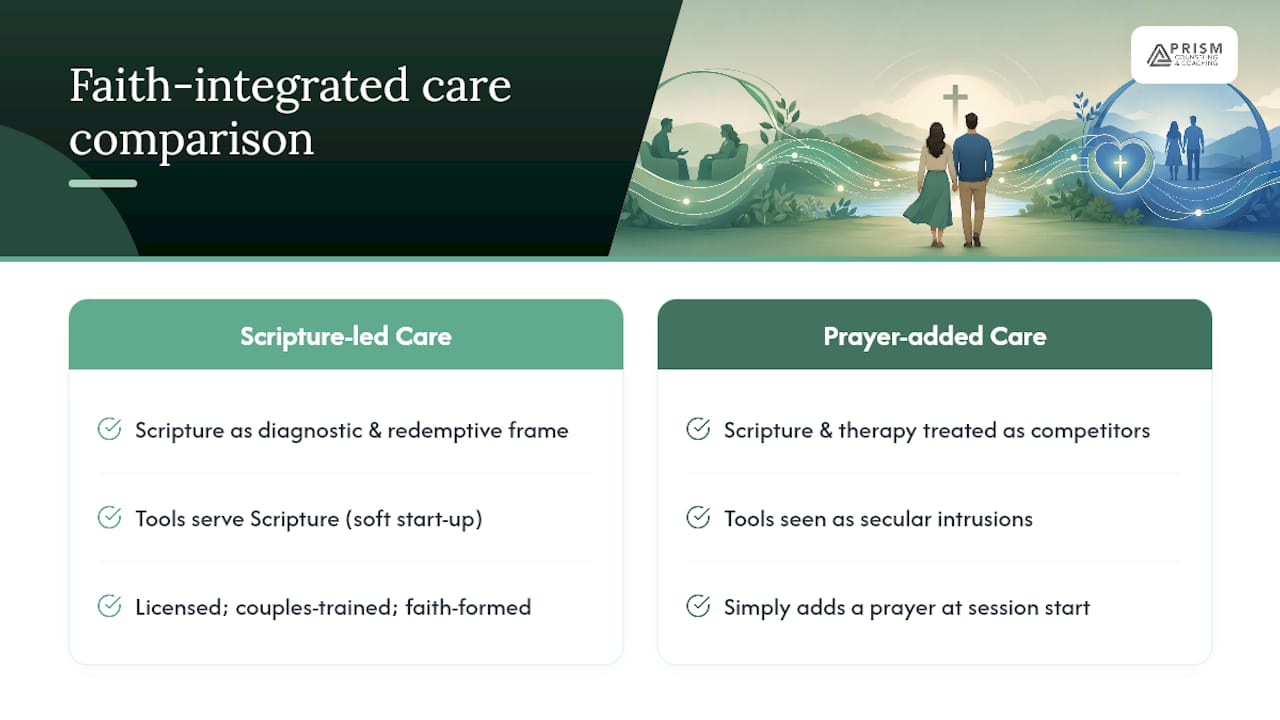
What we have also learned is that the counselor's own integration matters as much as their technique list. A clinician who is licensed, trained in couples work, and genuinely formed by their faith will ask different questions, hold different silences, and offer different hope than one who simply adds a prayer at the start of a session.
Prism Counseling & Coaching: faith-integrated care for couples in Phoenix
Prism Counseling & Coaching brings over 14 years of experience in spiritually-integrated therapy to couples in the Phoenix and Peoria area. The practice's licensed counselors hold credentials including LPC and LMFT, and they integrate Scripture and prayer as genuine clinical tools, not decorative additions. Because Prism operates on a private-pay model, new clients typically get an opening within days rather than weeks.
Christian marriage counseling at Prism covers the full range of presenting issues: communication breakdown, infidelity recovery, premarital preparation, parenting conflict, and faith differences within the couple. Telehealth options are available alongside in-person sessions in Phoenix and Peoria.
To get started, visit Prism's couples counseling page and request an intake. Bring a brief sense of what you hope to work on; your counselor will handle the rest from there.
Sources
Recommended
- Prism Counseling & Coaching | Faith-Based Counseling and Spiritually-Integrated Therapy in Peoria and Phoenix AZ - Prism Counseling & Coaching | Arizona Christian Counseling and Spiritually-Integrated Therapy in Peoria and Phoenix
- Prism Counseling & Coaching | Faith-Based Counseling and Spiritually-Integrated Therapy in Peoria and Phoenix AZ - Prism Counseling & Coaching | Arizona Christian Counseling and Spiritually-Integrated Therapy in Peoria and Phoenix
- Christian Counseling Resources | Articles, Videos, and Podcast Resources by Topic - Prism Counseling & Coaching | Faith-Based Counseling and Spiritually-Integrated Therapy in Peoria and Phoenix AZ