

Faith-integrated counseling can genuinely help many Christians with depression, especially when clinical care and spiritual support work together. If you are in crisis right now, call or text 988 or go to your nearest emergency room. If you are not in immediate danger, the most helpful next step is scheduling an initial consultation with a licensed, faith-integrated counselor.
When you are ready to find a counselor, look for these credentials:
- LPC (Licensed Professional Counselor)
- LCSW (Licensed Clinical Social Worker)
- LMFT (Licensed Marriage and Family Therapist)
- PsyD or PhD (Licensed Psychologist)
Prism Counseling & Coaching in the Phoenix area offers Christian counseling for depression with licensed clinicians who integrate faith naturally into evidence-based therapy, with openings typically available within days.
Key Takeaways
Faith-integrated therapy combines licensed clinical care with a client's Christian beliefs, making it one of the most fitting options for Christians navigating depression who want both spiritual and psychological support.
| Point | Details |
|---|---|
| Faith-integrated therapy is clinical care | It uses licensed clinicians and evidence-based methods like CBT and RCBT, not spiritual advice alone. |
| Loss of felt faith is a symptom | Depression can temporarily reduce your sense of God's presence; this tends to recover as depression is treated. |
| Vet credentials before booking | Require a state license (LPC, LCSW, LMFT, PsyD/PhD) and ask directly about therapy approach and faith integration. |
| Crisis resources are immediate | Call or text 988 any time for free, confidential crisis support; call 911 if you are in immediate danger. |
| Prism Counseling & Coaching | Licensed, private-pay, faith-integrated counseling in the Phoenix area with openings typically within days. |
Table of Contents
- What is Christian depression counseling, and how does it differ from pastoral care?
- How do Christian counselors treat depression in practice?
- What does the evidence say about faith-integrated therapy for depression?
- How do you choose a Christian counselor in the U.S.?
- What should you expect in your first sessions and over time?
- When should you seek urgent help?
- Why a balanced faith-integrated approach matters: Prism Counseling & Coaching
- A clinician's note on faith and depression
- Prism Counseling & Coaching is ready to help you take the next step
- Sources
What is Christian depression counseling, and how does it differ from pastoral care?
Christian depression counseling, more precisely called faith-integrated therapy, is licensed mental health care that intentionally weaves a client's Christian beliefs, Scripture, and prayer into evidence-based clinical treatment. It is not pastoral counseling alone, and it is not secular therapy with a Bible verse added at the end. The distinction matters because depression is both a clinical condition and, for many believers, a deeply spiritual experience.
Kathryn Butler and other clinicians are clear on this point: clinical depression is not purely a spiritual problem, and treating it as one risks real harm. A "just pray it away" response can deepen shame and delay care that genuinely works. At the same time, secular therapy that ignores a client's faith can feel hollow or even alienating for someone whose identity is rooted in their relationship with God.
Faith-integrated therapy holds both realities. A licensed Christian counselor conducts a full clinical assessment, uses therapies with a research base, and refers for medication when indicated. The spiritual dimension is woven in as a resource, not a replacement for clinical skill.
Here is how the three approaches compare:
| Approach | Who provides it | Clinical tools | Faith integration |
|---|---|---|---|
| Pastoral counseling | Pastor or chaplain | Typically none | Scripture, prayer, spiritual direction |
| Secular therapy | Licensed clinician | CBT, DBT, IPT, etc. | None or minimal |
| Faith-integrated therapy | Licensed clinician | CBT, RCBT, IPT, etc. | Scripture, prayer, theological framing alongside clinical tools |
A typical course of faith-integrated therapy includes a structured clinical assessment, a collaboratively built treatment plan, evidence-based therapy sessions, and the optional integration of Scripture study or prayer. Medication referral to a psychiatrist or primary care provider is part of the picture when symptoms are severe or persistent.
How do Christian counselors treat depression in practice?
The clinical backbone of most Christian depression counseling is Cognitive Behavioral Therapy (CBT), adapted for a faith context. Standard CBT identifies distorted thinking patterns and replaces them with more accurate ones. In a Christian adaptation, those accurate replacements are often grounded in biblical truth.

The most structured version of this is Religiously Integrated Cognitive Behavioral Therapy, or RCBT. The RCBT manual describes session-level exercises that map specific cognitive distortions to corresponding scriptural promises. A thought like "I am worthless" is examined not only through a cognitive lens but also through the lens of being made in the image of God. That dual reframing tends to feel more complete for clients whose worldview is deeply Christian.
Common therapeutic approaches used in Christian depression counseling include:
- CBT and Christian CBT: Identifying and restructuring distorted thoughts using both cognitive techniques and Scripture.
- RCBT (Religiously Integrated CBT): A structured manual-based approach that explicitly maps cognitive work to biblical truths.
- Interpersonal Therapy (IPT): Addresses relationship patterns and grief, often integrated with a theology of community and forgiveness.
- Dialectical Behavior Therapy (DBT): Emotion regulation and distress tolerance skills, sometimes framed through concepts of suffering and endurance in faith.
- Trauma-informed care: Processes past wounds while honoring the client's spiritual narrative and relationship with God.
Faith-integration techniques alongside these therapies often include Scripture study used as cognitive reframing homework, prayer at the opening or close of sessions when the client requests it, and collaboration with a pastor or church care team when the client gives consent.
For someone whose faith is central to their identity, that alignment is not a luxury. It is part of what makes the work feel worth doing.
What does the evidence say about faith-integrated therapy for depression?
The research base for psychotherapy in general is solid. Systematic reviews and meta-analyses place CBT and behavioral activation among the most reliably effective treatments for depression across a wide range of severity levels. Interpersonal therapy and problem-solving therapy also show consistent results. That foundation matters because faith-integrated approaches build on these same clinical methods.
The evidence specifically for Christian-adapted therapy is more limited in scale but consistently encouraging. A comparative inpatient study found that both secular CBT and a Christian-adapted CBT program reduced depressive symptoms. The Christian program produced significantly higher spiritual-wellbeing scores. The sample was small, which means the finding is suggestive rather than definitive, but it points in a direction that makes clinical sense: when therapy resonates with a person's deepest commitments, they tend to engage more fully.
Additional clinical research supports the broader principle that matching a therapeutic model to a client's worldview improves engagement and outcomes. The mechanism is not mysterious. People work harder in therapy when it feels coherent with who they are.
Honest limits worth knowing:
- Most specialty studies on Christian counseling vary widely in how they define "Christian integration."
- Severe or treatment-resistant depression often requires medication alongside therapy; no counseling approach alone is sufficient in those cases.
- The quality of a faith-integrated counselor depends heavily on their clinical training, not just their theological orientation.
The practical takeaway is this: faith-integrated therapy is a clinically grounded option, not an alternative to real treatment. For many Christians, it is the form of real treatment that fits best.
How do you choose a Christian counselor in the U.S.?
Faith language on a website does not guarantee clinical competence. Vetting a Christian counselor requires the same rigor you would apply to any licensed mental health provider, plus a few faith-specific questions.
Credentials to require
- State licensure in one of the recognized mental health disciplines: LPC, LCSW, LMFT, PsyD, or PhD in clinical or counseling psychology.
- Verification through your state's licensing board website, which takes about two minutes and confirms the license is active and in good standing.
- Telehealth licensing: if you want to meet remotely, confirm the counselor is licensed in your state. The PSYPACT map shows where interstate telepsychology is permitted for participating psychologists.
Questions to ask on first contact
- What therapy approach do you use for depression, and is it evidence-based?
- How do you integrate Christian faith into sessions, and do you follow the client's lead on that?
- Are you willing to coordinate with my primary care doctor or psychiatrist if medication is part of my care?
- What is your stance on medication for depression?
- How do you handle confidentiality, and what are the limits of it?
- What are your fees, and do you offer a sliding scale or accept insurance?
Red flags to watch for
- Claims of guaranteed healing or cure through prayer alone.
- Refusal to refer for medication or medical evaluation when symptoms are severe.
- No verifiable state license.
- Pressure to involve your church or pastor without your explicit consent.
- Framing depression as a sin or a sign of weak faith.
Costs and insurance
Most faith-integrated private-pay counselors charge between $100 and $200 per session, though rates vary by region and clinician experience. Insurance coverage for mental health services is required under the Mental Health Parity and Addiction Equity Act, but not every licensed counselor accepts every plan. Ask directly during intake: "Do you accept my insurance, and if not, what is your private-pay rate?" A practical guide to finding local counseling can help you understand what questions to ask about coverage and what to expect from the intake process.
What should you expect in your first sessions and over time?
The first session is not therapy yet. It is an intake. Your counselor will ask about your history, current symptoms, and what brought you in. Many clinicians use the PHQ-9, a nine-item screening tool that measures depression severity and tracks change over time. You will also discuss safety, meaning the counselor will ask directly whether you have had thoughts of harming yourself. This is standard practice, not an alarm.
What a typical intake and early treatment period looks like:
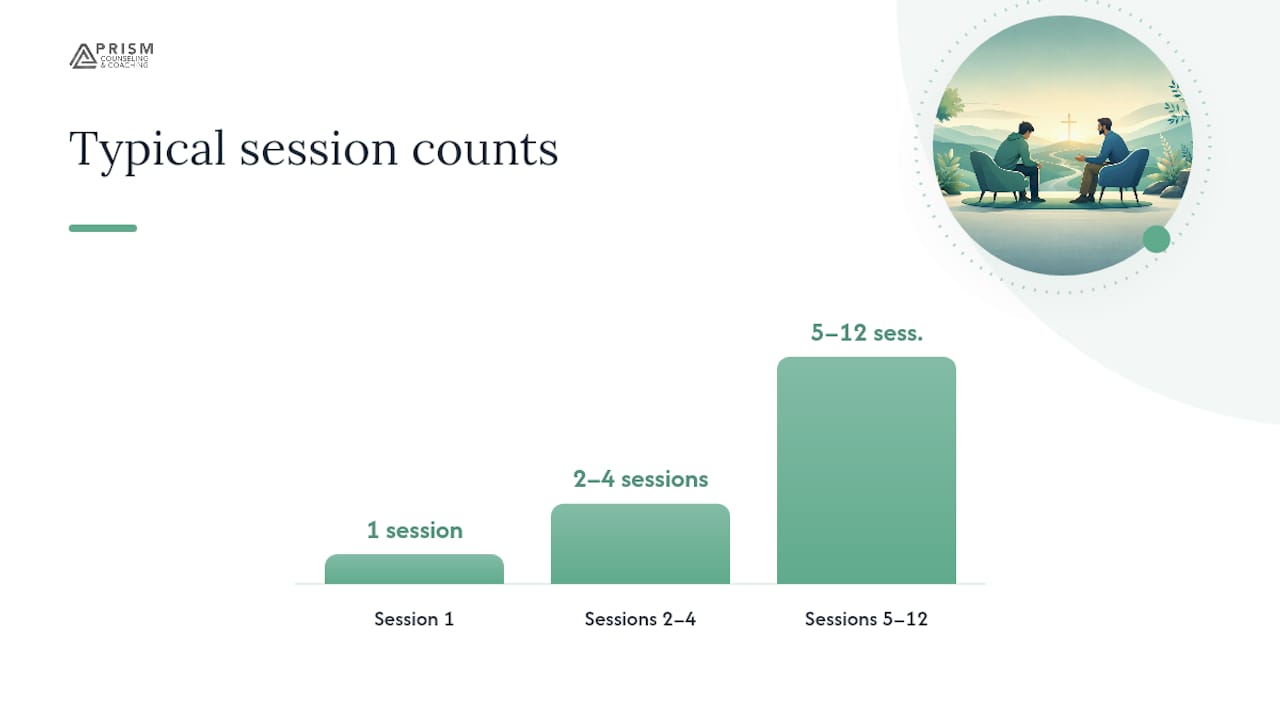
- Session 1: History, symptom screening (PHQ-9 or similar), safety assessment, and initial goals.
- Sessions 2–4: Collaborative treatment planning, introduction to the therapy model, and early skill-building or psychoeducation.
- Sessions 5–12: Active therapy work. For mild to moderate depression, many people notice meaningful improvement within this window.
- Beyond session 12: Chronic, complex, or trauma-related depression often benefits from longer-term work. Your counselor should discuss this with you openly rather than extending sessions indefinitely without a clear rationale.
Medication referral is most likely to come up when symptoms are severe, when there is a history of multiple depressive episodes, or when therapy alone is not producing enough change after a reasonable trial. A good faith-integrated counselor will raise this conversation directly and without shame.
For sessions tied to faith goals, you might bring a specific Scripture passage that has felt meaningful or troubling, a question about God's presence in your suffering, or a pattern in your prayer life you want to explore. Your counselor can help you work with that material clinically and spiritually at the same time.
When should you seek urgent help?
If you are having thoughts of suicide or self-harm, or if you feel unsafe right now, please stop reading and take one of these steps immediately:
Call or text 988 — the U.S. national Suicide and Crisis Lifeline — to reach a trained counselor 24 hours a day, 7 days a week. You can also chat online at 988lifeline.org. If you are in immediate danger, call 911 or go to the nearest emergency room.
A brief safety plan can help in the hours before you reach a professional:
- Remove or limit access to means of self-harm if you can do so safely.
- Tell one trusted person where you are and how you are feeling.
- Write down three contacts you can call: a friend or family member, your counselor's crisis line, and 988.
- Stay in a safe environment and avoid being alone if possible.
Faith-integrated clinicians are trained in safety planning and are bound by the same mandatory reporting and duty-to-warn obligations as all licensed mental health providers. If a client is at imminent risk, a licensed counselor will involve emergency services. That is not a breach of trust. It is the most caring thing a clinician can do.
Depression can temporarily erode the felt experience of faith, making prayer feel hollow and God feel distant. That loss of felt connection is a symptom of the disorder, not a verdict on your relationship with God. It tends to recover as depression is treated. Reaching out for help is not a failure of faith. It is wisdom.
Why a balanced faith-integrated approach matters: Prism Counseling & Coaching
Prism Counseling & Coaching has served individuals, couples, families, and teens in the Phoenix area for over 14 years. The practice's Christian counseling services are delivered by licensed clinicians, meaning every therapist holds a recognized state credential (LPC, LMFT, LCSW, or equivalent) and is trained in evidence-based methods alongside faith integration.
What makes the Prism model distinct is its private-pay structure. Without insurance billing, there are no waitlists driven by credentialing delays, and sessions are not shaped by what an insurer will authorize. Openings are typically available within days.
Prism's approach to ethics and safety includes:
- Confidentiality: Sessions are private. Limits to confidentiality (mandatory reporting for child abuse, imminent danger) are explained clearly at intake.
- Medical coordination: Clinicians collaborate with primary care providers and psychiatrists when medication is part of a client's care plan.
- Client-centered faith integration: Scripture, prayer, and theological reflection are offered as resources, not required. The client's comfort and consent guide how much faith content enters the room.
- Nondiscrimination: Prism offers affirming care for all clients, including LGBTQ+ individuals.
Services relevant to depression include individual therapy, telehealth sessions, and an employer-focused faith-based Employee Assistance Program (EAP) for organizations that want to offer faith-integrated mental health support to their teams. Theological perspectives on suffering remind us that faithfulness and endurance matter more than the immediate removal of pain, and that framing shapes how Prism's clinicians walk with clients through difficult seasons.
A clinician's note on faith and depression
Walking with someone through a depressive episode is one of the most sacred things a counselor does. The valley is real. The weight is real. We do not minimize it, and we do not offer easy answers.
What we do offer is presence, skill, and hope grounded in something more durable than a feeling. Many clients come in wondering whether their struggle means God has forgotten them. We gently hold that question with them while also doing the clinical work that helps lift the fog. Over time, most people find that their faith does not disappear in depression. It waits. And as the depression lifts, it returns.
If you are wondering whether to reach out, the answer is yes. Sessions are confidential. Pastoral collaboration happens only when you want it. You do not have to have your theology sorted out before you call.
Prism Counseling & Coaching is ready to help you take the next step
For Christians in the Phoenix area who want faith-integrated care without a long wait, Prism Counseling & Coaching offers a clear path forward. The private-pay model means no insurance gatekeeping, no weeks-long waitlists, and a counselor who knows how to hold both your clinical needs and your spiritual life with equal care.
Services available for depression and related concerns include:
- Individual therapy with a licensed, faith-integrated clinician
- Telehealth sessions for flexibility and privacy
- Faith-based EAP for employers and church sponsorship programs for congregations
Booking is straightforward. Visit Prism Counseling & Coaching to request an appointment online, or call the practice directly. A first consult typically covers your goals, your history, and how faith integration will work in your sessions. Most clients have an appointment within a few days of reaching out.
Sources
- What does depression mean for my faith?
- Until the Shadows Flee: Anxiety and Depression in the Christian Life
- RCBT manual (Christian version)
- 988 Lifeline
This article is general information, not a substitute for advice from a qualified doctor. Consult a qualified healthcare professional about your own circumstances before acting on anything here.
Recommended
- Christian Counseling Resources | Articles, Videos, and Podcast Resources by Topic - Prism Counseling & Coaching | Faith-Based Counseling and Spiritually-Integrated Therapy in Peoria and Phoenix AZ
- Prism Counseling & Coaching | Faith-Based Counseling and Spiritually-Integrated Therapy in Peoria and Phoenix AZ - Prism Counseling & Coaching | Arizona Christian Counseling and Spiritually-Integrated Therapy in Peoria and Phoenix
- Prism Counseling & Coaching | Faith-Based Counseling and Spiritually-Integrated Therapy in Peoria and Phoenix AZ - Prism Counseling & Coaching | Arizona Christian Counseling and Spiritually-Integrated Therapy in Peoria and Phoenix