

Christian executive coaching is one-on-one, confidential leadership coaching that weaves biblical principles directly into practical leadership decisions, and for leaders who want their faith and their work to move in the same direction, a faith-integrated coach is often the most effective choice. You get the structure and accountability of professional coaching alongside a shared spiritual framework, so the conversations go deeper than strategy.
Who it helps:
- Business owners, senior executives, lead pastors, and nonprofit directors navigating high-stakes decisions
- Emerging leaders preparing for greater responsibility within their organizations or ministries
- Leaders in transition, burnout, or seasons of moral and ethical tension
What to expect:
- Clearer vision, stronger team performance, and measurable leadership growth
- Confidential, one-on-one sessions that integrate scripture and spiritual reflection with practical leadership tools
- A structured engagement with regular accountability built in
Ready to explore whether this is the right fit? Schedule a discovery conversation with Prism-counseling to get started.
Key Takeaways
Christian executive coaching works best when it integrates biblical identity formation with measurable leadership outcomes, delivered through a confidential, structured engagement with a coach who shares your faith framework.
| Point | Details |
|---|---|
| Faith-integrated, not faith-adjacent | Effective Christian coaching applies scripture and spiritual discernment directly to real leadership decisions, not as an add-on. |
| Typical engagement duration | Sessions run regularly; progress is measured at intervals with documented action plans. |
| Credentials and fit both matter | Check for ICF affiliation or equivalent, verifiable outcomes, and theological alignment before committing. |
| Written agreement is important | Confirm deliverables, pricing, cancellation terms, and confidentiality in writing before the first paid session. |
| Prism-counseling is a recommended next step | Prism-counseling's private-pay model offers individualized, confidential coaching with openings typically within days. |
Table of Contents
- What is Christian executive coaching, and how does it differ from therapy or mentoring?
- What outcomes can you realistically expect from faith-based leadership coaching?
- Who typically hires a Christian leadership coach?
- How is a Christian executive coaching program structured?
- What credentials and trust signals should you look for in a coach?
- How do you measure progress and know when coaching is working?
- What does Christian executive coaching typically cost?
- How do you choose a Christian executive coach? A practical checklist
- Prism-counseling: a recommended faith-integrated coaching provider
- A word from our practice
- Ready to take a next step with Prism-counseling?
- Sources
What is Christian executive coaching, and how does it differ from therapy or mentoring?
Christian executive coaching is a professional, forward-looking relationship in which a trained coach works one-on-one with a leader to develop specific leadership capacities, grounded in biblical values and spiritual discernment. The focus is always on where you are going and how to get there, not on processing past wounds.
That distinction matters when you are choosing between support options. Therapy addresses psychological healing and emotional health, often working through past experiences. Mentoring is typically an informal relationship with a more experienced peer who shares wisdom from their own story. Coaching is structured, goal-oriented, and time-bound. A Christian leadership coach holds all three threads loosely but stays firmly in the coaching lane: helping you clarify decisions, build skills, and act with greater intentionality as a leader who answers to God.
Faith-integrated coaching intentionally anchors leadership in purpose and biblical stewardship, translating spiritual disciplines into business disciplines. Many coaches hold or work toward professional affiliations such as the International Coaching Federation (ICF), which sets ethical and competency standards for the field. That credential tells you the coach has been trained in a recognized methodology, not just accumulated years of experience.
What outcomes can you realistically expect from faith-based leadership coaching?
The clearest benefit most leaders name first is reduced isolation. Harvard Business Review notes that CEO loneliness is a genuine and underacknowledged reality, and a coach who shares your faith provides a rare space where you can speak honestly about the weight of leadership without filtering your convictions. That alone shifts decision quality.
Beyond that, leaders who complete a structured coaching engagement commonly report:
- Sharper vision clarity: the ability to articulate organizational priorities in a way their teams can actually follow
- Improved decision-making: a consistent framework for evaluating choices against both strategic goals and biblical values
- Stronger team performance: fewer unresolved conflicts, clearer role expectations, and healthier culture
- Spiritual integration: leadership decisions experienced as expressions of vocation, not just performance metrics
- Reduced burnout risk: a structured accountability relationship that catches drift before it becomes crisis
Christian executive coaching can also align business goals with faith-based purpose while supporting measurable outcomes, which means the return is both spiritual and organizational. Leaders who extend coaching beyond an initial year often do so because the formation work deepens over time, not because the first year failed.
Who typically hires a Christian leadership coach?
The leaders who most often seek faith-based executive coaching share one thing: they carry responsibility that few people around them fully understand.

CEOs and business owners often arrive at coaching when growth has outpaced their leadership capacity, or when a values conflict inside the organization has surfaced something they cannot resolve alone. Senior executives may come during a succession season, a merger, or a period of team dysfunction that has resisted internal solutions.
Lead pastors and ministry directors face a distinct set of pressures: managing staff, navigating congregational expectations, and sustaining their own spiritual health simultaneously. Counseling for pastors and ministry-specific coaching address the unique intersection of spiritual authority and organizational leadership that secular coaching often misses entirely.
Nonprofit executives frequently deal with resource scarcity, board dynamics, and mission drift, all at once. Emerging next-generation leaders seek coaching when they sense a calling that is larger than their current role but need someone to help them develop the capacity to step into it.
The triggering seasons vary: burnout, a failed hire, a board conflict, a moral failure in the organization, a planned transition, or simply the quiet recognition that you have been leading from depletion for too long. Most leaders start coaching when the cost of staying stuck finally exceeds the discomfort of asking for help.
How is a Christian executive coaching program structured?
Faith-integrated coaching engagements commonly run several months, with sessions held regularly. Each session typically runs 60–90 minutes and follows a rhythm that balances reflection and action.
A typical session moves through: a brief check-in on the leader's current state, a review of commitments from the previous session, focused work on the current leadership challenge (often with a scripture or spiritual reflection applied directly to the decision at hand), and a clear set of action steps with accountability built in. The agenda is not rigid, but the structure keeps the conversation productive rather than merely supportive.
Sample engagement timeline:
| Phase | Timeframe | Focus |
|---|---|---|
| Intake and assessment | Month 1 | Clarify goals, complete assessments, establish baseline |
| Rapid alignment | Months 1–3 | Identity and purpose work; clarify leadership convictions |
| Implementation cycles | Months 3–9 | Skill development, decision-making, team and culture work |
| Consolidation and legacy | Months 9–12+ | Measure outcomes, plan next season, transition or extend |
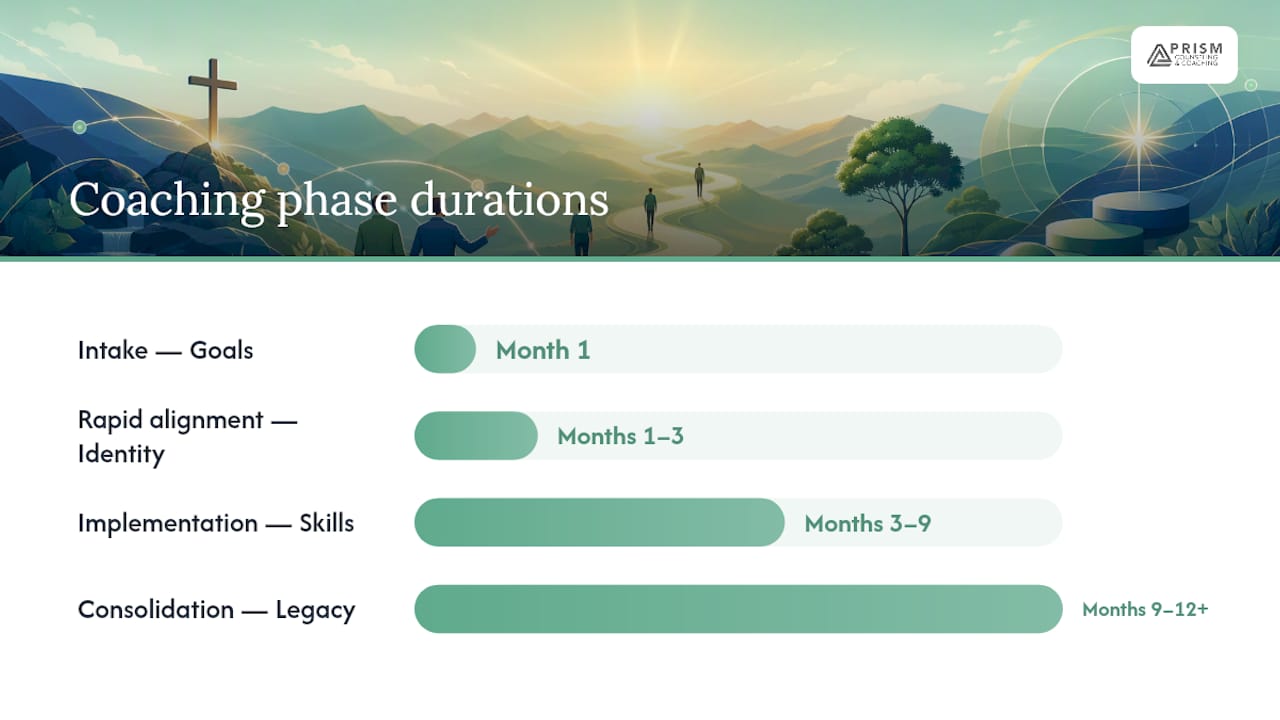
A strong coaching model progresses from identity to stewardship to influence, meaning the early work is about who you are as a leader before it addresses what you do. Confidentiality is a non-negotiable ethical standard in professional coaching. A reputable Christian coach will state their confidentiality practices clearly at the outset and hold to them without exception.
What credentials and trust signals should you look for in a coach?
Choosing a coach is a high-stakes decision, and the right signals are specific. Look for:
- Documented leadership experience: years spent leading organizations, not just coaching them
- Theological maturity: the ability to engage scripture thoughtfully and apply it to leadership without reducing it to motivational slogans
- Professional training: ICF membership or equivalent credential signals methodological rigor
- Clear confidentiality practices: stated in writing before the first session
- Verifiable client outcomes: testimonials, case studies, or references you can actually contact
- Denomination and theological fit: a coach whose convictions are close enough to yours that the spiritual framework feels shared, not imposed
Verification steps matter as much as the checklist. Ask for two or three references and call them. Request a sample session or a no-cost discovery call before committing to a package. Seasoned Christian leadership coaches typically welcome that conversation because they know fit is mutual. If a coach resists references or pushes you to sign quickly, that is a signal worth heeding.
Theological fit deserves its own conversation during intake. You do not need a coach who shares every doctrinal position, but you do need one who understands your tradition well enough to engage it honestly.
How do you measure progress and know when coaching is working?
Progress in Christian leadership development is both measurable and formational, and the best coaching agreements track both dimensions.
Typical timeline markers:
- Months 0–1: Intake, assessment, and goal-setting; baseline established
- Months 1–3: Rapid alignment; leader can articulate a clearer sense of calling and organizational direction
- Months 3–9: Implementation; team retention improves, documented decisions show greater follow-through, conflict decreases
- Months 9–12+: Consolidation; leader reports spiritual flourishing alongside organizational results; many choose to extend
Concrete success indicators include improved team retention, a documented strategic plan with measurable milestones, fewer escalated conflicts, and a leader who describes their work as an expression of calling rather than a source of depletion. Quarterly reviews, 360-degree feedback from direct reports, and documented action plans give the engagement structure that both coach and leader can evaluate honestly.
Independent coaching providers note that many clients continue beyond an initial year to advance leadership formation, which reflects how the work deepens rather than concludes.
What does Christian executive coaching typically cost?
Pricing for faith-based executive coaching varies considerably, and understanding why helps you evaluate proposals accurately.
Cost ranges are shaped by several factors:
- Coach experience and seniority: a coach with 15+ years of executive leadership and a full credential portfolio commands higher rates than someone newer to the field
- Session frequency and package length: twice-monthly sessions over 12 months cost more than monthly sessions over six
- Included assessments: tools like the Christian DISC® or other leadership inventories add value and cost
- Organizational vs. individual coaching: coaching that includes team sessions or organizational consulting is priced differently than individual work
- Prep, follow-up, and on-site days: some coaches include between-session availability; others do not
Always request a written engagement agreement before committing. That document should specify deliverables, session frequency, pricing, cancellation terms, and confidentiality practices. A coach who cannot or will not provide one in writing is not operating at a professional standard.
How do you choose a Christian executive coach? A practical checklist
Selection is a process, not a single decision. Score potential coaches against these criteria:
- Theological alignment: shared enough to make the spiritual work genuine
- Verifiable leadership experience: they have led, not just coached leaders
- Measurable outcomes: they can point to specific results from past clients
- Confidentiality: stated clearly and in writing
- Chemistry: you feel safe enough to be honest in the first conversation
Sample discovery call questions:
- "How do you integrate scripture into a coaching session without it feeling formulaic?"
- "Can you describe a leadership challenge a past client faced and how the coaching helped them navigate it?"
- "What does your confidentiality agreement cover, and can I see it before we start?"
- "How do you handle a situation where your theological convictions differ from mine?"
Red flags to watch for:
- Vague outcome language ("you'll grow as a leader") with no specifics
- Pressure to sign a long-term contract before a discovery call
- No references, or reluctance to provide them
- Confidentiality practices that are verbal only, never documented
Pro Tip: Many Christian coaches offer a free or low-cost introductory session before any package commitment. Use it. The quality of that first conversation tells you more about fit than any credential list.
Prism-counseling: a recommended faith-integrated coaching provider
Prism-counseling has served individuals, couples, and leaders in the Phoenix area for over 14 years, building a practice that holds professional rigor and spiritual depth in the same hand. Their coaching offering includes Christian DISC® Coaching, which integrates a biblically-grounded behavioral assessment with one-on-one coaching to help leaders understand how their God-given wiring shapes their leadership style and team dynamics.
The practice operates on a private-pay, small-practice model. That structure is a deliberate choice: it means individualized attention, genuine confidentiality, and faster access than insurance-based services typically allow. Prism's faith-based counseling approach reflects the same values in their coaching work, where the spiritual and the practical are never treated as separate tracks.
For ministry leaders specifically, Prism-counseling offers resources and coaching designed around the particular pressures of pastoral and nonprofit leadership. Their Spiritual Care Today Podcast gives prospective clients a sense of the practice's theological voice and approach before the first conversation.
To begin, complete the application form or visit the website to learn more about current availability. Openings typically come within days, not weeks.
A word from our practice
We started this work because we believe leadership formed by faith produces something different than leadership formed by ambition alone. The leaders we walk alongside are not looking for a motivational boost. They are looking for someone who understands the weight of leading with conviction, and who can help them carry it with greater wisdom and less isolation. If you are in that season, we would be glad to have that first conversation with you. Come ready to talk honestly about where you are and where you sense God calling you next.
Ready to take a next step with Prism-counseling?
Prism-counseling offers faith-integrated executive coaching that goes beyond generic leadership advice. For Christian business and ministry leaders in the Phoenix area, the practice provides a private, confidential space where your convictions are not a footnote to the coaching work but the foundation of it. The Christian DISC® Coaching program and individual executive coaching sessions are available now, with openings typically within days.
Churches and organizations can also explore church sponsorship options to bring faith-integrated coaching to their leadership teams as part of a broader care and development strategy.
To get started, visit Prism-counseling or complete the application to request your discovery call. The first conversation is low-pressure and focused on whether the fit is right for you.
Sources
- It's time to acknowledge CEO loneliness (HBR)
Recommended
- Christian DISC® Coach - Prism Counseling & Coaching | Faith-Based Counseling and Spiritually-Integrated Therapy in Peoria and Phoenix AZ
- Life Coaching - Prism Counseling & Coaching | Faith-Based Counseling and Spiritually-Integrated Therapy in Peoria and Phoenix AZ
- Counseling for Pastors - Prism Counseling & Coaching | Faith-Based Counseling and Spiritually-Integrated Therapy in Peoria and Phoenix AZ
- My Journey Through Conversion Therapy | A Pastor and Counselor's Experience - Prism Counseling & Coaching | Faith-Based Counseling and Spiritually-Integrated Therapy in Peoria and Phoenix AZ