

A Christian life coach is a trained guide who blends Biblical principles with proven coaching methods to help clients grow spiritually, emotionally, and practically. If you're drawn to this work, know that credible training comes in two main forms: pathways aligned with the International Coaching Federation (ICF) and ministry-based certificate programs. The right first step depends on whether you're aiming for professional credentialing or ministry service.
Before you commit to a program, it helps to know what you're looking for.
- A syllabus with named modules, not vague promises
- Supervised coaching hours you can actually log
- Mentor feedback built into the structure
- A clear credential or certificate at the finish line
Pro Tip: Before enrolling in any program, book a free discovery call. A five-minute conversation tells you more about fit than any brochure.
Key Takeaways
Christian life coaching works best when it pairs Biblical integration with structured coaching skills, clear ethical boundaries, and a credential path that matches your professional goals.
| Point | Details |
|---|---|
| Definition matters | A Christian life coach combines Biblical principles with coaching methods, distinct from counseling or discipleship alone. |
| Choose your credential path | ICF-accredited routes suit professional coaches; ministry certificates suit those focused on church-based service. |
| Verify accreditation claims | Check institutional claims against the Department of Education's DAPIP database before enrolling. |
| Budget for supervised hours | Expect mentor coaching and logged practice hours regardless of which certification path you choose. |
| Consider Prism's training path | Prism Counseling & Coaching pairs Biblical foundations with supervised practice inside an active faith-based counseling practice. |
Table of Contents
- What Christian Life Coaching Actually Involves
- How Christian Coaching Differs From Secular Coaching and Counseling
- Training and Accreditation Options Worth Comparing
- What a Credible Curriculum Should Teach
- Your Step-by-Step Path to Certification
- Budgeting Time and Money for Your Training
- Why Consider Prism Counseling & Coaching's Training Path
- What Training Actually Feels Like
- Start Your Training With Prism Counseling & Coaching
- Frequently Asked Questions
- Sources
What Christian Life Coaching Actually Involves
A Christian life coach walks alongside clients as they pursue goals in career, relationships, leadership, or spiritual maturity, always through a Biblical lens. Unlike a mentor who simply shares wisdom from experience, or a pastor focused on discipleship, a coach uses structured questions and accountability to help clients discover their own next steps.
Clients typically come seeking help with:
- Discerning calling or vocational direction
- Strengthening a marriage or family relationships
- Building leadership skills for ministry or workplace roles
- Recovering a sense of purpose after a major life transition
- Establishing habits that support emotional and spiritual wellbeing
Pro Tip: If someone is dealing with a diagnosable condition like depression, trauma, or anxiety that disrupts daily functioning, they need licensed Christian counseling first. Coaching works best once a person is stable enough to focus on forward movement rather than crisis stabilization.
How Christian Coaching Differs From Secular Coaching and Counseling
Secular life coaching centers entirely on goals and performance. Christian life coaching keeps Scripture, prayer, and discernment at the center of the process, treating personal growth as inseparable from spiritual growth. A coach might ask what a client believes God is inviting them toward, not just what they want to achieve by next quarter.
The boundary with counseling matters just as much. Coaching is not therapy, and a responsible coach screens for red flags: unresolved trauma, suicidal ideation, or patterns that need clinical intervention rather than goal-setting. Trauma-informed Christian coaching may use grounding and nervous-system awareness techniques, but practitioners are clear that these tools support coaching conversations, not replace licensed treatment.
Coaching aims for short-term, goal-focused progress. Counseling addresses deeper clinical needs. Confusing the two can leave a struggling person without the care they actually need.
Training and Accreditation Options Worth Comparing
Three main paths lead to a credential, and each serves a different purpose.
ICF-accredited programs follow the International Coaching Federation's framework toward credentials like the ACC or PCC. These require documented training hours, supervised practice, and mentor coaching. Reputable national accreditation pathways typically demand logged hours plus observed sessions before a candidate can even apply, which is why this route carries the strongest market recognition for coaches who want to work across both faith and secular settings.
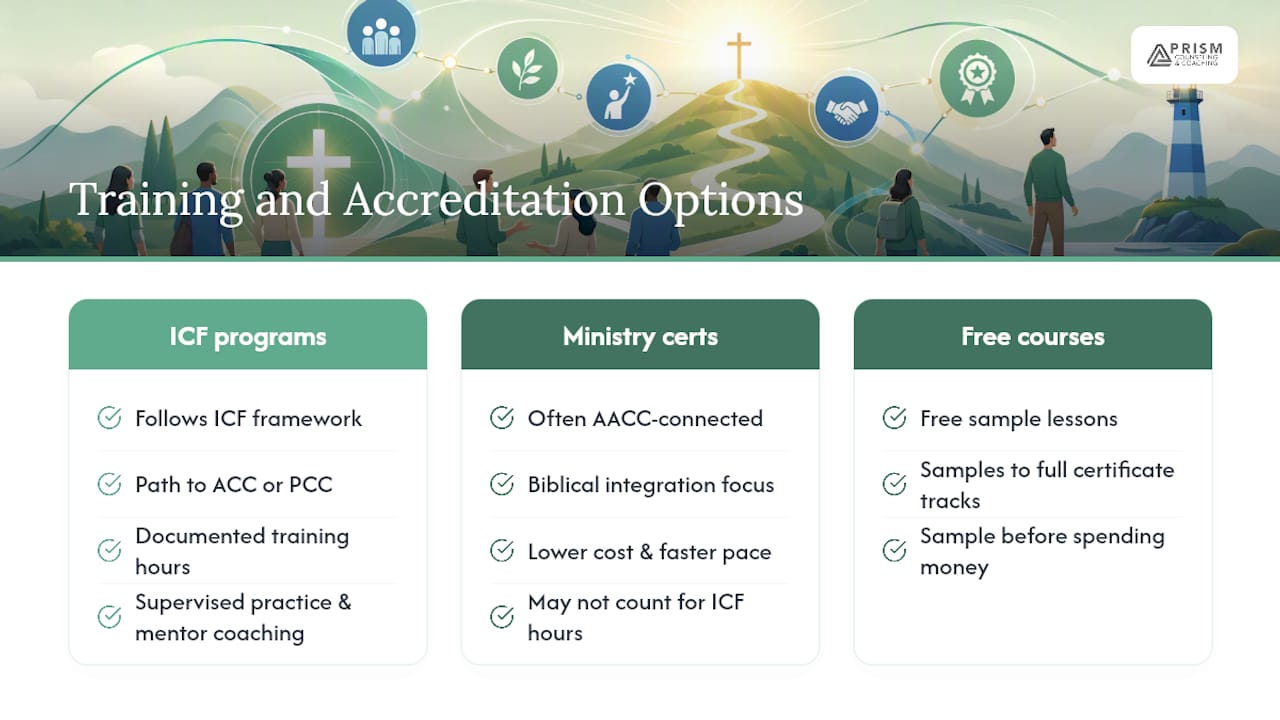
Ministry certificates and short courses, often through organizations connected to the American Association of Christian Counselors Foundation, focus heavily on Biblical integration. These programs cost less and move faster, but they don't always translate into ICF-recognized hours if you later want that credential.
Free introductory courses and webinars let you sample the material before spending money. Programs like Light University's professional Christian life coaching offerings, the Christian Leaders Institute, and the Center for Christian Coaching each provide entry points ranging from free sample lessons to full certificate tracks.
Whatever route you consider, verify claims against the Department of Education's Database of Accredited Postsecondary Institutions and Programs when a school references formal accreditation. Look for an explicit syllabus, stated supervised-hour requirements, named mentors, and graduate testimonials you can actually verify.
What a Credible Curriculum Should Teach
A strong program builds competency, not just theory. Expect these core modules:
- Biblical foundations for coaching, covering how Scripture informs a coaching conversation without turning it into a sermon
- Coaching models and techniques, including goal-setting frameworks and structured session formats
- Active listening and powerful questions, the actual mechanics of drawing out a client's own insight
- Accountability structures that keep clients moving between sessions
- Ethics and boundaries, including exactly when to refer a client to licensed mental health care
Practical training matters as much as lecture content. Look for roleplay exercises, supervised coaching hours with real feedback, and assessment tools like values inventories or DISC-style instruments that help clients understand themselves before setting goals.
Your Step-by-Step Path to Certification
- Complete a foundational course covering coaching basics and Biblical integration principles.
- Begin supervised practice, working with real or practice clients under a mentor's observation.
- Log your coaching hours. Reputable accreditation pathways typically require documented training and mentor coaching hours before certification is granted.
- Apply for your credential, whether that's an ICF-recognized certification or a ministry certificate from your training provider.
- Start building your practice while continuing mentor relationships for ongoing feedback.
Timelines vary widely. Many students need several months to complete foundational training and log required supervised hours. Some programs compress the classroom portion into a few months, though supervised practice hours still take time to accumulate regardless of how fast the lectures move. Anyone planning for ICF credentialing should expect mentor coaching sessions built into that same window.
Budgeting Time and Money for Your Training
Costs vary sharply by pathway. Ministry certificates and short courses tend to sit at the lower end of the price spectrum, especially when tied to a webinar series or church-based training. Full ICF-accredited programs generally cost more, reflecting additional components such as mentor coaching and supervised practice.
Time commitment follows the same pattern: expect several hours weekly for coursework plus additional hours for supervised practice sessions outside class.
Pro Tip: Ask your church about sponsorship before assuming you have to pay full price. Many congregations partner with training providers or counseling practices to fund staff and volunteer development, and it costs nothing to ask.
Why Consider Prism Counseling & Coaching's Training Path
Prism Counseling & Coaching has substantial experience integrating faith into therapeutic and coaching work for individuals, couples, and families. That track record shapes a training approach built on real clinical and coaching experience, not just theory.
The program pairs Biblical foundations with supervised practice, giving you feedback from people who work with real clients daily rather than only in a classroom setting. Because Prism operates as a small, private-pay practice, aspiring coaches training through Prism connect directly with practitioners instead of getting lost in a large institutional pipeline.
Readers can explore Prism's Christian counseling services to understand the clinical foundation behind the coaching approach, or browse the resources hub for sample teaching material before committing further.
What Training Actually Feels Like
Expect Scripture study woven into coaching labs, not bolted onto the side. Peer accountability partners will challenge your assumptions as often as your instructors do, and supervised practice sessions with real feedback can feel more exposing than any lecture.
Pro Tip: Keep a coaching model in one hand and your Bible in the other. Faith should shape the conversation without replacing the actual coaching skill.
Start Your Training With Prism Counseling & Coaching
Prism Counseling & Coaching offers a faith-integrated approach that most standalone coaching certificate programs can't match: training grounded in an active counseling practice, not a course built in isolation. Where many programs teach coaching theory alongside faith content as separate tracks, Prism's coaches train alongside practitioners who apply spiritually-integrated care every day with real clients across anxiety, marriage, grief, and career transitions.
That combination matters if you want your coaching to hold up outside the classroom. Whether you're weighing a full certification path or just want to sample the material first, Prism makes both easy: browse the resources hub for sample lessons and podcast episodes, or explore church sponsorship options if your congregation might help fund your training. Ready to talk specifics? Reach out through Prism's Christian counseling page to schedule a discovery call and find the training track that fits your goals.
Frequently Asked Questions
Do I need a college degree to become a Christian life coach? No degree is required for most ministry certificate programs, though ICF-accredited pathways focus on training hours and supervised practice rather than academic credentials.
Can a Christian life coach also provide counseling? Only if they hold a separate mental health license. Coaching and counseling are distinct disciplines with different training, scope, and legal requirements.
How long does it take to become certified? Part-time students often need three to twelve months, while accelerated programs compress coursework into eight to twelve weeks, though supervised hours still take additional time to complete.
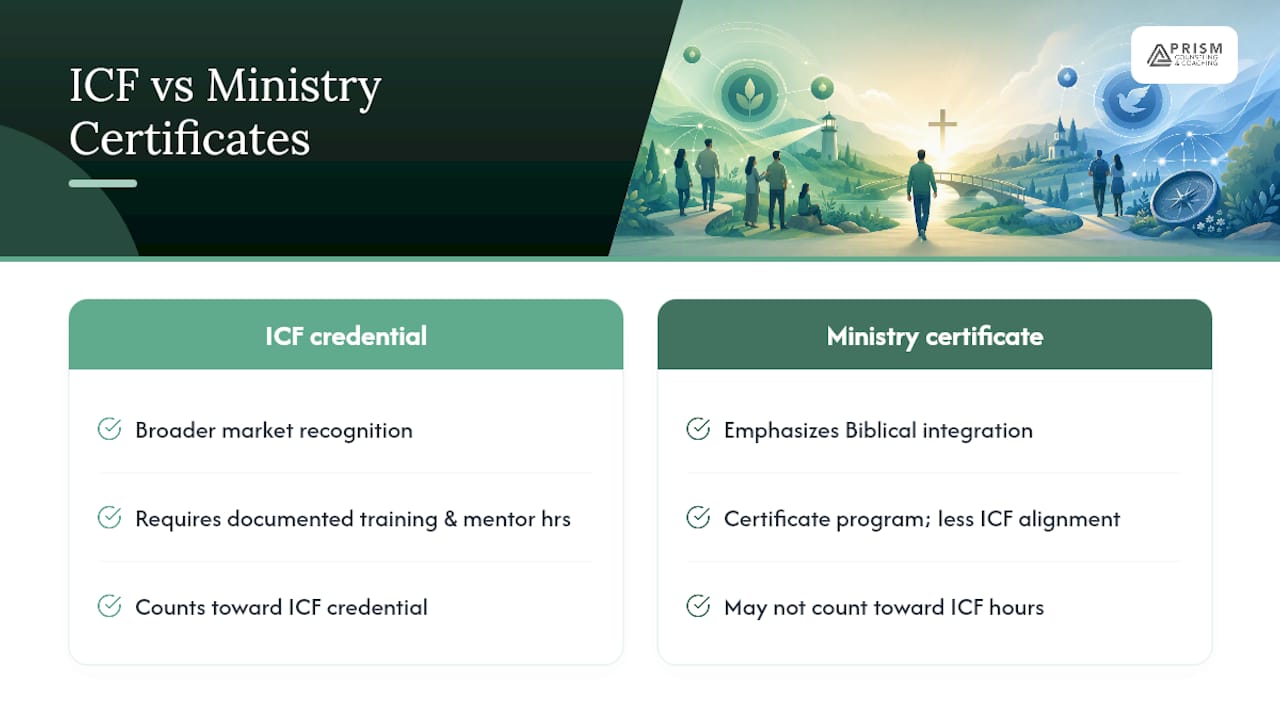
What's the difference between an ICF credential and a ministry certificate? An ICF credential carries broader market recognition and requires documented training and mentor coaching hours; a ministry certificate emphasizes Biblical integration and often costs less but may not count toward ICF hours.
Is confidentiality different in a ministry coaching context? Ministry settings often blend pastoral and coaching relationships, so coaches should set clear confidentiality agreements upfront, especially when church leadership or elders might expect updates on a member's progress.
Sources
Recommended
- Christian DISC® Coach - Prism Counseling & Coaching | Faith-Based Counseling and Spiritually-Integrated Therapy in Peoria and Phoenix AZ
- Life Coaching - Prism Counseling & Coaching | Faith-Based Counseling and Spiritually-Integrated Therapy in Peoria and Phoenix AZ
- The Center for Pastoral Counseling and Spiritual Integration (PCSI) - Prism Counseling & Coaching | Faith-Based Counseling and Spiritually-Integrated Therapy in Peoria and Phoenix AZ
- Signs You Are Called to Christian Counseilng - Prism Counseling & Coaching | Faith-Based Counseling and Spiritually-Integrated Therapy in Peoria and Phoenix AZ