

Start tonight with three biblically rooted moves: a soft start-up, a 2:1 listening ratio, and thirty seconds of shared prayer before the hard topic even comes up. These are not clever tricks. They are simple, repeatable habits that lower defensiveness and open space for the Holy Spirit to work in an ordinary Tuesday-night conversation.
A soft start-up means opening with your own feelings and needs instead of an accusation. A listening ratio favoring listening twice as much as speaking reflects James 1:19's call to be "quick to hear, slow to speak." And a brief prayer, even one sentence, reminds you both that you are on the same team facing the issue together, not facing each other as opponents.
Here are three micro-scripts you can use tonight:
- Instead of "You never help with the kids," try: "I feel overwhelmed by bedtime and I need a plan we build together."
- As the listener, respond with: "So you're feeling stretched thin at night. Tell me more."
- Before either of you speaks, pray together: "Lord, help us hear each other the way You hear us."
Key Takeaways
Christian marriage communication improves fastest when soft start-ups, a 2:1 listening ratio, and brief shared prayer are practiced consistently, not just during crises.
| Point | Details |
|---|---|
| Start soft, not sharp | Open hard conversations with your feelings and a specific need instead of blame or criticism. |
| Listen twice as much as you speak | Aim for a 2:1 listening ratio, rooted in James 1:19, to prioritize understanding over being right. |
| Validate before you problem-solve | Acknowledge your spouse's feelings even when you disagree with their conclusion. |
| Repair quickly after rupture | Use a time-out, a specific apology, and a request for forgiveness to reset after a bad conversation. |
| Get faith-integrated support when stuck | Prism-counseling offers private-pay couples counseling in the Phoenix area with fast availability when self-guided steps aren't enough. |
Table of Contents
- Why Christian Marriage Communication Starts With Worship, Not Technique
- Common Communication Traps Christian Couples Fall Into
- Core Principles For Safe, Fruitful Conversations
- A Step-By-Step Loop For Working Through Hard Talks
- What Research And Christian Counselors Say About This
- Listening Exercises To Practice Together This Week
- The Repair Roadmap: Recovering When A Talk Goes Wrong
- Daily And Weekly Rhythms That Support Better Conversations
- When To Consider Faith-Based Counseling
- Sin Versus Simple Mistakes In How You Talk
- Grace And Forgiveness As The Engine Of Growth
- Building Humility And Love As Your Communication Foundation
- Talking During Conflict Versus During Calm
- Scripture's Own Examples Of Marriage Communication
- What We See Help Couples Most
- Guided Help Through Faith-Integrated Couples Counseling
- Frequently Asked Questions
- Sources
Why Christian Marriage Communication Starts With Worship, Not Technique
Good Christian marriage communication is not primarily a skill set. It is an overflow of a heart being shaped by grace. Ephesians 4:29 sets the bar plainly: speech should build up "according to the need of the moment, that it may give grace to those who hear." That is a high standard for a Tuesday argument about the credit card bill, but it is the standard Scripture gives.
Ephesians 4:15 calls this "speaking the truth in love," a phrase that refuses to let couples choose between honesty and kindness. You need both, every time. James 1:19 adds the practical order of operations: listen first, speak carefully, and let anger cool before it drives the conversation. None of these verses hand you a script. They shape the posture behind whatever words you eventually choose.
Communication techniques, including the ones covered later in this guide, work best when governed by gospel priorities rather than treated as a stand-alone fix. A biblically centered approach treats speech itself as an act of worship, meaning even a Gottman-style conversation tool only does lasting good when it serves confession, forgiveness, and humility rather than replacing them.
Three truths worth keeping in view before any hard conversation:
- Your marriage is a covenant, not a negotiation, and covenant language rules out scorekeeping.
- Confession and repentance are part of communication, not an emergency exit from it.
- Prayer and Scripture reading are ordinary maintenance for a marriage, not rescue measures reserved for crises, a point GotQuestions makes plain when it frames these habits as foundational rather than optional.
Pro Tip: Pray together for thirty seconds before any conversation you expect to be hard. It sounds small, but naming God as a third party in the room changes how both of you talk.
Common Communication Traps Christian Couples Fall Into
Most couples don't fail because they lack love. They fail because they fall into the same handful of patterns on repeat, often without noticing.
- Defensiveness. One spouse raises a concern gently, and the other immediately explains, justifies, or counterattacks instead of listening. A wife says, "I felt alone at the party," and her husband responds, "Well, you were on your phone the whole time too." The original concern never gets addressed.
- Soft stonewalling. This looks like quiet withdrawal rather than slammed doors. A husband goes silent, nods along, and mentally checks out while his wife keeps talking, believing the conversation is progressing when it has actually ended.
- Mistaking "thinking out loud" for a decision. One spouse floats an idea ("Maybe we should move closer to my parents") and the other hears a firm plan, gets hurt or anxious, and reacts to a decision that was never actually made. Practitioners note this confusion is common enough that couples benefit from explicitly labeling exploratory talk as processing rather than deciding.
- Scoring and win-lose thinking. Conversations turn into debates with a winner, and being "right" starts to matter more than being close.
- Weaponizing Scripture. Quoting Ephesians 5:22 at your spouse mid-argument to win a point turns God's Word into ammunition instead of nourishment, and it almost always backfires.
Most of these traps are ordinary friction, the kind every marriage has. But some patterns cross a line worth naming directly: repeated contempt, coercive or threatening speech, or a consistent refusal to take any responsibility. Those are signals to seek outside help rather than keep troubleshooting alone.
Core Principles For Safe, Fruitful Conversations
A handful of principles show up in almost every healthy marriage conversation, whether the couple could name them or not.
- Soft start-up. Open with your feelings and a specific need, not blame. "I felt hurt when..." works better than "You always..."
- 2:1 listening ratio. Aim to listen about twice as long as you speak. This single habit, rooted in James 1:19, does more to de-escalate conflict than almost any other adjustment.
- Validation is not agreement. You can say "That makes sense that you'd feel that way" without agreeing your spouse is right about everything. Therapists point out that this distinction is what makes a partner feel safe rather than dismissed.
- The First Response Principle. Whoever responds first sets the emotional temperature for the rest of the exchange. A calm, validating first response can reset a conversation even after a rough opening line.
- Time-outs and self-soothing. "Can we pause for twenty minutes and come back to this?" is not avoidance. It is wisdom, as long as you actually come back.
- Mutual submission. Ephesians 5:21 calls both spouses to "submit to one another," which rules out either partner treating their preferences as automatically final.
Pro Tip: Save hard conversations for a window when neither of you is running on empty. If either partner's heart rate is elevated from stress, hunger, or exhaustion, the conversation will run hotter than the topic deserves. Wait until you're both calm enough to actually hear each other.
A Step-By-Step Loop For Working Through Hard Talks
When a topic feels loaded, a chaotic, unstructured conversation almost guarantees escalation. A simple timeboxed loop keeps both spouses safe and gives the conversation somewhere to go.
- Prepare separately, briefly. Spend two minutes each identifying what you actually need, not just what's annoying you.
- Open with prayer and a soft start-up. One sentence of prayer, then: "I'd like to talk about [topic]. I feel [emotion] because [need]."
- Speaker turn (3 to 5 minutes). One spouse talks, uninterrupted, using a timer if needed. Script: "The thing I keep coming back to is..."
- Listener mirrors back (1 minute). "What I hear you saying is... Did I get that right?" The listener does not defend or problem-solve yet.
- Switch roles and repeat steps 3 and 4.
- Dig for the deeper need. Ask, "What's the dream or hope underneath this for you?" Conflicts often mask a real longing, like feeling secure or respected, that never gets named directly.
- Build one small next step together. Not a five-point plan. One concrete, doable change either of you can act on this week.
- Schedule a five-minute check-in for a few days later to see how the small step is going.
A simple timebox: total conversation 20 to 30 minutes, speaker turns of 3 to 5 minutes, mirroring of about 1 minute, and a final 5 minutes for planning the next step.
The way you open the conversation matters more than almost anything that follows. Gottman Institute research has found that roughly 94% of a difficult conversation's trajectory can be predicted from how it begins. If the first three minutes carry criticism or contempt, the whole conversation tends to follow that path. A soft start-up isn't a nicety. It's the single highest-leverage move in the entire loop.

What Research And Christian Counselors Say About This
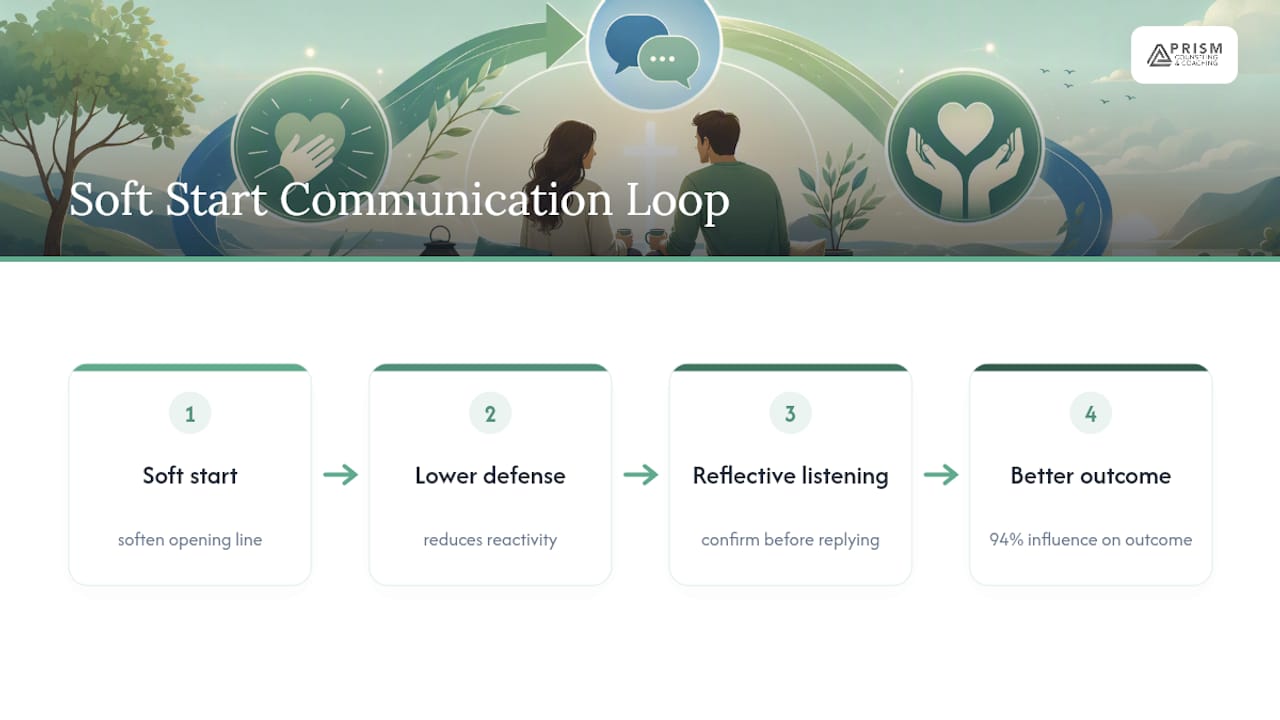
Scripture sets the "why" behind healthy communication. Research and clinical experience help fill in the "how," and the two line up more than most couples expect.
The 94 percent finding on conversation starts, mentioned above, is backed by decades of Gottman Institute observation of real couples in conflict. That single data point explains why so much marriage advice circles back to the same instruction: soften the opening line.
Counselors also draw a firm line between validation and agreement. PsychCentral's guidance on marriage communication recommends reflective listening and "closing the loop," meaning you confirm you understood correctly before responding, rather than assuming and moving on. This single habit prevents a large share of the "you never listen" arguments couples have.
Reflective listening and closed-loop checks give couples a way to confirm understanding before reacting, cutting off a huge share of misunderstandings before they start.
It's worth being honest about the limits here. Communication methods can slow down a fight and clear space for a better conversation. They cannot, by themselves, soften a proud heart or produce genuine repentance. That work belongs to the gospel. The methods create the conditions; grace does the changing.
Listening Exercises To Practice Together This Week
Building the 2:1 listening habit takes repetition, not willpower. These exercises work best practiced on low-stakes topics before you try them on your hardest conversations.
- Mirroring practice (10 minutes). Pick a neutral topic, like your week. One spouse talks for two minutes; the other repeats back the content and feeling before responding. Swap.
- A 2:1 day. For one full day, the listening spouse consciously tracks whether they're listening roughly twice as long as they're talking in every conversation, not just the serious ones.
- Closed-loop check-ins. After any conversation that mattered, one spouse asks, "What did you hear me say?" This takes thirty seconds and catches misunderstandings before they calcify.
- The "dreams within conflict" prompt. During a disagreement, pause and ask, "What's the deeper hope or fear behind this for you?" This question alone often defuses arguments that seemed purely practical.
Sample mirroring phrases for the listener: "What I'm hearing is..." "So the part that hurt most was..." "It sounds like you need..." Sample validation lines: "That makes sense." "I can see why you'd feel that way." "I hadn't thought of it that way before."
- Start with five-minute sessions on genuinely low-stakes topics before applying these to real conflict.
- Review together weekly: What felt natural? What felt forced?
- Expect awkwardness at first. Scripted phrases feel stiff until they don't.
The Repair Roadmap: Recovering When A Talk Goes Wrong
Every couple has conversations that go sideways. What separates thriving marriages from stuck ones is not the absence of bad talks. It's a reliable way back.
- Call a time-out. "I need twenty minutes before we keep going" is a legitimate request, not a dodge.
- Use a brief cooling ritual. Pray alone, take a walk, or simply breathe. The goal is calming your body, not rehearsing your argument.
- Own your specific part. Not "I'm sorry you feel that way," but "I'm sorry I raised my voice and interrupted you three times."
- Take one small repair action. A hand on the shoulder, making coffee, or moving a plan you'd been stubborn about. Small, concrete gestures rebuild trust faster than long speeches.
- Ask for forgiveness directly. "Will you forgive me for that?" invites a real answer instead of assuming reconciliation happened just because you apologized.
Sample apology script: "I was defensive earlier and it shut down the conversation. I'm sorry. Can we try again?"
If the same rupture repeats despite honest attempts at repair, or if either spouse feels unsafe rather than just frustrated, that's a signal to bring in a counselor or trusted pastor rather than keep cycling through the same five steps alone.
Daily And Weekly Rhythms That Support Better Conversations
Communication rarely fails in a single dramatic moment. It erodes slowly, through weeks with no real connection. Small, repeatable rhythms prevent that erosion better than any single big conversation.
- Thirty seconds of shared prayer before bed, even just naming one thing you're grateful for and one thing you're struggling with.
- A five-minute weekly check-in, ideally the same day and time each week, covering what went well and what needs attention.
- A daily gratitude or Scripture exchange, as simple as texting one verse or one thing you appreciated about your spouse that day.
Each rhythm ties back to a simple biblical pattern. Prayer keeps you dependent on God rather than your own effort. Confession, as Encompass Connection Center frames it, requires an ongoing climate of trust and acknowledgment, not a one-time fix. Gratitude counters the drift toward keeping score that quietly poisons long marriages.
Pro Tip: Start smaller than feels necessary. A rhythm that takes thirty seconds and actually happens beats a thirty-minute devotional plan that collapses after a week. Celebrate the streak, not the ambition.
When To Consider Faith-Based Counseling
Self-guided practice solves most communication ruptures. Some situations call for a trained third party, and recognizing the difference early saves years of frustration.
Consider reaching out for help if:
- You've tried the conversation loop repeatedly and keep landing in the same stuck place.
- One or both of you feels unsafe, not just uncomfortable, during hard conversations.
- There's unresolved betrayal, such as an affair or ongoing dishonesty, that neither of you knows how to address alone.
- Anxiety, depression, or other mental health concerns are making communication feel impossible rather than just difficult.
If you decide to look for a counselor, these questions help you evaluate fit:
- How do you integrate Scripture and faith into couples counseling?
- What is your training and licensure?
- How do you handle confidentiality between spouses?
- What approach or method do you use for conflict work?
- What are your fees, and do you accept insurance or operate private-pay?
- Do you offer telehealth or online sessions?
- How soon can we get an appointment?
- What does progress typically look like, and over what timeframe?
Couples who benefit most from faith-integrated counseling are usually those who want practical tools and want their faith taken seriously as part of the healing process, not set aside during the clinical hour. Christian counseling exists precisely for that overlap.
Sin Versus Simple Mistakes In How You Talk
Not every hurtful moment in a marriage conversation is sin, and treating every misstep as a moral failure creates a marriage where nobody feels safe being imperfect.
A mistake looks like fumbling for words, misreading tone over text, or forgetting something your spouse mentioned last week. These are human limitations, not character flaws. They deserve patience, not a confession.
A sinful pattern looks different: repeated contempt, manipulation, stonewalling as punishment, or using truth as a weapon rather than a gift. Ephesians 4:29's standard, that speech should give grace, is a useful test. A poorly timed comment that lands badly is usually a mistake. A pattern of speech designed to control, belittle, or punish is something else.
The practical test is repetition and intent. One clumsy comment during a stressful week is not the same as a habit of interrupting your spouse every time they raise a concern. Ask honestly: was this a slip, or is this how I usually respond under pressure? If it's a pattern, it calls for repentance, not just an explanation. If it's a one-off, both spouses benefit from extending the same grace they'd want extended to them.
Grace And Forgiveness As The Engine Of Growth
Communication skills improve gradually, with plenty of backsliding along the way. Grace is what makes that slow process survivable.
Colossians 3:13 calls couples to forgive "as the Lord forgave you," which sets a standard well beyond simply letting things go when convenient. It means choosing to release a debt even when your spouse hasn't fully earned it back yet, because that is exactly how you've been forgiven.
In practice, this means expecting relapse. You will use the soft start-up beautifully for two weeks and then snap at your spouse over something small. That is not proof the method failed. It's proof you're human, and it's an invitation to apologize specifically, ask forgiveness, and try again the next day. Marriages that grow in communication are rarely the ones with the fewest failures. They're the ones with the shortest gap between failure and repair.
Grace also changes how you interpret your spouse's bad day. A husband who's short with his wife after a rough shift at work is not necessarily revealing his true character. Extending the benefit of the doubt, while still being honest about the impact, keeps small moments from calcifying into resentment.
Building Humility And Love As Your Communication Foundation
Every technique in this guide eventually fails without humility underneath it. You can know the perfect script and still use it to win rather than connect if pride is driving the conversation.
Philippians 2:3 calls believers to "count others more significant than yourselves," which in marriage terms means genuinely entertaining the possibility that your spouse's perspective has merit, even when it's inconvenient. Humility shows up in small, practical ways: asking a clarifying question instead of assuming you already know what your spouse means, admitting when you're wrong before being pressed to, and staying curious about your spouse's inner world even after years of marriage.
Love, in the 1 Corinthians 13 sense, is "patient" and "not irritable." That's a high bar for a conversation about who forgot to pay a bill, but it reframes the goal. You are not trying to win the exchange. You are trying to love the person in front of you well, which sometimes means losing an argument you technically could have won.
A simple daily practice: before a hard conversation, silently ask yourself, "What does loving my spouse well look like in the next ten minutes?" That question, asked honestly, changes tone almost immediately.
Talking During Conflict Versus During Calm
The rules for a good conversation shift depending on whether you're in the middle of a disagreement or simply catching up over dinner. Treating both moments the same way is a common, avoidable mistake.

During conflict, keep language short and concrete. Use "I" statements, stick to one issue at a time, and resist the urge to bring up three other unresolved grievances. Timeboxing, as outlined in the conversation loop above, matters far more here than during calm moments. A twenty-minute cap on a hard talk prevents the slow spiral into exhaustion-driven cruelty.
During calm times, the goal shifts from resolution to connection. This is when you build the reserve of goodwill that conflict conversations draw from later. Ask open-ended questions about your spouse's day, dreams, or worries that have nothing to do with an active disagreement. Couples who only talk when something's wrong train each other to associate deep conversation with dread.
A practical rule of thumb: use calm moments to build understanding, and use conflict moments to apply it. If you've spent months learning your spouse's real fears and hopes during easy conversations, you'll recognize those same fears surfacing during a hard one, which makes empathy far easier to access in the moment it's needed most.
Scripture's Own Examples Of Marriage Communication
The Bible doesn't give a communication manual, but its portraits of couples and marriage instruction offer real texture.
The Song of Solomon shows a couple who speak admiration and desire to each other directly and specifically, not in vague generalities. That kind of specific, verbal affirmation is a pattern worth imitating: naming exactly what you appreciate rather than a generic "you're great."
Priscilla and Aquila, mentioned together repeatedly in Acts and Paul's letters, model a marriage that worked as a genuine team, teaching and ministering side by side rather than operating in separate lanes. Their partnership suggests communication built around shared purpose, not just shared logistics.
Ephesians 5:25-33 frames Christ's sacrificial love for the church as the pattern for a husband's love, a standard that reframes hard conversations entirely. A husband asking "How can I lay down my preferences here?" is applying that passage directly, not just being agreeable. GotQuestions points to this passage alongside practical habits like shared prayer and Bible reading as the biblical foundation for how couples actually talk to each other day to day.
What We See Help Couples Most
A couple recently in counseling described the same fight recurring for years: one felt unheard, the other felt criticized, and both walked away more distant each time. The turning point wasn't a dramatic breakthrough. It was learning to mirror each other's words before responding, paired with a nightly thirty-second prayer.
What tends to shift fastest is the mechanical skill: soft start-ups, mirroring, timeboxing. Couples often report noticeably calmer conversations within a couple of weeks. What takes longer is the heart work underneath, the humility, the letting go of scorekeeping, the willingness to repent quickly. That part is a lifelong process, not a two-week fix.
If you take one step this week, make it this: pick one hard topic you've been avoiding, and try the soft start-up and mirroring exercise on it, even imperfectly. Progress rarely looks graceful at first.
Guided Help Through Faith-Integrated Couples Counseling
Reading through a communication framework is a strong start, but some patterns are stubborn enough that they need a trained third party in the room. Prism-counseling offers faith-integrated couples counseling for exactly that situation, with a private-pay model that often means an opening within days rather than the weeks-long wait typical of insurance-based practices.
A first session typically involves both spouses sharing their perspective on the core conflict pattern while the counselor listens for the deeper needs underneath, much like the "dreams within conflict" exercise covered earlier. Most couples work with a counselor for a defined season rather than indefinitely, with a small-practice model that keeps sessions private and personalized rather than rushed.
Clients consistently report three shifts: fewer conversations spiraling into contempt, a faster path back to repair after conflict, and a renewed sense that their faith and their marriage struggles can be addressed in the same room, not two separate compartments of life. If you're ready for a next step, you can review couples counseling in Peoria, explore online session options if in-person visits aren't practical, or browse the resource library for additional tools while you decide.
Frequently Asked Questions
What is the biblical basis for good communication in marriage? Ephesians 4:15, Ephesians 4:29, and James 1:19 form the core framework: speak truth in love, use words that build up, and listen before responding. These verses shape motive, not just method.
How do I stop conversations from turning into arguments? Pair that with a 2:1 listening ratio and you'll cut off most escalation before it starts.
What's the difference between validating my spouse and agreeing with them? Validation means acknowledging their feelings make sense given their experience. Agreement means you share their conclusion. You can validate without agreeing, and doing so creates safety without requiring you to abandon your own view.
When should we see a Christian marriage counselor instead of working through issues ourselves? Consider counseling if the same conflict keeps recurring despite honest effort, if either spouse feels unsafe rather than just frustrated, or if unresolved betrayal or worsening mental health is part of the picture.
How is Christian marriage communication different from general communication advice? It uses the same practical tools, like soft start-ups and reflective listening, but governs them with gospel priorities: confession, forgiveness, and humility as the foundation rather than technique alone.
Sources
A few resources go deeper than this guide has room for. The Gottman Institute offers research-backed communication tools. PsychCentral covers reflective listening and when to seek counseling. FamilyLife offers practical, faith-rooted tools tested in real marriages. Encompass Connection Center frames the everyday climate that makes communication safe. Biblical Living Center explains how Scripture should govern any communication technique you adopt.
Start with one or two of these rather than all five at once, and let your reading shape a small, realistic practice plan for the coming month.
Recommended
- Prism Counseling & Coaching | Faith-Based Counseling and Spiritually-Integrated Therapy in Peoria and Phoenix AZ - Prism Counseling & Coaching | Arizona Christian Counseling and Spiritually-Integrated Therapy in Peoria and Phoenix
- Prism Counseling & Coaching | Faith-Based Counseling and Spiritually-Integrated Therapy in Peoria and Phoenix AZ - Prism Counseling & Coaching | Arizona Christian Counseling and Spiritually-Integrated Therapy in Peoria and Phoenix
- Ask a Christian Counselor Podcast - Prism Counseling & Coaching | Faith-Based Counseling and Spiritually-Integrated Therapy in Peoria and Phoenix AZ