

Christian mindfulness is the practice of bringing your full attention to the present moment while inviting God into it, filling your mind with Scripture and the Holy Spirit rather than emptying it toward nothing. It offers real spiritual presence and real stress relief, and it costs you almost nothing to try.
Here is a way to test it right now.
- Sit still. Breathe in slowly for four counts while silently praying, "Be still,"
- Breathe out for four counts, finishing, "and know that I am God" (Psalm 46:10)
- Repeat for 60 seconds, letting each breath anchor you to that phrase
That is the whole practice in miniature. Everything below simply builds on it.
TL;DR:
- Christian mindfulness emphasizes filling the mind with Scripture and inviting the Holy Spirit, rather than emptying it like secular practices.
- Key techniques include breath prayers, Scripture meditation, body scans, centering prayer, and gospel imagination, designed for various time commitments.
- Practice adjustments, such as replacing "emptying" with "filling" and keeping God's name in scripts, help maintain theological integrity.
- Early research suggests Christian mindfulness can reduce perceived stress and enhance spiritual surrender, but it should not replace trauma-focused therapy.
- Starting with simple practices like a 60-second breath prayer and gradually building consistency increases long-term engagement and spiritual benefits.
Table of Contents
- What Is Christian Mindfulness and How Is It Different from Secular Mindfulness?
- Where Does This Come From? Christian Roots That Look Like Mindfulness
- How Do You Actually Practice Christian Mindfulness?
- How Do You Keep Secular Mindfulness Techniques Theologically Sound?
- What Does the Research Say About Christian Mindfulness and Mental Health?
- A 7-Day Starter Plan for Building Christian Mindfulness
- Key Takeaways
- Where to Learn More
- Practice Meets Presence: What This Approach Gets Right
- Sources
What Is Christian Mindfulness and How Is It Different from Secular Mindfulness?
Christian mindfulness is present-moment awareness aimed at God, not at your own thoughts in isolation. Secular mindfulness often asks you to observe your mind and let it empty. Christian mindfulness asks you to notice your mind and then fill it, inviting the Holy Spirit into whatever you find there.
That distinction shows up in Scripture long before "mindfulness" became a wellness buzzword. Paul tells believers to be "transformed by the renewing of your mind" (Romans 12:2), and to "pray without ceasing" (1 Thessalonians 5:17), which is less a command to pray in one long stretch and more an invitation to stay relationally aware of God throughout an ordinary day. Philippians 2:1-5 grounds this awareness in humility and communion with others, not private detachment.
- Secular approach: observe thoughts, release attachment, seek inner calm
- Christian approach: observe thoughts, offer them to God, seek his presence
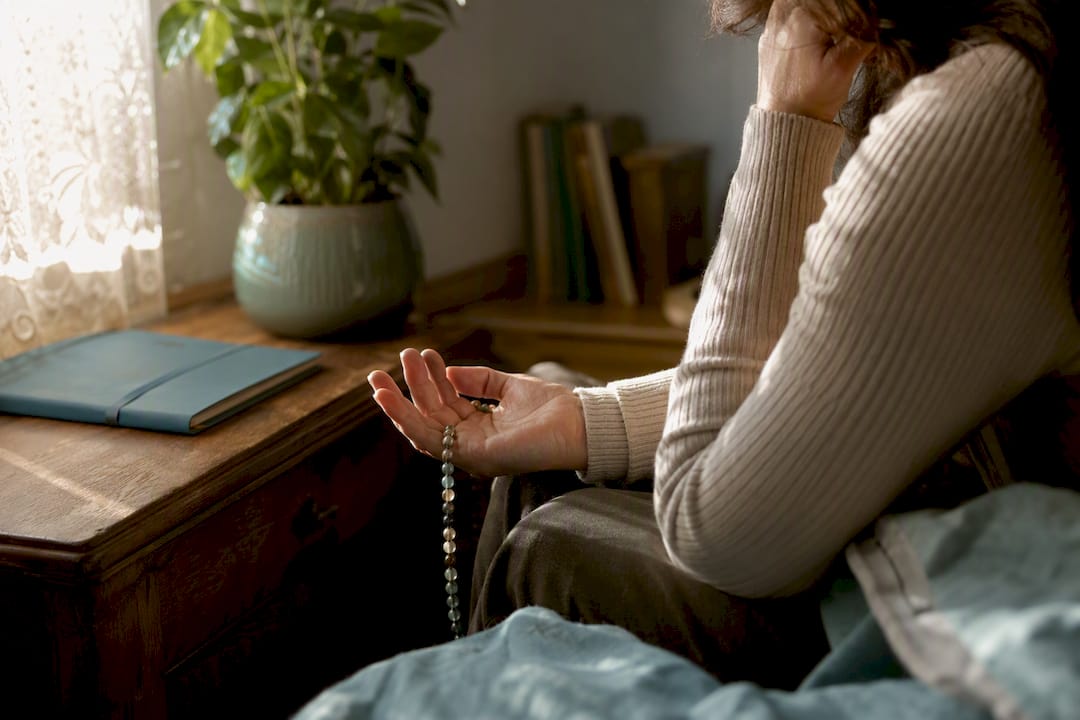
A breath prayer captures the shift in one sentence: instead of a generic mantra, you might breathe in on "Come, Lord Jesus," and breathe out on "I am yours." Research on Christian accommodative mindfulness describes this kind of scripture-anchored breathing as one of several adapted techniques therapists use to keep the practice theologically grounded while still calming the nervous system.
Where Does This Come From? Christian Roots That Look Like Mindfulness
Christians have practiced attentive, embodied prayer for centuries, long before mindfulness entered the cultural vocabulary. These aren't borrowed techniques dressed up in Bible verses. They're recovered ones.
- Lectio divina: a four-movement practice of reading Scripture slowly (lectio), reflecting on it (meditatio), responding in prayer (oratio), and resting in God's presence (contemplatio)
- The Examen: a daily review of where you noticed God's presence and absence, developed by Ignatius of Loyola
- The Jesus Prayer: a repeated phrase ("Lord Jesus Christ, Son of God, have mercy on me") used by Eastern Christian monastics for centuries
- Interior recollection: a contemplative tradition of gathering scattered attention back toward God
The USCCB's own primer on lectio divina frames it as a method for praying with Scripture, not a self-improvement technique, and that framing matters. It positions the four movements as a relationship, not a relaxation routine. A parallel primer from Father Boniface Hicks walks through the same four steps as a way of letting a single verse "read you" as much as you read it.
How Do You Actually Practice Christian Mindfulness?
Pick one practice below based on the time you have and what you need in the moment.
- Breath prayer (1 to 5 minutes). Choose a short scripture phrase, split across an inhale and exhale. Try "Be still" (inhale) and "and know You are God" (exhale), from Psalm 46:10. Repeat until your breathing slows.
- Scripture meditation, or lectio divina (5 to 20 minutes). Pick a short passage, a psalm or a few verses from the Gospels work well. Read it slowly four times: once to hear it, once to notice a word or phrase that stands out, once to respond in prayer, and once to simply rest in silence.
- Adapted body scan (8 to 12 minutes). Move attention slowly from your feet to your head, but instead of neutral observation, thank God for that part of your body's design and function as you go. Psalm 139:14 ("I am fearfully and wonderfully made") works well as a recurring line.
- Centering prayer (5 to 10 minutes). Choose one sacred word, like "Abba" or "Jesus." When thoughts intrude, gently return to the word as a way of returning to God's presence, rather than trying to force the mind blank.
- Guided gospel imagination (5 to 15 minutes). Read a Gospel scene slowly, then imagine yourself present in it. What do you see, hear, smell? Where are you standing? What might Jesus say to you there?
Use breath prayer for sudden stress, scripture meditation for a morning devotion, and the body scan or centering prayer when you have more time before or after a worship gathering.
Pro Tip: Keep a single index card with your favorite breath prayer phrase written on it. Anxiety rarely waits for a convenient moment, and having the words ready removes the friction of trying to think of a verse mid crisis.
How Do You Keep Secular Mindfulness Techniques Theologically Sound?
Many popular mindfulness apps and scripts are theologically neutral by design, which means they can drift into language that quietly conflicts with a Christian worldview if you're not paying attention. Three adjustments keep the practice anchored.
- Replace "emptying" with "filling." Instead of clearing your mind, fill it with Scripture and invite the Holy Spirit into the space you've made.
- Reframe impersonal language. Swap "connect with your inner energy" for "connect with the God who made you."
- Keep discernment active. Take every thought captive to Christ (2 Corinthians 10:5) rather than treating every impulse as worth honoring.
Watch for red flags: any script that implies you are your own source of peace, that treats sin as an illusion to dissolve rather than a real condition to confess, or that frames "enlightenment" as the finish line instead of communion with God. As therapists working with Christian accommodative mindfulness note, the fix is usually simple. A common secular prompt like "notice your breath and let go" becomes "notice your breath and give this moment to God."
Pro Tip: If an app's script never mentions God by name in ten minutes of guided meditation, that's your cue to substitute your own scripture phrase instead of the app's default line.
What Does the Research Say About Christian Mindfulness and Mental Health?
Small but growing bodies of research back what contemplative Christians have practiced for generations. A peer-reviewed overview of Christian accommodative mindfulness defines the approach and reviews early trials, including a randomized study of a Jesus Prayer based contemplative program that found reduced perceived stress and greater surrender to God among participants. The sample sizes in this research remain modest, so the findings point toward promise rather than proof, but the direction is consistent with what pastoral counselors report anecdotally.
At Prism-counseling, Tres and the counseling team use adapted mindfulness as one tool among several, not a stand-alone treatment plan.
Faith-integrated mindfulness works best as a bridge into deeper emotional processing, not a replacement for it. When a body scan or scripture meditation surfaces a painful memory or trauma response, that's a signal to pause the practice and bring it to a counselor, not to push through alone.
Practical guardrails that follow from this:
- Start new practices at 5 minutes and build toward 20 as tolerance grows
- Screen yourself honestly for trauma history before extended body-scan work
- Treat unexpected grief, panic, or intrusive memories during practice as a reason to seek support, not a reason to quit quietly
If stress or anxiety surfaces repeatedly during your practice, Prism-counseling's practical strategies for dealing with anxiety offers additional tools worth pairing with contemplative prayer.
A 7-Day Starter Plan for Building Christian Mindfulness
Building any new spiritual habit works better in small, specific steps than in vague resolutions. Try this one-week rhythm and adjust the length up or down as it fits your schedule.
- Day 1 (2 minutes): Breath prayer using Psalm 46:10 before getting out of bed.
- Day 2 (5 minutes): Lectio divina on Psalm 23.
- Day 3 (3 minutes): Breath prayer paired with mealtime grace.
- Day 4 (10 minutes): Adapted body scan before sleep.
- Day 5 (5 minutes): Centering prayer using the word "Abba."
- Day 6 (15 minutes): Guided gospel imagination on John 21:1-14.
- Day 7 (20 minutes): Combine lectio divina and journaling on where you noticed God's presence this week.
Each night, jot two or three lines answering: Where did I sense God today? What distracted me? What one practice do I want to repeat tomorrow? Pairing the habit with something you already do, morning coffee, mealtime, or bedtime, makes it far more likely to stick than scheduling it as a separate task.
Key Takeaways
Christian mindfulness works by replacing the "empty your mind" instruction of secular practice with Scripture and the Holy Spirit, turning present-moment awareness into present-moment communion with God.
| Point | Details |
|---|---|
| Definition matters | Christian mindfulness fills the mind with Scripture and invites the Holy Spirit rather than seeking emptiness. |
| Rooted in tradition | Lectio divina, the Examen, and the Jesus Prayer are centuries-old parallels, not new imports. |
| Start small | Begin breath prayer or centering prayer at 5 minutes and build toward 20 as it becomes familiar. |
| Watch for red flags | Reframe any script that removes God's name, denies sin, or treats enlightenment as the goal. |
| Know when to pause | Trauma memories surfacing during practice are a cue to consult a faith-integrated counselor. |
Where to Learn More
- Christian accommodative mindfulness (MDPI): the research behind adapted protocols and early trial results
- Lectio Divina primer (USCCB): the church's own guide to praying with Scripture
- Introduction to Lectio Divina (Father Boniface Hicks): a practical walk through the four movements
- Focus on the Family's Christian approach to mindfulness: scriptural grounding for the practice
- Practicing Mindfulness from a Christian Perspective (APU): short exercises for sitting in God's presence
- Guided meditations by Paul Stebles: gospel-centered audio practice for those who prefer spoken guidance
- Prism-counseling's Christian counseling resources: articles and podcast episodes on faith-integrated practice
Practice Meets Presence: What This Approach Gets Right
The conventional wisdom on mindfulness treats it as a neutral technique you can bolt onto any belief system. That framing undersells what Christian mindfulness actually offers. The research on Christian accommodative mindfulness and centuries of lectio divina point to something more specific: attention becomes formative depending on what it's aimed at. Aim it at nothing, and you get calm. Aim it at God, and you get communion, which tends to produce calm as a byproduct rather than the goal itself.
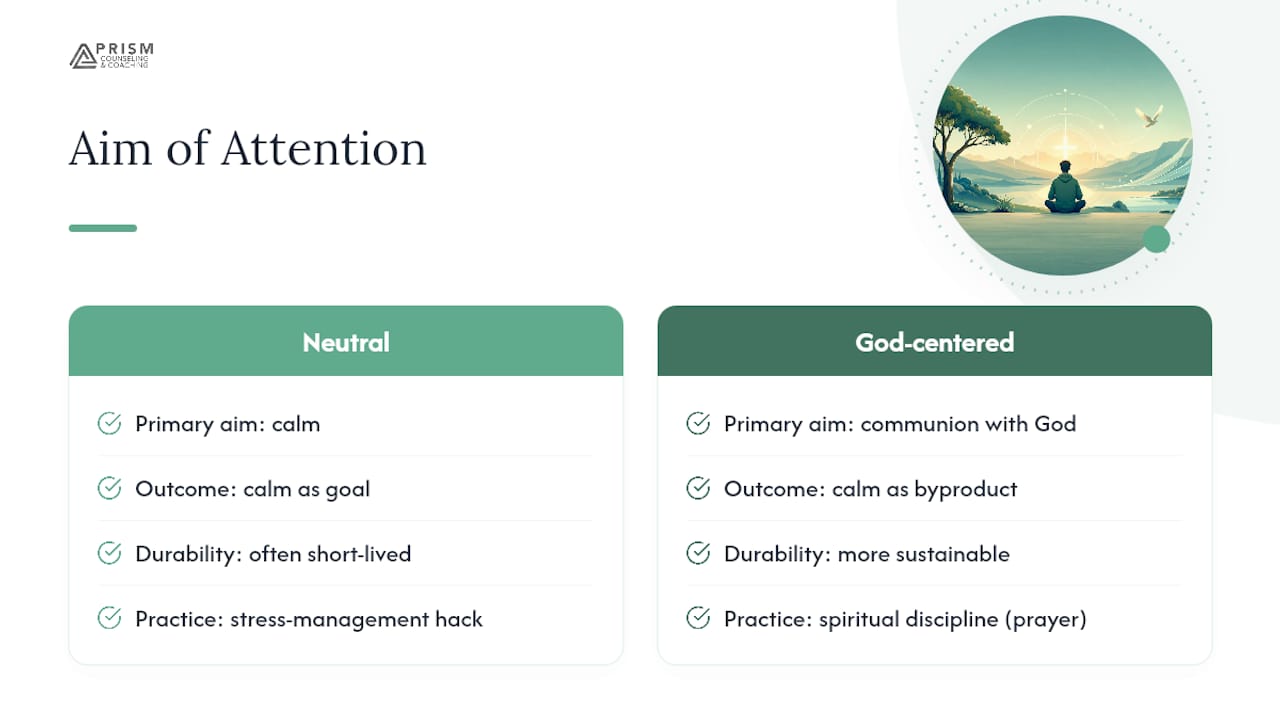
Where most advice falls short is treating mindfulness as a stress management hack rather than a spiritual discipline with a mental health upside. The order matters. If you chase the calm first, you'll likely abandon the practice the first week it doesn't deliver. If you chase God's presence first, as the Jesus Prayer and Psalm-based breath prayers have done for centuries, the stress relief tends to follow.
Start with the smallest practice, a single breath prayer, before attempting a 20 minute routine. Consistency at 60 seconds beats ambition that fizzles by Thursday.
— Tres
This article is general information, not a substitute for advice from a qualified doctor. Consult a qualified healthcare professional about your own circumstances before acting on anything here.
Sources
- Christian accommodative mindfulness: Definition, current research, and group protocol (MDPI)
- Mindfulness: A Christian Approach - Focus on the Family
- Introduction to Lectio Divina - Father Boniface Hicks, OSB
- Practicing Mindfulness from a Christian Perspective - APU
- Lectio Divina primer - USCCB
Recommended
- Prism Counseling & Coaching | Faith-Based Counseling and Spiritually-Integrated Therapy in Peoria and Phoenix AZ - Articles
- Practical Strategies for Dealing with Anxiety - Prism Counseling & Coaching | Faith-Based Counseling and Spiritually-Integrated Therapy in Peoria and Phoenix AZ
- Overcoming Anxiety with the Love of God - Prism Counseling & Coaching | Faith-Based Counseling and Spiritually-Integrated Therapy in Peoria and Phoenix AZ
- Avoiding Ministry Burnout - Prism Counseling & Coaching | Faith-Based Counseling and Spiritually-Integrated Therapy in Peoria and Phoenix AZ