

Christian premarital counseling is a faith-integrated preparation program that combines biblical teaching, practical relationship skills, and validated assessment tools to help you build a marriage on a shared spiritual foundation. Before you schedule your first session, here are three steps to take right now:
- Pick a format. Choose between a church-led group class, pastor-led sessions, a licensed Christian counselor, or a self-guided curriculum like Ready to Wed from Focus on the Family.
- Schedule your first session or start a curriculum. Aim to begin several months before your wedding date.
- Complete a relationship assessment. Ask your counselor or pastor about Prepare/Enrich or SYMBIS to identify strengths and growth areas before your wedding day.
Prism-counseling offers faith-integrated premarital counseling in the Phoenix area and via telehealth, with openings typically available within days.
Key Takeaways
Christian premarital counseling works best when couples start early, choose a format that matches their depth of need, and use a validated assessment to surface what conversation alone might miss.
| Point | Details |
|---|---|
| Start at least 4–6 months out | Beginning early leaves room to address serious issues without wedding-day pressure. |
| Match format to your situation | Church classes suit community-minded couples; licensed counselors are best for complex histories or trauma. |
| Use a validated assessment | Prepare/Enrich or SYMBIS surfaces strengths and growth areas that conversation alone often misses. |
| Ask the right questions | Confirm credentials, faith integration approach, assessment use, and referral process before committing. |
| Pause for safety concerns | Unmanaged addiction, abuse, or coercive control requires specialized help before marriage proceeds. |
| Prism-counseling local option | Faith-integrated premarital counseling in Phoenix and via telehealth, with openings available within days. |
Table of Contents
- What does Christian premarital counseling actually do for you?
- Core topics most Christian premarital programs cover
- Which format fits your situation?
- Assessment tools and curricula you should know about
- How long does premarital counseling take, and what does it cost?
- How to choose the right counselor or pastor, and what to ask them
- What to do if counseling uncovers serious concerns
- A perspective on what faith-integrated preparation really means
- Prism-counseling is ready to walk with you through this
- Sources
What does Christian premarital counseling actually do for you?
Faith-integrated preparation changes the entire frame of the conversation. Where secular premarital programs focus primarily on communication styles and conflict patterns, Christian premarital counseling adds a third dimension: your shared theology, your understanding of covenant, and how your faith shapes every practical decision from finances to parenting. The result is a program that addresses both the clinical and the spiritual at the same time.
Practically, couples who complete a structured premarital program tend to enter marriage with clearer communication habits, an agreed-upon approach to money, and an honest conversation about sexual expectations already behind them. They also leave with a referral path: if deeper issues surface during sessions, a good counselor or pastor will know when to send you to a specialist rather than push forward.
Some counseling practices weave evidence-based couple skills, including Gottman-informed communication techniques and Emotionally Focused Therapy principles, directly into scripture and prayer. That combination addresses both clinical and spiritual needs in a single setting, which is one reason faith-integrated counseling tends to feel more personally relevant to Christian couples than a generic premarital workshop.
Core topics most Christian premarital programs cover
A well-designed program moves through ten core areas. Desiring God's premarital question guide and The Gospel Coalition's list of surprises every counselor should cover both emphasize that the topics most couples skip are often the ones that cause the most friction later. Work through each one before your wedding:
- Faith and spiritual life. How will we pray together, and what does regular church involvement look like for our family?
- Communication. What does it look like when one of us shuts down, and how will we re-engage?
- Conflict resolution. What is our agreed-upon process for resolving a disagreement before we go to bed? Practical de-escalation and reflective listening skills are often taught directly in sessions.
- Finances. Will we combine accounts, and who is responsible for tracking the budget?
- Roles and expectations. How do we understand headship and submission in our specific marriage, and where do we agree or differ?
- Intimacy and sexual expectations. What are our expectations for frequency, and how will we talk about unmet needs?
- Family of origin and in-laws. How will we handle holidays and major decisions when our families disagree with us?
- Children and parenting. Do we want children, when, and how will we discipline?
- Personality and strengths. Where do our temperaments complement each other, and where might they create friction?
- Forgiveness and conflict repair. What does asking for and receiving forgiveness look like in our relationship?
Pro Tip: Not every difference requires resolution before the wedding. A useful decision rule from Desiring God: differences in preference (coffee vs. tea, morning vs. night person) can be negotiated over time. Differences in core conviction (whether to have children, theological non-negotiables, financial ethics) need honest agreement before you marry. Ask your counselor to help you sort which category each unresolved issue falls into.
Which format fits your situation?
Four delivery formats exist, and each suits a different couple. The right choice depends on your budget, schedule, the depth of faith integration you want, and whether you're carrying complex histories into the relationship.

| Format | Typical cost | Duration | Faith integration | Common assessments |
|---|---|---|---|---|
| Church group class | Free to $50 | 4–8 weekly sessions | High (scripture-based curriculum) | Ready to Wed, none |
| Pastor-led sessions | Free to $100/session | 4–6 sessions | High (pastoral discretion) | Varies; often informal |
| Licensed Christian counselor | $100–$200/session | 6 sessions | Moderate to high (clinician-led) | Prepare/Enrich, SYMBIS |
| Self-guided curriculum | $30–$80 one-time | Self-paced (4 weeks) | Moderate (structured workbook) | Ready to Wed, SYMBIS |
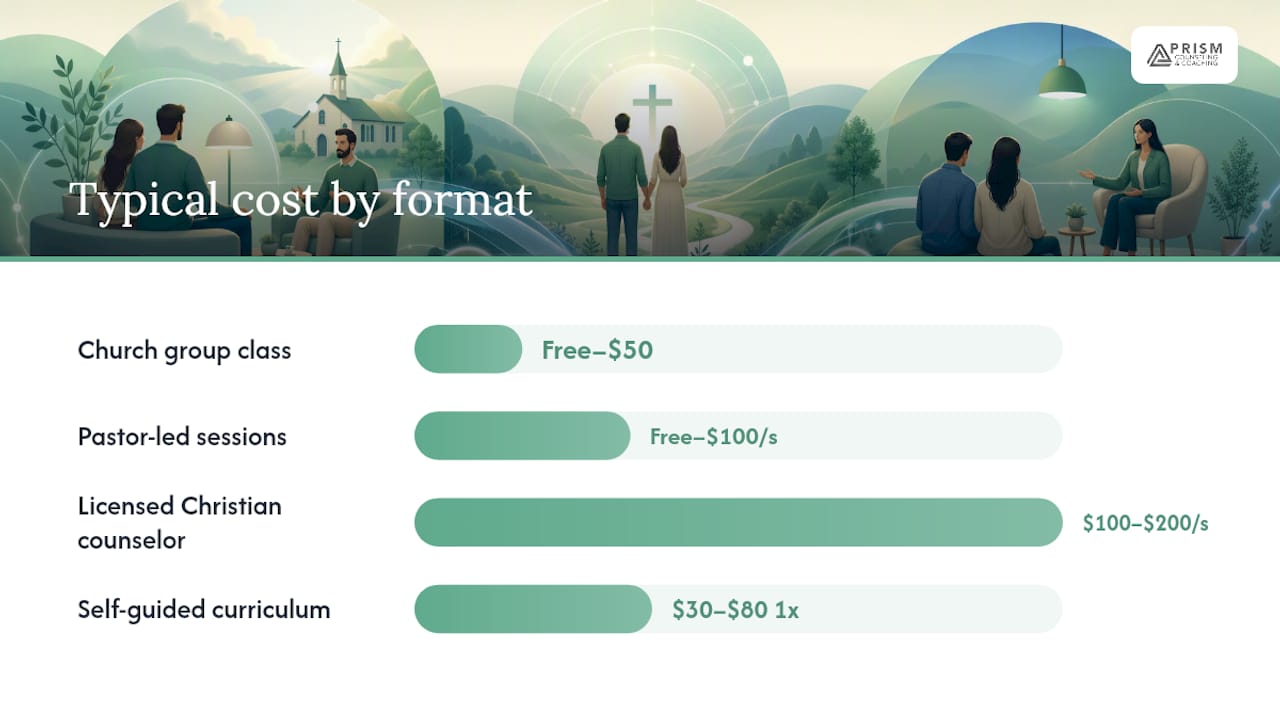
Church group classes work well for couples who want community accountability and a structured biblical framework at low cost. The Ready to Wed kit from Focus on the Family is one of the most widely used church-based curricula, built specifically for pastors and mentors leading engaged couples through biblically rooted preparation.
Pastor-led sessions offer personal pastoral relationship and flexibility in content, though the depth of clinical skill varies significantly by pastor. If your pastor has completed formal couples training, this format can be excellent. If not, it pairs well with a validated assessment tool.
Licensed Christian counselors are the right choice when one or both partners carry trauma histories, prior marriages, mental health concerns, or significant family-of-origin wounds. The clinical training adds a layer of safety and skill that pastoral care alone may not provide.
Self-guided curricula suit couples with scheduling constraints or those who want to supplement another format with structured homework. They work best as a complement, not a replacement, for live sessions.
Assessment tools and curricula you should know about
Three tools appear most often in faith-integrated premarital programs, and each measures something different.
- Prepare/Enrich is a research-based assessment that identifies couple strengths and growth areas across categories including communication, conflict resolution, finances, and family of origin. A trained facilitator guides a structured debrief session where you review your results together. Ask to see a sample couple report before you commit to a facilitator, and confirm they are certified to administer the debrief.
- SYMBIS (Save Your Marriage Before It Starts) is a personality-focused assessment developed by Drs. Les and Leslie Parrott. It maps each partner's individual traits and then shows how those traits interact as a couple. SYMBIS tends to feel less clinical than Prepare/Enrich and is popular in church settings.
- Ready to Wed is a curriculum rather than a psychometric assessment. It includes video sessions, a leader guide, and participant workbooks designed for church or mentor use. It covers biblical marriage foundations, communication, conflict, finances, and intimacy in a structured sequence.
A good debrief session for any assessment should last at least 60–90 minutes, walk through both strengths and growth areas without rushing, and end with two or three concrete commitments the couple makes together. If a facilitator hands you a printout and sends you home without discussion, that is not a debrief.
For couples with complex histories, prior trauma, or blended-family dynamics, a validated assessment like Prepare/Enrich is strongly recommended rather than optional. The data surfaces patterns that conversation alone often misses.
How long does premarital counseling take, and what does it cost?
Start earlier than you think you need to. Most counselors and pastors recommend beginning at least four to six months before your wedding date. That window gives you time to work through difficult topics without the pressure of an approaching ceremony, and it leaves room to seek additional support if something significant surfaces.
Program lengths vary by format. Church group classes typically run four to eight weekly sessions. Pastor-led or counselor-led programs usually span six to ten sessions, each lasting 50–90 minutes. Some practices offer two-day intensive formats that compress the content into a weekend, which suits couples with demanding schedules or those who live in different cities.
Cost follows format closely. Church-based programs are often free or low-cost. Self-guided curricula run roughly $30–$80 for materials. Individual counselor sessions in the United States typically range from $100 to $200 per session for private-pay clients, though rates vary by region and clinician.
Pro Tip: Faith-integrated premarital counseling is rarely covered by insurance, since it is often classified as preventive rather than clinical care. Ask your counselor whether they offer a sliding scale or a package rate for a set number of sessions. Private-pay practices like Prism-counseling often have more scheduling flexibility and faster availability than insurance-based providers.
How to choose the right counselor or pastor, and what to ask them
Before you commit to a format or a facilitator, run through this selection checklist:
- Is the counselor licensed (LPC, LMFT, LCSW) or does the pastor have formal couples training?
- Do they use a validated assessment tool like Prepare/Enrich or SYMBIS?
- Do they offer in-person sessions, telehealth, or both?
- What is their explicit approach to faith integration? Do they use scripture, prayer, and biblical frameworks, or is faith a secondary add-on?
- What is their referral process if deeper issues emerge?
When you call or email a potential counselor or pastor, ask these questions directly:
- How many premarital sessions do you typically recommend, and what does each session cover?
- Which assessment tool do you use, and are you certified to debrief it?
- How do you incorporate faith and scripture into your sessions?
- What happens if we uncover a serious issue during counseling?
- Do you offer telehealth or only in-person sessions?
- What is your fee per session, and do you offer a package rate?
- How far in advance do couples typically book with you?
- What homework or reading do you assign between sessions?
A Focus on the Family minister-author recommends at least six premarital sessions as a minimum structure, noting that fewer sessions often leave important topics unaddressed.
Red flags that suggest pausing or seeking a different provider:
- A facilitator who skips the assessment debrief or rushes through it
- No clear process for handling serious disclosures (abuse, addiction, mental health crises)
- Pressure to proceed with the wedding regardless of what surfaces in sessions
- No referral network for specialized therapy or medical evaluation
What to do if counseling uncovers serious concerns
Premarital counseling sometimes surfaces issues that require more than preparation. That is not a failure of the process. It is the process working exactly as it should.
If sessions reveal any of the following, pause and seek specialized help before proceeding:
- Active addiction or substance dependence in either partner
- A history of physical, emotional, or sexual abuse within the relationship
- Patterns of coercive control (monitoring, isolation, financial control)
- Unmanaged mental health crises, including suicidal ideation
- Sexual coercion or pressure around physical boundaries
The referral path in these situations is direct: ask your counselor or pastor to connect you with a licensed therapist who specializes in trauma, addiction, or domestic safety. A medical evaluation may also be appropriate. Delaying a wedding is far less painful than entering a marriage that is not yet safe.
Pro Tip: If you feel unsafe raising a concern in a joint session, ask for one individual session with the counselor alone. A skilled, ethical counselor will make space for that conversation without pressure.
A perspective on what faith-integrated preparation really means
Most premarital programs teach couples what to discuss. Fewer teach them how to hold those conversations with grace when the answers are hard.
What I have seen, both in clinical work and in pastoral settings, is that the couples who benefit most from Christian premarital counseling are not the ones who arrive with the fewest problems. They are the ones who arrive willing to be honest. The assessment tools, the curricula, the session structure: all of it is scaffolding for a deeper willingness to be known by your partner and to know them in return.
Faith integration is not simply adding a scripture verse to a communication exercise. At its best, it means bringing a theology of grace into the room, one that says both of you are imperfect, both of you are loved, and the covenant you are making is bigger than either of you can sustain on your own. That framing changes how couples receive difficult feedback from an assessment. It changes how they hear a hard question about finances or family history. It gives them a shared language for repair when conflict happens, because it will.
The practical tools matter. Prepare/Enrich data is genuinely useful. Gottman-informed communication skills work. But the couples who carry those tools well into marriage are the ones who also carry a shared conviction that their marriage is worth fighting for, not just maintaining. That conviction is what faith-integrated counseling, done well, builds.
Prism-counseling is ready to walk with you through this
Engaged couples in the Phoenix area and beyond have a faith-integrated option that combines clinical rigor with genuine spiritual care. Prism-counseling's couples counseling includes premarital counseling, Prepare/Enrich facilitation, and relationship intensives, all delivered by counselors who integrate scripture, prayer, and evidence-based therapy in every session.
Prism-counseling operates on a private-pay model, which means no insurance delays, no waitlists measured in months, and openings typically available within days. Sessions are available in person in the Phoenix and Peoria area and via telehealth for couples who need flexibility. For churches looking to sponsor or host premarital programs for their congregation, Prism-counseling's church sponsorship program offers a structured partnership path. Couples who want to explore faith-based Christian counseling before booking can also browse the resource library and podcast for a sense of the approach. To schedule your first session or request intake information, visit Prism-counseling's contact page and expect a response within one business day.
Sources
These resources are worth bookmarking before your first session, and worth sharing with your pastor or counselor:
- Ready to Wed™ Christian Premarital Counseling Kit - Focus on the Family
- Prepare/Enrich
- Questions to Ask When Preparing for Marriage | Desiring God
- 6 Surprises Every Premarital Counselor Should Cover
Recommended
- Christian Counseling - Prism Counseling & Coaching | Faith-Based Counseling and Spiritually-Integrated Therapy in Peoria and Phoenix AZ
- My Journey Through Conversion Therapy | A Pastor and Counselor's Experience - Prism Counseling & Coaching | Faith-Based Counseling and Spiritually-Integrated Therapy in Peoria and Phoenix AZ
- Christian Counseling Resources | Articles, Videos, and Podcast Resources by Topic - Prism Counseling & Coaching | Faith-Based Counseling and Spiritually-Integrated Therapy in Peoria and Phoenix AZ
- Ask a Christian Counselor Podcast - Prism Counseling & Coaching | Faith-Based Counseling and Spiritually-Integrated Therapy in Peoria and Phoenix AZ