

Yes. Employee Assistance Program use is confidential in almost every circumstance in the United States, protected by HIPAA and, for substance use records, by 42 CFR Part 2. A handful of narrow exceptions exist, like danger to yourself or others, but your employer generally sees only aggregate numbers, never your name attached to a diagnosis.
TL;DR:
- Most third-party EAP vendors store records with role-based access, limiting viewing to counselors and necessary staff only.
- Federal laws like HIPAA and 42 CFR Part 2 strongly protect EAP confidentiality, with state laws adding further restrictions against employer access.
- Confidentiality exceptions include cases of immediate danger, abuse reporting, court orders, and signed release authorizations.
- Employers typically see only aggregate data like session counts and trends, never individual diagnoses or session notes.
- Verifying privacy practices involves reviewing confidentiality notices, confirming BAA existence, and using secure communication channels.
Table of Contents
- How EAP confidentiality works in practice
- What laws and regulations protect EAP privacy in the U.S.?
- When can EAP confidentiality be limited?
- What can your employer actually see?
- Do fitness-for-duty and security clearances change the rules?
- How can you verify your EAP's privacy practices before you use it?
- Why Prism Counseling Approaches Privacy the Way We Do
- A Private, Faith-Integrated Option When Your EAP Isn't Enough
- Where to Read the Full Policies Yourself
- Sources
How EAP confidentiality works in practice
Most EAPs are run by third-party vendors, not your own HR department, and that separation is the backbone of your privacy. When a counseling company operates independently of your employer, there's no shared database, no shared badge system, and no manager who can casually pull your file. In-house programs can still protect you well, but the wall between clinical records and personnel records has to be built deliberately rather than assumed.
Records live in systems with role-based access, meaning only the counselors and administrative staff who need to see your information can open it. Your file sits apart from your personnel record, so a supervisor reviewing your performance history has no path into your counseling notes.
Intake itself is designed to limit exposure. Scheduling usually happens through a phone line or secure portal, and clinical details wait until you're on a protected channel with your counselor. This is why reputable programs steer you away from email or a general company inbox for anything sensitive.
- Third-party EAP vendors typically offer stronger separation than in-house programs run by your own HR team.
- Records are stored with role-based access, so only your counselor and necessary administrative staff can view them.
- Scheduling and clinical details are handled through different channels, with secure portals reserved for anything sensitive.
- Employers usually receive utilization counts and trend data, not names or session content.
Pro Tip: If your company's EAP intake process asks for clinical details over a regular email thread, that's a red flag. Ask whether a secure portal or phone line exists before sharing anything about your situation.
What laws and regulations protect EAP privacy in the U.S.?
Federal law does most of the heavy lifting here, and it's worth knowing the specific statutes by name so you can ask informed questions.
HIPAA applies to most EAPs that provide counseling or otherwise generate protected health information, because they're treated as covered entities or operate through a group health plan. That triggers the Privacy Rule, the Security Rule, and mandatory breach notification if your data is ever exposed. If your EAP is bundled with your employer's group health coverage, rules around plan sponsorship often determine exactly how HIPAA attaches to it.
42 CFR Part 2 governs substance use disorder records specifically, with protections that historically went beyond HIPAA. Updates finalized in 2024, with compliance phasing through 2026, aligned Part 2 enforcement more closely with HIPAA and barred programs from requiring you to waive your complaint rights as a condition of getting help.
The Privacy Act covers federal employees, with individual agencies like DOE and DHS layering on their own EAP confidentiality policies that mirror the separation-of-records principle.
State law adds another layer. Washington passed a statute, effective June 9, 2022, that flatly forbids employers from obtaining individually identifiable EAP participation data and bars using that participation in employment decisions. Other states have similar protections, so it's worth checking your own state's rules alongside federal law.
- HIPAA covers most EAPs providing counseling services or PHI.
- 42 CFR Part 2 protects substance use records with enforcement now closer to HIPAA standards.
- The Privacy Act and agency policy protect federal employees.
- Washington State law bars employers from accessing identifiable EAP data.
When can EAP confidentiality be limited?
Confidentiality has boundaries, and knowing them ahead of time keeps you from being caught off guard. The exceptions are narrow and defined by law, not left to a counselor's discretion.
- Immediate danger. If you present a credible threat to yourself or someone else, counselors have a legal duty to warn or protect, which can override confidentiality.
- Mandatory abuse reporting. Suspected child abuse, elder abuse, or abuse of a dependent adult must be reported regardless of your wishes.
- Court orders and subpoenas. A judge can compel disclosure of records in specific legal proceedings.
- Signed releases. If you sign a release, often for a supervisor referral or fitness-for-duty evaluation, disclosure is limited to exactly what you authorized, nothing more.
Outside these four situations, what you share with an EAP counselor stays with that counselor.
What can your employer actually see?
Your employer, as the plan sponsor, is entitled to program-level information, not your clinical file. That typically means session counts, overall utilization rates, and broad thematic trends like stress or work-life balance showing up across the workforce.
What employers cannot routinely obtain includes your name, your diagnosis, and anything discussed in session. That protection exists because of the same HIPAA and 42 CFR Part 2 framework discussed above, reinforced by Business Associate Agreements between the employer and the EAP vendor. The rare exception is a supervisor-referral case, where the EAP might confirm only attendance or program compliance, never clinical substance.
- Employers can see: aggregate session counts, utilization rates, general program themes.
- Employers cannot see: names, diagnoses, session notes, or individually identifiable data.
- BAAs and minimum-necessary access rules keep vendor and employer roles separated.
Pro Tip: Ask your HR department whether a Business Associate Agreement exists between your company and the EAP vendor. If they can't answer, that's worth following up on before you enroll.
Do fitness-for-duty and security clearances change the rules?
Voluntary self-referral, where you reach out to the EAP on your own, carries the strongest confidentiality protection. A supervisor referral, whether mandatory or strongly recommended, shifts things slightly, because it usually requires a signed release before you begin.

That release is narrow by design. It typically permits confirmation of attendance and general compliance with a treatment plan, not a summary of what you discussed. Employees in safety-sensitive roles often face fitness-for-duty evaluations that follow this same limited-disclosure model.
Security clearance processes, including the SF-86 form, generally distinguish routine counseling from hospitalization or certain diagnoses. Seeking help for stress or a difficult season rarely triggers reporting obligations, though the line shifts for inpatient care. Anyone weighing disclosure in a clearance role, or navigating a workplace safety concern that led to a referral, benefits from asking the EAP directly what a release actually covers before signing it.
- Self-referrals carry stronger privacy protection than supervisor-mandated referrals.
- Fitness-for-duty releases usually confirm attendance and compliance only.
- SF-86 clearance forms treat routine counseling differently than hospitalization.
How can you verify your EAP's privacy practices before you use it?
You don't have to take confidentiality on faith. A short round of questions to HR or the EAP vendor tells you almost everything you need to know.
- Ask for the EAP's Notice of Privacy Practices and read what it says about data sharing.
- Ask whether a Business Associate Agreement exists between your employer and the vendor.
- Ask who holds your records, whether that's a third-party vendor or an in-house team.
- Read your intake paperwork closely for language on individually identifiable data, since university and agency EAP notices often spell this out clearly.
- Keep sensitive details off open email or social media; use the secure portal or phone line your EAP provides.
- If you suspect a breach, request your records in writing and file a complaint with your EAP vendor or HHS if needed.
Pro Tip: Save a copy of your EAP's confidentiality notice when you enroll. If a dispute ever comes up, having the original language in hand makes the conversation far easier.
Why Prism Counseling Approaches Privacy the Way We Do
We've spent over 14 years in Phoenix walking alongside people through anxiety, grief, and seasons that felt too heavy to carry alone, and privacy has always shaped how we work. Our private-pay model means there's no insurance claim trail and no employer reporting structure to navigate, which is a meaningful difference for someone who has hit the limits of what an EAP can offer.
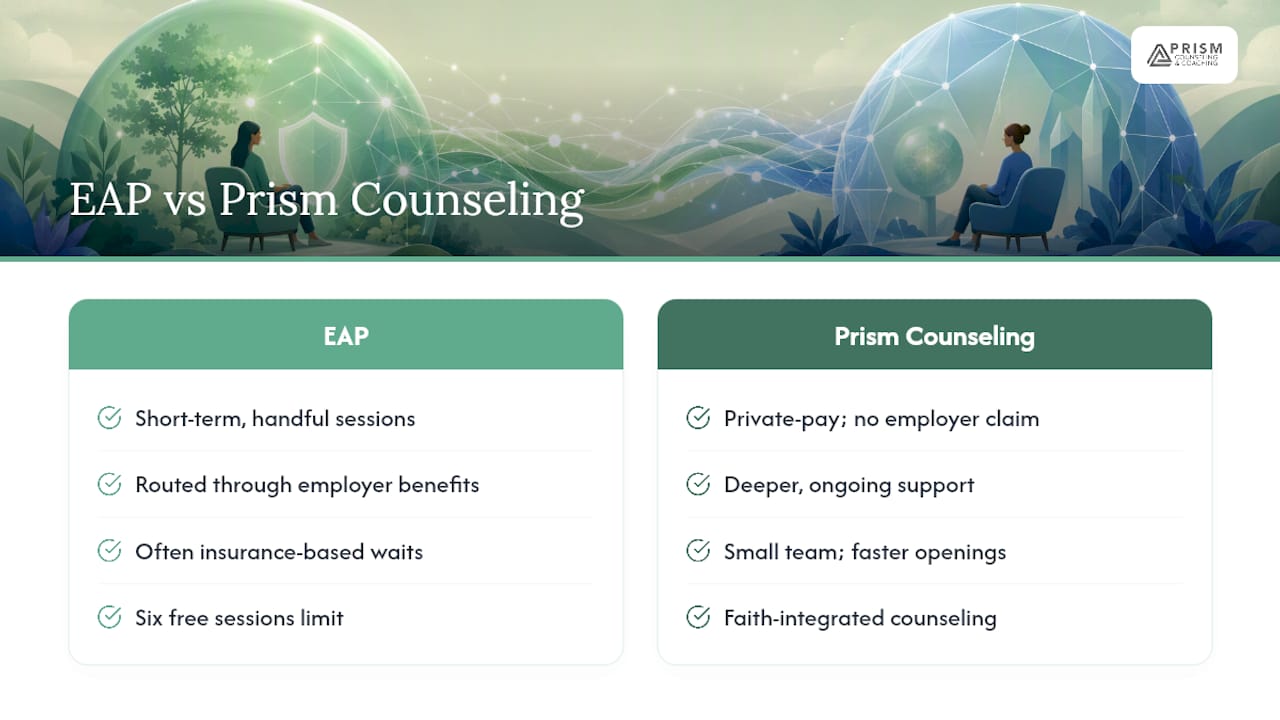
An EAP is often built for short-term, situational support. When you need ongoing care, faith integrated into the process, or a counselor who understands both your emotional and spiritual struggle, private counseling becomes the better fit. Our intake and records practices keep your information contained to your care team, whether you meet with us in person or through our online counseling option.
— Tres
A Private, Faith-Integrated Option When Your EAP Isn't Enough
An EAP works well for a short-term nudge, a handful of sessions to steady you during a rough patch. Prism-counseling is the alternative for employees who need something deeper: a small, private-pay practice in the Phoenix area where your care isn't routed through an employer's benefits system at all.
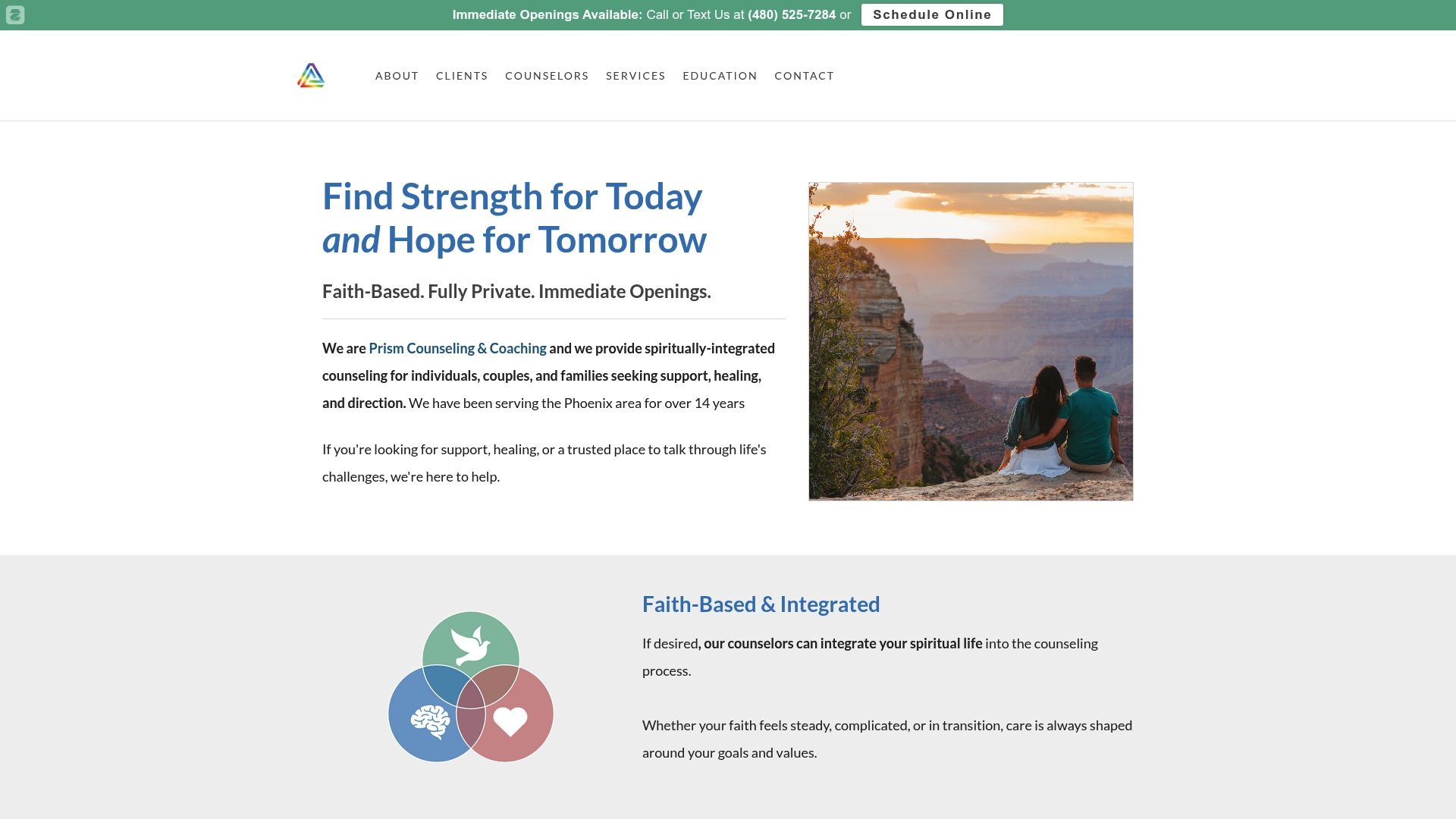
That private-pay structure means no insurance claim ever touches your employer's radar, and our small team means you're not waiting weeks for an opening the way many insurance-based practices require. If your EAP's six free sessions helped but weren't enough, or if you want a counselor who integrates your faith into the work rather than setting it aside, that's exactly where we come in. Employers exploring a faith-based option for their teams can also look into our church and organization sponsorship programs.
If you're ready for private, ongoing support, visit our individual counseling page to see available openings and book a session directly.
Where to Read the Full Policies Yourself
For the complete legal language behind everything covered here, the HHS fact sheet on HIPAA and 42 CFR Part 2 covers federal privacy rules directly. The LLNL EAP confidentiality page shows how a real employer describes record separation and disclosure limits, and the UT Austin EAP confidentiality notice offers a plain-language example of an intake and consent policy worth comparing against your own.
This article is general information, not a substitute for advice from a qualified doctor. Consult a qualified healthcare professional about your own circumstances before acting on anything here.
Sources
- HHS — HIPAA and 42 CFR Part 2 fact sheet
- UT Austin EAP confidentiality notice (PDF)
- LLNL EAP — Confidentiality
Recommended
- Prism Counseling & Coaching | Faith-Based Counseling and Spiritually-Integrated Therapy in Peoria and Phoenix AZ - Payment Options Blog
- ACPE Spiritual Care Specialist Program - Prism Counseling & Coaching | Faith-Based Counseling and Spiritually-Integrated Therapy in Peoria and Phoenix AZ
- Concierge Therapy with Tres Adames - Prism Counseling & Coaching | Faith-Based Counseling and Spiritually-Integrated Therapy in Peoria and Phoenix AZ
- Overcoming Trust Issues - Prism Counseling & Coaching | Faith-Based Counseling and Spiritually-Integrated Therapy in Peoria and Phoenix AZ