

Most U.S. employers pay a modest per employee per month amount for an Employee Assistance Program, translating to a moderate annual cost per employee under standard to high-touch service tiers. BambooHR's industry guidance places the broader annual range at $10–$100 per employee depending on services and organization size. A 1998 peer-reviewed study by MT French et al. documented annual costs per eligible employee for standard and enhanced EAP services — figures that remain a foundational academic benchmark even as market prices have shifted.
Two quick conversions every HR budget owner should keep handy:
- Monthly budget: PEPM × eligible headcount (e.g., $2.00 × 1,000 employees = $2,000/month, or $24,000/year)
- Effective cost per served employee: (PEPM × 12 × headcount) ÷ (headcount × utilization rate) — at 10% utilization, a $2.00 PEPM program costs roughly $240 per employee who actually uses it
Pro Tip: Before you finalize any budget number, ask each vendor for their documented utilization rate among comparable employers. A $1.50 PEPM program with 4% utilization often delivers less value than a $3.00 PEPM program with 12% utilization, once you calculate effective cost per served employee.
Key Takeaways
Most U.S. employers pay $1.00–$5.00 PEPM for an EAP, but effective cost per served employee, not PEPM alone, is the number that determines whether the investment delivers real value.
| Point | Details |
|---|---|
| U.S. PEPM benchmark | Most programs run $1.00–$5.00 PEPM, or $12–$60 per employee per year across standard to high-touch tiers. |
| Effective cost per served employee | Divide annual program cost by the number of employees who actually use it; utilization rate changes this figure more than PEPM does. |
| Access time drives utilization | Guaranteed first-appointment windows of 3–5 days consistently outperform 10–14 day windows on utilization and outcomes. |
| Budget beyond the contract | Employee communications and manager training are separate line items that directly raise utilization and lower effective cost per outcome. |
| Prism-counseling for faith-based employers | Prism-counseling offers a faith-integrated EAP for Phoenix-area employers, with openings typically available within days and a custom employer quote available on request. |
Table of Contents
- What drives the EAP cost per employee in vendor quotes?
- How do vendors charge for EAPs? The main pricing models explained
- U.S. EAP cost benchmarks by service tier and employer size
- Hidden costs and how to calculate real EAP value
- How to budget for an EAP and evaluate vendor quotes
- What to expect during onboarding and year one
- When a faith-based or niche EAP is the right fit for your organization
- What I've learned about EAP procurement that most guides skip
- Prism-counseling's faith-integrated EAP for Phoenix-area employers
- Primary sources and further reading
- Sources
What drives the EAP cost per employee in vendor quotes?
Two vendors can quote the same employer very different PEPM figures for what looks like the same program. The gap usually comes down to a handful of concrete factors.
Service level is the biggest lever. Oliver Wyman's April 2025 market analysis maps four tiers: traditional ($1–$3 PEPM), high-touch ($2–$4 PEPM), innovative ($10–$14 PEPM), and high-value ($5–$10 PEPM). Each tier reflects a different combination of clinical depth, access speed, and technology integration.
Beyond tier, these factors move price:
- Number of included sessions: Most traditional EAPs include 1–3 sessions per issue per year; high-touch and innovative models may include 6–12 or unlimited sessions.
- Family coverage: Extending eligibility to household members typically adds $0.25–$0.75 PEPM.
- Guaranteed access times: Programs that guarantee a first appointment within 3–5 business days cost more than those with 10–14 day windows.
- Clinical scope: Adding psychiatry, medication management, or integrated care pathways raises PEPM noticeably.
- Provider network model: Broad referral networks (the vendor refers out) cost less than curated or owned-provider networks with direct scheduling.
- Reporting and analytics: Real-time utilization dashboards and outcome reporting are often priced as add-ons in lower tiers.
- Contract length: Multi-year agreements typically carry lower PEPM than annual contracts.
- Regional pricing: Urban markets with higher clinician costs tend to carry slightly higher PEPM.
Company size matters too. Smaller employers generally pay more per head because fixed program costs spread across fewer employees. The SHRM toolkit on managing EAPs recommends that small employers explore purchasing consortia to access larger-tier pricing — a practical move that can reduce PEPM by pooling headcount with peer organizations.
Pro Tip: When comparing quotes, ask vendors to separate the PEPM for guaranteed access times from the base rate. Faster access is the single feature most correlated with utilization, and it is often negotiable as a standalone upgrade rather than a full-tier jump.
How do vendors charge for EAPs? The main pricing models explained
Understanding the pricing structure behind a quote helps you predict costs, spot incentive misalignments, and negotiate more effectively. The EAP ROI Guide's pricing model summary lays out four common structures:
-
Per-employee-per-month (PEPM): A flat monthly rate per eligible employee regardless of use. Typical range: $1–$5/month for basic to mid-tier programs. Predictable budgeting, but the vendor profits more when utilization stays low — a structural tension worth naming in procurement conversations.
-
Capitated annual rate: A fixed annual fee per employee, often $12–$40/year. Functionally similar to PEPM but billed annually, which can simplify accounting and sometimes unlock a small discount for upfront payment.
-
Fee-for-service (per-visit): The employer pays only when an employee uses the program, typically $150–$300 per session. Variable cost is appealing in theory, but unpredictable in practice and can create budget exposure if a critical incident drives sudden high utilization.
-
Hybrid/value-based: A higher base PEPM ($8–$15/month) that bundles therapy, coaching, digital tools, and outcome measurement into one payment. These models often replace multiple point solutions and tend to produce better utilization data.
Lyra Health's analysis of the traditional EAP model notes that standard PEPM figures cited in SHRM references have historically run around $0.75–$1.50, and critiques the perverse incentive built into pure PEPM: a vendor paid a flat rate per head has little financial motivation to drive utilization. Fixed-price contracts, as Sonder's procurement guidance explains, tend to produce fewer billing surprises and can encourage higher utilization compared with fee-for-service arrangements.
Large employers with 5,000+ employees tend to prefer PEPM or capitated models because the predictability simplifies multi-year benefits budgeting. Mid-size employers often find hybrid models worth the higher PEPM once they account for the point solutions those models replace.
Pro Tip: Ask any fee-for-service vendor for a utilization cap or a blended-rate option. Without a ceiling, a single workplace trauma event can generate session costs that blow past your annual budget in one month.
U.S. EAP cost benchmarks by service tier and employer size
The table below synthesizes current market data from Oliver Wyman's 2025 analysis and CareFirst's broker pricing table, with the French et al. academic baseline as a historical anchor.
| Service tier | PEPM range | Annualized per employee | Typical included sessions |
|---|---|---|---|
| Traditional | $1.00–$3.00 | $12–$30 | 1–3 per issue |
| High-touch | $2.00–$4.00 | $24–$36 | 4–8 per issue |
| High-value | $5.00–$9.00 | $60–$105 | 6–12 or unlimited |
| Innovative | $10.00–$14 | $120–$168 | Unlimited + digital tools |
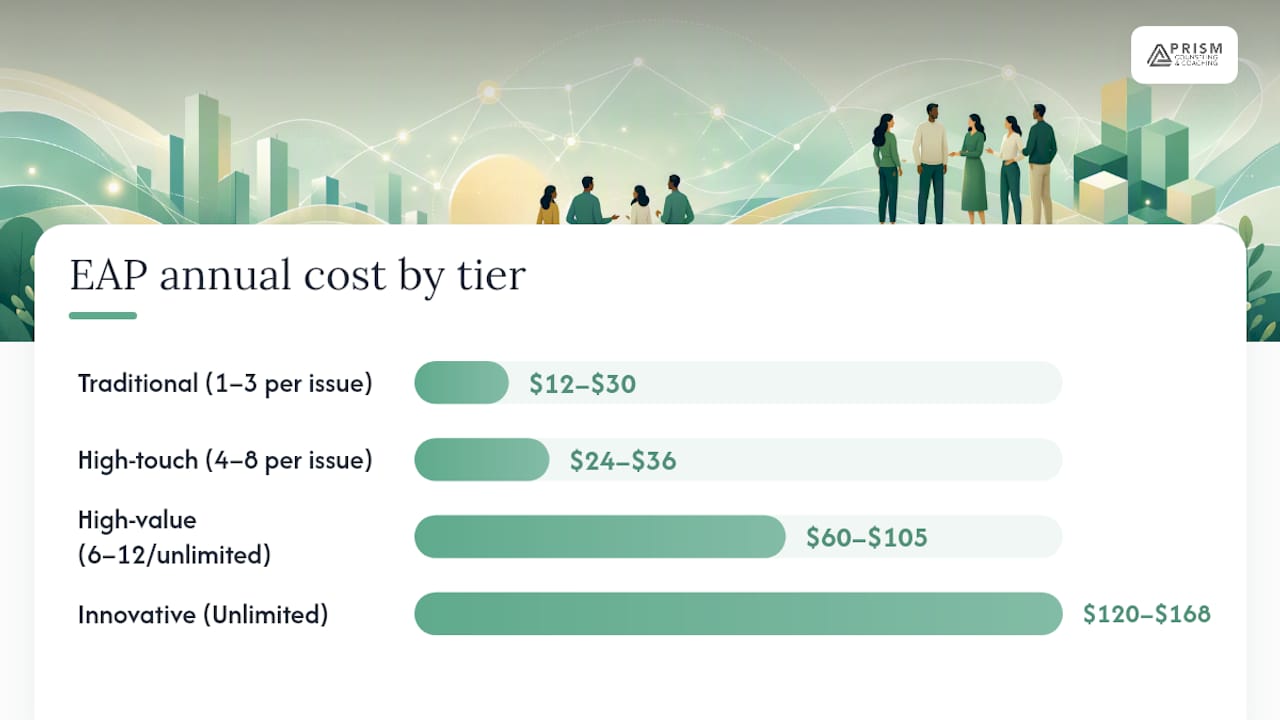
CareFirst's broker pricing shows many mid-size employer bands clustered in the $1.00–$2.00 PEPM range for standard programs, consistent with the traditional tier above.
Employer size effect: A 50-person employer may pay $3.00–$4.00 PEPM for a traditional program, while a 2,000-person employer accesses comparable services at $1.25–$1.75 PEPM. Volume discounts are real and negotiable, especially above 500 eligible employees.
Typical EAP utilization in the U.S. runs between 3% and 10% of eligible employees per year for traditional programs, with high-touch and innovative models often reaching 15–30%. At a modest utilization rate, a $2.00 PEPM program serving 500 employees results in a significant effective cost per served employee, which decreases with increased utilization even if the contract price remains unchanged.
Hidden costs and how to calculate real EAP value
The sticker PEPM is only part of the story. BambooHR's EAP guidance frames the "cost of inaction" as the more important number: untreated mental health conditions drive disability claims, absenteeism, presenteeism, and turnover, all of which carry costs that dwarf a well-utilized EAP.
A worked example for a 500-employee employer at $2.00 PEPM:
- Annual EAP spend: $12,000
- Utilization at 8%: 40 employees served
- Effective cost per served employee: $300
- Estimated avoided turnover (even one retained employee at median replacement cost of ~$15,000): net positive ROI in year one
Peer-reviewed research on EAP outcomes supports the link between EAP access and measurable improvements in workplace functioning, absenteeism, and presenteeism — reinforcing the case that utilization, not PEPM alone, determines whether the investment pays off (PubMed study on EAP outcomes).
Levers that increase value without increasing PEPM:
- Engagement campaigns: Regular, destigmatizing communications (not just an annual benefits email) consistently lift utilization.
- Manager training: Teaching managers to recognize distress and make warm referrals is the single highest-leverage utilization driver most employers underuse.
- Guaranteed access times: Shorter wait times correlate with higher follow-through after initial contact.
- Integrated care pathways: Programs that connect EAP sessions to ongoing therapy or medication management reduce the "cliff" employees fall off after their included sessions run out.
Employers should also budget for employee communications and manager training as line items separate from the PEPM contract. These investments, as BambooHR notes, are what actually move utilization and lower effective cost per outcome.
How to budget for an EAP and evaluate vendor quotes
A repeatable evaluation process protects you from comparing apples to oranges across vendor proposals. Group your vendor questions into these categories:
Pricing and scope:
- What is the PEPM, and what does it include exactly?
- Are dependents and household members covered, and at what additional cost?
- What sessions are included per issue, per year, per person?
- Are there any services (psychiatry, legal, financial counseling) that trigger additional fees?
Access and quality:
- What is the guaranteed time to first appointment?
- Is the provider network owned, curated, or broad-referral?
- What is the average-documented utilization rate among comparable employers?
Reporting and accountability:
- What utilization data do you receive, and how often?
- Can you see outcome metrics (symptom reduction, return-to-work rates)?
- Are reports included in the PEPM or priced separately?
Contract terms:
- What is the minimum contract length, and what are early-termination provisions?
- Are PEPM rates locked for the contract term or subject to annual increases?
- How is billing handled for new hires and terminations mid-month?
Red flags to watch for:
- Vague utilization reporting with no outcome data
- Guaranteed access times longer than 10 business days
- Unclear family member eligibility
- Paywalls for higher levels of care (e.g., psychiatry requires a separate contract)
- No documented utilization benchmarks from comparable employers
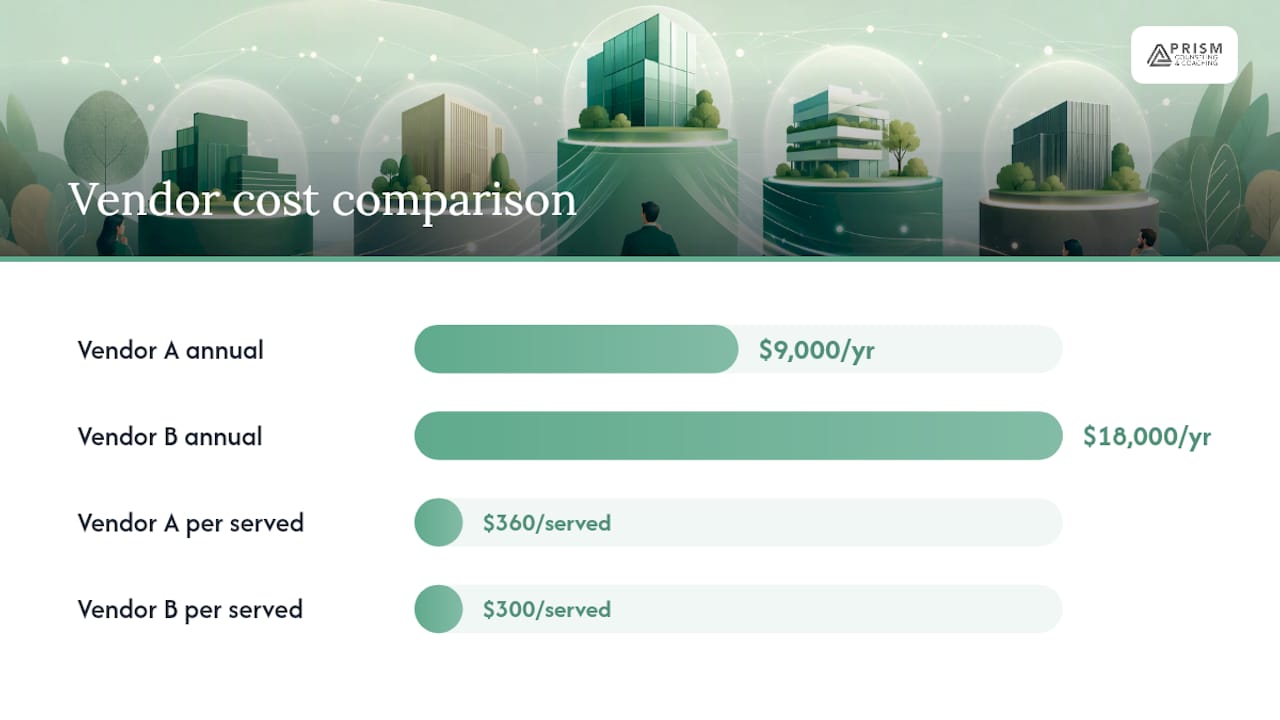
A quick apples-to-apples comparison: Vendor A quotes $1.50 PEPM with 3 sessions included and a 10-day access guarantee. Vendor B quotes $3.00 PEPM with 8 sessions and a 3-day guarantee. For a 500-employee employer, Vendor A costs $9,000/year and Vendor B costs $18,000/year. If Vendor B's faster access drives utilization from 5% to 12%, Vendor B serves 60 employees versus Vendor A's 25 — at an effective cost of $300 versus $360 per served employee. The higher PEPM delivers lower effective cost per outcome.
The SHRM EAP toolkit documents fixed-fee, fee-for-service, and consortia contract structures in detail and is worth reviewing before any RFP process.
Pro Tip: Request a sample utilization report from each vendor before signing. If a vendor cannot show you what their reporting looks like, that is a strong signal that accountability is not built into their model.
What to expect during onboarding and year one
Signing a contract is the beginning, not the end, of the procurement process. Most EAP implementations follow a predictable arc:
- Weeks 1–4: Contract execution, data handoff (eligible employee roster), and vendor system setup. Expect to provide census data and confirm dependent eligibility rules.
- Weeks 4–8: Employee communications launch. This is where most employers underinvest. A single benefits-enrollment email rarely moves utilization; plan for at least two to three touchpoints across channels.
- Weeks 6–12: Manager training rollout. Even a 60-minute virtual session on recognizing distress and making referrals meaningfully increases utilization in the first year.
- Months 3–6: Initial utilization ramp. Utilization is typically lowest in the first quarter and builds as awareness grows. Budget for this ramp rather than expecting full utilization from day one.
- Month 6: First vendor reporting cycle. Review utilization data, compare to benchmarks, and identify any access or awareness gaps before the year-end renewal window.
On the financial side, some vendors offer prorated billing for mid-year launches, and a few provide implementation credits for communication materials. Ask about both during contract negotiation. Multi-year contracts (two to three years) typically lock in PEPM rates and give you more leverage to negotiate access guarantees and reporting upgrades. Begin renewal conversations at least 90 days before contract expiration — that is when you have the most negotiating leverage.
Pro Tip: Build a 12-month communications calendar before the contract launches, not after. Employers who plan their engagement cadence in advance consistently outperform those who rely on the vendor's default outreach.
When a faith-based or niche EAP is the right fit for your organization
Not every workforce is best served by a generalist EAP. Faith-based and niche programs add measurable value in specific situations, and knowing when to consider them saves employers from paying for features their employees will not use.
Use cases where faith-integrated EAPs add real value:
- Faith-based employers (churches, Christian schools, faith-based nonprofits) whose employees specifically seek spiritually integrated care
- Organizations where a significant portion of the workforce identifies as religious and has expressed preference for faith-aligned counseling
- Employers who want to offer a culturally competent option alongside a generalist program
- Community partnerships where a local, relationship-based provider is preferred over a national call-center model
Evaluation criteria unique to niche EAPs:
- Does the program offer opt-in controls so employees who prefer secular counseling can access it without friction?
- How is religious integration handled — is it therapist-led, client-directed, or both?
- What is the provider's cultural competence across different faith traditions?
- Does the referral network include licensed clinicians with both clinical and theological training?
- How does the program handle employees who do not identify with the sponsoring faith tradition?
When presenting a faith-based EAP option in a diverse workforce, frame it as an additional resource rather than a replacement. Opt-in enrollment, rather than default enrollment, respects employee autonomy and tends to produce higher satisfaction among those who do choose it. For employers with a predominantly faith-identified workforce, default enrollment with a clear opt-out is often appropriate and increases utilization among the employees most likely to benefit.
Pro Tip: When evaluating a faith-based EAP, ask specifically whether counselors hold both clinical licensure (LPC, LCSW, or equivalent) and recognized theological training. Spiritual care without clinical grounding is pastoral support, not an EAP — and the distinction matters for compliance and outcomes.
What I've learned about EAP procurement that most guides skip
Most EAP procurement conversations get stuck on PEPM. That number is easy to compare, easy to put in a spreadsheet, and almost entirely the wrong thing to optimize for.
The employers who get the most from their EAP investment share one habit: they treat utilization as a program outcome they are responsible for, not a metric the vendor owns. A $1.50 PEPM contract that sits unused is not a budget win. It is a missed opportunity to reach employees who are quietly struggling with anxiety, grief, or workplace stress — the same struggles that, left unaddressed, show up later as turnover, disability claims, and lost productivity.
Access time is the variable that matters most and gets negotiated least. When an employee finally decides to ask for help, a 10-day wait is often long enough for that decision to reverse. Shorter guaranteed access times, even at a modestly higher PEPM, consistently produce better utilization and better outcomes. That is the trade-off worth making.
For faith-based employers and organizations in the Phoenix area, there is another dimension worth naming: spiritual care is not a soft add-on. For many employees, integrating their faith into the counseling process is the difference between engaging with support and avoiding it entirely. A program that honors that dimension, rather than treating it as irrelevant, reaches people that a generalist EAP simply will not.
Prism-counseling's faith-integrated EAP for Phoenix-area employers
For Phoenix-area employers who want an EAP that goes beyond a referral hotline, Prism-counseling offers a faith-integrated Employee Assistance Program built on over 14 years of clinical and spiritual care experience. Where national EAP vendors route employees to an anonymous call center, Prism-counseling connects them with licensed counselors who integrate spiritual care into evidence-based therapy — addressing anxiety, depression, grief, trauma, and workplace stress in a way that resonates with employees whose faith is central to how they process difficulty.
The model is private-pay and relationship-based, with openings typically available within days rather than weeks. For faith-based organizations, churches, and employers who want to offer spiritually integrated support as part of their benefits package, Prism-counseling's church and employer sponsorship program provides a clear path to contracting. Contact Prism-counseling directly to request a custom employer quote or a one-page pricing summary for your organization.
Primary sources and further reading
The benchmarks in this article were derived from a synthesis of peer-reviewed academic research, industry market analyses, broker pricing tables, and HR practitioner guidance. No single source covers the full range; the figures represent a cross-referenced consensus across the sources below.
- MT French et al. (1998) — peer-reviewed cost study, annual cost per eligible employee
- Oliver Wyman (April 2025) — tiered PEPM market analysis
- SHRM — Managing Employee Assistance Programs toolkit
- CareFirst broker pricing table — PEPM by employer size
- BambooHR — annual cost ranges and cost of inaction
- EAP ROI Guide — pricing model comparison
- Lyra Health — PEPM incentive critique and session counts
- PubMed — peer-reviewed EAP outcomes research
- Sonder — fixed-price vs. fee-for-service procurement guidance
Sources
- CareFirst specialty employee assistance pricing (broker PDF)
- 3 keys to unlocking value in an evolving EAP market (Oliver Wyman, April 2025)
- Managing Employee Assistance Programs: A Comprehensive Toolkit (SHRM)
- Everything You Need to Know About Employee Assistance Programs (BambooHR blog)
- EAP pricing models explained (EAP ROI Guide)
- PubMed: study on EAP outcomes
Recommended
- Prism Counseling & Coaching | Faith-Based Counseling and Spiritually-Integrated Therapy in Peoria and Phoenix AZ - Payment Options Blog
- Paying Privately - Prism Counseling & Coaching | Faith-Based Counseling and Spiritually-Integrated Therapy in Peoria and Phoenix AZ
- Church Sponsorship - Prism Counseling & Coaching | Faith-Based Counseling and Spiritually-Integrated Therapy in Peoria and Phoenix AZ
- Using Your HSA or FSA Card - Prism Counseling & Coaching | Faith-Based Counseling and Spiritually-Integrated Therapy in Peoria and Phoenix AZ