

If you want a Christian counselor who respects your faith and delivers clinically sound care, prioritize a state-licensed mental health clinician (LPC, LCSW, LMFT, or psychologist) who integrates Christian beliefs into evidence-based therapy. That combination matters more than any label on a directory listing.
Here's where to start today:
- Search a specialized Christian counseling directory or a mainstream platform with a faith filter.
- Ask your pastor, ministry leader, or church staff for a vetted referral.
- Book a free 15-minute consultation to confirm licensure and screen for genuine fit before you commit to a full session.
Key Takeaways
Finding the right Christian counselor requires verifying licensure first, then confirming genuine faith integration through direct questions during a free consultation.
| Point | Details |
|---|---|
| Prioritize licensure | Choose an LPC, LCSW, LMFT, or psychologist over an unlicensed coach for diagnosable concerns. |
| Use the free consult as an interview | Ask about faith integration, training, and referral practices before booking a full session. |
| Verify, don't assume | "Christian counselor" isn't a protected title, so confirm credentials directly with the state board. |
| Match format to the problem | Choose individual, couples, or group counseling based on where the issue actually lives. |
| Consider Prism Counseling & Coaching | A 14-plus-year Phoenix practice offering licensed, faith-integrated therapy with openings within days. |
Table of Contents
- Where to Find a Christian Therapist Near You
- How Do You Verify a Christian Counselor's Credentials?
- What Does Christian Counseling Cost, and Are There Free Options?
- What Happens in Your First Christian Counseling Session?
- Pastoral Care, Biblical Counseling, or Licensed Therapy: Which Do You Need?
- How Prism Counseling & Coaching Supports Your Search
- Does the Counselor's Theology Actually Match Yours?
- Warning Signs of a Poor Fit or Unqualified Counselor
- Individual, Couples, or Group Christian Counseling: How Do You Choose?
- What This Guide Gets Right About Christian Counseling
- Start Your Search With a Real Consultation
- Useful Resources for Verifying a Christian Counselor
- Sources
Where to Find a Christian Therapist Near You
Specialized directories built for faith-based care are often the fastest starting point. Sites built specifically for finding a Christian therapist let you filter by state, specialty, and denomination, though you still have to confirm the license yourself before booking anything.
Mainstream platforms have caught up here too. Directories like Psychology Today and Alma now include faith filters alongside insurance and specialty options, which means you can cross-reference "accepts my insurance" with "identifies as Christian" in a single search. That overlap matters if cost is a factor, since not every faith-integrated clinician takes insurance.
Church networks remain one of the most reliable channels, even in an app-driven search process. Here's a practical sequence to follow:
- Ask your pastor or a trusted ministry leader for names they've referred before, and ask specifically why.
- Check whether your church or a nearby seminary runs a counseling clinic. Many seminaries staff supervised clinics at reduced rates.
- Call a ministry referral network. Focus on the Family maintains a vetted referral network and offers a one-time phone consultation to point you toward licensed, faith-aligned clinicians.
- Search directories using specific phrases: "Christian counselor near me," your city plus "faith-based therapist," or "Christian counseling telehealth" options if you want remote sessions.
- Scan every profile for four things before reaching out: license type, listed specialties, telehealth availability, and whether a free consultation is offered.
Pro Tip: Don't stop at the first listing that says "Christian" in the bio. Open the license verification link on the profile itself, or search your state licensing board directly, before you request that first call.
How Do You Verify a Christian Counselor's Credentials?
The word "Christian counselor" isn't a protected credential. It's a self-description, which means the training behind it can range from a graduate degree in clinical psychology to a weekend certificate program. Practitioners consistently advise clients to review actual credentials rather than trust the label alone.
Four licenses indicate real clinical training and state oversight:
- LPC (Licensed Professional Counselor): master's-level training plus supervised clinical hours.
- LCSW (Licensed Clinical Social Worker): clinical social work training with a focus on systems and family dynamics.
- LMFT (Licensed Marriage and Family Therapist): specialized training in relational and family treatment.
- Psychologist (PhD or PsyD): doctoral-level training, often including assessment and testing.
For anything diagnosable, whether that's depression, an anxiety disorder, or trauma, the safer path is a licensed clinician rather than an unlicensed coach, no matter how warm or spiritually fluent that coach sounds. Clinically sound care depends on licensure, not just good intentions, and pastoral counseling, while valuable, doesn't carry the same standardized training.
Watch for these warning signs during your search: no license number listed anywhere, vague phrases like "certified Christian counselor" with no accrediting body named, or pressure to avoid medication even when a licensed prescriber has recommended it.
Bring these four questions into your first call:
- "Are you licensed to practice in my state, and what's your license number?"
- "How does your Christian faith shape your clinical approach?"
- "What specific training do you have for my situation?"
- "If medication or a referral becomes appropriate, how would you coordinate that?"
What Does Christian Counseling Cost, and Are There Free Options?
Cost is often the deciding factor, so ask about it plainly during your first contact rather than waiting for an invoice to surprise you. Private-pay counselors set their own rates and typically bill per session, while insurance-based providers work within a negotiated rate tied to your plan, sometimes with a smaller copay but a longer wait for an opening.
Before you commit, ask two questions: what's the per-session rate, and does that rate change if a claim gets denied?
- Use the free 15-minute consultation that most Christian counselors offer to ask about cost, sliding-scale availability, and what a typical treatment length looks like for your concern.
- Ask about sliding-scale fees, which many private-pay practices offer based on income.
- Check community mental health centers and seminary training clinics, which often charge reduced rates because sessions are supervised.
- Call a ministry helpline or use SAMHSA's treatment locator if you need a bridge option while you keep searching for the right long-term fit.
Nobody should skip care because the first quote felt out of reach. Ask about the sliding scale before you assume there isn't one.
What Happens in Your First Christian Counseling Session?
Your first session isn't a leap of faith, it's an assessment. Most licensed clinicians follow a similar early structure:
- A history-taking conversation covering your concern, background, and what brought you in.
- A safety and crisis screen, standard practice regardless of faith background.
- Goal-setting, where you and the counselor name what progress would look like.
- An initial treatment plan, often built around an evidence-based method.
Methods like Cognitive Behavioral Therapy (CBT) and EMDR are common foundations, and a licensed clinician can layer prayer or Scripture into that framework without replacing the clinical method itself. If your counselor identifies something beyond their scope, a specific phobia requiring specialized exposure work, or a symptom pattern suggesting a medication evaluation, they should say so and offer a referral rather than push forward alone.
You're also allowed to set boundaries. If you want less prayer time and more skill-building, or vice versa, say so in the first or second session. A good clinician adjusts.
Pastoral Care, Biblical Counseling, or Licensed Therapy: Which Do You Need?
These three paths get lumped together, but they solve different problems. Pastoral counseling is clergy-led, usually short-term, and centered on spiritual support or discipleship, not clinical diagnosis. Biblical counseling emphasizes Scripture as the primary counseling framework, often through a church or parachurch ministry, with training that varies widely and no universal licensure requirement.
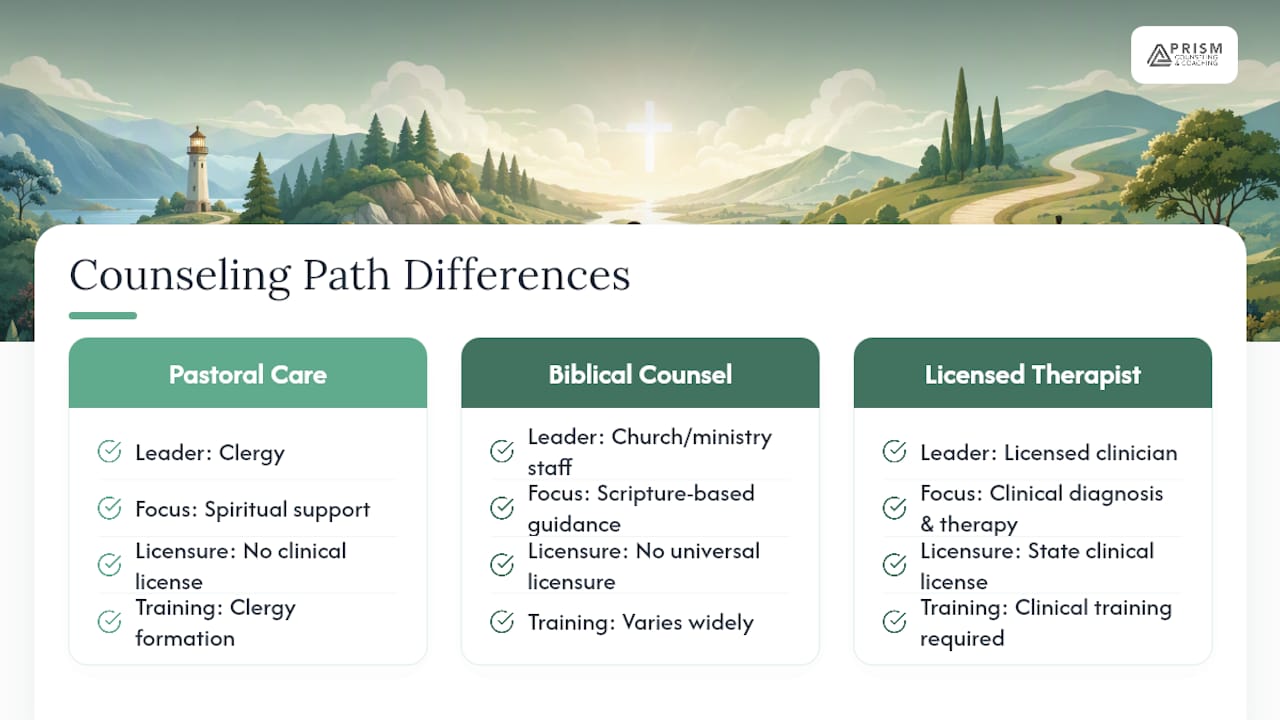
Licensed Christian counseling is different: a clinician with a state license and clinical training who integrates faith at the client's request. If you're facing a diagnosable condition, a long-standing depression, trauma symptoms, or a marriage in genuine crisis, a licensed clinician is the safer primary choice. Pastoral care works well alongside that, for discipleship or spiritual encouragement, but it shouldn't stand in as your only support for a clinical issue. With your consent, a good therapist can coordinate with your pastor so both forms of care point the same direction.
How Prism Counseling & Coaching Supports Your Search
Prism Counseling & Coaching has spent more than 14 years specializing in faith-integrated therapy for individuals, couples, and families across the Phoenix area, including Christian counseling for anxiety, depression, trauma, and relationship strain. Because the practice runs on a small, private-pay model, clients often get openings within days instead of the weeks-long waitlists common with insurance-based clinics.
- Licensed clinicians who integrate Christian faith into evidence-based treatment, not unlicensed coaching.
- Individual, couples, and online counseling options for clients across the Phoenix area.
- The Ask a Christian Counselor Podcast and a growing resource library that reflect the practice's ongoing clinical and theological grounding.
[author_bio] [brand_signal]
Pro Tip: Use your free consultation call to ask Prism the same four vetting questions listed earlier in this guide. A confident, specific answer to "how does your faith shape your clinical approach" tells you more than any bio paragraph.
Does the Counselor's Theology Actually Match Yours?
Ask about denominational background early, not because doctrine needs to match perfectly, but because it shapes how a counselor talks about sin, forgiveness, suffering, and family roles. A counselor from a strict complementarian tradition and one from a more egalitarian tradition can both be excellent clinicians, yet they may frame a marriage conflict very differently.

A few direct questions surface this quickly: "What's your denominational background, and how might that shape our sessions?" "How do you handle it if my convictions differ from yours on a specific issue?" "Would you push a particular theological position, or follow my lead?"
You're not looking for a rubber stamp of agreement. You're looking for a counselor who can hold their own convictions while genuinely respecting yours, especially on the topics where Christians disagree in good faith: parenting philosophy, gender roles, or how directly Scripture should be quoted in session. If a counselor seems unable to separate their personal theological stance from your treatment goals, that's worth naming out loud before you continue. A brief mismatch on a minor point is normal. A pattern of steering every session toward their doctrinal preference is not.
Warning Signs of a Poor Fit or Unqualified Counselor
Trust your discomfort. If something feels off in the first session or two, it usually is. A few specific signals are worth taking seriously rather than explaining away.
- No verifiable license number, or a license that doesn't match the state you're sitting in.
- Scripture or prayer used to shut down a difficult emotion rather than explore it.
- Pressure to stop prescribed medication without involving your prescriber.
- Vague answers when you ask about training for your specific concern.
- A counselor who talks more than they listen, or who seems to have a fixed script for every client.
- Discomfort or defensiveness when you ask direct questions about credentials or approach.
None of these automatically means the counselor is unsafe, but a cluster of them is a real signal to look elsewhere. A licensed clinician should welcome your questions about their training. Someone who bristles at "can you tell me about your clinical background" is telling you something important before you've even started treatment.
Individual, Couples, or Group Christian Counseling: How Do You Choose?
The format should follow the problem, not the other way around. Individual counseling fits best when the issue is primarily internal, anxiety, depression, grief, a personal trauma history, or a season of vocational uncertainty. You need space to process without managing someone else's reaction in the room.
Couples counseling makes sense when the presenting problem lives in the relationship itself: communication breakdown, trust repair after betrayal, or premarital preparation before a wedding. A counselor trained in couples work uses different tools than individual therapy, structured communication exercises, conflict de-escalation techniques, so ask specifically whether your prospective counselor has that training rather than assuming individual therapy skills transfer automatically.
Group counseling works well for shared-experience issues: grief support, recovery from addiction, or a men's or women's group processing a common season of life. The format offers something individual sessions can't, the felt sense that you're not the only one carrying a particular struggle. If you're unsure which format fits, say so on your consultation call. A good counselor will ask enough questions to steer you toward the right structure rather than defaulting to whatever they happen to offer.
What This Guide Gets Right About Christian Counseling
The conventional advice on this topic tends to treat "find a Christian counselor" as a directory problem, plug in a search term, pick a friendly-looking profile, done. That undersells what's actually at stake. The real work is verification: confirming a license, asking pointed questions about training, and testing whether faith integration is substantive or just a marketing word on a homepage.
What gets overlooked most often is how much the free consultation can reveal if you actually use it as an interview instead of a formality. Most people spend those 15 minutes being polite. Spend them asking the four questions in this guide instead. A confident, specific answer about training and faith integration tells you more in one call than a week of reading bios.
Prioritize the license first, the faith fit second, not because faith doesn't matter, but because clinical competence is what keeps faith integration from becoming a substitute for real treatment. A licensed clinician who genuinely understands your convictions, like the approach Prism Counseling & Coaching takes, gives you both pieces at once instead of forcing a tradeoff.
— Tres
Start Your Search With a Real Consultation
Prism Counseling & Coaching gives Phoenix-area clients something most insurance-based practices can't: an opening within days, not weeks, because the practice runs on a small, private-pay model instead of a packed insurance panel. That matters when you're dealing with anxiety, depression, grief, or a relationship crisis right now, not whenever a waitlist clears.
If you've read this far because you want a licensed clinician who takes your faith seriously without sacrificing clinical rigor, that's exactly the model Prism was built around. The practice serves individuals, couples, and families across Phoenix, with options for online counseling if in-person visits aren't practical for your schedule. Reach out to schedule your free introductory consultation and ask the vetting questions from this guide directly, including how faith shapes the clinical approach and what training applies to your specific concern. Visit the Christian counseling page to see current openings and request your first session.
Useful Resources for Verifying a Christian Counselor
- SAMHSA's treatment locator for licensed services and crisis support.
- Focus on the Family's referral network for vetted, faith-aligned clinicians.
- Psychology.com's overview of Christian counseling for a clinical primer.
This article is general information, not a substitute for advice from a qualified doctor. Consult a qualified healthcare professional about your own circumstances before acting on anything here.
Sources
- Difference between pastoral care and counseling | Calvin Seminary
- Christian Counselor Directory - Find a Therapist
- How to find a Christian counselor | Focus on the Family
Recommended
- Find - Prism Counseling & Coaching | Faith-Based Counseling and Spiritually-Integrated Therapy in Peoria and Phoenix AZ
- Signs You Are Called to Christian Counseilng - Prism Counseling & Coaching | Faith-Based Counseling and Spiritually-Integrated Therapy in Peoria and Phoenix AZ
- Ask a Christian Counselor Podcast - Prism Counseling & Coaching | Faith-Based Counseling and Spiritually-Integrated Therapy in Peoria and Phoenix AZ