

Interfaith marriage counseling helps couples build a shared, workable life that honors both partners' faith identities while resolving the practical conflicts that spiritual differences create. If you and your partner are navigating different religious backgrounds, the most useful next step is scheduling a consultation with a faith-competent therapist who can hold both traditions with equal respect.
Here is what to bring to that first conversation:
- The specific decisions causing friction right now (wedding officiant, children's religious education, holiday observances)
- Any unspoken hopes or fears about your partner's faith changing over time
- Questions about how the therapist handles religious neutrality
Most couples leave the first three sessions with a clearer map of their nonnegotiables, a shared vocabulary for faith conversations, and at least one practical agreement about a recurring conflict.
Key Takeaways
Couple consensus on spiritual matters, not individual religiosity alone, predicts relationship functioning, which means the goal of interfaith counseling is shared understanding, not theological agreement.
| Point | Details |
|---|---|
| Counseling goal | Build a shared meaning system and practical agreements, not resolve theological differences. |
| When to seek help | Seek counseling before wedding planning, child-rearing decisions, or holiday conflicts become entrenched patterns. |
| Therapist selection | Prioritize religious neutrality, cultural competence, and a strong therapeutic alliance over any specific modality. |
| Between-session tools | Use structured listening, curiosity questions, and a household ritual map to reduce conflict between appointments. |
| Prism-counseling | Offers faith-integrated couples counseling and premarital support in Phoenix, with private-pay confidentiality and telehealth availability. |
Table of Contents
- What is interfaith marriage counseling, really?
- Why do interfaith couples seek counseling?
- What actually happens in interfaith counseling sessions?
- Does interfaith counseling actually work?
- How do you choose the right counselor for an interfaith marriage?
- Practical strategies to use between sessions
- What does interfaith counseling cost, and how long does it take?
- Why cultural competence goes beyond religion
- How religious holidays and daily practices affect your relationship
- How extended family and community pressure shape interfaith marriages
- Legal considerations for interfaith marriages in the U.S.
- Resources for interfaith couples beyond counseling
- What we see most often with interfaith couples
- Prism-counseling offers faith-integrated couples support in Phoenix
- Sources
What is interfaith marriage counseling, really?
Interfaith marriage counseling is couples therapy that addresses the relational strain created by religious and spiritual differences, alongside the everyday relationship issues those differences generate. A licensed therapist, typically an LMFT (Licensed Marriage and Family Therapist) or LPC (Licensed Professional Counselor) with training in faith-sensitive practice, helps both partners understand each other's spiritual worlds without requiring either person to abandon their beliefs.
What it is not: it is not religious instruction, not a conversion effort, and not a clergy-led intervention unless both partners specifically request a pastoral element. The therapist's role is to create a neutral, structured space where both traditions are treated with equal dignity. According to TherapyExplained, the goal is moving couples from avoidance to genuine understanding, and from vague tension to practical agreements.
The core goals are concrete: build a shared meaning system, set healthy limits with extended family, and plan parenting and holiday practices before they become flashpoints.
Pro Tip: When you call to schedule your first session, say something like: "We're an interfaith couple and we want a therapist who can hold both of our traditions with equal respect." That one sentence screens for religious neutrality before you ever sit down.
Why do interfaith couples seek counseling?
The triggers are often practical before they are theological. A national study by Prepare/Enrich found that most couples report unresolved spiritual differences, and over one-third said those differences caused direct tension in their relationships, affecting parenting, finances, and social circles. The conflict rarely starts with doctrine. It starts with whose family's Christmas traditions you follow, or whether your child gets baptized.
Common reasons couples seek mixed faith marriage counseling include:
- Wedding planning: disagreements about officiant choice, ceremony content, or whether to have a religious ceremony at all
- Child-rearing: which faith (if any) to raise children in, religious education, and rites of passage like baptism or bar/bat mitzvah
- Holiday and ritual clashes: navigating two sets of sacred observances in one household
- In-law and community pressure: family members who view the marriage as a threat to religious identity or heritage
- One partner's faith shift: deconversion, reconstruction, or a deepening of faith that changes the relational dynamic
Beneath these visible triggers, there are often hidden drivers. Academic research links theological disparity in marriages to more frequent conflicts over household labor and financial decisions, suggesting that many "religious" arguments actually reflect deeper unmet needs around autonomy, belonging, or security. A couple fighting about whether to attend Christmas Eve Mass may really be negotiating whose family of origin gets priority.
What actually happens in interfaith counseling sessions?
Most therapists working with interreligious relationship counseling draw from several evidence-based modalities. The Gottman Method is widely used because its "shared meaning" framework maps directly onto the interfaith challenge: couples identify the rituals, roles, and values that give their relationship meaning, then negotiate where those overlap and where they differ. Emotionally Focused Therapy (EFT) helps partners understand the attachment fears underneath faith conflicts. Imago dialogue gives couples a structured way to speak and listen without triggering defensiveness.
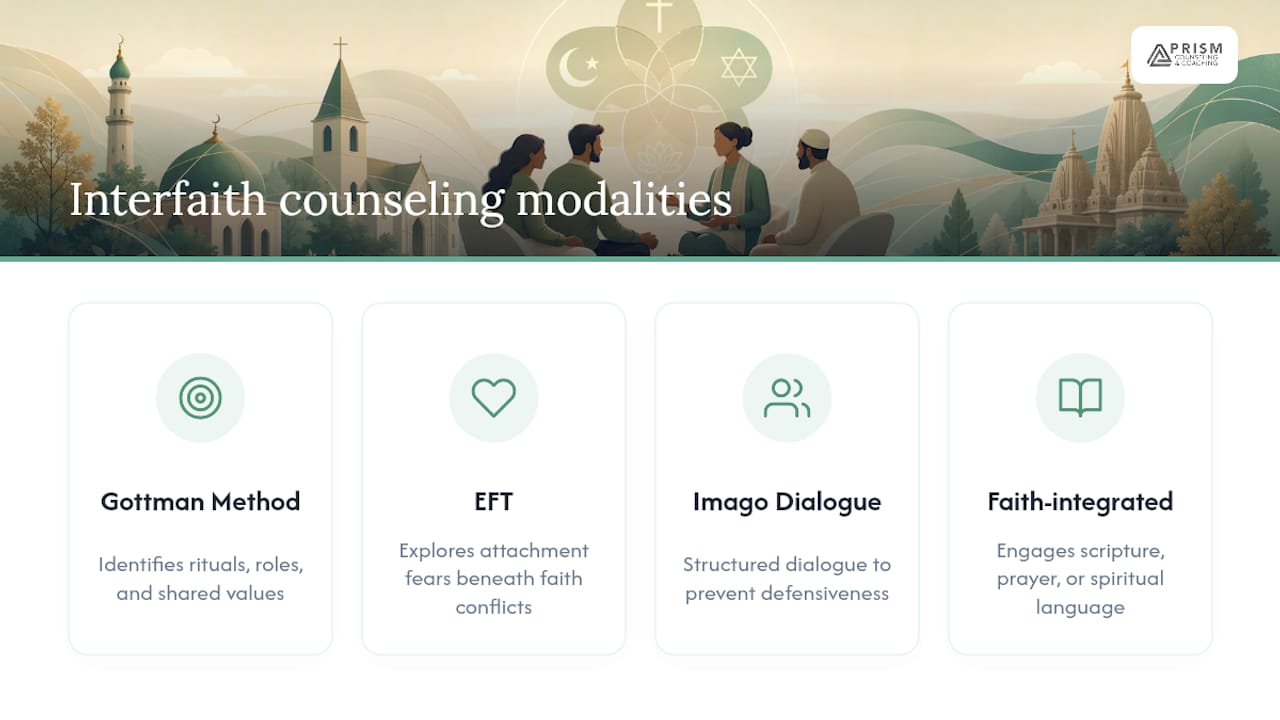
Faith-integrated therapy adds another layer. A therapist trained in this approach can engage with spiritual language, scripture, or prayer as therapeutic tools if both partners find that helpful, without imposing any tradition's framework.
A typical session arc looks like this: the therapist first assesses each partner's faith history and what their tradition means to them personally. From there, sessions move quickly to practical territory, because focusing on theological debate tends to entrench positions rather than build connection.
Premarital counseling for interfaith couples differs from ongoing therapy in scope. It is time-limited (often 6–10 sessions), structured around specific decisions, and designed to surface issues before family pressure compounds them. Ongoing couples therapy is more open-ended and addresses patterns as they emerge.
Does interfaith counseling actually work?
The evidence is encouraging, with some important nuance. Pew Research Center data shows that religion shapes marriage and family decisions in measurable ways across U.S. households, and that couples who share religious practices report higher relationship satisfaction. That context matters: it tells us spiritual alignment is not trivial, but it also tells us that couples who actively negotiate shared practices can close that gap.
The Prepare/Enrich research makes a clinically important point: couple consensus on spiritual matters predicts relationship functioning more strongly than individual religiosity alone. In other words, it is not whether you are religious, but whether you and your partner have worked out a shared understanding that matters most.
Premarital counseling, specifically, is a high-leverage intervention. The Gottman Institute notes that premarital counseling is especially effective at surfacing faith-related issues before they become urgent, giving couples practical agreements before family pressure and life transitions amplify the stakes.
The strongest predictor of success in any couples therapy, including cross-cultural marriage therapy, is the therapeutic alliance: the quality of trust and collaboration between the couple and their therapist. A therapist who is neutral, culturally competent, and genuinely curious about both partners' traditions outperforms any specific technique.
How do you choose the right counselor for an interfaith marriage?
The therapist's religious neutrality is not optional. Here is a practical framework for evaluating candidates:
Must-have qualities:
- Training in couples therapy (LMFT, LPC, or equivalent credential with couples specialization)
- Demonstrated comfort with faith and spirituality as therapeutic topics
- Clear neutrality: no agenda to favor, minimize, or resolve one tradition over another
- Cultural competence that extends beyond religion to ethnicity, family structure, and community context
Questions to ask in an initial consult:
- "Have you worked with couples from different religious backgrounds? What does that work look like?"
- "How do you handle it if one partner wants to incorporate prayer or scripture and the other doesn't?"
- "What's your approach to confidentiality, especially if one of us has a relationship with a clergy member you know?"
- "Can you walk me through what a typical session looks like in the first month?"
Red flags to watch for:
- The therapist suggests that one partner's faith is the source of the problem
- They push toward conversion or suggest that one tradition is more compatible with healthy relationships
- They seem uncomfortable when faith comes up or change the subject quickly
- They have no clear answer about how they handle religious differences
The PMC research on therapeutic alliance supports therapist neutrality and cultural competence as central to success with mixed-faith couples. If the fit feels off after two sessions, it is reasonable to say so and look for a better match.
Practical strategies to use between sessions
You do not have to wait for a therapist to start making progress. These tools work before your first appointment and between sessions.
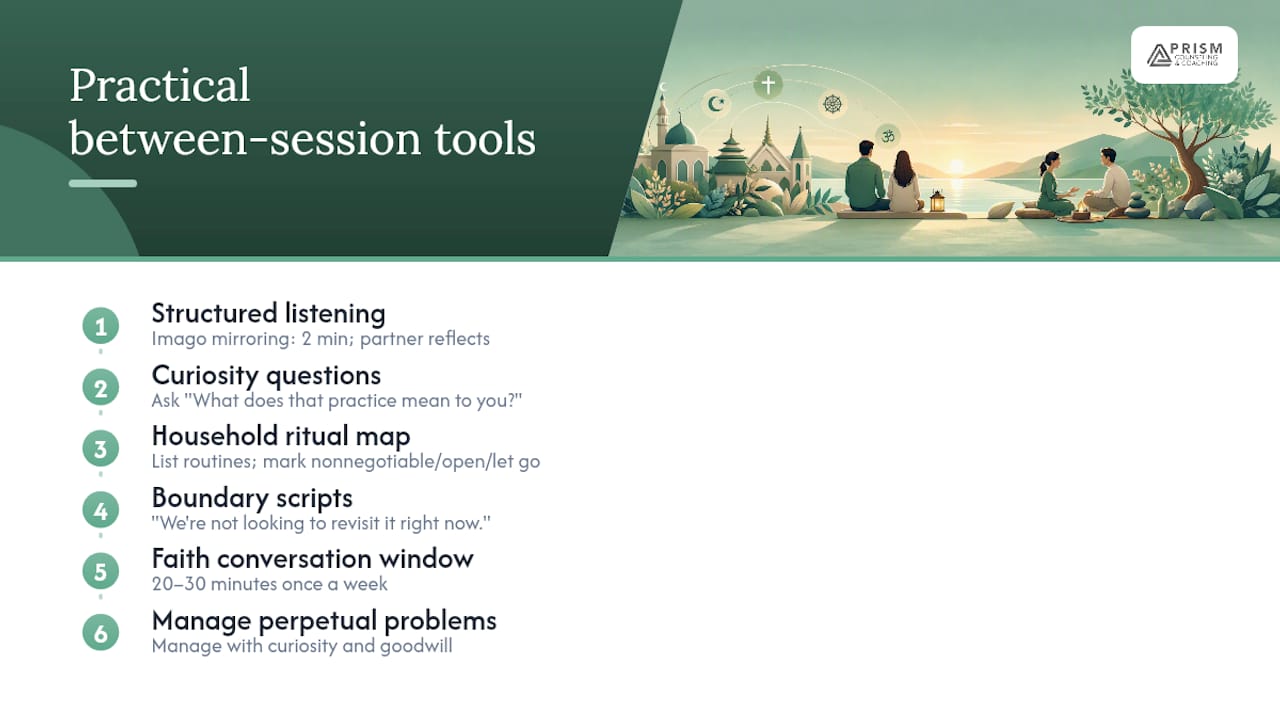
Structured listening: Borrow the Imago mirroring format. One partner speaks for two minutes about a faith-related concern. The other reflects back what they heard, word for word, without rebuttal. Then ask: "Is there more?" This simple structure interrupts the defensive cycle most interfaith arguments fall into.
Curiosity questions: Replace "Why do you believe that?" (which sounds like a challenge) with "What does that practice mean to you?" or "What would it feel like if we didn't do that?" Curiosity opens; interrogation closes.
A household ritual map: Sit down together and list every recurring practice in your home, from Sunday morning routines to holiday traditions. Mark each one as "nonnegotiable for me," "open for discussion," or "I could let this go." The map makes invisible expectations visible before they become arguments.
Boundary scripts with family: When extended family applies pressure, a simple script helps: "We've talked about this together and we've made a decision we're both comfortable with. We're not looking to revisit it right now." Calm, united, and brief.
Pro Tip: Set a "faith conversation window" of 20–30 minutes once a week, separate from daily life. Knowing there is a dedicated time for these topics reduces the anxiety that the conversation might ambush you at dinner.
Utah State University's practitioner guidance notes that many religious differences in marriage are perpetual problems, meaning they will not be "solved" but can be managed with curiosity and goodwill rather than avoidance.
What does interfaith counseling cost, and how long does it take?
Typical timeline:
- Premarital counseling: 6–10 sessions over 2–3 months, focused on specific decisions and agreements
- Ongoing couples therapy: 3–6 months for most presenting concerns, with some couples continuing longer for deeper relational work
- Session frequency: weekly to start, shifting to biweekly as progress stabilizes
U.S. cost ranges (private-pay):
- Couples therapy sessions typically run $150–$250 per session in most U.S. markets, with higher rates in major metro areas
- Telehealth sessions are often priced comparably to in-person, and many states now require insurance parity for telehealth
- Sliding scale options are available at many practices for couples who qualify
Insurance considerations:
- Most insurance plans do not cover couples therapy directly; they may cover individual sessions if one partner has a diagnosable condition
- Private-pay therapy preserves confidentiality more fully, since no diagnosis is required for billing
- For faith-integrated therapy specifically, private-pay often gives you access to a wider pool of spiritually trained therapists who do not accept insurance
Telehealth advantage: If you live in an area without a local therapist trained in blended faith marriage support, telehealth opens access to specialists across your state. Many interfaith couples find it easier to attend sessions consistently when they do not have to coordinate travel.
Why cultural competence goes beyond religion
Religious identity and cultural identity are not the same thing, and a skilled therapist knows the difference. An interfaith couple where one partner is Jewish and the other is Catholic is navigating theology, yes, but also family systems, ethnic identity, historical memory, and community belonging. A Hindu-Christian couple may be managing immigration history, caste expectations, and language alongside doctrinal differences.
Cultural competence in counseling means the therapist can hold all of those layers without collapsing them into a single "religion problem." It means understanding that a partner's insistence on a particular holiday practice may be about grief for a lost homeland as much as it is about faith. It means recognizing that pressure from a partner's family is shaped by cultural survival instincts, not just religious zeal.
Couples therapy for diverse faiths works best when the therapist asks about cultural background explicitly, not just religious affiliation, and treats each partner as an expert on their own tradition.
How religious holidays and daily practices affect your relationship
Holidays are the most visible friction point, but the daily texture of religious life creates just as much strain. Morning prayer, dietary restrictions, Sabbath observance, fasting seasons, and weekly worship attendance all shape the rhythm of a household. When those rhythms differ, small daily negotiations accumulate into resentment if they are never named.
The holiday calendar compounds this. Thanksgiving, Christmas, Hanukkah, Eid, Diwali, Passover, and Easter can all fall within weeks of each other, and each carries family expectations, travel obligations, and emotional weight. Couples who have not made explicit agreements about how to handle these seasons often find themselves in the same argument every year.
The most effective approach is to treat the holiday calendar as a shared planning document, not a battleground. Decide in advance which celebrations you will attend together, which you will each observe separately, and which you will create new shared versions of. That decision, made calmly in a counseling session or at home, prevents the annual ambush.
How extended family and community pressure shape interfaith marriages
Extended family is often the loudest voice in an interfaith marriage, and it rarely speaks with one tone. One family may grieve the loss of religious continuity. Another may worry about grandchildren's spiritual formation. A faith community may apply social pressure through subtle exclusion or direct confrontation.
These pressures are real, and they deserve to be named in counseling rather than minimized. A therapist working with interfaith couples helps partners develop a united front: agreeing on what information to share with family, how to respond to religious pressure, and where to draw limits around holiday decisions and child-rearing.
The 18Doors practitioner resource notes that counselors working with interfaith couples focus on building referral connections and educational resources for navigating community relationships, rather than trying to resolve the community's concerns on the couple's behalf. The couple's relationship is the client, not the extended family system.
Legal considerations for interfaith marriages in the U.S.
In the United States, marriage is a civil contract governed by state law, and no state requires couples to share a religious affiliation to marry. A marriage license is issued by the county clerk's office in the state where the ceremony takes place, and the requirements (age, identification, waiting periods) vary by state but do not include religious criteria.
Officiant requirements do vary. Most states allow ordained ministers, civil officiants (judges, justices of the peace), and in some states, friends or family members who obtain online ordination. If you want a religious ceremony that is also legally binding, the officiant must be authorized under your state's law. Some interfaith couples choose a civil ceremony for legal purposes and a separate blessing ceremony with clergy from one or both traditions.
One practical note: if one partner's faith tradition does not recognize civil marriage as valid without a religious ceremony, that can create tension around the legal versus spiritual dimensions of the marriage. A counselor can help you work through what each ceremony means to each of you before the wedding, not after.
Resources for interfaith couples beyond counseling
Counseling is the most direct path to personalized support, but several other resources offer meaningful help:
Books: Celebrating Your New Jewish Daughter by Debra Nussbaum Cohen, The Interfaith Family Guidebook by Joan Hawxhurst, and Mixed Blessings by Paul Cowan and Rachel Cowan are widely recommended by practitioners working with interfaith couples.
Online communities: InterfaithFamily.com (now part of 18Doors) and the Interfaith Families Project offer forums, articles, and local group connections for couples navigating blended faith marriage support.
Support groups: Many cities have interfaith family groups connected to synagogues, Unitarian Universalist congregations, or community centers. These groups normalize the experience and reduce isolation.
Podcasts and articles: Prism-counseling's Christian counseling resources hub includes articles, videos, and podcast content on faith-integrated relationships, spiritual transitions, and couples communication, useful for couples who want to read alongside their counseling work.
Assessment tools: The Prepare/Enrich inventory, used by many premarital counselors, includes a spiritual beliefs module that maps couple consensus on faith issues. Ask your therapist whether they use it.
What we see most often with interfaith couples
One pattern shows up in session after session: what looks like a fight about religion is almost always a fight about being known and respected. A partner who insists on attending Christmas Eve Mass is not necessarily trying to impose their faith. They are often asking, "Does the person I married care about what matters most to me?"
We call this "spiritual leakage," the way unspoken expectations about a partner's eventual faith shift seep into daily interactions as resentment, withdrawal, or low-grade conflict. One partner quietly hopes the other will come around. The other senses the hope and feels pressure they never agreed to. Neither names it. The resentment grows. This is one of the most common and most treatable patterns we see.
The work at Prism-counseling is not to resolve theological differences. It is to help couples build a shared meaning system that both partners can live inside with integrity. That means validating each person's beliefs without requiring agreement, naming the unspoken expectations before they calcify, and building practical agreements about the household decisions that faith touches every week.
Couples who do this work often describe a shift: from feeling like their faith is a problem in the marriage to feeling like it is a part of who they are that their partner genuinely sees. That shift is possible. We have watched it happen many times.
Prism-counseling offers faith-integrated couples support in Phoenix
Navigating spiritual differences in marriage is genuinely hard, and generic couples therapy often misses the specific weight of faith-related conflict. Prism-counseling brings over 14 years of experience in faith-integrated counseling to interfaith couples in the Phoenix and Peoria area, with a private-pay model that means no insurance delays, no required diagnosis, and appointments available within days.
For interfaith couples specifically, Prism-counseling offers premarital counseling structured around the decisions that matter most before the wedding, and ongoing couples counseling for partners navigating faith differences at any stage of marriage. Telehealth sessions are available for couples who prefer to meet from home or who are outside the immediate Phoenix area. The private-pay structure also preserves full confidentiality, which matters when faith and family are both in the room.
To schedule an initial consultation, visit the Prism-counseling booking page and come prepared with your top two or three concerns. The first session is a conversation, not a commitment, and it is the clearest way to find out whether this is the right fit for both of you.
Sources
- Spiritual Beliefs and Marriage (Prepare/Enrich PDF)
- The Gottman Institute
- PMC article on couples therapy and therapeutic processes
- Religion in marriages and families (Pew Research Center)
- Interfaith Couples Counseling: Navigating Faith Differences | TherapyExplained
This article is general information, not a substitute for advice from a qualified doctor. Consult a qualified healthcare professional about your own circumstances before acting on anything here.
Recommended
- Christian Marriage Counseling in Peoria, Arizona - Prism Counseling & Coaching | Faith-Based Counseling and Spiritually-Integrated Therapy in Peoria and Phoenix AZ
- Church Sponsorship - Prism Counseling & Coaching | Faith-Based Counseling and Spiritually-Integrated Therapy in Peoria and Phoenix AZ
- Prism Counseling & Coaching | Faith-Based Counseling and Spiritually-Integrated Therapy in Peoria and Phoenix AZ - Prism Counseling & Coaching | Arizona Christian Counseling and Spiritually-Integrated Therapy in Peoria and Phoenix
- Prism Counseling & Coaching | Faith-Based Counseling and Spiritually-Integrated Therapy in Peoria and Phoenix AZ - Prism Counseling & Coaching | Arizona Christian Counseling and Spiritually-Integrated Therapy in Peoria and Phoenix