
Yes. Prayer can interrupt a panic attack the moment it starts, especially when you pair a short, spoken prayer with slow, extended-exhale breathing and a grounding step like naming five things you see. A PCORI-funded study found meditative practices worked as well as standard approaches for many people with anxiety, which is encouraging, but prayer works best as an anchor, not a replacement for care from a faith-based counseling practice if attacks keep coming back or start controlling your life.
TL;DR:
- Short prayers paired with extended exhale breathing can effectively interrupt a panic attack by calming both the mind and body.
- Preparing and practicing a specific prayer and verse ahead of time increases the likelihood of using it successfully during an attack.
- Combining prayer with grounding techniques, like the 5-4-3-2-1 method, helps manage symptoms within the typical ten-minute peak of a panic attack.
- Faith-based counseling that integrates scripture, prayer, and evidence-based therapies offers ongoing support beyond immediate prayer techniques.
- Recognizing emotional shame and spiritual doubts is vital for lasting healing, with distress acknowledged as a human experience demonstrated by biblical figures like Jesus.
Table of Contents
- Short Prayers and Scriptures to Pray During a Panic Attack
- How to Pair Breathing and Grounding With Prayer
- How Do You Build a Panic Prayer Plan Before You Need One?
- When Should You Seek Clinical or Emergency Help Instead of Just Praying?
- What Emotional and Spiritual Struggles Come With Panic Attacks?
- How Can a Faith Community Support Someone Through Panic Attacks?
- Can Meditation and Contemplative Prayer Help With Anxiety?
- Have Others Found Relief From Panic Through Prayer?
- How Prayer and Counseling Work Together
- Find Faith-Integrated Support for Anxiety in Phoenix
- Sources
- FAQ
Short Prayers and Scriptures to Pray During a Panic Attack
When your chest tightens and your thoughts start racing, you don't need eloquent words. You need something true, short, and easy to grab. That's the whole point of pairing panic attacks and prayer: you're not trying to write poetry, you're trying to interrupt a spiral with something solid.
Here are prayers you can pray out loud, whisper, or simply think, each tied to a verse you can return to again and again.
- "Lord, be my strength right now." Anchored in Isaiah 41:10: "Fear not, for I am with you; be not dismayed, for I am your God."
- "God, I give You this fear. Guard my heart." Anchored in Philippians 4:6–7: "Do not be anxious about anything, but in every situation, by prayer and petition, with thanksgiving, present your requests to God. And the peace of God, which transcends all understanding, will guard your hearts and your minds in Christ Jesus."
- "Be still. He is God. I am not alone." Drawn from Psalm 46:10: "Be still, and know that I am God."
- "He is my shepherd. I lack nothing, not even calm." From Psalm 23: "The Lord is my shepherd; I shall not want."
- "God is my refuge. My help is near." Drawn from Psalm 46: "God is our refuge and strength, an ever-present help in trouble."
- "You have not given me a spirit of fear." Anchored in 2 Timothy 1:7: "For God gave us a spirit not of fear but of power and love and self-control."
- "Jesus, calm this storm in me." A quiet echo of the disciples' plea in the boat, reminding you that panic in a body is not new to God.
- "I trust You even though I feel afraid." A simple line you can repeat like a heartbeat, one phrase per breath.
You can pray these silently while sitting in a meeting, whisper them in a bathroom stall, or say them aloud in your car. Some people repeat one short line repeatedly, timing it with their breath. Others write one verse on an index card and read it word by word until their hands stop shaking.
Pro Tip: Save your favorite prayer and verse as a note on your phone's lock screen or in a pinned text message. When panic hits, you won't have to think, you'll just open your phone and start praying immediately.
How to Pair Breathing and Grounding With Prayer
Prayer calms the spirit. Breathing calms the body. Prayer and grounding techniques work best together, addressing both mind and body responses during panic.
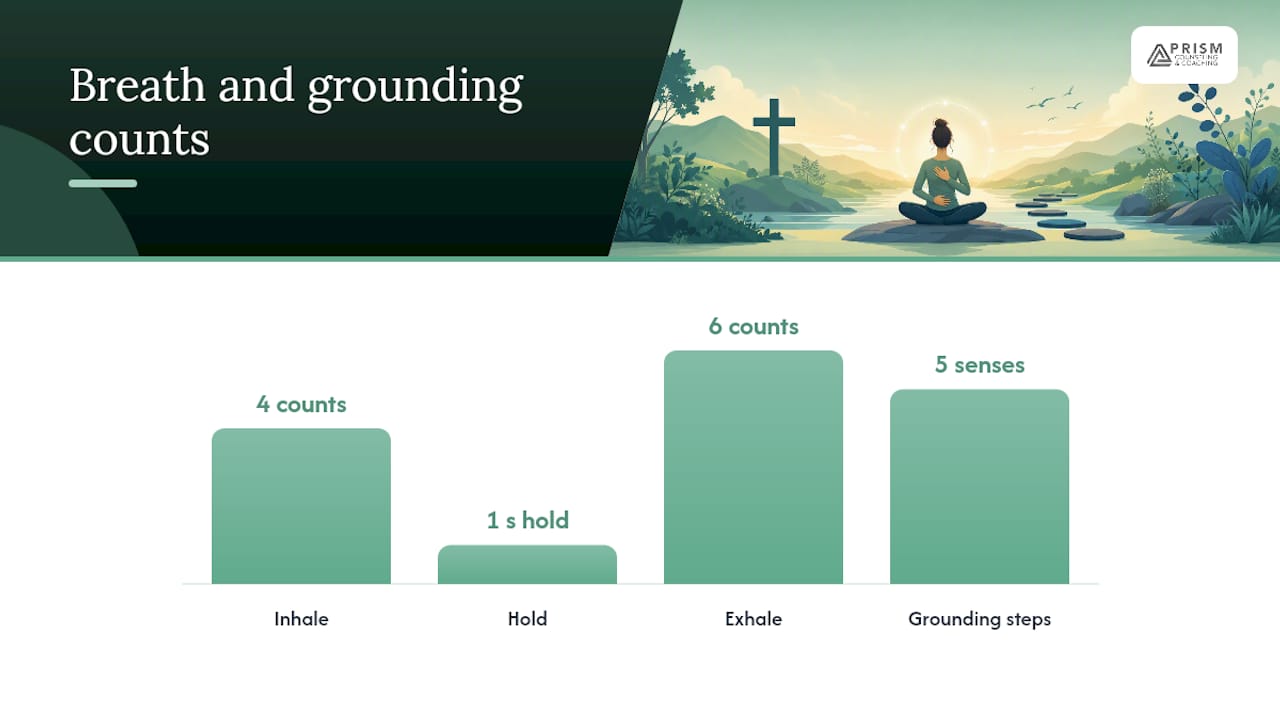
Here's why the breathing part matters physiologically: an extended exhale, longer than your inhale, signals your parasympathetic nervous system to slow your heart rate and ease the fight-or-flight response driving the panic. Pairing that exhale with a silent or whispered phrase anchors your mind while your body calms and downshifts.
Follow this order the next time panic starts building:
- Sit down if you can. Standing during a panic attack often makes the dizziness worse.
- Anchor your feet flat on the floor. Feel the ground pushing back against your soles.
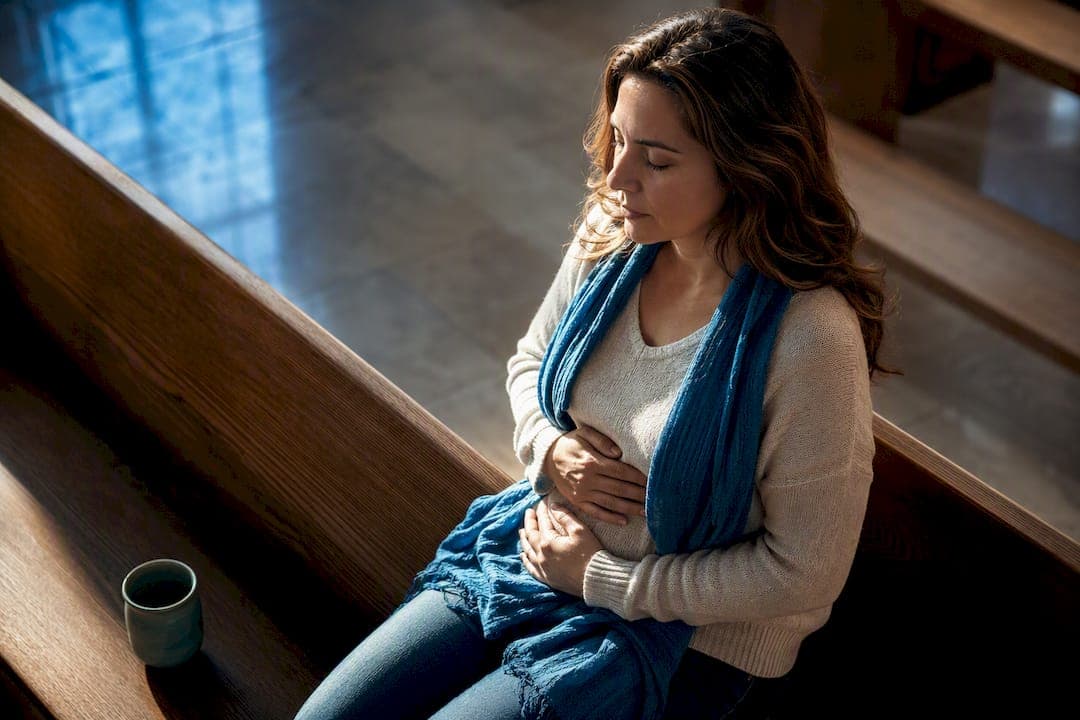
- Place one hand over your heart or chest. The pressure itself is calming, and it gives your prayer a physical home.
- Breathe in for a slow count of four. Hold for one second at the top.
- Exhale for a slow count of six while silently or quietly saying your chosen prayer phrase, like "Be still, and know."
- Name five things you can see, four you can touch, three you can hear, two you can smell, one you can taste. This is the classic 5-4-3-2-1 grounding technique, and it works because panic pulls your mind into the future while grounding pulls it back into the room you're actually in.
Repeat the breath and prayer cycle for a few minutes to help manage peak panic symptoms. Panic attacks have a biological time limit, peaking within about ten minutes and then beginning to subside, so this combination is designed to get you through the worst of it, not to end it instantly.
How Do You Build a Panic Prayer Plan Before You Need One?
The believers who recover fastest from panic attacks aren't improvising in the moment. They rehearsed ahead of time, so the words came without having to think.
Build your plan now, while you're calm, using these steps:
- Choose one prayer and one verse from the list above, or write your own short line, no more than one or two sentences.
- Write it down on an index card for your wallet, a sticky note by your bed, or a saved note on your phone titled "Panic Prayer."
- Practice it for two to five minutes daily, even on calm days, pairing it with the same breathing pattern you'd use during an attack.
- Name one trusted contact, a spouse, friend, or pastor, you can text or call if an attack feels bigger than you can handle alone.
- Write a simple next step for when prayer and breathing aren't enough: who you'll call, and when you'll reach out for Christian counseling for anxiety.
Pro Tip: Rehearsal matters more than most people realize. Practicing your breath-and-verse combination daily, even for two minutes, trains your body to reach for it automatically under stress instead of freezing.
When Should You Seek Clinical or Emergency Help Instead of Just Praying?
Prayer is a genuine anchor, but it isn't a diagnostic tool, and it was never meant to replace medical judgment. Some symptoms need more than a verse and a slow breath.
Seek emergency care immediately if you experience:
- Chest pain, pressure, or a racing heart that does not ease after several minutes of calming breath
- Fainting, numbness, or symptoms that could signal a heart or neurological issue
- Panic attacks happening so often they're stopping you from working, sleeping, or leaving the house
- Any thoughts of harming yourself or others
Faith-integrated counseling exists precisely for the space between an isolated scary moment and a medical emergency. Practices like Prism Counseling & Coaching combine evidence-based approaches such as CBT and EMDR with a client's own scripture and spiritual language, so you're not asked to choose between your faith and clinical treatment. A first session usually starts with your story, your triggers, and what recovery would look like for you specifically, spiritually and practically.
What Emotional and Spiritual Struggles Come With Panic Attacks?
Panic rarely stays purely physical. Most believers wrestling with panic attacks and prayer also wrestle with a quieter, harder question underneath: why is this happening to me if I have faith?
Shame is common. People often feel embarrassed that fear got the better of them, as if a racing heart in the grocery store somehow contradicts trusting God. Guilt follows close behind, especially for those raised to believe that "real faith" should feel like constant peace. Isolation creeps in next, because panic attacks can feel impossible to explain to someone who hasn't lived through one.
There's also a specific spiritual ache that shows up: feeling distant from God at the exact moment you need Him most. Scripture doesn't dodge this. In the Garden of Gethsemane, Jesus himself experienced overwhelming distress before his arrest, sweating and pleading in anguish. That passage matters here because it tells you plainly that intense fear is not evidence of weak faith. It's evidence of being human.
Recognizing these layered struggles, not just the racing pulse but the shame and spiritual doubt riding alongside it, is often the first step toward healing that lasts longer than the attack itself.
How Can a Faith Community Support Someone Through Panic Attacks?
A church, small group, or faith community can be one of the most powerful supports available to someone facing recurring panic, but only if the response is informed rather than dismissive.
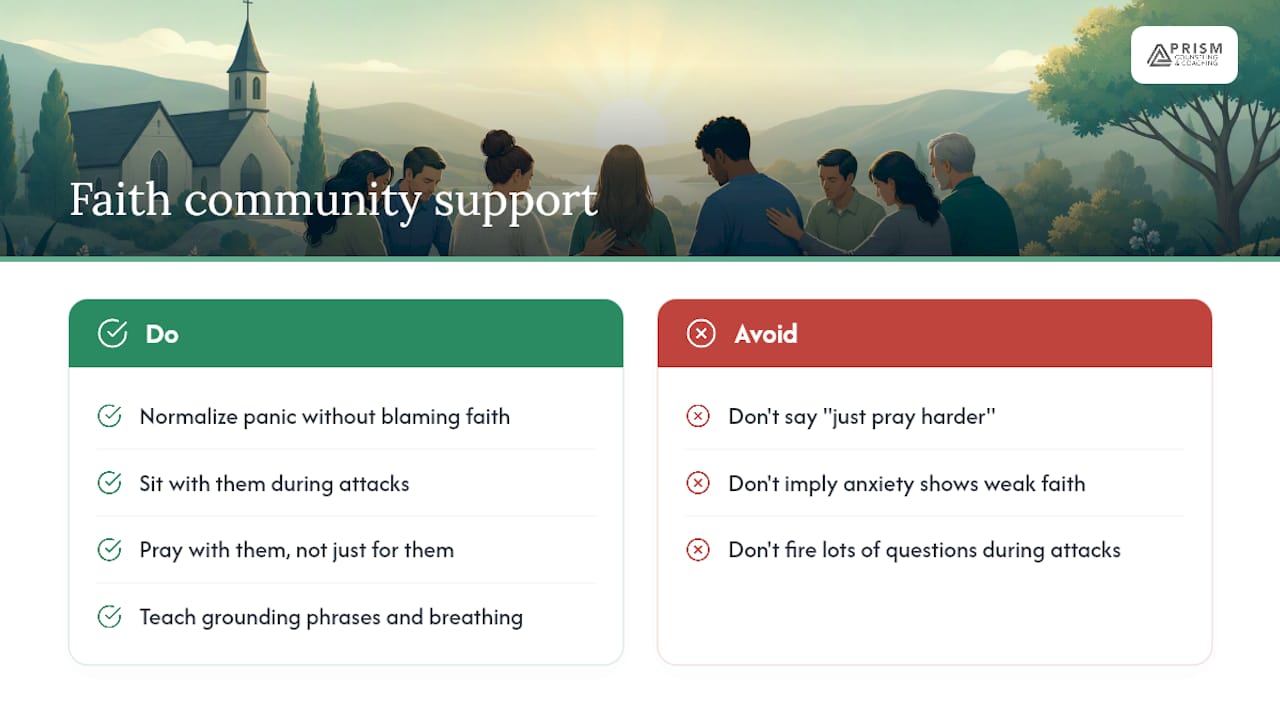
The most helpful support from a faith community normalizes panic attacks without dismissing them as a lack of faith. Telling someone "just pray harder" or implying their anxiety reflects a faith deficit tends to deepen shame rather than relieve it. What actually helps is simpler: sitting with someone during a hard moment, praying with them rather than just for them, and checking in consistently rather than only during a crisis.
Practical support matters too. A small group willing to learn a few grounding phrases, or a friend who knows to help someone slow their breathing rather than firing off more questions, can shorten an attack considerably. Some churches now build this into pastoral training, treating panic attacks and prayer support as a normal part of caring for a congregation, not an edge case.
Communities that pair spiritual encouragement with a willingness to say "this might need more than we can offer, let's find you a Christian counselor" tend to see people recover with less shame and less isolation. That referral isn't a failure of faith. It's often the clearest expression of it.
Can Meditation and Contemplative Prayer Help With Anxiety?
Contemplative prayer, the practice of sitting quietly with scripture rather than rushing through requests, gives panic-prone minds something structured to hold onto instead of spiraling thoughts.
One method worth learning is lectio divina, an ancient practice of slowly reading a short verse, like "Be still, and know that I am God," several times, pausing after each reading to notice what word or phrase stands out. This isn't just tradition for tradition's sake. Research on meditative practices, including a large PCORI-funded comparison of over 12,000 people, found meditation reduced anxiety symptoms at a level comparable to standard treatment approaches for many participants.
That doesn't mean contemplative prayer replaces professional care for ongoing anxiety. It means the practice of slow, repetitive, scripture-anchored attention has a real calming effect on the nervous system, not just a spiritual one. Try setting a timer for five minutes, choosing one verse, and simply breathing through it slowly, letting the same words settle deeper with each repetition instead of rushing to the next request.
Have Others Found Relief From Panic Through Prayer?
Devotional writers and pastoral counselors who work with anxious believers report a consistent pattern: people who prepare a short prayer ahead of time and rehearse it regularly are far more likely to actually use it when panic strikes, rather than freezing or forgetting everything they know.
One recurring account describes someone who kept a single verse, Isaiah 41:10, written on a card in their wallet for months before an attack ever happened. When panic hit during a work presentation, they didn't have to search for words. The verse was already there, already familiar, and reciting it while breathing slowly gave them something to hold onto until the wave passed.
This lines up with what devotional guidance on preparing a panic prayer consistently recommends: readiness beats improvisation. The believers who describe prayer as genuinely helpful during panic almost always mention practicing beforehand, not discovering the right words in the middle of the crisis.
How Prayer and Counseling Work Together
Prayer gave people something to hold onto long before therapy had language for panic attacks, and it still does that job well. What changes outcomes is pairing it with technique, an extended exhale, a grounding phrase, a plan written down before the next attack arrives. One pattern shows up again and again in faith-integrated work: people who write their panic prayer down and practice it weekly report catching attacks earlier, sometimes before the physical symptoms fully build.
— Tres
Find Faith-Integrated Support for Anxiety in Phoenix
If short prayers and breathing techniques help but you're still facing panic attacks that keep coming back, some faith-based counseling practices offer therapy that treats your faith as an asset, not something to set aside during sessions. Small, private-pay practices in the Phoenix area typically offer openings within days rather than the weeks-long waits common with insurance-based clinics.
A first session usually starts with your story: your triggers, your spiritual background, and what you want recovery to look like. From there, counselors may weave evidence-based methods like CBT and EMDR together with scripture and prayer practices you already trust, rather than asking you to choose one language over the other. Anxiety, panic, grief, and trauma are often addressed with a faith-integrated approach.
If panic attacks are disrupting your work, sleep, or relationships, explore faith-based counseling and book a session to start building a plan that goes beyond the moment of crisis.
Sources
The prayers in this article draw from Psalm 23, Psalm 46 (including Psalm 46:10), Isaiah 41:10, Philippians 4:6–7, and 2 Timothy 1:7. Breathing and grounding guidance references PCORI's research summary on meditative practices and anxiety. For continued reading on faith and anxiety, visit Prism's Christian counseling resources.
This article is general information, not a substitute for advice from a qualified doctor. Consult a qualified healthcare professional about your own circumstances before acting on anything here.
- PCORI: PCORI-funded study shows meditation can be effective compared with medication to treat adults with anxiety
- Short Prayer for a Panic Attack Right Now - Walk Faithful
FAQ
What Is the Spiritual Root of Panic Attacks?
Panic attacks are primarily a physiological response, not a spiritual failing, though they often carry spiritual weight, especially fear, shame, or feeling distant from God during the attack. Faith-integrated counseling addresses both the body's stress response and the spiritual questions panic tends to stir up.
What Does the Bible Say About Panic Attacks?
Scripture addresses overwhelming fear and distress, though it does not use clinical terms like panic attacks, including Isaiah 41:10, Philippians 4:6–7, and Jesus' own anguish in the Garden of Gethsemane. These passages consistently pair acknowledgment of fear with a call to bring that fear directly to God.
What Should You Not Do During a Panic Attack?
Avoid standing during a panic attack if possible, holding your breath, or isolating yourself in a way that cuts off support. Pairing prayer with slow, extended-exhale breathing and grounding tends to work far better than trying to suppress the fear outright.
What Did Jesus Say About Stress and Anxiety?
Jesus addressed anxiety directly, telling his followers not to worry about tomorrow, and he modeled genuine distress himself in Gethsemane before his arrest, showing that intense fear and deep faith can coexist. His teaching, paired with passages like Philippians 4:6–7, forms much of the scriptural foundation faith-based counselors use with anxious clients.
Can Prism Counseling & Coaching Help With Panic Attacks?
Yes. Prism Counseling & Coaching offers faith-based counseling for anxiety that integrates scripture and prayer with evidence-based techniques like CBT and EMDR, with a private-pay model that typically allows new clients to start within days.