

Pastoral burnout counseling combines faith-integrated therapy with clinical assessment, and yes, it can help you if you are exhausted, cynical, or wondering whether you have anything left to give your congregation. Start with a confidential evaluation from a licensed clinician who understands ministry life. If cost or church transparency worries you, private-pay counseling protects your privacy. If you are having thoughts of self-harm, call 988 or go to an emergency room now. Some practices offer this kind of faith-integrated support.
TL;DR:
- Pastoral burnout can be identified by emotional exhaustion, cynicism, and compassion fatigue, which often develop gradually and may mimic depression.
- Effective counseling options include weekly outpatient therapy, intensive retreats, and spiritual direction, with recovery timelines ranging from months to over a year for severe cases.
- Faith-integrated counseling combines evidence-based therapies with prayer, biblical reflection, and spiritual conversations, requiring counselors to demonstrate both clinical and faith sensitivity.
- Finding confidential, faith-sensitive counselors involves private-pay models, telehealth options, and trusted referrals outside church settings to bypass stigma and role conflict.
- Long-term prevention includes sustained boundaries, ongoing counseling, deliberate delegation, and active peer support to maintain mental health and avoid relapse.
Table of Contents
- What Are the Signs of Pastoral Burnout?
- How Does Pastoral Burnout Counseling Work?
- How Does Faith-Integrated Counseling Actually Work?
- How Do You Find a Confidential Pastoral Counselor?
- What Does Pastoral Burnout Recovery and Prevention Look Like?
- Why Does Peer Support Matter for Pastoral Burnout?
- How Do You Choose a Qualified Pastoral Burnout Counselor?
- What Does Sustainable Ministry Look Like Long-Term?
- What Actually Causes Pastoral Burnout?
- A Counselor's Honest Take
- Faith-Integrated Counseling for Pastors at Prism Counseling & Coaching
- Sources
- FAQ
What Are the Signs of Pastoral Burnout?
Pastoral burnout rarely announces itself. It creeps in through small changes: a sermon prep session that used to take two hours now takes six, a hospital visit that once felt sacred now feels like an obligation you resent. The three markers researchers use to define burnout are emotional exhaustion, cynicism or depersonalization, and a sense of ineffectiveness. For pastors, a fourth shows up often: compassion fatigue, the numbness that sets in after years of absorbing other people's grief without anywhere to set it down.
The overlap with clinical depression and anxiety is real and important. Occupational stress and burnout are closely linked to broader mental health conditions, and clinical literature on burnout's correlates recommends a clinical assessment whenever symptoms persist. Burnout and depression can look nearly identical from the outside. That is exactly why a counselor, not a sabbatical alone, needs to make the call.
Quick self-check. You may be dealing with pastoral burnout if you notice several of these:
- Dreading tasks that used to bring you joy, like preaching or counseling members
- Feeling emotionally flat or detached during pastoral care visits
- Irritability with your spouse, kids, or staff that feels out of character
- Trouble sleeping, or sleeping constantly and still feeling drained
- A persistent sense that nothing you do makes a difference
Seek same-day medical or psychiatric evaluation if you experience suicidal thoughts, self-harm urges, or a sudden inability to function at home or work. Those are not burnout symptoms to manage alone. They are emergencies.
How Does Pastoral Burnout Counseling Work?
Counseling for pastoral burnout usually takes one of four shapes, and the right one depends on how deep the exhaustion runs.
- Outpatient weekly counseling. Most pastors start here: fifty-minute sessions, once a week, with a counselor trained in both clinical therapy and ministry culture. This format works well for early-stage burnout and ongoing maintenance.
- Counseling intensives or retreats. When weekly sessions have not moved the needle, or when a pastor has reached crisis level, a one to two week intensive format offers concentrated therapy alongside rest and spiritual care. Programs like QuietWaters Ministries' burnout intensive illustrate how this looks in practice: days built around both professional counseling and biblical reflection, away from the demands of church life.
- Spiritual direction. This is not a replacement for clinical therapy, but a complementary practice focused on discernment, prayer, and the pastor's own relationship with God, often running in parallel with counseling.
- Supervision and consultation. Ongoing peer or professional consultation, even after the crisis passes, functions as a maintenance layer, not just a crisis response.
Expect clinical modalities like cognitive behavioral therapy, trauma-informed care, or grief work, depending on what surfaces. Recovery timelines vary widely. Mild burnout may improve with consistent counseling over a few months; deeper burnout tied to trauma or long-term neglect can require many months to a year or more. Confidentiality standards apply the same way they would for any client, and most counselors will loop in a spouse or trusted elder only with the pastor's explicit consent.
How Does Faith-Integrated Counseling Actually Work?
Faith-integrated counseling does not mean swapping Scripture in for clinical training. It means a licensed counselor uses evidence-based methods, like cognitive behavioral therapy or trauma processing, while also making room for prayer, biblical reflection, and honest conversation about doubt, calling, and spiritual identity. For a pastor whose sense of self is tangled up with ministry, that combination matters. A counselor who treats faith as background noise misses half the picture.
Some counselors specialize in pastoral and ministry-specific care and have worked in this space for many years. A few things distinguish that approach for pastors specifically:
- A private-pay model that helps protect confidentiality by avoiding insurance paperwork
- Openings sometimes available more quickly than the typical waits common with insurance-based practices
- Podcast and article resources built specifically for Christian counseling topics, useful for pastors wanting to understand the process before booking
- Counselors generally trained to recognize when a referral to a physician or psychiatrist might be needed
Pro Tip: If a counselor cannot clearly explain how they would refer you to a psychiatrist or physician for medication evaluation, keep looking. Faith-sensitive care still needs a clear boundary with medical care.
For pastors researching what this role even involves, it helps to understand what a pastoral counselor actually does before your first call.
How Do You Find a Confidential Pastoral Counselor?
Finding the right counselor starts with knowing where to look and what to ask. Denominational referral lists are a reasonable starting point, but they are not the only option, and for many pastors, a referral through church structures feels like the opposite of confidential.
Better starting points often include professional referral networks, local faith-based private practices, and word-of-mouth from a trusted pastor outside your own congregation. When you call, ask directly: Are you licensed, and in what state? How do you integrate faith into clinical work, specifically? What is your confidentiality policy if my church contacts you? Do you offer telehealth?
- Choose private-pay over insurance if you want to avoid any record tied to your employer
- Ask about telehealth or off-site sessions if being seen at a local counseling office feels risky
- Use an employer-based EAP program if your church offers one, since these are typically structured for confidentiality
- Get a referral from a trusted colleague outside your denomination rather than relying only on internal channels
Stigma is the biggest barrier here, and research on clergy help-seeking identifies stigma and role imbalance, feeling like you cannot be both the helper and the one who needs help, as the top reasons pastors delay care. Naming that tension out loud with church leadership, even briefly, tends to open doors rather than close them.
What Does Pastoral Burnout Recovery and Prevention Look Like?
Recovery is not a single vacation. Deep pastoral burnout typically responds better to a staged, coordinated plan than to an ad hoc week off, according to a systematic review of ministry burnout covering 82 empirical studies.
- Get a medical evaluation first if you have any physical symptoms: fatigue, appetite changes, or sleep disruption can have medical roots that counseling alone will not fix.
- Start regular counseling, weekly or biweekly, and stay with it past the point where you start feeling better. Relapse often happens when sessions stop too early.
- Rebuild basic health habits. Sleep, exercise, and nutrition are not fluff. Clinical self-care guidance from university counseling centers lists these as central to burnout recovery, not optional extras.
- Practice actual Sabbath, a full day with no sermon prep, no visits, no church email.
- Delegate deliberately. Identify two or three tasks this month that someone else on staff or in the congregation can own.
- Reintegrate gradually. Return to full duties over weeks, not days.
Churches carry responsibility too: redistributing workload, building a confidential care pathway for staff, and adopting a sabbatical policy before crisis hits, not after.
Pro Tip: Track progress in months, not weeks. A pastor six months into recovery who can preach without dreading Monday, and who has taken two full Sabbath days in the last month, is on a healthy trajectory even if some fatigue remains.
Why Does Peer Support Matter for Pastoral Burnout?
Isolation is often the accelerant that turns ordinary ministry stress into full burnout. Pastors are trained to counsel others through crisis, but that same training can make it feel unnatural to ask for help themselves. Community changes that equation.
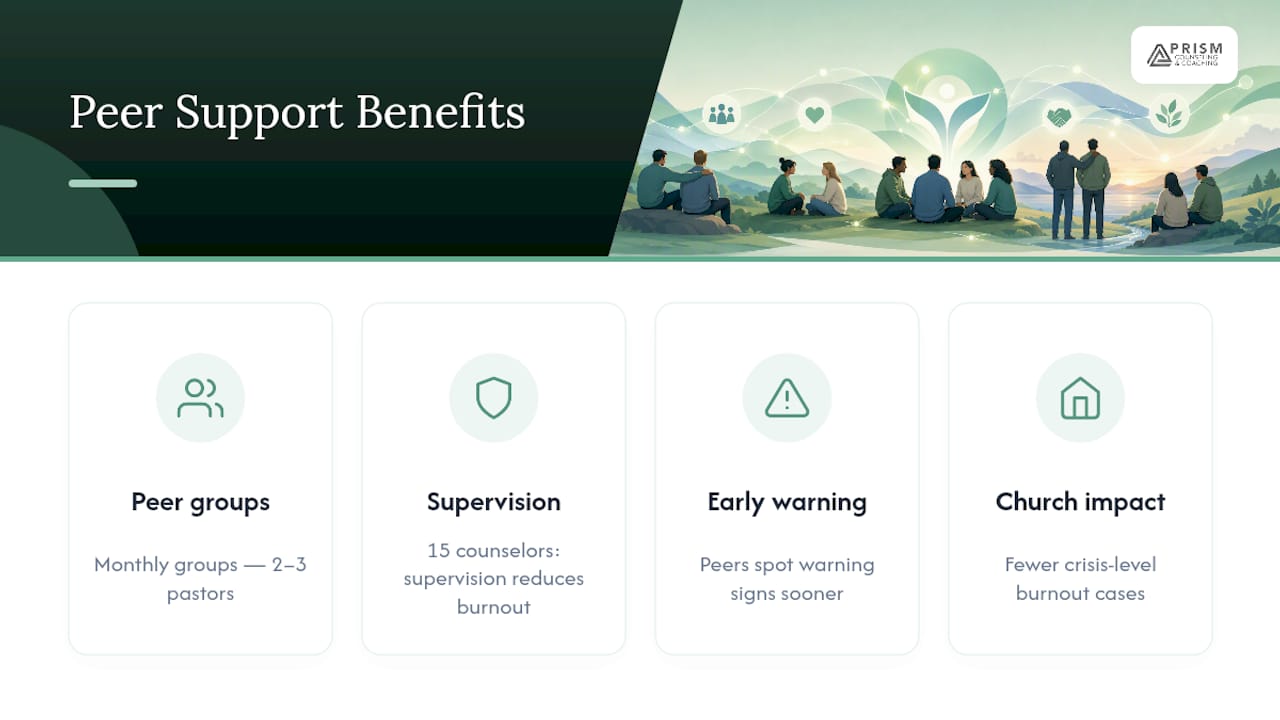
Peer support works because it breaks the illusion that struggling is unique to you. A pastor who meets monthly with two or three other pastors, outside the competitive dynamics of a denominational hierarchy, gains a place to say "I am not okay" without political consequence. Supervision and consultation groups formalize this further. Pastoral counselors themselves report that ongoing supervision and consultation are central to reducing burnout, stress, and ethical missteps, based on interviews with 15 pastoral counselors examining how they manage the emotional weight of the role.
This is not just a nice addition to recovery. It functions as an early warning system. A peer group notices when your jokes turn bitter, or when you stop showing up, faster than you notice it in yourself. It also gives you somewhere to land during the harder stretches of counseling, when old wounds surface and you need someone who understands ministry pressure specifically, not just stress in the abstract.
Churches that build this into their culture, whether through staff cohorts, regional pastor gatherings, or structured supervision, see fewer crisis-level burnout cases. The investment is small compared to the cost of losing a pastor to burnout entirely.
How Do You Choose a Qualified Pastoral Burnout Counselor?
Credentials matter here more than they might for general life stress, because pastoral burnout sits at the intersection of clinical mental health and spiritual identity. A counselor needs both halves.
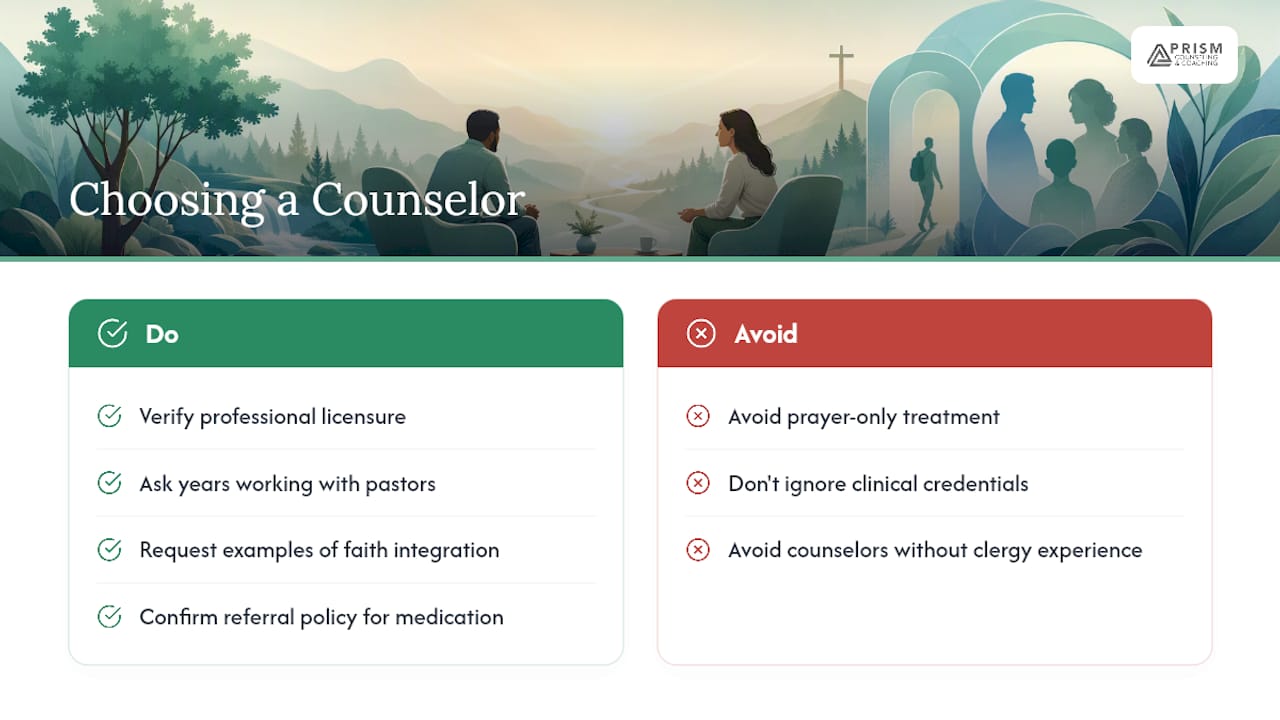
Start with licensure. Look for a Licensed Professional Counselor, Licensed Clinical Social Worker, or Licensed Marriage and Family Therapist, credentials that require supervised clinical hours and state board oversight. Licensure alone does not guarantee faith competence, though. Ask how many pastors or ministry staff the counselor has worked with, and ask them to describe, specifically, how they weave prayer or Scripture into a session without turning therapy into a Bible study.
Experience with ministry-specific stress is a genuine differentiator. A counselor who has never worked with clergy may misread a pastor's guilt over "failing" the congregation as garden-variety anxiety, missing the theological weight underneath it. Years in practice matter too: a counselor with over a decade in faith-integrated work has likely seen the full range, from early warning signs to full breakdowns, and knows which format fits which stage.
Watch for red flags: a counselor who dismisses your faith outright, or one who avoids any clinical framework and relies only on prayer. Both extremes fail pastors. The right fit holds clinical rigor and spiritual sensitivity at the same time, and is upfront about when your case needs a referral to a psychiatrist for medication evaluation rather than talk therapy alone.
What Does Sustainable Ministry Look Like Long-Term?
Recovering from burnout once is not the same as staying well. Long-term sustainability requires structural changes, not just a return to old habits with better intentions.
Build boundaries into your calendar permanently, not just during recovery. That means a protected day off that survives even a busy season, and a clear policy for what constitutes an emergency worth interrupting it. Continue counseling on a lower-frequency maintenance basis, monthly rather than weekly, as a checkpoint rather than a crisis response. Many pastors who relapse do so because they treated counseling as a fix rather than an ongoing practice.
Renegotiate your role with church leadership honestly. If workload was a driver of your burnout, a return to the exact same job description without changes sets up a repeat cycle. This might mean adding staff, redistributing pastoral care visits among elders, or simply saying no to committees that do not need you personally.
Keep peer relationships active even once you feel well. The pastors who sustain healthy, long ministries tend to have consistent outside accountability: a counselor, a peer group, or both, checked in with regularly rather than only in emergencies.
What Actually Causes Pastoral Burnout?
Workload gets blamed most often, and it is a real factor: pastors routinely juggle preaching, counseling, administration, and crisis care with no clear off switch. But workload alone rarely explains why one pastor burns out and another with a similar schedule does not.
Role stress runs deeper. Pastors are expected to be theologian, CEO, counselor, and moral exemplar simultaneously, often for a congregation that holds conflicting expectations about which role matters most. That tension, being everything to everyone, wears differently than simple overwork.
Isolation compounds both. Pastors counsel others through their darkest moments but rarely have a peer relationship where they can be equally vulnerable. A systematic review of 82 studies on ministry burnout identified occupational demands, relational pressures, trauma exposure, and inadequate support as the recurring threats behind clergy burnout, not any single cause acting alone.
Trauma exposure deserves specific attention. Pastors absorb secondhand trauma constantly: sitting with families after a suicide, walking through a divorce, standing at a child's hospital bed. Without structured supervision or consultation to process that weight, it accumulates. That accumulation, more than any single hard week, is often what tips exhaustion into full burnout.
A Counselor's Honest Take
Pastors wait too long to ask for help because they have spent years being the one others call. That instinct to serve first is not a character flaw. It is also not sustainable without support flowing back to you. Confidential, faith-sensitive counseling is not a failure of faith or leadership. It is the same care you would recommend to anyone in your congregation who was hurting this badly..
— Tres
Faith-Integrated Counseling for Pastors at Prism Counseling & Coaching
Pastoral burnout counseling works best when confidentiality is a priority. Some practices use private-pay models to protect privacy and may have shorter wait times than insurance-based counseling.
Prism's counselors specialize in faith-integrated care for individuals and families, with over 14 years of experience weaving clinical methods and spiritual support together. Churches can also explore sponsorship and EAP-style arrangements for staff care, and pastors researching options can start with the counseling for pastors page to see what a first session looks like. If you are ready to talk to someone, book a faith-based counseling session to schedule a confidential first appointment.
This article is general information, not a substitute for advice from a qualified doctor. Consult a qualified healthcare professional about your own circumstances before acting on anything here.
Sources
- NCBI/PMC article on burnout and clinical correlates
- Pastoral Counselors’ Perceptions Regarding Supervision/Consultation to Prevent Burnout and Ethical Violations
- Research on barriers to clergy seeking help (Psychnexus)
- Counseling and Mental Health Center self-care guidance (UT Austin)
FAQ
What Is Pastoral Burnout Counseling?
It is counseling, often faith-integrated, that combines clinical methods like cognitive behavioral therapy with spiritual support to help pastors recover from emotional exhaustion, cynicism, and reduced effectiveness in ministry.
How Long Does Pastor Burnout Recovery Take?
Mild burnout often improves within eight to twelve weeks of consistent counseling, while deeper burnout tied to trauma or long-term neglect can take six months to a year.
Is Pastoral Burnout the Same as Depression?
Not exactly. The two overlap significantly and both involve exhaustion and low mood, which is why clinical evaluation matters for an accurate diagnosis rather than self-assessment alone.
How Can I Keep My Counseling Confidential From My Church?
Choose a private-pay counselor, such as those at Prism Counseling & Coaching, to avoid an insurance record, and ask directly about telehealth options and confidentiality policies before your first session.
When Should a Pastor Seek Emergency Care Instead of Counseling?
Seek immediate medical or psychiatric help, including calling 988 or going to an emergency room, if you experience suicidal thoughts, self-harm urges, or a sudden inability to function.