

Pastoral counseling certification is the credential that formally recognizes your ability to blend spiritual care with sound counseling practice, and for most people the fastest way there is a graduate certificate paired with Clinical Pastoral Education. If your calling is church-based ministry, that combination can get you serving in months rather than years. If your calling leads toward clinical licensure, a master's degree plus roughly 1,000 hours of supervised practice and a state exam is the road you're actually on. Either way, the decision starts with one honest question: who do you want to sit across from, and in what setting?
TL;DR:
- Most pastoral counseling certifications require a combination of coursework, supervised clinical hours, and ongoing CEUs, with licensure tracks demanding roughly 1,000 to 2,000 post-degree hours.
- Certificate programs are quick entry points for church-based roles but can transfer credits into a master's program if career goals change later.
- State licensure is essential for independent clinical practice or insurance billing, and coursework must align with licensing requirements from the beginning to avoid costly retrofits.
- Certification from bodies like NBCPC or NACC involves rigorous standards, including hundreds of hours of supervised work and regular re-certification, while ordination offers spiritual authority without necessarily granting clinical credentials.
- Specializations such as crisis intervention, addiction, or grief counseling can influence your program choice and career path, emphasizing the need to plan early for focused competency development.
Table of Contents
- What Is Pastoral Counseling Certification, Really?
- What Are the Main Types of Pastoral Counseling Programs?
- What Do Programs Actually Require You to Complete?
- What Are the Main Pastoral Counseling Certification Bodies?
- Do You Need a State License, or Just Church Certification?
- How Do You Choose the Right Program?
- What Does a Realistic Certification Timeline Look Like?
- How Prism Counseling & Coaching's Training Resources Fit In
- Certification, Ordination, and Where They Overlap
- What Ethical Standards Govern Pastoral Counseling?
- What's the Job Market and Salary Outlook for Certified Pastoral Counselors?
- What Specializations Can You Pursue Within Pastoral Counseling?
- Balancing Ministry Readiness With Clinical Competence
- How Prism-counseling Can Support Your Training Journey
- Sources
- FAQ
What Is Pastoral Counseling Certification, Really?
Pastoral counseling certification isn't one single thing, and that trips up a lot of well-meaning candidates. It can mean a school-issued academic certificate, a board credential through a national certifying body, or a specialized designation earned inside a graduate program. Each one answers a different question about what you're prepared to do and where you're prepared to do it.
The common thread across every version of this credential is integration: you're demonstrating that you can hold theology and psychology together without letting either one crowd out the other. Grief is not linear, and neither is the training that prepares you to walk with someone through it. That's why the strongest programs don't just teach counseling technique or biblical doctrine in isolation. They teach you to move between the two fluidly, the way a good shepherd moves between comfort and correction.
What Are the Main Types of Pastoral Counseling Programs?
Choosing a credential starts with knowing what each option actually prepares you for. The four common paths lead to very different careers, even though they sound similar on paper.
- Graduate certificates (typically 12 to 18 credits) are the quickest entry point, built for people already serving in a church who need structured counseling training without a full degree commitment.
- Master's degrees (commonly 48 to 60 credits) prepare you for broader mental health work and are usually the prerequisite if state licensure is your goal.
- M.Div. or theology degrees with counseling coursework suit pastoral leaders who want counseling competence woven into a full ministry credential rather than as a separate track.
- Clinical Pastoral Education (CPE) is hands-on, supervised clinical training, most common in chaplaincy and hospital ministry, where real-time feedback from supervisors and peers replaces classroom theory.
Graduate certificates often transfer credits into a master's later, so choosing the shorter route now doesn't necessarily close the door on the longer one.
What Do Programs Actually Require You to Complete?
Before you apply anywhere, it helps to know the concrete benchmarks admissions committees and certifying bodies are measuring you against. These numbers vary by school, but the pattern is consistent enough to plan around.
- Admission basics. Most programs require a baccalaureate degree, official transcripts, pastoral or academic references, and often a statement of faith for explicitly Christian counseling certification tracks.
- Core coursework. Expect classes in counseling theory, psychological assessment, crisis intervention, ethics, and the integration of theology and psychology, the backbone of any faith-based clinical education.
- Credit load. Certificate programs commonly run 12 to 18 credits; a program like Neumann's Pastoral Care Specialist certificate requires about 18 credits of coursework and clinical practice, often ending in a consultation portfolio rather than a thesis. Master's programs typically run 48 to 60 credits.
- Clinical hours. CPE is intensive, supervised, and emotionally demanding by design. It's meant to surface your blind spots before you carry them into someone else's crisis. If licensure is the goal, plan for roughly 1,000 to 2,000 supervised post-degree hours, though the exact number depends on your state.
What Are the Main Pastoral Counseling Certification Bodies?
Once your coursework is settled, the next decision is which credential to pursue and from whom. Two names dominate this space, along with a handful of school-issued designations that function similarly.
The National Board for Certified Pastoral Counselors (NBCPC) offers a tiered system through its NCPC certification framework. The entry levels focus on foundational training, but the top tier, NCPC 3, is genuinely rigorous.
Certification benchmark: NCPC 3 requires 20 semester hours of graduate coursework in pastoral counseling, another 20 in general counseling, 1,000 hours of documented work experience, and 50 hours of supervision, plus 24 continuing education units every year, and re-certification every three years.
Beyond NBCPC, two other names matter:
- NACC (Board Certified Pastoral Counseling Program) offers board certification aimed at chaplains and pastoral counselors working in institutional and healthcare settings.
- Neumann University's CPCS (Pastoral Care Specialist) is a school-based credential that functions as a certificate of advanced study, useful if you want a recognized designation without pursuing full board certification.
The maintenance requirements matter as much as the entry requirements. A credential that demands annual CEUs and periodic re-certification is asking for a lifetime commitment, not a one-time achievement, so factor that ongoing cost into your career planning now.
Do You Need a State License, or Just Church Certification?
This is the single most consequential decision in the entire process, and too many candidates skip past it. State licensure, whether LPC, LMFT, or LCSW, is required in most states if you plan to practice psychotherapy independently, bill insurance, or open a private clinical practice. No pastoral certification substitutes for that license.
Clergy can typically offer pastoral counseling within their own congregation without a state license, but that permission has real limits. You generally cannot diagnose or treat clinical mental disorders under the umbrella of pastoral care alone. The line between comforting someone through depression and treating major depressive disorder is a legal one, not just a semantic one.
Confirm your state's licensing board rules before you commit to a program. If clinical practice is even a possibility down the road, choose coursework that aligns with licensure competencies from the start, since retrofitting a certificate-only education into a licensure track later almost always costs more time and money than planning for it up front.
How Do You Choose the Right Program?
A good program should survive a short list of pointed questions. Ask them before you enroll, not after.
- Is the program regionally accredited or accredited by the Association of Theological Schools (ATS)?
- Does the coursework map onto your state's licensure requirements, if that's a goal?
- Who supervises the practicum or CPE placement, and does the school help arrange it?
- What do CEUs and re-certification actually cost over ten years, not just the first one?
- Can faculty point to their own clinical credentials, not just academic ones?
Pro Tip: Call the admissions office and ask directly how many students from the last two cohorts completed a CPE placement successfully. Vague answers here are the clearest red flag you'll get before enrolling.
Red flags worth walking away from: no clear supervision policy, no practicum support, unaccredited status, or CEU requirements the school can't explain in plain language.
What Does a Realistic Certification Timeline Look Like?
Most people underestimate the timeline until they map it out. Here's a workable version.
- Years 1 to 4: Complete a bachelor's degree, ideally with psychology or ministry coursework if you already know your direction.
- Years 4 to 5 (certificate route): Add a 12 to 18 credit graduate certificate and CPE placement; you can often begin church-based counseling roles here.
- Years 4 to 6 (master's route): Complete a 48 to 60 credit master's degree instead, laying the academic foundation for licensure.
- Years 6 to 8 (licensure route): Log supervised post-degree hours and sit for your state exam.
- Ongoing: Budget for annual CEUs and periodic re-certification once you've earned your credential.
How Prism Counseling & Coaching's Training Resources Fit In
Training resources are built around the principle of integrating counseling skill with genuine spiritual grounding. If you're still deciding whether this field is right for you, these resources can help.
- How to Become a Pastoral Counselor walks through the certification landscape in more practical detail.
- Free Pastoral Counseling Training lets you sample foundational concepts at no cost before committing to a program.
- The Center for Pastoral Counseling and Spiritual Integration (PCSI) offers structured training that mirrors the learning outcomes certificate programs are built around.
- The Ask a Christian Counselor podcast gives you practitioner perspective on real scenarios, not just theory.
None of these resources substitute for accredited coursework or board certification, but after more than 14 years of faith-integrated practice, Prism-counseling has learned where beginners get stuck, and these tools exist to meet you there before you commit years and tuition to a formal program.
Certification, Ordination, and Where They Overlap
Ordination and pastoral counseling certification answer different questions, and confusing them is one of the most common mistakes candidates make. Ordination is a recognition of spiritual calling and authority within a religious body, typically granted by a denomination or congregation. Certification is a recognition of professional competence in counseling technique, typically granted by an academic institution or a certifying board like NBCPC or NACC.
You can be ordained without being certified, and plenty of pastors counsel their congregants without ever pursuing NCPC or CPCS credentials. That's legal within the boundaries of pastoral care discussed earlier. You can also be certified without being ordained. Many certificate and master's programs accept lay counselors, chaplains, and non-ordained ministry staff, since the coursework focuses on counseling competence rather than ecclesiastical authority.
The overlap happens when someone wants both: recognized spiritual authority to lead and recognized clinical competence to counsel with depth. This dual credential is especially common among hospital and hospice chaplains, where institutions often require both ordination status from a sponsoring denomination and a board certification like the one NACC offers. Ordination alone rarely satisfies a hospital's clinical credentialing committee. Certification alone rarely satisfies a denomination's requirements for pastoral authority.
If your goal is a hybrid role, plan for both tracks simultaneously rather than sequentially. Many CPE placements and graduate programs will accept you while ordination is in process, so the two timelines can run in parallel instead of stacking on top of each other and adding years to your preparation.
What Ethical Standards Govern Pastoral Counseling?
Every certifying body builds its credential around a code of ethics, and the themes repeat across NBCPC, NACC, and most graduate program handbooks. Confidentiality sits at the center, though it carries a distinctly pastoral complication: what you hear in a counseling session may differ from what's protected under clergy privilege, and the two legal frameworks don't always align neatly.
Competence boundaries matter just as much. A certified pastoral counselor is ethically obligated to recognize the edge of their training and refer out when a client's needs exceed it, particularly for suicidal ideation, active addiction, or diagnosable mental illness requiring medication management. Referring isn't a failure of pastoral care; it's the responsible expression of it.
Dual relationships present a particular challenge in church settings that secular counseling rarely faces in the same way. Counseling someone who also serves on your church board, sings in your choir, or shares your small group requires a level of role clarity that most ethics codes address directly, because the counselor and the congregant relationship can blur boundaries in ways clinical settings usually avoid.
Informed consent, appropriate use of scripture, and respecting a client's autonomy even when their choices conflict with your theological convictions round out the core standards. The best programs don't just teach these principles abstractly. They put you in supervised placements where you have to apply them under real pressure, with a supervisor there to catch what you miss.
What's the Job Market and Salary Outlook for Certified Pastoral Counselors?
Career paths for certified pastoral counselors split roughly three ways: church-based counseling ministry, chaplaincy in hospitals, hospice, or the military, and licensed clinical practice for those who complete the state licensure track. Each path has a different ceiling and a different day-to-day reality.
Church-based roles often pay through a ministry salary structure rather than a clinical fee schedule, so compensation varies enormously by denomination, congregation size, and region. Chaplaincy positions in hospital systems tend to follow institutional pay scales tied to healthcare staffing more broadly. For the licensed clinical route, the Bureau of Labor Statistics tracks wage and outlook data for the broader counseling occupations that pastoral counselors with clinical licensure fall under, and that data is a more reliable benchmark than anecdotal ministry salary figures floating around online.
The practical takeaway: if income stability and growth potential matter to your decision, the licensure track generally offers more predictable financial footing than certificate-only, church-based roles. That doesn't make the certificate route the wrong choice. Plenty of people pursue pastoral counseling as a bivocational calling alongside other ministry work, where the goal is service capacity, not primary income. Know which category you're in before you pick a program, because the two paths reward very different training investments.
What Specializations Can You Pursue Within Pastoral Counseling?
Generalist pastoral counseling training covers a wide base, but most practitioners eventually gravitate toward a specialty that matches their congregation's needs or their own sense of calling. Crisis intervention is one of the most common, preparing counselors to respond to acute situations like suicidal crisis, sudden loss, or trauma disclosure, often building directly on the crisis intervention coursework already embedded in most certificate and master's curricula.
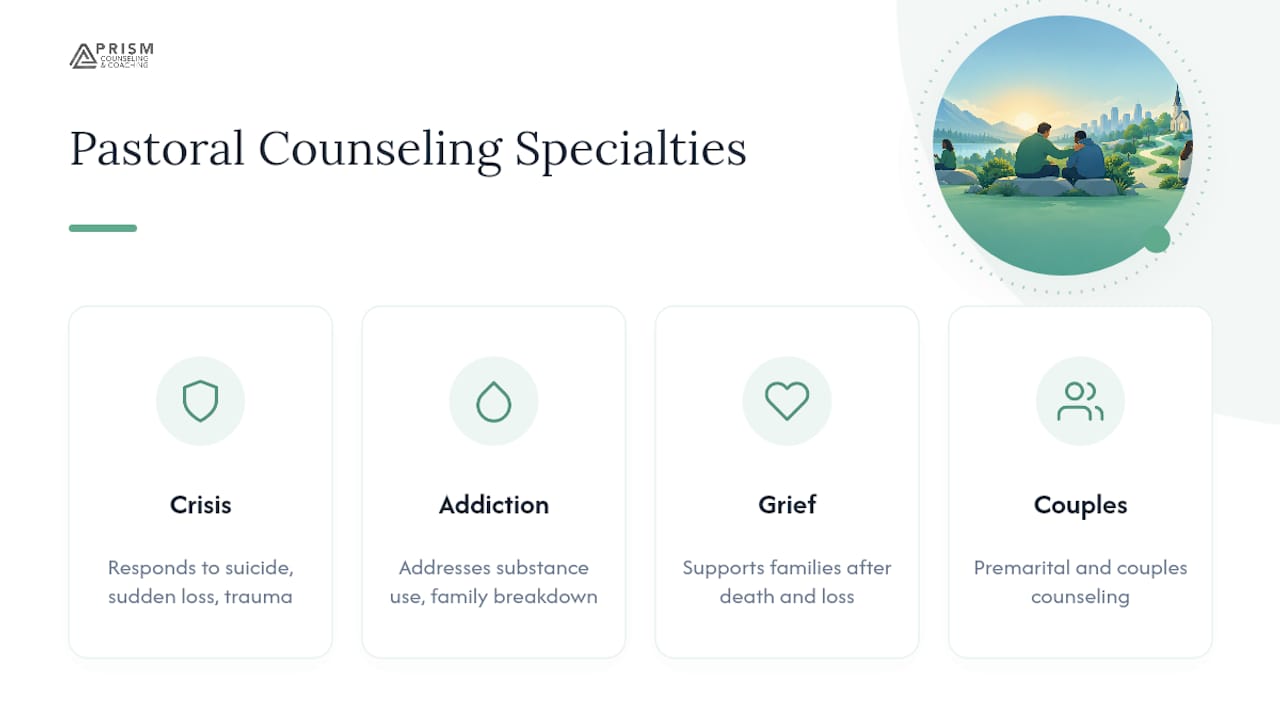
Addiction counseling is another frequent specialization, particularly relevant given how often substance use intersects with the grief, shame, and family breakdown that bring people into pastoral care in the first place. Some master's programs offer formal concentrations in Addictions Counseling alongside options like Marriage and Family Ministry or Trauma and Crisis Counseling, letting you build specialized competence directly into your degree rather than adding it later through separate continuing education.
Grief and bereavement counseling is a natural fit for pastoral training generally, since walking with families through death and loss sits at the heart of most ministry work already. Marriage and family counseling draws heavily on premarital and couples work that many church-based counselors are already doing informally, long before they pursue formal credentialing.
Choosing a specialization early can shape which certificate concentration or master's track you select, so it's worth naming your intended focus before you enroll rather than treating it as an afterthought.
Balancing Ministry Readiness With Clinical Competence
The temptation in this field is to treat spiritual calling as sufficient preparation on its own. It isn't. Supervised clinical hours and CPE exist because good intentions don't automatically produce good clinical judgment, especially with trauma and crisis.
Match your training to where you'll actually serve, and take the ethical weight of that setting seriously. That's not caution for caution's sake. It's the difference between helping someone and quietly harming them while believing you're helping.
— Tres
How Prism-counseling Can Support Your Training Journey
Prism-counseling is a practical starting point for readers who want faith-integrated training without navigating a large institution's bureaucracy first. Some small, private-pay practices offer immediate openings and individualized attention that larger, insurance-based training pipelines often can't match.
If you're exploring whether this field fits your calling, start with the Center for Pastoral Counseling and Spiritual Integration to see how structured training combines biblical grounding with counseling skill. If you'd rather test the waters first, the free pastoral counseling training costs nothing and takes far less time than a full program application. And if you want to experience faith-integrated counseling from the client side before you ever counsel someone else, book a standard 50-minute session for $195 and see how the integration actually works in practice.
This article is general information, not a substitute for advice from a qualified doctor. Consult a qualified healthcare professional about your own circumstances before acting on anything here.
Sources
- Psychology
- CAS/CPCS Pastoral Care Specialist — Neumann University catalog
- Graduate Certificate in Pastoral Counseling — Liberty University
FAQ
What Do You Need to Become a Pastoral Counselor?
You typically need a bachelor's degree at minimum, followed by a graduate certificate or master's degree in pastoral counseling or a related field. If you want state licensure and clinical practice rights, add supervised post-degree clinical hours and a passing score on your state's licensure exam.
What Is the Typical Pastoral Counselor Salary?
Salary varies widely depending on whether you work in church ministry, chaplaincy, or licensed clinical practice, since each follows a different pay structure. The Bureau of Labor Statistics tracks wage data for the broader mental health counseling occupations that licensed pastoral counselors fall under, which is the most reliable benchmark for the clinical track.
What Can You Do With a Pastoral Counseling Degree?
A pastoral counseling degree opens paths into church-based counseling ministry, hospital or hospice chaplaincy, and, with additional licensure, private clinical practice. Many graduates also move into specialized roles like crisis intervention or addiction counseling within a congregation or healthcare setting.
How Do You Get a Pastoral Counseling Certificate?
Apply to an accredited program offering a graduate certificate, typically requiring a bachelor's degree, transcripts, and references. Complete the required coursework, usually 12 to 18 credits, along with any required clinical practicum or CPE component, then submit your credential application to the issuing school or certifying body.