

Using Scripture in counseling means grounding instruction, comfort, correction, and spiritual growth in the Bible's own teaching, applied with wisdom and the Holy Spirit's help rather than as a rulebook pulled off a shelf. The foundational text most biblical counselors point to is 2 Timothy 3:16–17, which describes Scripture as "profitable for teaching, for reproof, for correction, and for training in righteousness." Organizations like CCEF (the Christian Counseling & Educational Foundation) and the Biblical Counseling Coalition have built entire counseling frameworks around that single verse pairing, and practices like Prism Counseling & Coaching apply the same principle in real sessions with real people carrying real pain.
You don't need a seminary degree to understand how this works, but you probably do want to know it isn't just a counselor flipping open a Bible and reading a verse that sounds relevant. There's a structure to it, a theology behind it, and boundaries around it, especially when someone is in crisis.
Pro Tip: If a counselor assigns you a passage, ask why that specific verse and what response they hope it produces. Good scriptural counsel always has a purpose behind it, not just a comforting sound.
Key Takeaways
Scripture functions in counseling as a teaching, correcting, and discipling tool grounded in 2 Timothy 3:16-17, working alongside clinical care rather than replacing it when needed.
| Point | Details |
|---|---|
| Theological basis | 2 Timothy 3:16-17 names four uses of Scripture: teaching, reproof, correction, and training in righteousness. |
| Four purposes in practice | Each purpose maps to a session-level goal, from establishing truth to building lasting habits. |
| Sufficiency has limits | Scripture gives principles for life and godliness but isn't a technical manual for every clinical decision. |
| Crisis situations need clinical care | Self-harm risk, psychosis, or medical danger call for immediate referral, not just counseling homework. |
| Prism Counseling & Coaching example | Prism integrates Scripture into Christian counseling and couples counseling with built-in referral pathways for clinical needs. |
Table of Contents
- What 2 Timothy 3:16–17 Says and Why Counselors Cite It
- The Four Practical Purposes of Scripture in Counseling
- Bible Passages Counselors Use and Sample Homework Assignments
- How Counselors Actually Bring Scripture Into a Session
- Is Scripture Sufficient? Limits, Referrals, and Crisis Safety
- How to Receive Scripture Well as a Counselee
- A Real-World Example: Prism Counseling & Coaching's Approach
- The Pastoral Heart Behind Scripture in Counseling
- Faith-Integrated Counseling Through Prism Counseling & Coaching
- Sources
What 2 Timothy 3:16–17 Says and Why Counselors Cite It
The verse itself is short, but it does a lot of theological work in two sentences.
That single sentence gives biblical counselors their entire job description. The Biblical Counseling Coalition treats these four functions as a practical roadmap rather than abstract theology, and the mapping from ancient text to modern counseling office is more direct than you might expect.
- Teaching becomes the counselor establishing what's true about God, identity, suffering, or relationships when a client's thinking has gotten distorted.
- Reproof becomes gently exposing a false belief the client has been living by, often one they didn't know they held.
- Correction becomes naming a specific behavior pattern that needs to change, not just the belief underneath it.
- Training in righteousness becomes the ongoing discipleship work of building new habits so the change actually sticks.
Notice the order. Truth comes first, then the exposure of what's wrong, then a call to change, and only then the slower work of building something new. Skip a step, and counseling starts to feel like a lecture or, worse, like judgment without a path forward.
The Four Practical Purposes of Scripture in Counseling
Here's what each of those four purposes actually looks like when a counselor and client are sitting across from each other, not in a textbook.
- Teaching. The counselor lays out a biblical truth the client hasn't fully grasped, often about God's character or their own identity. A woman convinced she's disqualified from grace because of past mistakes might be walked through Romans 8:1, "There is now no condemnation for those who are in Christ Jesus." The typical response isn't instant relief. It's usually quiet resistance at first, because shame doesn't let go easily.
- Reproof. This is where the counselor names a lie the client has been believing, sometimes for years. Someone who equates their worth with performance might be shown Ephesians 2:8-9 on grace apart from works. Clients often get defensive here before they get free, and a counselor who rushes this step without earning trust first will do more harm than good.
- Correction. The counselor addresses a specific behavior, not just a belief. A husband stuck in a pattern of contempt toward his wife might be confronted with James 1:19 on being "quick to listen, slow to speak, slow to become angry." This step requires real pastoral care, because correction delivered without warmth reads as condemnation.
- Training in righteousness. This is the long game: practicing a new way of responding until it becomes second nature. A client working through anxiety might be given Philippians 4:6-7 as a memory verse to recite in the specific moments panic starts to rise, session after session, until the pattern shifts.
Timing and tone matter enormously across all four. A counselor who reproves before establishing trust, or corrects before teaching, tends to lose the client entirely. Humility has to run underneath every one of these moves, because the counselor applying Scripture to someone else's life is not exempt from needing the same truths applied to their own.
Bible Passages Counselors Use and Sample Homework Assignments
Most counselors keep a working list of go-to passages organized by the issue at hand, not memorized at random but matched deliberately to what a client is facing.

| Issue | Common Passages | Sample Homework |
|---|---|---|
| Comfort and grief | Psalms, Matthew | Read one psalm daily, journal one sentence on where God feels present or absent |
| Repentance and change | Psalm 51, 1 John 1:9, James | Write out a specific confession, then a specific replacement behavior |
| Identity in Christ | Romans 8, Ephesians 1, 2 Corinthians | Memory card with one identity verse, reviewed morning and evening |
| Wisdom and decisions | Proverbs 3, James 1 | Journaling prompt: what fear is driving this decision, and what does trust look like here |
| Relationships and conflict | Ephesians, 1 Corinthians, Colossians | Practice one verse-based response the next time conflict arises, then report back |
| Anxiety and fear | Philippians, Isaiah, 1 Peter | Read-reflect-apply cycle: read the verse, name the specific fear, write one action step |
These groupings aren't exhaustive. Verse lists built around Proverbs, Psalms, John, and Romans show up constantly in homework because they cover such wide emotional and practical territory.
One caution matters here: verses about suffering or endurance can land badly with someone processing trauma if they're handed over too quickly or without context. A trauma survivor told to "count it all joy" in James 1:2 before they've had space to grieve can feel dismissed rather than helped. Good counselors introduce these passages slowly and check in on how they land.
Pro Tip: Write assigned verses on physical index cards instead of just saving them on your phone. The act of writing helps commit them to memory, and a physical card is easier to reach for in a hard moment than unlocking a screen.
How Counselors Actually Bring Scripture Into a Session
Scripture rarely shows up as a standalone Bible study bolted onto a counseling appointment. It gets woven into a workflow that builds across weeks.
A typical arc looks like this: the counselor assesses what's happening in the client's life and thinking, assigns a specific passage tied to that issue, asks the client to practice applying it between sessions, then reviews what happened and adjusts. That loop repeats, sometimes for months, with the passages shifting as the client's needs change.
- Guided Scripture reading walks a client through a passage together, in session, rather than assigning it cold.
- Topical Bible studies group several passages around one theme, like anxiety or marriage conflict, over multiple weeks.
- Memory work asks clients to internalize a verse so it's available in the moment a triggering thought or feeling shows up.
- Scripture-based reframes take a distorted thought the client voices and gently offer a biblical alternative in real time.
- Prayerful application invites the client to bring the passage directly to God rather than just intellectually agreeing with it.
- Integration with clinical interventions blends scriptural reflection with evidence-based approaches like cognitive behavioral techniques when symptoms call for more structured clinical tools.
| Method | Typical Counselor Role | What Success Looks Like |
|---|---|---|
| Reading-based | Facilitator walking through the text together | Client understands the passage's meaning and context |
| Memory-based | Coach reinforcing repetition and recall | Client can recall and apply the verse under stress |
| Application-based | Guide connecting text to specific behavior change | Client reports a changed response in a real situation |
| Integrated-with-therapy | Collaborator working alongside clinical methods | Symptoms improve alongside spiritual growth |
No single method works for every client. Someone in acute crisis often needs the integrated approach far more than a straight memory-work assignment, which is exactly why the next section matters.
Is Scripture Sufficient? Limits, Referrals, and Crisis Safety
Scripture is authoritative and sufficient for the truths of life and godliness, but that doesn't mean it replaces prudent medical or clinical care when someone needs it. This is the single most misunderstood point in biblical counseling, and getting it wrong can genuinely hurt people.
CCEF's own teaching on sufficiency makes a careful distinction: Scripture provides the principles and truths necessary for spiritual and relational wholeness, but it was never meant to function as a technical manual for every clinical decision. Ed Welch and other experienced biblical counselors have long argued that sufficiency requires humility, not a shortcut around learning how the body and mind actually work. Theology That Walks breaks this down further, distinguishing progressive, completed, formal, and material senses of sufficiency, which is part of why counselors disagree about how much room to give secular psychological insight in the room.
A systematic review comparing psychological, Christian, and biblical counseling approaches found that each tradition developed different strengths and blind spots, which is exactly the argument for collaboration rather than competition between them. Share The Struggle's practitioner guidance frames this well: Scripture often anchors meaning and identity, while clinical methods stabilize biological or severe cognitive symptoms. Used together, they tend to produce better outcomes than either alone.
Certain situations call for immediate clinical or crisis intervention, not another counseling homework assignment.
- Thoughts, plans, or intent to harm oneself or someone else.
- Symptoms of severe psychosis, such as hallucinations or a break from reality.
- Any medical risk, including eating disorders with physical complications or substance withdrawal.
- Domestic violence or abuse requiring safety planning beyond what a counseling office can provide.
A faithful counselor documents these moments carefully and coordinates directly with physicians, psychiatrists, or crisis services rather than trying to handle everything alone. If you're wondering whether a relationship struggle has crossed into needing more structured intervention, guidance on when to seek couples counseling offers a useful gauge for that specific situation. The same referral instinct applies well beyond couples work.
How to Receive Scripture Well as a Counselee
If you're heading into faith-based counseling for the first time, knowing what a healthy Scripture-integrated session looks like will help you engage with more confidence and less anxiety.
A healthy session generally involves the counselor explaining why a particular passage was chosen, giving you room to react honestly (including negatively), and adjusting the approach if a verse lands wrong rather than doubling down. It should never feel like a scripted lecture where your specific pain gets flattened into a generic Bible answer.
Questions worth asking your counselor early on:
- How will Scripture be used in our sessions, and how will you decide which passages fit my situation?
- What happens if an assigned verse brings up more pain instead of relief?
- Will you coordinate with a physician or psychiatrist if that becomes necessary?
- How do you balance biblical counsel with clinical training?
A simple journaling template can help you process assigned verses between sessions: write the verse, name one honest reaction to it (even if it's frustration), and note one small way you tried to apply it that week. Bring that page back to your next session rather than trying to remember everything from memory.
Pro Tip: If a passage triggers a strong emotional reaction, tell your counselor rather than pushing through it alone. That reaction is often exactly the material worth exploring together, not a sign you're doing counseling wrong.
A Real-World Example: Prism Counseling & Coaching's Approach
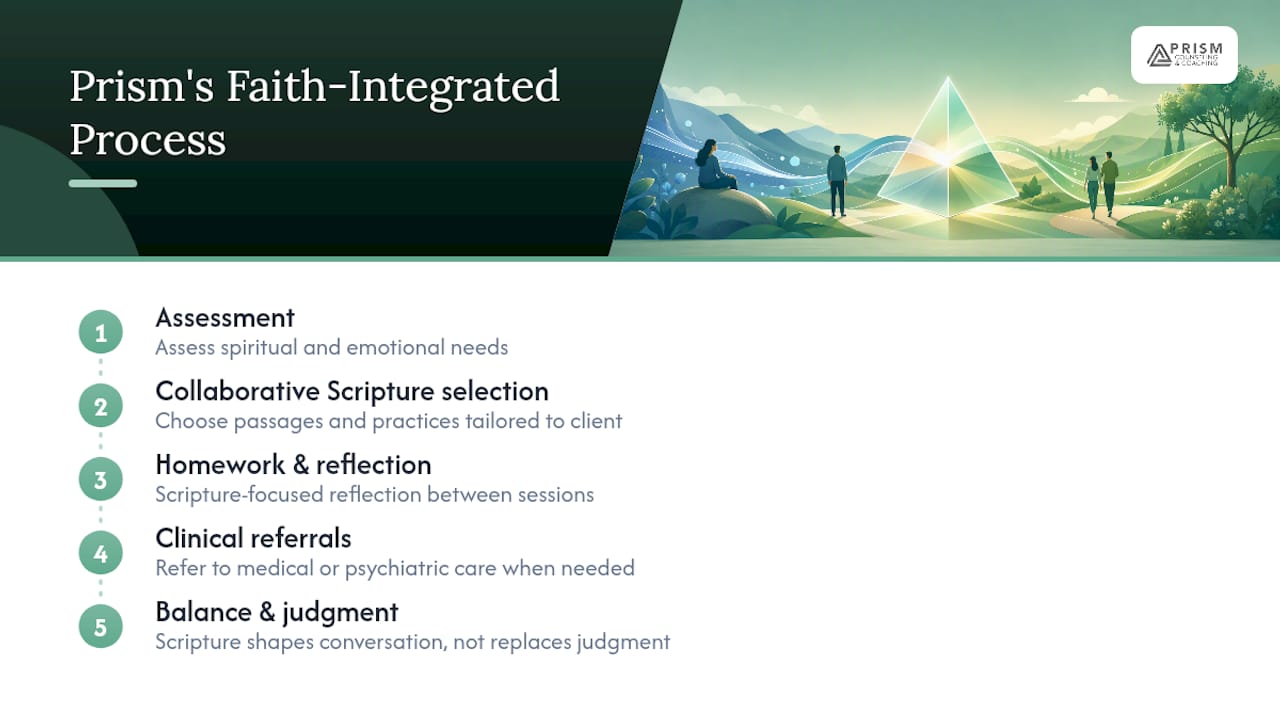
Prism Counseling & Coaching, based in the Phoenix area, offers one working model of how Scripture gets integrated into actual sessions, though it's far from the only valid way to do this work.
The general pattern starts with an honest assessment of what a client is carrying, spiritually and emotionally. From there, counselors collaborate with the client to identify passages and practices that fit their specific situation rather than applying a one-size-fits-all verse list. Homework often includes scripture-focused reflection between sessions, and when a client's needs point toward medical or psychiatric care, Prism's counselors build referral pathways into the process rather than treating faith and clinical care as competitors.
Faith-integrated counseling works best when Scripture shapes the conversation without replacing sound judgment about when someone needs additional clinical support.
Several of Prism's services explicitly build Scripture into the counseling relationship, including Christian counseling for individuals working through anxiety, depression, or identity struggles, and options for those who want the flexibility of online counseling rather than an in-person appointment. This is one client's example of how the model works in practice, not a claim that it's the only legitimate approach to faith-based care.
The Pastoral Heart Behind Scripture in Counseling
The goal of using Scripture in a counseling room was never to win an argument or prove a point. It's to walk alongside someone toward the kind of change that actually holds, the kind that comes from a changed heart rather than gritted-teeth compliance. Counselors who lean on Scripture well tend to hold their own conclusions loosely, because correction delivered without humility curdles into shame fast, and shame rarely produces the training in righteousness that 2 Timothy actually describes.
There's a real tension in this work between naming what's wrong and staying gentle enough that the person in front of you doesn't shut down. Prayer matters here as much as any verse chosen for the session, because change of the kind Scripture describes isn't something a counselor can manufacture through the right quote at the right time. It's slower than that, and it depends on something beyond technique.
Faith-Integrated Counseling Through Prism Counseling & Coaching
If reading through how Scripture works in counseling has you wondering what it would look like for your own situation, Prism Counseling & Coaching offers something most people can't get quickly through insurance-based practices: an opening within days, not weeks, because the practice runs on a small, private-pay model built for individualized attention rather than volume.
Prism serves individuals, couples, and families across the Phoenix area facing anxiety, depression, grief, trauma, and relationship strain, with counselors trained to integrate Scripture respectfully into the therapeutic process rather than treating faith as an afterthought. Services that build on the approach described throughout this article include Christian counseling for individual work, Christian marriage counseling for couples navigating conflict, and a growing library of counseling resources with articles and homework templates you can start using today. If you'd rather talk through your specific situation first, reach out to schedule a consultation and ask directly how Scripture would be incorporated into your care.
Sources
For readers who want to go deeper on any piece of this topic, these sources shaped the theological and practical grounding throughout this article.
- Bible, Belief & Truth: 2 Timothy 3:16–17 (Faith and Health Connection)
- Is Scripture Sufficient for Counseling? (CCEF)
- Four Purposes of Scripture When Counseling Others (Biblical Counseling Coalition)
- Biblical Counseling vs Therapy: What’s Right for You? (Share The Struggle)
This article is general information, not a substitute for advice from a qualified doctor. Consult a qualified healthcare professional about your own circumstances before acting on anything here.
Recommended
- Signs You Are Called to Christian Counseilng - Prism Counseling & Coaching | Faith-Based Counseling and Spiritually-Integrated Therapy in Peoria and Phoenix AZ
- Christian Counseling Resources | Articles, Videos, and Podcast Resources by Topic - Prism Counseling & Coaching | Faith-Based Counseling and Spiritually-Integrated Therapy in Peoria and Phoenix AZ
- Christian Counselor Job - Prism Counseling & Coaching | Faith-Based Counseling and Spiritually-Integrated Therapy in Peoria and Phoenix AZ