

Spiritually integrated therapy intentionally weaves a client's faith, beliefs, and spiritual practices into evidence-informed psychotherapy, and for those who want it, this often speeds up symptom relief. This isn't casual talk about faith during a session. It's a structured clinical approach, sometimes shortened to SIP, where a trained therapist assesses your spiritual life the way they'd assess your sleep or your relationships, then builds it into your treatment plan.
Research on this approach is still growing, but the early signals are encouraging. A practice-based evidence study following 1,227 clients found meaningful drops in psychological distress, with the sharpest gains showing up in the very first month of care.
Who tends to benefit most?
- People who want their beliefs actively included in healing, not set aside
- Clients wrestling with existential or meaning-centered pain, like "why did this happen to me?"
- Trauma survivors, when the approach lines up with their existing values and community
- Anyone who has felt unseen by therapy that ignored the spiritual dimension of their pain
That last point matters more than it might seem. Feeling unseen is often what keeps people from ever walking into a counselor's office in the first place.
Key Takeaways
Spiritually integrated therapy works best when a trained clinician formally assesses a client's beliefs and builds them into an evidence-informed treatment plan rather than treating faith as incidental.
| Point | Details |
|---|---|
| Early gains are common | Practice-based research on 1,227 clients found the steepest distress reduction in the first month of treatment. |
| Training separates SIP from casual faith talk | ACPE SIP requires formal didactic training plus additional hours of group or individual consultation, with recertification. |
| Spiritual struggle can slow progress | Unresolved spiritual distress, like anger at God, may need direct attention before symptoms fully improve. |
| Ethics require client-led goals | Trained clinicians avoid imposing beliefs and document spiritual interventions explicitly. |
| Prism Counseling & Coaching offers a trained, local option | Prism's counselors bring 14+ years of experience integrating faith ethically for Phoenix-area individuals, couples, and families. |
Table of Contents
- What Spiritually Integrated Therapy Looks Like in Session
- The Research Behind Spiritually Integrated Psychotherapy
- Techniques Therapists Actually Use in Practice
- What ACPE SIP Training Actually Requires
- Keeping Spirituality in Therapy Ethical and Client-Centered
- How to Find and Vet a Qualified Spiritually Integrated Therapist
- What Therapy Sessions Actually Look Like Week to Week
- Prism Counseling & Coaching: How We Practice Spiritually Integrated Therapy
- A Grounded Take on Where Spiritually Integrated Therapy Is Headed
- Ready to Talk to a Trained, Faith-Integrated Counselor?
- Frequently Asked Questions
- Sources
What Spiritually Integrated Therapy Looks Like in Session
A trained clinician doesn't guess at your beliefs. They ask. Spiritual assessment usually happens early, often in the first or second session, using open questions about your faith background, your current practices, and where you find meaning or struggle to find it. This isn't a checklist exercise. It shapes how the therapist builds your case conceptualization, meaning how they understand what's driving your symptoms and what resources might help you heal.
From there, spirituality gets woven into the actual work of therapy, not bolted on as an afterthought.
- Prayer or meditation, when requested. A therapist might invite a client to sit with a short guided prayer before processing a difficult memory, always with the client's consent and preference leading the way.
- Sacred-text reflection. For clients grounded in scripture, a therapist might explore a specific passage together, unpacking what it means to the client's current struggle rather than lecturing about doctrine.
- Meaning and virtue work. Borrowing from meaning-centered approaches, therapists help clients reconnect with purpose, especially useful for grief, chronic illness, or moral injury.
- Community linkage. Encouraging connection with a faith community, a pastor, or a support group as part of the broader healing plan, not as a replacement for therapy.
The best therapists treat these tools the way a carpenter treats a toolbox: not every job needs every tool, and the client decides which ones fit.
Pro Tip: If your therapist never asks about your spiritual life during intake, ask them directly whether they're comfortable incorporating it. A good clinician will welcome the question rather than deflect it.
The Research Behind Spiritually Integrated Psychotherapy
The clearest data point comes from a 2024 practice-based evidence study that tracked 1,227 clients across 164 practitioners in 37 clinical settings over an initial 12-week period. Distress dropped significantly, and the steepest improvement clustered in month one rather than building slowly over time.
Early gains, then a plateau pattern. Clients in spiritually integrated care most often see their biggest shift in the first four weeks, followed by more gradual, incremental progress through the rest of a 12-week course.
Broader literature backs this up in specific populations. Reviews and case-level evidence point to reduced depressive symptoms, anxiety, and PTSD symptoms among religiously aligned clients, particularly when the spiritually-informed approach to psychiatric care matches what the client already values. That last condition isn't a minor footnote. Mismatched spirituality, therapy that pushes beliefs a client doesn't hold, tends to backfire.
There's a wrinkle worth knowing about. Research on the reciprocal relationship between spiritual and psychological distress shows that clients carrying unresolved spiritual struggles, like anger at God or a sense of abandonment by their faith community, often improve more slowly unless a therapist addresses that struggle directly.
What the evidence doesn't yet cover as thoroughly:
- Long-term outcomes beyond the 12-week window most studies track
- Clients from minority faith traditions, who are underrepresented in current research
- Comparisons against standard therapy without any spiritual component, isolating the spiritual piece specifically
Honest evidence means naming the gaps, not just the wins.
Techniques Therapists Actually Use in Practice
Spiritually integrated therapy borrows heavily from established therapeutic models and adds a spiritual layer on top, rather than inventing something from scratch. A session might blend cognitive behavioral techniques with faith language, or pair somatic trauma work with prayer, depending entirely on what the client brings to the room.
Common techniques you might encounter:
- Values clarification through a faith lens, helping clients name what matters most to them using language drawn from their own tradition
- Forgiveness-focused interventions, carefully paced and never rushed, especially in cases involving betrayal or family rupture
- Gratitude and lament practices, giving equal room to thankfulness and honest grief, since meaning-centered approaches recognize both as part of healing
- Homework tied to spiritual disciplines, like a devotional reading paired with a journaling prompt connecting it to the week's therapeutic goal
- Cognitive reframing using scripture or spiritual narrative, where a client's belief system becomes the vehicle for challenging distorted thinking, not something therapy works around
None of this replaces evidence-based frameworks like CBT or trauma-focused approaches. It sits alongside them. Readers curious about how evidence-based therapy methods generally work will recognize a lot of overlap here, just with a spiritual thread running through the fabric.
A therapist worth trusting will check in regularly: does this technique still feel right to you? Beliefs shift, doubts surface, and good SIP practice tracks that movement instead of assuming day-one preferences hold steady forever.
What ACPE SIP Training Actually Requires
Not every therapist who mentions faith in session has real training in spiritual integration. That distinction matters, and it's worth understanding what formal credentialing looks like.
The ACPE Spiritually Integrated Psychotherapy program-trainer-certification) structures training across two levels, each requiring 15 hours of didactic instruction, for 30 hours total. On top of that, clinicians complete roughly 20 hours of group or individual consultation, working through real cases under supervision. Recertification keeps the credential current rather than treating it as a one-time achievement.
Spiritually integrated practice is a formalized, competency-based skill set, distinct from simply being comfortable discussing faith. The ACPE draws that line clearly: informal comfort with the topic is not the same as trained competency.
After completing this training, clinicians should demonstrate specific, observable skills:
- Conducting a structured spiritual assessment as part of intake
- Recognizing and managing spiritual countertransference, meaning the therapist's own beliefs bleeding into treatment decisions
- Addressing harmful or distorted religious messaging a client may carry
- Using personal spirituality as an interpretive resource without steering the client toward it
Why does this level of specificity matter? Because most clinicians never receive it. Surveys of mental health professionals show most receive little to no formal training on discussing spiritual or religious material during standard graduate education. A license alone doesn't guarantee this skill set. It's important to ask directly.
Keeping Spirituality in Therapy Ethical and Client-Centered
Spirituality entering the therapy room carries real risk if it's handled poorly. The biggest one: a therapist quietly steering a client toward the therapist's own beliefs instead of following the client's lead. Ethical SIP practice guards against that with cultural humility, meaning the therapist stays curious about beliefs unlike their own rather than treating their own tradition as the default standard.
Watch for these warning signs:
- A therapist who pushes a specific theology rather than exploring your own
- Pressure to attend a particular church, group, or practice as a condition of continued care
- Discomfort or dismissiveness when you express doubt or a different tradition than the therapist's own
- No mention of informed consent around how spirituality will factor into your treatment plan
Documentation and supervision matter here too. Clinicians trained in SIP competencies are expected to name spiritual interventions explicitly in treatment notes and revisit consent regularly, not assume a one-time conversation covers it forever.
Pro Tip: If a therapist ever makes you feel like your doubts are a problem to be fixed rather than something worth exploring together, that's a signal to look elsewhere.
How to Find and Vet a Qualified Spiritually Integrated Therapist
Finding the right fit takes a few deliberate steps rather than a Google search and a hope.
- Confirm the clinical license first. A therapist needs a standard mental health license (LPC, LCSW, LMFT, or psychologist) before spiritual training even enters the conversation.
- Ask about specific spiritual integration training. Don't accept "I'm a person of faith" as an answer. Ask whether they've completed ACPE SIP training or an equivalent supervised program.
- Request a consultation call. Most clinicians offer a short intro call. Use it to ask how they'd handle a client whose beliefs differ from their own.
- Ask how they document spiritual interventions. A trained clinician will have a clear, matter-of-fact answer here, not a vague shrug.
- Watch how they respond to your specific tradition. A well-trained therapist adapts language and technique to your beliefs rather than applying a one-size-fits-all spiritual framework.
- If you can't find one locally, ask about telehealth options. Trained SIP clinicians are still relatively rare, and many now offer virtual sessions to widen access.
Red flags to walk away from: vague answers about training, resistance to your questions, or any suggestion that "results" depend on how devout you are. Given the education gap in this specific area, it's worth prioritizing therapists who can name their training rather than assuming good intentions equal competence.
What Therapy Sessions Actually Look Like Week to Week
A typical spiritually integrated session follows a familiar shape: check-in, a focused intervention tied to your treatment goals, then integration and homework. What changes is the content, not the structure. A session addressing anxiety might still use grounding techniques borrowed from standard therapy modalities for anxiety and depression, just framed through language and practices meaningful to you.

Timeline expectations track closely with what the research shows: many clients notice initial shifts within the first month, with steadier, smaller gains continuing through a 12-week course of care.
Clinicians typically track progress using:
- Standard measures like the PHQ-9 for depression symptoms
- Session-by-session outcome surveys measuring overall distress
- Spiritually focused check-ins gauging whether faith feels like a resource or a source of struggle that week
If progress stalls past the 12-week mark, that's the natural point to revisit the plan together, not push forward on autopilot.
Prism Counseling & Coaching: How We Practice Spiritually Integrated Therapy
For over 14 years, Prism Counseling & Coaching has offered faith-based counseling and spiritually integrated therapy across the Phoenix area, serving individuals, couples, families, and teens.
- Trauma-informed care alongside spiritually integrated approaches, tailored to what each client's faith actually means to them
- LGBTQ+ affirming counseling delivered with the same care and respect as every other service
- A private-pay model that protects confidentiality and typically opens appointments within days, not weeks
- Counselors trained specifically in weaving faith ethically into evidence-informed treatment, rather than treating spirituality as an afterthought
If you want to see how this looks for individual clients specifically, our services for individuals page walks through intake, common concerns, and scheduling.
A Grounded Take on Where Spiritually Integrated Therapy Is Headed
The conventional wisdom treats "faith-friendly therapy" as a soft, feel-good add-on. That framing undersells it. The practice-based evidence on symptom reduction in the first month suggests something more clinically serious is happening when spirituality gets integrated well, not just tolerated.
Where the field falls short is training. Most clinicians still enter practice without any formal preparation for this work, which means the burden of vetting falls on clients who are often too vulnerable to interrogate credentials carefully. That's backward. The ACPE SIP competencies exist precisely because informal comfort with faith talk isn't the same skill as managing spiritual countertransference or catching harmful religious messaging.
If you take one thing from this, prioritize training over vibe. A warm, faith-affirming therapist without documented competency is still a gamble. One with real supervised hours behind them, like the model Prism Counseling & Coaching has built over 14 years in Phoenix, gives you both the comfort and the clinical rigor. Ask about the training first. The warmth tends to follow naturally when the competence is real.
Ready to Talk to a Trained, Faith-Integrated Counselor?
If you've read this far, you're likely looking for something specific: a therapist who won't make you choose between your faith and real clinical care. That's the exact gap Prism Counseling & Coaching was built to close in the Phoenix area, with counselors who bring both licensed clinical training and genuine competency in spiritual integration, not a weekend seminar's worth of familiarity.
Because Prism operates on a private-pay model, most new clients find an opening within days rather than waiting weeks through an insurance queue, with the added privacy that comes from a small, dedicated practice. Whether you're navigating anxiety, grief, trauma, or a season where your faith feels shaken rather than steady, our Christian counseling services page outlines exactly how sessions work and how to get started. If you'd rather explore before booking, our resource library has articles, videos, and podcast episodes covering many of the concerns raised in this piece. Reach out this week and see what an opening looks like.
Frequently Asked Questions
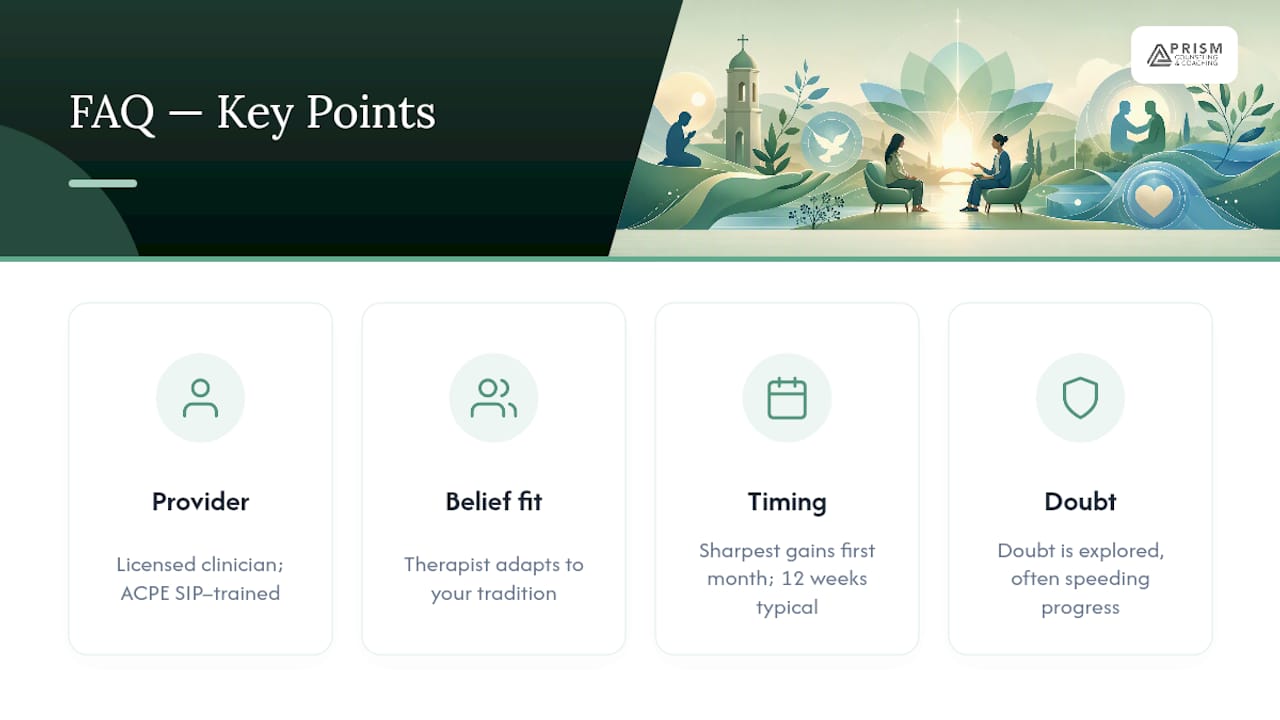
Is spiritually integrated therapy the same as pastoral counseling? No. Pastoral counseling is typically provided by clergy without a mental health license, while spiritually integrated therapy is delivered by a licensed clinician who has also completed specific training, often through the ACPE SIP program, in ethically weaving spirituality into clinical care.
Do I need to share my therapist's religious beliefs for this to work? Not at all. A well-trained clinician adapts to your tradition and values rather than requiring alignment with their own. If a therapist ever suggests otherwise, that's worth questioning directly.
How long before I notice a difference? Practice-based research on over a thousand clients found the sharpest improvement in the first month, with more gradual progress continuing through a typical 12-week course of care.
Can this approach help with trauma specifically? Case-level evidence suggests meaning-centered, spiritually informed care can support trauma recovery when paired with standard psychiatric stabilization, particularly for clients whose distress carries an existential or moral dimension.
What if I have doubts about my faith? Will that be treated as a problem? A trained therapist treats doubt as material worth exploring, not something to correct. Research on spiritual struggle actually shows addressing those doubts directly can speed up overall progress rather than derail it.
This article is general information, not a substitute for advice from a qualified doctor. Consult a qualified healthcare professional about your own circumstances before acting on anything here.
Sources
- Practice-based evidence for spiritually integrated psychotherapies (Journal of Counseling Psychology / PubMed entry)
- Integrating meaning and purpose: A spiritually-informed approach to psychiatric care (PMC case report / review)
Recommended
- Spiritual Care Today Podcast - Prism Counseling & Coaching | Faith-Based Counseling and Spiritually-Integrated Therapy in Peoria and Phoenix AZ
- ACPE Spiritual Care Specialist Program - Prism Counseling & Coaching | Faith-Based Counseling and Spiritually-Integrated Therapy in Peoria and Phoenix AZ
- Prism Counseling & Coaching | Faith-Based Counseling and Spiritually-Integrated Therapy in Peoria and Phoenix AZ - Ask a Christian Counselor Podcast
- SCS Application - Prism Counseling & Coaching | Faith-Based Counseling and Spiritually-Integrated Therapy in Peoria and Phoenix AZ