

Yes, therapy is confidential in nearly every case. What you say in session, your diagnosis, and even the fact that you're a client stays protected by law and by professional ethics codes. The exceptions are narrow, specific, and rooted in safety rather than convenience. A therapist won't break your trust because a conversation gets uncomfortable. They'll only step outside confidentiality when the law requires it or when someone's safety genuinely depends on it.
HIPAA sets the federal floor for how mental health information is protected, but state law fills in the specifics, and those specifics vary more than most people realize.
The main situations where confidentiality has legal limits:
- Imminent danger to yourself (suicidal intent with a plan, not passing thoughts)
- Duty to warn when there's a specific, identifiable threat to another person
- Suspected child, elder, or dependent-adult abuse
- A valid court order or subpoena compelling disclosure
Quick fact: Federal HIPAA law creates national baseline protections, but the exact circumstances requiring mandatory disclosure, like what counts as "imminent" risk, are defined by state law, not federal law.
Key Takeaways
Therapy confidentiality is the legal and ethical default, and it only gives way to narrow, clearly defined exceptions involving imminent safety risk or specific legal mandates.
| Point | Details |
|---|---|
| Confidentiality is the baseline | Session content, diagnosis, and even client status stay private unless a specific legal exception applies. |
| Exceptions are narrow | Imminent danger to self, identifiable threats to others, suspected abuse, and valid court orders are the main triggers. |
| Psychotherapy notes get extra protection | These require separate authorization beyond your general medical record release under HIPAA. |
| Insurance sees less than you think | Insurers typically get diagnosis codes and billing details, not session transcripts or psychotherapy notes. |
| Ask questions before you disclose | Confirm platform encryption, note-keeping practices, and disclosure policies at intake, not after a crisis arises. |
Table of Contents
- What Stays Private in Therapy
- Legal and Ethical Exceptions: Danger, Duty to Warn, Abuse, and Subpoenas
- Psychotherapy Notes vs. the Medical Record
- What Your Insurer or Employer Might Actually See
- Teletherapy, Texting, and Digital Privacy
- Confidentiality for Minors: What Parents and Teens Should Know
- How Therapists Decide When to Disclose
- Protecting Your Own Privacy in Therapy: Questions and Choices That Matter
- Why Prism Counseling & Coaching Takes This Seriously
- Mandatory Reporting Beyond Abuse: Infectious Disease and Other Exceptions
- What Happens If Your Confidentiality Is Breached
- Confidentiality After Therapy Ends: Records and Retention
- Confidentiality in Couples, Family, and Group Therapy
- What Actually Matters Most in This Conversation
- Sources
What Stays Private in Therapy
Here's the honest, grounding answer: almost everything. Your therapist is bound to protect not just what you say, but the fact that you're in therapy at all. If a family member, an employer, or even a well-meaning neighbor calls your therapist's office asking, "Is she seeing you?" the standard, ethical response is to neither confirm nor deny that you're a client. That silence isn't evasiveness. It's the protection working exactly as it should.
What's generally covered under therapy confidentiality:
- The content of your sessions, including what you disclose about your history, relationships, or struggles
- The fact that you are or have ever been a client
- Your diagnosis and treatment plan
- Your contact information and appointment details
- Any records your therapist keeps about your care
This protection exists because therapy only works when you can be honest. The American Psychological Association frames this as "relational safety," the sense that what happens in the room stays in the room so you can actually say the hard things out loud. That's also why most clinicians deliberately avoid connecting with clients on social media or acknowledging them in public unless the client initiates it first. It's not coldness. It's boundary-keeping in service of your trust.
Confidentiality doesn't mean isolation, though. If you want your therapist to coordinate with your psychiatrist, your primary care doctor, or even a spouse or parent, you can authorize that. This usually happens through a signed release of information, a document that names exactly who can receive what, and for how long. You control that release. You can narrow it, expand it, or revoke it later. Nothing gets shared with another provider or family member without your written permission unless a legal exception applies.
Pro Tip: Ask your therapist directly, in your first session, "What would you tell someone if they called asking whether I'm your client?" Their answer tells you a lot about how seriously the practice takes confidentiality before you've disclosed anything sensitive.
If you're wondering whether therapeutic privacy extends to insurance companies, family members who are paying for sessions, or even other therapists at the same practice, the short answer is: it depends on consent, and we'll walk through each of those situations later in this guide. For now, understand the baseline. Privacy is the default. Disclosure is the exception, and a narrow one at that.
Legal and Ethical Exceptions: Danger, Duty to Warn, Abuse, and Subpoenas
Every exception to confidentiality in counseling exists for one reason: preventing serious, foreseeable harm. None of them exist to punish you for what you say or to give your therapist an easy way out of a hard conversation.
-
Danger to yourself. A therapist can break confidentiality when there's an imminent risk of suicide, meaning specific intent, a plan, and the means to carry it out. Passive thoughts like "sometimes I wonder if life is worth it" don't trigger mandatory disclosure. Most therapists respond to those thoughts with a safety plan built collaboratively with you, not a phone call behind your back. The threshold for breaking confidentiality is high on purpose, so people feel safe enough to talk about dark thoughts without fearing immediate consequences.
-
Duty to warn, duty to protect. This is the exception most people have heard of but few understand correctly. It traces back to the 1976 California Supreme Court case Tarasoff v. Regents of the University of California, which established that therapists have a duty to protect identifiable victims from credible threats made by a client. The key word is identifiable. General anger, venting, or hypothetical statements ("I could just kill him") don't usually meet the legal bar. The duty to warn requires a specific, named or clearly identifiable person and a credible, imminent threat, not an emotional outburst.
-
Mandatory abuse reporting. Therapists in all states are legally required to report suspected child, elder, or dependent-adult abuse. The standard is reasonable suspicion, not certainty or proof. If you disclose that a child in your life is being harmed, your therapist doesn't need photographic evidence to file a report; they need a reasonable basis for concern. Reporting timelines and specific definitions vary by state, but the underlying obligation is close to universal.
-
Court orders and subpoenas. A judge can compel a therapist to release records or testify, most often in custody disputes, personal injury cases, or criminal proceedings. This is the exception clients misunderstand most. A subpoena alone doesn't always mean records get released. Therapists and their legal counsel often push back, asking a judge to limit the scope of what's disclosed, arguing for a protective order, or releasing only what's directly relevant to the legal question at hand.
A subpoena is a request compelled by the legal process, not an automatic hand-over. Many therapists, working with an attorney, will fight to narrow what a court actually sees, disclosing summary information rather than full session notes whenever the law allows it.
If you're facing a custody battle or a lawsuit where your therapy records might become relevant, this is exactly the moment to talk to your therapist and possibly a family law attorney before any subpoena arrives. Once one lands on your therapist's desk, your options narrow considerably.
Psychotherapy Notes vs. the Medical Record
Not all therapy documentation is created equal under the law, and this distinction matters more than most clients realize.
Under HIPAA, "psychotherapy notes" are a specially protected category, separate from your general medical record. These are the private, process-oriented notes a therapist keeps for their own reference: hypotheses about what's driving your behavior, details of a specific technique used in session, or personal impressions that help guide treatment. They typically exclude medication details, session start and stop times, treatment modalities, or clinical summaries needed for billing.
That distinction isn't a technicality. HHS guidance confirms that psychotherapy notes require separate, specific authorization for release in nearly every circumstance, even when you've already signed a general release for your medical records. A general authorization to share "my records" with your primary care doctor typically does not include these notes unless you specifically say so.
Key distinction: Your standard medical record, the one insurers can request, usually contains diagnosis codes, dates of service, and billing information. It does not usually include the detailed content of what you said in session.
- Psychotherapy notes: private clinical impressions, kept separately, require specific authorization
- Medical record: diagnosis, treatment plan summary, dates of service, billing codes
- Insurers typically see: the medical record, not psychotherapy notes
- Courts can, in some circumstances, compel access to either, depending on state law and the nature of the case
In rare cases, a therapist may even withhold psychotherapy notes from you, the client, if releasing them would cause substantial harm to you or someone else, though state rules on this vary. This isn't common, but it exists as a safeguard, not a loophole for hiding information from you.
What Your Insurer or Employer Might Actually See
If you're using insurance to pay for therapy, your privacy isn't gone, but it isn't absolute either. Understanding the difference matters.
Every time your therapist bills your insurance, an Explanation of Benefits (EOB) typically gets generated and sent to the policyholder, which might be you, a parent, or a spouse if you're on someone else's plan. That EOB usually lists the date of service, the provider's name, and a billing code indicating the type of service (individual therapy, family session, and so on). It generally does not include what you discussed.
Here's what typically happens with insurance-based therapy:
- Insurers receive diagnosis codes, treatment dates, and billing information to process claims
- Insurers do not typically receive psychotherapy notes or session transcripts
- If you're a dependent on a family policy, the policyholder may see that services occurred, even if they can't see details
- Employee Assistance Programs (EAPs) generally report only de-identified, aggregated usage data to employers, such as "40 employees used counseling services this quarter," not who used them or why
This is precisely why some clients choose to pay privately rather than run therapy through insurance. Paying out of pocket means no EOB gets generated, no diagnosis code gets filed with a third party, and no claim history exists that a future insurer or employer could ever request. It's one of the more overlooked reasons private-pay practices appeal to people juggling sensitive family, career, or legal circumstances.
Teletherapy, Texting, and Digital Privacy
Online counseling has changed what confidentiality has to account for. It's no longer just about a closed office door, it's about encryption, platform security, and where your data physically lives.
"HIPAA-compliant" telehealth platforms are required to use encrypted video and secure data storage, and to sign a business associate agreement with the practice. What that label doesn't guarantee is that every communication method around your therapy is equally protected. A therapist using a HIPAA-compliant video platform for sessions but texting appointment reminders from a personal cell phone, or emailing you through a regular Gmail account, is creating a gap in the protection.

Unencrypted text messages and personal email are two of the more common, avoidable weak points in therapy confidentiality. If a practice sends anything clinical, not just scheduling, through unsecured channels, that's worth asking about directly.
If a practice does experience a data breach, HIPAA requires notification to affected clients, and in significant breaches, to HHS and sometimes the media, within specific timeframes. You have a right to know if your information was exposed.
Questions worth asking before starting teletherapy:
- Is the video platform encrypted and HIPAA-compliant, specifically?
- Are sessions ever recorded, and if so, who can access the recording and for how long?
- How long are session records retained, and where are they stored?
- What method is used for appointment reminders and non-clinical communication?
Pro Tip: If a practice can't clearly answer what happens to your data if their systems are ever breached, that's a signal to ask more questions before booking, not after. Prism-counseling addresses these protocols directly for clients considering online Christian counseling, including how sessions are secured and how records are handled remotely.
Confidentiality for Minors: What Parents and Teens Should Know
This is one of the more emotionally loaded corners of therapeutic privacy, and for good reason. A teenager needs enough privacy to be honest. A parent needs enough information to feel like a responsible guardian. Those two needs don't always align neatly.
Under HIPAA, parents are typically considered a minor's "personal representative," which generally gives them the right to access their child's records. But state law frequently complicates this. Many states grant minors, particularly teens above a certain age, the right to consent to their own mental health treatment for specific issues like substance use or reproductive health, without parental notification. Peer-reviewed research on confidentiality in therapeutic relationships points out just how much these consent ages and rules vary by state and by service type, which is why blanket assumptions rarely hold up.
In practice, most clinicians handle this by setting clear ground rules at intake, with both the parent and the teen in the room. A common agreement sounds something like: "I won't share the specifics of what your child tells me, but I will let you know if I have serious safety concerns." That transparency upfront tends to build trust with both parties rather than creating suspicion later.
Exceptions still apply. If a minor discloses suicidal intent, abuse, or another safety-critical issue, a therapist will typically involve a parent or guardian regardless of the general privacy agreement.
If you're a parent wondering how much you'll be told, or a teen wondering how much stays private, ask the clinician directly at the first appointment: "What exactly would you tell my parent (or me) if something concerning came up?" A therapist who can answer that clearly, before treatment starts, is one worth trusting with the harder questions later.
How Therapists Decide When to Disclose
Breaking confidentiality is never a snap decision. Ethical therapists follow a structured process, even in urgent moments, because getting it wrong in either direction carries real consequences for the client's safety and their trust.
-
Risk assessment first. The therapist evaluates how specific, immediate, and credible the threat actually is. Vague statements get explored further in conversation. Specific plans with means and timeline move toward action.
-
Consultation, when time allows. Many clinicians consult a supervisor, a colleague, or legal counsel before disclosing anything, particularly in ambiguous cases. This isn't stalling. It's a safeguard against overreacting to something that doesn't actually meet the legal threshold.
-
Client involvement whenever safety allows. Whenever it's possible without increasing danger, an ethical therapist tells the client what they're about to do and why, before doing it. Involving the client in the process, rather than disclosing behind their back, is standard ethical practice except in the rare cases where advance notice itself would raise risk.
-
Documentation of the reasoning. Every step of that decision, what was assessed, who was consulted, why action was or wasn't taken, gets documented. This protects the client's record and the clinician's accountability.
The goal isn't disclosure for its own sake. It's disclosing the minimum amount of information, to the minimum number of people, necessary to keep someone safe, whether that's a call to emergency services with a name and address, or a report to a child protective services hotline with only the relevant facts.
Protecting Your Own Privacy in Therapy: Questions and Choices That Matter
You have more control over your privacy than most people assume. It starts with asking the right questions before you ever sign an intake form.
-
Ask directly at intake: "Who else in this practice can see my records?" "Do you keep separate psychotherapy notes?" "What platform do you use for telehealth, and is it encrypted?"
-
Read your informed consent form line by line. This document should spell out exactly when confidentiality can be broken and how records are stored. If something's unclear, ask before signing, not after.
-
Request limited authorizations, not blanket ones. If you want your therapist to speak with your psychiatrist about medication only, say so specifically. A release can be as narrow as one topic and one recipient, with an expiration date you control.
-
Consider private-pay if insurer visibility worries you. Paying out of pocket removes the paper trail that comes with filing insurance claims, since no diagnosis code or claim history gets shared with a third party when you're not billing insurance.
-
Consult an attorney before a legal matter touches your therapy. If you're in a custody dispute or anticipate litigation where your records might be relevant, talk to a family law attorney and your therapist together, ideally before any subpoena is issued, not after.
Pro Tip: Write down your specific privacy concerns before your first appointment and hand them to your therapist directly. "I need you to know I'm in a custody case" or "please don't leave voicemails at this number" takes the guesswork out of protecting what matters most to you.
If you're considering individual counseling, these are exactly the questions worth raising during your first conversation, before any sensitive history gets shared.
Why Prism Counseling & Coaching Takes This Seriously
We've built our practice around a simple conviction: people won't be honest about their pain if they're worried it will travel further than the room they're sitting in. Over more than 14 years of walking alongside individuals, couples, and families in the Phoenix area, we've seen how much trust depends on getting the quiet details right, not just the big legal ones.
Our private-pay model isn't just about faster access, though it does mean clients typically get an opening within days instead of waiting on insurance authorizations. It also means fewer third parties ever touch your file. No insurance claim, no diagnosis code sent to a payer, no EOB landing in someone else's mailbox.
What this looks like in practice:
- Clear, specific consent conversations before any information is ever shared with another provider or family member
- Teletherapy sessions run through encrypted, secure platforms, with clear answers about recording and data retention
- Faith-integrated care that respects both your spiritual convictions and your right to decide who hears about your journey
- A small, private-pay structure that limits the number of hands your records ever pass through
Privacy, for us, isn't paperwork. It's part of how healing actually happens.
Mandatory Reporting Beyond Abuse: Infectious Disease and Other Exceptions
Abuse reporting gets most of the attention, but it isn't the only mandatory reporting obligation that can touch therapeutic privacy. Some states require healthcare providers, including certain mental health clinicians, to report specific communicable diseases to public health authorities. This typically applies to conditions like active tuberculosis or certain sexually transmitted infections, and it usually falls more heavily on medical providers than talk therapists, but the overlap can catch clients off guard.
There's also a narrower, more debated version of this issue: in some states, if a client discloses that they're engaging in behavior that could knowingly expose an identifiable third party to a serious infectious disease, that can intersect with duty-to-warn style obligations, similar in spirit to the Tarasoff framework. The details here vary significantly by state and are far less standardized than child abuse reporting.
The practical takeaway is this: mandatory reporting isn't a single, fixed list. It's a patchwork of state-specific public health and safety laws that sit alongside HIPAA's federal privacy floor. If you have a specific health condition you're worried about disclosing, it's reasonable to ask your therapist directly, before you share it, what their state's reporting obligations actually require.
What Happens If Your Confidentiality Is Breached
You have real rights if your therapy confidentiality is violated, whether through negligence, a technology breach, or an ethical lapse by the clinician.
If a licensed therapist improperly discloses your information, you can typically file a complaint with the state licensing board that oversees their profession, and in cases involving HIPAA violations, with the HHS Office for Civil Rights, which investigates covered-entity breaches. Licensing boards can discipline, fine, or in serious cases revoke a clinician's license for confidentiality violations. That's not a hollow threat; it's an active enforcement mechanism clients can use.
Therapists, for their part, carry a legal and ethical obligation to notify you if your information was breached, particularly under HIPAA's breach notification rule, which requires disclosure within specific timeframes depending on the scope of the breach. You're also generally entitled to request an accounting of disclosures, meaning a record of who your information was shared with and why, outside of routine treatment and payment activities.
If you believe your confidentiality has been violated, document exactly what happened, when, and who was involved, then raise it directly with the practice first. If that doesn't resolve it, a formal complaint to the licensing board or HHS OCR is the next step. You are not powerless in this, and the systems exist precisely because breaches, while rare, do happen.
Confidentiality After Therapy Ends: Records and Retention
Confidentiality doesn't expire the moment you stop attending sessions. Your therapist's ethical and legal obligations to protect your records continue well beyond termination, though how long those records are kept varies by state and by licensing board requirements, often somewhere between seven and ten years for adults, and longer for records involving minors.
When therapy ends, whether by mutual agreement, a client's choice, or a referral elsewhere, ethical practice typically includes a conversation about what happens to your file. If you switch therapists, your prior records don't transfer automatically. You'll need to sign a release authorizing the new provider to request them.
One detail people rarely think about until it matters: if a therapist retires, closes a practice, or passes away, there are typically state-mandated procedures for transferring or securely destroying client records, often through a designated records custodian. If you're working with a solo practitioner, it's reasonable to ask what their continuity plan is. A well-run practice will have a clear answer.
Confidentiality in Couples, Family, and Group Therapy
Confidentiality gets more complicated the moment more than one person is in the room, and this is where a lot of clients get surprised.
In couples or family therapy, the "client" is often the relationship or the family system, not any single individual. This changes how confidentiality works. Many therapists set an explicit "no secrets" policy at the start: if one partner shares something privately in an individual session (an affair, for example), the therapist may decline to continue couples work while holding that secret, precisely because it would undermine the honesty the joint sessions depend on. Other clinicians take a different approach and will hold individual confidences unless safety is at risk. Ask which model your therapist uses before you disclose anything privately within a couples or family framework.
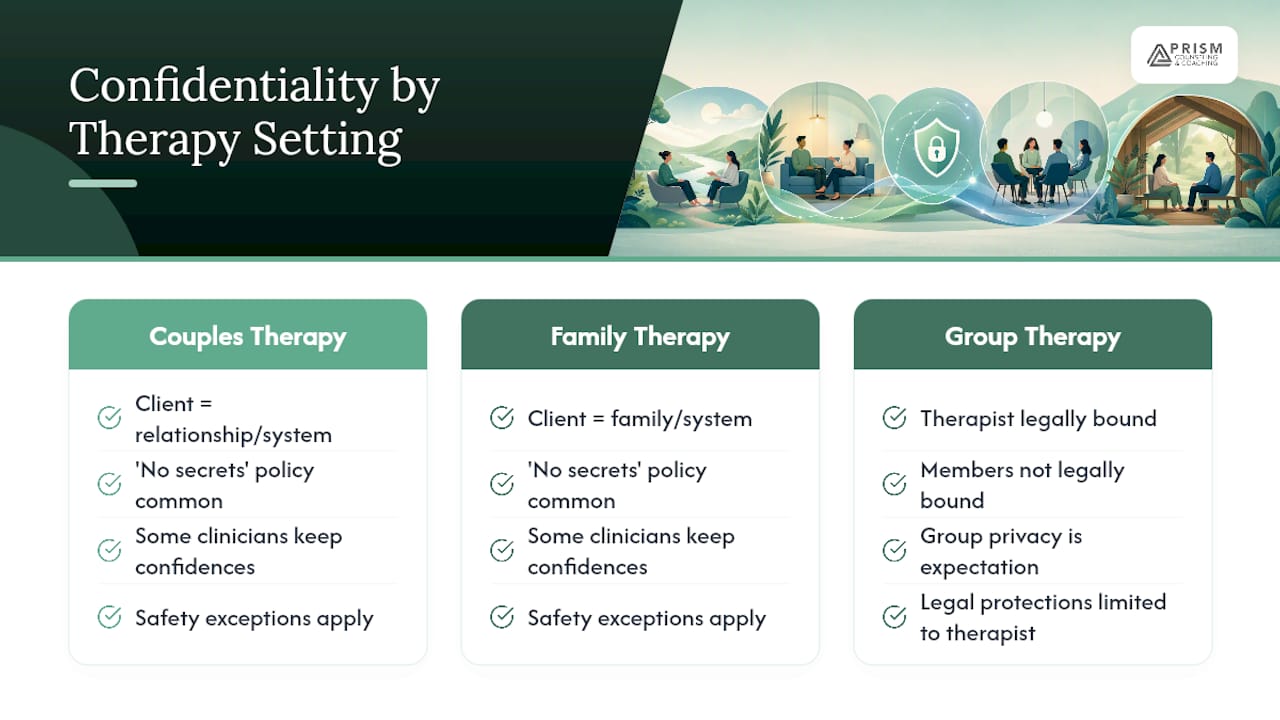
Group therapy raises a different challenge entirely. The therapist is still bound by full confidentiality rules, but other group members are not licensed professionals, and their promise to keep what's shared private is an ethical expectation the group agrees to, not a legally enforceable one. A skilled group facilitator sets this expectation clearly at the outset and revisits it regularly, but it's worth knowing that the legal protections around individual therapy don't extend the same way to your fellow group members.
What Actually Matters Most in This Conversation
Most explainers on this topic bury the useful part under legal jargon, and that's a disservice. The technical distinctions, HIPAA versus state law, psychotherapy notes versus the medical record, matter less to most people than one practical question: what will my therapist actually do if something sensitive comes up? That's the question intake forms rarely answer plainly, and it's the one worth asking out loud.
The conventional advice tends to stop at "therapy is confidential, don't worry." That's technically true and practically incomplete. Confidentiality has edges, and knowing exactly where those edges sit, before you need to test them, is what actually builds trust in the process. A therapist who explains their disclosure process clearly, unprompted, is showing you something more valuable than a privacy policy. They're showing you how they think under pressure.
If you take one thing from this, let it be this: ask the hard questions early. Privacy isn't something you hope for in therapy. It's something you can actually verify, one direct conversation at a time.
— Tres
This article is general information, not a substitute for advice from a qualified doctor. Consult a qualified healthcare professional about your own circumstances before acting on anything here.
Sources
For readers who want the primary sources behind these protections, start with official federal guidance and professional standards rather than secondhand summaries.
- Protecting your privacy: Understanding confidentiality in psychotherapy — APA
- A Matter of Trust: Confidentiality in Therapeutic Relationships — PMC
- Exceptions to confidentiality in counseling — SimplePractice
Recommended
- Church Sponsorship - Prism Counseling & Coaching | Faith-Based Counseling and Spiritually-Integrated Therapy in Peoria and Phoenix AZ
- Therapist Opening - Prism Counseling & Coaching | Faith-Based Counseling and Spiritually-Integrated Therapy in Peoria and Phoenix AZ
- My Journey Through Conversion Therapy | A Pastor and Counselor's Experience - Prism Counseling & Coaching | Faith-Based Counseling and Spiritually-Integrated Therapy in Peoria and Phoenix AZ
- Prism Counseling & Coaching | Faith-Based Counseling and Spiritually-Integrated Therapy in Peoria and Phoenix AZ - Ask a Christian Counselor Podcast