

Trauma healing with a faith-based approach is a recovery process that combines clinical psychology and spiritual care to address both emotional wounds and damage to one's relationship with God. Spiritually integrated therapy, the recognized clinical term for this practice, treats trauma as a whole-person experience. It does not separate the psychological from the spiritual. Frameworks like the Dual-Language Theory position Scripture and psychology in covenantal dialogue, allowing each to inform the other. For people whose faith is central to their identity, this integration is not optional. It is the difference between partial recovery and genuine healing.
What is the clinical framework behind trauma healing with a faith-based approach?
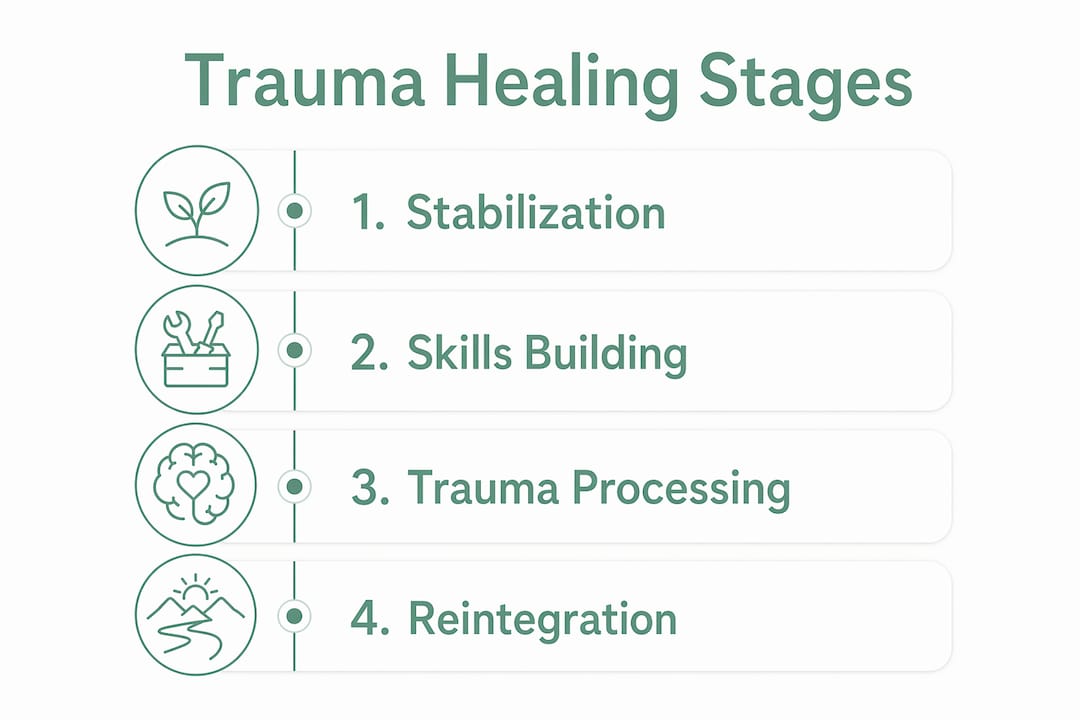
Spiritually integrated therapy follows a structured, four-stage clinical roadmap: Stabilization, Skills building, Paced trauma processing, and Integration. This sequence prevents re-traumatization by building safety and coping capacity before a person ever revisits painful memories. Skipping stabilization and moving straight to trauma processing is one of the most common mistakes in both secular and faith-based care.
The Dual-Language Theory adds a layer that secular therapy cannot provide. It holds that Scripture governs meaning-making while psychology supplies the behavioral and neurological tools for change. A counselor working within this model might use cognitive processing techniques to address shame, then anchor the reframe in the theological concept of imago Dei, the belief that every person bears the image of God. That combination reaches places that either language alone cannot.
Trauma also creates what clinicians call spiritual wounds. These are distortions in a person's image of God, often formed when abuse, loss, or betrayal occurred within a religious context. Spiritual wounds affect both physiological responses and faith, meaning a survivor may feel terror during prayer or numbness during worship without understanding why. Secular therapy addresses the nervous system response but misses the theological grief. Faith-based therapy addresses both.

Pro Tip: Ask a prospective counselor directly whether they are trained in both trauma-informed clinical methods and theology. A counselor who is strong in one but not the other will leave part of your healing unaddressed.
The table below shows how the four clinical stages map to spiritual goals in an integrated approach.
| Clinical stage | Spiritual focus |
|---|---|
| Stabilization | Rebuilding a sense of safety with God and self |
| Skills building | Developing prayer, grounding, and community practices |
| Paced trauma processing | Grieving spiritual losses and confronting distorted God-images |
| Integration and future planning | Reclaiming faith identity rooted in grace, not performance |
How can you heal religious trauma step by step?
Healing religious trauma step by step requires both structure and patience. The process is not a straight line, and no two people move through it at the same pace. What matters is that each step builds on the one before it.
-
Name the experience. Healing begins when you call what happened by its real name. Religious trauma includes spiritual abuse, coercive control within a faith community, and theology weaponized to produce shame. Naming it removes the confusion that keeps many people stuck.
-
Set boundaries with triggers and toxic environments. Recalibrating spiritual instincts after a harmful religious environment is a core recovery task. This may mean stepping back from a specific church, a particular leader, or certain worship practices while you heal. Boundaries are not rejection of God. They are protection of your healing process.
-
Explore your identity apart from harmful belief systems. Many survivors of religious trauma built their entire sense of self around a system that hurt them. Therapy creates space to ask: Who am I when I remove the performance, the fear, and the shame? Theology offers an answer rooted in grace. Psychology offers tools to internalize it.
-
Replace performance-based thinking with grace-based identity. Six practical steps for healing religious trauma consistently include this shift. Performance-based faith says your worth depends on what you do. Grace-based identity says your worth is given, not earned. Making that shift at a felt level, not just an intellectual one, takes time and skilled support.
-
Engage trauma-informed counseling and community. Professional care is not a sign of weak faith. It is a practical, necessary step. A counselor trained in both psychology and theology can guide you through stages that self-help resources cannot safely navigate.
-
Practice patience with the non-linear process. Healing moves in cycles. You may feel significant progress, then encounter a setback triggered by a song, a sermon, or a season. That is normal. It does not mean you are failing.
Pro Tip: Keep a simple journal during your healing process. Write one sentence each day about what felt safe and one about what felt hard. Over weeks, patterns emerge that help both you and your counselor identify where you are in the process.
What challenges and misconceptions arise in faith-based trauma healing?
The most damaging misconception in faith-based trauma healing is that more faith alone will resolve trauma symptoms. Trauma's nervous system effects are "bottom-up" processes, meaning they live in the body's survival responses, not in conscious thought or belief. A person can hold deep, sincere faith and still experience flashbacks, hypervigilance, and emotional numbness. Telling a trauma survivor to "just pray more" misunderstands how trauma works neurologically.
Spiritual wounds create a specific kind of suffering that compounds this challenge. When trauma occurred within a religious context, the very practices meant to bring comfort, such as prayer, Scripture reading, and worship, can trigger the nervous system. Integrated treatments address both the physiological fight-or-flight response and the grief from faith damage. Treating only one dimension leaves the other unresolved.
Common obstacles people encounter include:
- The "period of darkness." Many survivors experience a season where faith feels shattered. This is not spiritual failure. It is a necessary part of honest grief before renewal can occur.
- Anger at God. Allowing anger and doubt to surface openly is not irreverence. It is the beginning of an honest relationship with God rather than a fearful one.
- Re-traumatization from rushed spiritual resolution. Pushing toward spiritual resolution too quickly can deepen wounds rather than heal them. Space and pacing matter enormously.
- Isolation. Many survivors withdraw from faith communities entirely, which removes a potential source of support. Finding a community that holds both clinical and spiritual awareness is worth the search.
"Seeking professional counseling is an act of spiritual stewardship, not a sign of spiritual weakness. Faith alone may not resolve trauma symptoms; combining faith with clinical care is how whole-person healing happens." — Complex Trauma in Christian Counselling & Faith Healing
This reframe matters. Many people delay getting help because they believe needing a counselor means their faith is insufficient. The opposite is true. Caring for your mind and body is caring for the life God gave you.
How do you find faith-based trauma healing support and community?
The right support combines licensed clinical training with genuine theological understanding. A counselor who is clinically skilled but spiritually indifferent will miss the spiritual dimension of your pain. A pastor who is spiritually warm but clinically untrained may unintentionally cause harm. You need both.
When evaluating a faith-based counselor or program, look for:
- Dual training. The counselor holds a clinical license and has formal education or supervised experience in theology or spiritual care.
- Trauma-informed methods. They use recognized approaches such as EMDR, somatic therapy, or cognitive processing therapy alongside spiritual integration.
- Respect for your pace. They do not push spiritual resolution before you are emotionally ready.
- Community connections. They can connect you with faith communities that understand trauma, not just faith communities that are enthusiastic.
Spiritual care specialist programs represent the most structured form of this dual training, combining psycho-spiritual interventions with clinical supervision. These programs produce counselors who can hold both a clinical case conceptualization and a theological framework simultaneously.
Telehealth has expanded access significantly. People in rural areas or those who cannot attend in-person sessions can now access faith-integrated mental health care from licensed counselors. When evaluating telehealth options, apply the same dual-training criteria above. The medium changes. The standards do not.
| What to look for | Why it matters |
|---|---|
| Clinical licensure | Ensures evidence-based, ethical care |
| Theological training | Allows counselor to engage spiritual wounds directly |
| Trauma-specific methods | Addresses nervous system responses, not just beliefs |
| Community referral network | Provides ongoing support beyond individual sessions |
For people navigating faith deconstruction alongside trauma, resources on responding to deconstruction offer a clinically grounded, spiritually sensitive framework that many find helpful during the most disorienting phases of recovery.
Key Takeaways
Trauma healing with a faith-based approach requires both clinical structure and spiritual integration, because trauma wounds the whole person and recovery must address both dimensions.
| Point | Details |
|---|---|
| Dual-Language Theory | Scripture and psychology work together; neither alone is sufficient for whole-person healing. |
| Four-stage clinical roadmap | Stabilization must come before trauma processing to prevent re-traumatization. |
| Spiritual wounds are real | Trauma distorts God-images and makes prayer and worship feel unsafe; integrated therapy addresses this directly. |
| Healing is non-linear | Periods of darkness, anger, and doubt are normal parts of recovery, not signs of failure. |
| Professional care is stewardship | Seeking a licensed, theologically trained counselor is a spiritual act, not a concession of weak faith. |
What I have learned from sitting with faith and trauma together
After years of working at the intersection of faith and trauma, the thing that surprises people most is how physical it all is. They expect the healing to happen in their minds or their spirits. They do not expect it to happen in their bodies. But trauma lives in the nervous system, and no amount of sincere belief bypasses that biological reality. The body needs to feel safe before the spirit can open back up.
The "period of darkness" is the part I want to speak to directly. Many people I have worked with interpret that season as evidence that God has abandoned them, or that their faith was never real. Neither is true. That darkness is often the first honest moment in a long time. It is where the performance stops and the real relationship with God can begin.
The other thing I have come to believe firmly: asking for help is not a spiritual detour. It is the path. The people who heal most completely are the ones who bring their full selves, including their doubt, their anger, and their broken God-images, into both the counseling room and their relationship with God. They do not compartmentalize. They integrate. And that integration, slow and sometimes painful as it is, is where genuine renewal happens.
— Tres
Prism-counseling's approach to faith-centered trauma care
Prism-counseling has provided spiritually integrated therapy in the Phoenix area for over 14 years, working with individuals, couples, and families who need care that honors both their clinical needs and their faith.
The counselors at Prism-counseling hold training in both clinical psychology and theology, which means your spiritual wounds receive the same careful attention as your emotional ones. Whether you are processing complex trauma, rebuilding after a harmful religious experience, or simply looking for a counselor who will not ask you to leave your faith at the door, Prism-counseling offers Christian counseling services designed for exactly that. For faith communities seeking to support their members, church sponsorship partnerships are also available. Appointments typically open within days, not weeks.
FAQ
What is faith-based trauma healing?
Faith-based trauma healing, also called spiritually integrated therapy, combines evidence-based clinical methods with theological frameworks to address both emotional and spiritual wounds from trauma. It treats the whole person rather than separating psychological recovery from spiritual recovery.
Is faith alone enough to heal trauma?
Faith alone is not sufficient to resolve trauma symptoms because trauma's effects are neurological and somatic, residing in the body's survival responses rather than in conscious belief. Effective recovery combines sincere faith with clinical trauma treatment.
What are spiritual wounds?
Spiritual wounds are distortions in a person's image of God caused by trauma, particularly trauma that occurred within a religious context. They can make prayer, worship, and community feel unsafe, and they require integrated clinical and spiritual treatment to heal.
How long does faith-based trauma recovery take?
Recovery timelines vary widely depending on the nature and duration of the trauma, the quality of support, and the individual's pace. Healing is non-linear, and an 8-week structured psycho-spiritual program can improve spiritual well-being measurably, though full integration typically takes longer.
How do I find a qualified faith-based trauma counselor?
Look for a licensed counselor with formal training in both clinical psychology and theology, experience with trauma-specific methods such as EMDR or cognitive processing therapy, and a demonstrated ability to engage spiritual questions without imposing a particular theological agenda.
Recommended
- Prism Counseling & Coaching | Faith-Based Counseling and Spiritually-Integrated Therapy in Peoria and Phoenix AZ - Prism Counseling & Coaching | Arizona Christian Counseling and Spiritually-Integrated Therapy in Peoria and Phoenix
- Prism Counseling & Coaching | Faith-Based Counseling and Spiritually-Integrated Therapy in Peoria and Phoenix AZ - Prism Counseling & Coaching | Arizona Christian Counseling and Spiritually-Integrated Therapy in Peoria and Phoenix
- Thank You Page - Prism Counseling & Coaching | Faith-Based Counseling and Spiritually-Integrated Therapy in Peoria and Phoenix AZ
- Christian Counseling Resources | Articles, Videos, and Podcast Resources by Topic - Prism Counseling & Coaching | Faith-Based Counseling and Spiritually-Integrated Therapy in Peoria and Phoenix AZ