
Vocational discernment is a prayer-led process of listening for God's specific call to a way of life — marriage, priesthood, religious life, or consecrated single life — and it is something you can begin today. It is distinct from choosing a career; the question is not "What job should I have?" but "How is God calling me to love?"
Start here, right now:
- Three daily questions (drawn from Fr. Mike Schmitz's method): Am I in a state of grace? Am I praying daily? Am I serving others? These three questions test your spiritual posture before anything else.
- One 10-minute prayer each morning, offered with open hands: "Lord, I want what You want."
- One contact this week: call or email your parish office and ask for the name of a spiritual director or your diocesan vocations office.
Success in discernment looks like two things: a recurring sense of peace and holy desire that persists across seasons, and confirmation from at least one wise, trusted person in your faith community.
Key Takeaways
Vocational discernment is a prayer-led, community-confirmed process that begins with daily faithfulness and deepens through spiritual direction, honest journaling, and patient testing of holy desires over time.
| Point | Details |
|---|---|
| Start with three daily questions | Ask: Am I in a state of grace? Am I praying daily? Am I serving others? These test your spiritual posture before anything else. |
| Look for convergence, not certainty | A calling tends to show up where desires, gifts, and open circumstances align — not in a single dramatic moment. |
| Use the three-pillar test | Check any strong sense of calling against Scripture, wise counsel, and circumstances before acting on it. |
| Expect a months-long process | Many dioceses encourage several months of prayer and formation before any formal commitment; clarity builds gradually. |
| Prism-counseling supports the process | When anxiety or trauma blocks discernment, faith-integrated counseling in Phoenix restores the freedom to hear and choose clearly. |
Table of Contents
- What vocational discernment really asks of you
- How to build a discernment routine, week by week
- Signs that a calling is forming — and what to ignore
- Who to talk to and where to find real help
- Practical exercises you can start this week
- When vocational anxiety calls for counseling alongside spiritual direction
- What we actually see in discernment — a pastoral reflection
- Prism-counseling walks with you through discernment
- Authoritative resources for vocational discernment
- Sources
What vocational discernment really asks of you
The foundational principles of discernment are simpler than most people expect, and more demanding than most people want.
Discipleship comes first. The Church frames vocation as a response to baptism and a call to holiness. Your primary vocation is to love God and become holy. Every secondary calling — marriage, priesthood, religious life — flows from that. This matters because it reorients the question. You are not searching for a perfect plan; you are growing into a faithful person.
Holy desires are data. Desires that arise during periods of genuine prayer and service tend to be more reliable than desires born from anxiety or comparison. As Desiring God notes, seek a convergence of desires, gifts, and circumstances. When all three point in the same direction, that alignment is worth paying attention to.
Healthy indifference protects you. St. Ignatius called it indifferencia — a genuine willingness to receive whatever God gives, without clinging to a preferred outcome. Forge describes this posture as the antidote to turning a calling into an idol. If you cannot honestly pray "Lord, even if it's not what I want," the discernment process will keep circling back to the same anxious question.
The USCCB grounds all of this in Scripture and Church teaching, and voices like Fr. Mike Schmitz of FOCUS make it practical and accessible for everyday Catholics. Both are worth consulting as you begin.
How to build a discernment routine, week by week
Discernment is primarily a process of prayer, accompaniment, and practical testing. The steps below give you a time-bound structure without pressure.
Week 1: Establish the daily habit
- Set aside 10–20 minutes each morning for prayer before any screen time.
- Ask Fr. Mike Schmitz's three daily questions as a brief self-check.
- Begin a discernment journal — one page per day, no editing required.
- Attend Mass and, if possible, Confession this week.
Week 2: Add structure
- Introduce the Ignatian Examen each evening (see the exercises section below).
- Write down recurring desires, fears, and moments of peace or resistance.
- Contact your parish or diocesan vocations office to schedule a first conversation.
Months 1–3: Deepen and test
- Monthly check-in with a spiritual director or trusted pastor.
- One weekend retreat within the first three months, if possible.
- At the three-month mark, review your journal for patterns: What keeps returning? What has faded?
What to expect at each checkpoint:
- 1 week: You will feel the friction of a new habit. That is normal. Stay with it.
- 1 month: Patterns in your journal will start to emerge. Bring them to your spiritual director.
- 3 months: Many dioceses encourage a formal period of several months of prayer and formation before any formal entry into seminary or religious life. By this point, you should have enough interior data to have a meaningful conversation about next steps.
Signs that a calling is forming — and what to ignore
Not every strong feeling is a call. Learning to read your interior life accurately is one of the most practical skills in discernment.
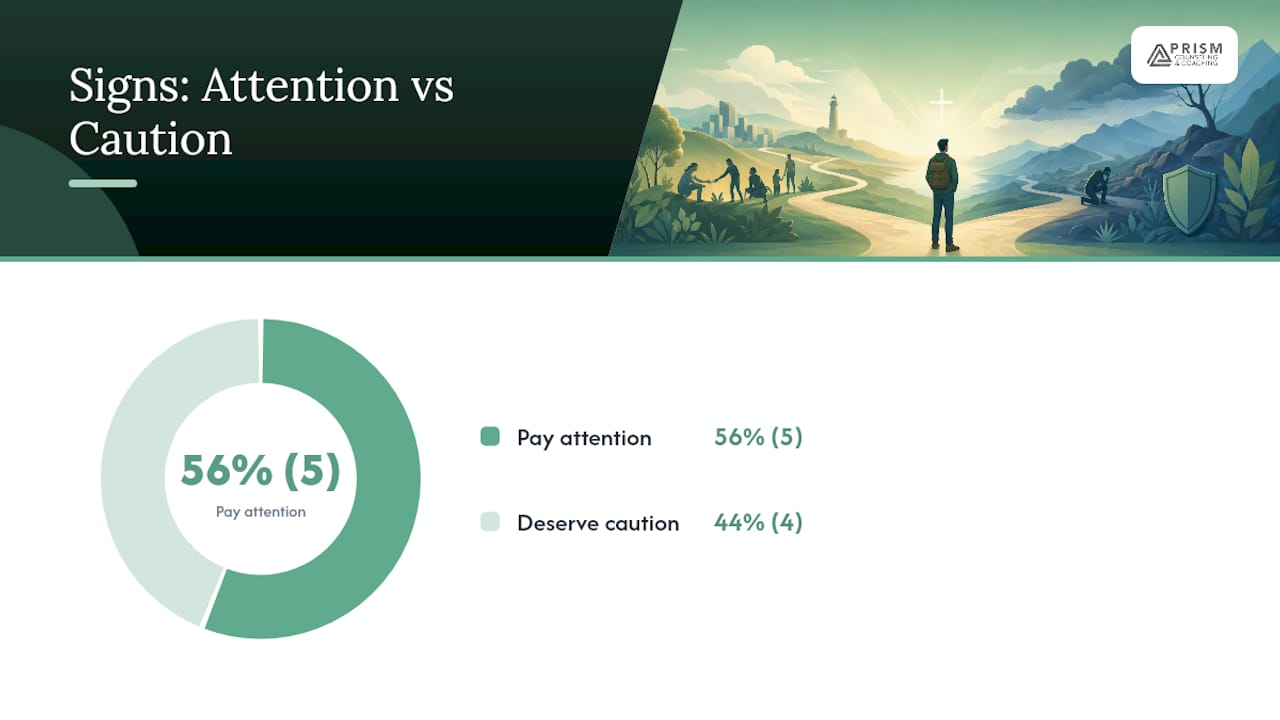
Signs worth paying attention to:
- A recurring desire that returns even after you have tried to set it aside
- A sense of peace and freedom when you imagine yourself in a particular vocation
- Joy and energy when you serve in ways connected to that calling
- Confirmation from people who know you well and pray faithfully
- Deep satisfaction and hope, even when the path is difficult
Signs that deserve caution:
- A desire that spikes during anxiety or loneliness and fades when life is stable
- A pull toward a vocation primarily because it feels safe, prestigious, or familiar
- Decisions made during a period of spiritual desolation (dryness, confusion, distance from God)
- An inability to imagine any other outcome — that rigidity often signals attachment, not calling
The Ignatian framework of consolation and desolation is useful here. Consolation is a movement toward God, marked by peace, love, and hope. Desolation is a movement away, marked by confusion, heaviness, or spiritual numbness. St. Ignatius taught that major decisions should not be made in desolation.
Pro Tip: Test any strong sense of calling against three pillars: Scripture (does this align with what God values?), wise counsel (do mature believers who know you affirm this?), and open circumstances (are doors actually opening?). This three-pillar convergence test filters emotional noise from genuine movement.
Who to talk to and where to find real help
| Resource | What they do | When to reach out |
|---|---|---|
| Spiritual director | Accompanies your interior life over time through regular one-on-one sessions | As soon as possible — ideally within the first month |
| Diocesan vocations office | Guides those exploring priesthood or religious life; provides structured formation | When you have a sustained sense of call to ordained or consecrated life |
| Retreat house | Offers structured silence, prayer, and guided reflection | Within the first three months; annually after that |
| Parish pastor or trusted clergy | Provides community-level confirmation and pastoral wisdom | Ongoing; especially for marriage discernment |
| Faith-integrated counselor | Addresses emotional or psychological barriers that cloud discernment | When anxiety, trauma, or depression interferes with freedom to pray or choose |
Finding a spiritual director is easier than most people assume. Ask your pastor for a recommendation, check your diocesan website's directory, or contact your local retreat house. When you reach out for the first time, you can simply say: "I am in a season of discernment and looking for someone to accompany me. Do you have availability, or can you recommend someone?"
What to expect in a first session: A good spiritual director will listen more than they speak. They will ask about your prayer life, your history with God, and what is stirring in you. They are not there to tell you what to do. Their role is to help you hear more clearly what God is already saying.
- Ask them: "How do you approach discernment with someone at the beginning of the process?"
- Ask them: "How often would we meet, and what is the format?"
- Expect confidentiality. Spiritual direction is a private, pastoral relationship.
Practical exercises you can start this week
The Ignatian Examen (brief version):
- Become still and ask the Holy Spirit to guide your review of the day.
- Give thanks for one specific moment of grace.
- Notice where you felt consolation (peace, love, energy toward God) and where you felt desolation (heaviness, distance, resistance).
- Bring one moment of desolation to God honestly.
- Ask for grace for tomorrow.
This takes about five minutes. Done daily, it builds a reliable picture of your interior movements over weeks and months.
Journaling prompts for discernment:
- What activities make me lose track of time in a good way?
- When do I feel most fully myself before God?
- What recurring desires have I been afraid to name?
- Who affirms gifts in me that I tend to dismiss?
- What doors have opened without my forcing them?
The 30-day obedience test: Choose three concrete, faithful steps connected to the vocation you are exploring — attend a vocations night, serve in a ministry, spend one hour in Eucharistic adoration weekly. Commit to all three for 30 days and journal the results. What grew? What faded? Bring those observations to your spiritual director or a trusted advisor.
Questions to bring to a spiritual director or trusted friend: "Do you see this desire as consistent with who I am becoming?" "What do you notice in me when I talk about this?" "Is there anything you see that I might be avoiding?"
You can also explore Christian counseling resources that support prayer practices and discernment exercises as a complement to these habits.
When vocational anxiety calls for counseling alongside spiritual direction
Seek faith-integrated counseling when anxiety, depression, or unresolved trauma is blocking your freedom to pray or choose honestly. Spiritual direction and counseling are not the same thing, and they are not in competition. They address different layers of the same person.
Signs that counseling may be the right next step:
- Persistent, paralyzing anxiety specifically tied to vocational questions
- Inability to sit in prayer without intrusive thoughts or physical panic
- A history of trauma that surfaces when you try to imagine your future
- Depression that makes every option feel equally hopeless
- A pattern of making and reversing major decisions driven by fear rather than faith
Clinical issues like anxiety and trauma commonly present as spiritual uncertainty. When that happens, vocational anxiety can make honest discernment nearly impossible without professional support to restore interior freedom.
Pro Tip: Spiritual direction and counseling can coordinate well when both parties know their roles. A counselor addresses the psychological barriers; a spiritual director accompanies the interior life. If you are working with both, it is appropriate to let each know the other exists, even without sharing session content. Understanding whether coaching or counseling fits your situation is a helpful first step.
Prism-counseling's counselors in the Phoenix area bring over 14 years of experience integrating faith into the therapeutic process. They work with individuals navigating anxiety, depression, and trauma — including the kind that surfaces during seasons of discernment. Sessions are available quickly, often within days, through a private-pay model that protects your privacy and keeps the focus on you.

What we actually see in discernment — a pastoral reflection
What we notice most often, sitting with people in the middle of discernment, is not confusion about God's will. It is fear of getting it wrong. People arrive carrying a kind of perfectionism about their calling — as if one missed sign means a wasted life. That fear is understandable, and it is also the thing most likely to stall the process.
The people who move forward well are not the ones who receive a dramatic sign. They are the ones who take the next faithful step, then the next, and let the path clarify over time. Small acts of obedience — showing up to prayer, serving where you are, having honest conversations with people you trust — create the conditions for clarity far more reliably than waiting for certainty.
If you are in that stuck place right now, we want you to know that reaching out for support is not a sign of weak faith. It is often the most courageous step in the whole process. Prism-counseling's spiritual direction resources are one place to start.
Prism-counseling walks with you through discernment
Discernment is not something you have to figure out alone, and sometimes the clearest obstacle is not spiritual — it is emotional. Prism-counseling offers faith-integrated individual counseling and Christian counseling in the Phoenix and Peoria area, with openings typically available within days. Whether you are navigating vocational anxiety, working through trauma that clouds your freedom to choose, or simply needing a space where your faith is respected and integrated into the therapeutic process, Prism-counseling's counselors are equipped to walk with you. Reach out through the website to schedule your first session and take one concrete step forward today.
Authoritative resources for vocational discernment
These sources offer grounded, practical help for anyone beginning or deepening a discernment process.
| Resource | Type | Why it helps |
|---|---|---|
| USCCB | Church authority | Grounds discernment in Scripture and Catholic teaching on vocation and holiness |
| FOCUS / Fr. Mike Schmitz | Practical teaching | Offers the three daily questions and a simple, accessible framework for daily discernment |
| Diocesan Vocations Office | Institutional support | Provides structured accompaniment for those exploring priesthood or religious life |
| Desiring God — God's Calling | Biblical framework | Explains the convergence of desires, gifts, and circumstances as reliable indicators |
| Vision Vocation Network | Vocational formation | Covers the Church's broad teaching that vocation begins with baptism and a call to holiness |
| Prism-counseling Resources | Local faith-integrated support | Articles, tools, and counseling information for those navigating discernment in the Phoenix area |
| Spiritual Care Today Podcast | Audio resource | Podcast episodes on spiritual formation and vocational topics for those who prefer listening |
Sources
- How do I find God's will for my life? (Desiring God interview)
- Focus
- How to discern God's calling for your life - Forge
Recommended
- On Creating the Christian DISC® - Prism Counseling & Coaching | Faith-Based Counseling and Spiritually-Integrated Therapy in Peoria and Phoenix AZ
- Christian DISC® Coach - Prism Counseling & Coaching | Faith-Based Counseling and Spiritually-Integrated Therapy in Peoria and Phoenix AZ
- Careers - Prism Counseling & Coaching | Faith-Based Counseling and Spiritually-Integrated Therapy in Peoria and Phoenix AZ
- Responding to Those Deconstructing - Prism Counseling & Coaching | Faith-Based Counseling and Spiritually-Integrated Therapy in Peoria and Phoenix AZ