
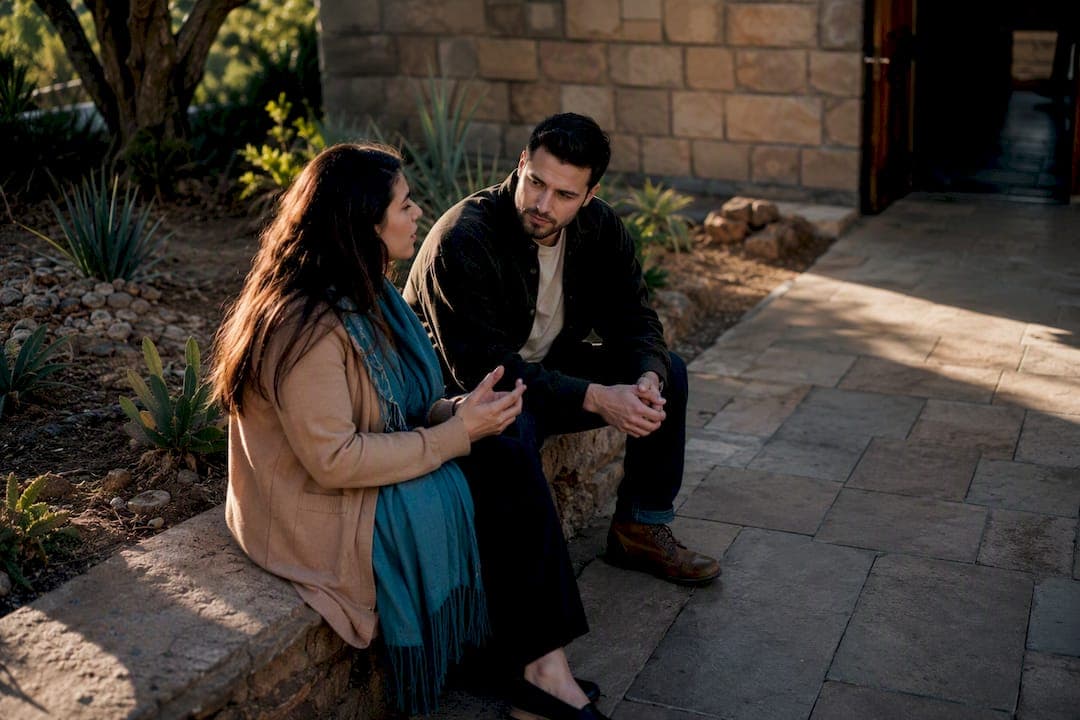
Yes, many people find a way to hold faith and sexuality together rather than surrendering one for the other. The most reliable first step is finding a safe, noncoercive space to talk it through, whether that's a trusted friend, a pastor trained in pastoral care, or a faith-integrated counselor. Research on religion and sexual identity backs this up, and so does the practical experience of counseling practices built for exactly this conversation.
TL;DR:
- Many faith communities vary widely in their stance on sexuality, from traditional views promoting celibacy outside heterosexual marriage to full affirmation of LGBTQ+ relationships.
- Biblical interpretation of sexuality is complex and often depends on context and theological lens, with no single passage providing definitive answers.
- Research shows that mental health outcomes for sexual minorities are better in affirming environments that promote identity integration and positive community belonging.
- Approaching reconciliation with faith and sexuality is a gradual process involving honest self-reflection, trusted conversation partners, and rejection of coercive practices like orientation change therapy.
- Support from trained, affirming counselors can help build safety, clarify values, and guide through the ongoing journey of faith and sexual identity.
Table of Contents
- Where Faith Perspectives Differ on Sexuality
- What Does the Bible Actually Say About Sexuality?
- Does Faith Help or Harm Sexual Minority Mental Health?
- How Do You Start Reconciling Faith and Sexuality?
- How Prism Counseling Approaches Faith and Sexuality
- Where Did Christian Views on Sexuality Come From?
- Faith, Sexuality, and the Identities That Shape Both
- How Do Other Faiths Approach Sexuality and LGBTQ+ Identity?
- How Has Faith-Based Teaching Shaped Laws Around Sexuality?
- Real Stories of Faith and Sexuality
- An Editorial Take on Faith and Sexuality Today
- Get Support for Faith and Sexuality Questions
- Sources
Where Faith Perspectives Differ on Sexuality
If you grew up in the church, you already know that "the Christian view" on sexuality isn't one thing. It depends entirely on which pew you're sitting in. Understanding the landscape helps you name what your own community actually teaches, rather than assuming it matches the loudest voice you've heard.
Three broad framings show up across denominations and even within the same congregation:
- Traditional or orthodox: Sexual expression belongs within marriage between a man and a woman, with chastity and procreative purpose as central values. This is the position the United States Conference of Catholic Bishops articulates, rooting sexual ethics in the nature and purpose of the marital bond.
- Pastoral or therapeutic: Doctrine may stay traditional, but practice leans toward care first. Leaders in this camp often prioritize walking alongside a person over enforcing a behavioral standard, especially in private conversation.
- Progressive or affirming: Sexual orientation and gender identity are viewed as part of God's design, with mutuality, consent, and covenant faithfulness replacing gender as the ethical measuring stick.
The practical stakes are real. A traditional congregation may expect celibacy outside heterosexual marriage and structure membership or leadership rolls around that expectation. A pastoral congregation might not change the rulebook but will quietly make room for someone still working things out. An affirming congregation removes the tension altogether by blessing same-sex relationships outright. Knowing which lane your community occupies changes what you can expect from a hard conversation before you ever have it.
What Does the Bible Actually Say About Sexuality?
Jesus never directly addressed same-sex relationships in the Gospels. His recorded teaching on sexuality centers on divorce, adultery, and the heart behind lust, which leaves later Christian sexual ethics built largely on inference from other texts, church tradition, and theological reasoning rather than a direct quote from Christ himself.
A handful of passages carry most of the interpretive weight in these discussions:
- Genesis 1 to 2, often read as establishing a creation pattern for marriage.
- Leviticus 18 and 20, part of the holiness code debated for its applicability today.
- Romans 1, frequently cited in traditional arguments and reinterpreted by progressive scholars in light of ancient context.
- 1 Corinthians 6 and 1 Timothy 1, where translation choices around specific Greek terms shape entire doctrinal positions.
The same verse can support opposite conclusions depending on the interpretive lens brought to it. That's exactly why this works better as a guided conversation than a solo Google search. A pastor trained in biblical languages, a trusted theological resource, or a counselor who can help you process what a given interpretation means for your life will get you further than another late night reading commentary alone.
Does Faith Help or Harm Sexual Minority Mental Health?
The honest answer is that it depends. The Religious/Spiritual Stress and Resilience (RSSR) model explains why religion produces such different outcomes for different people: whether faith functions as resilience or as a source of minority stress hinges on how well a person has integrated their sexual identity and on the stance their specific congregation takes toward LGBTQ+ members.
The research signal to watch: identity integration and congregational climate predict mental health outcomes more strongly than religious affiliation itself does. A devout person in an affirming church and a devout person in a hostile one are not having the same experience of faith at all.
Hostile religious environments carry documented costs. Attempts to change someone's sexual orientation, sometimes called conversion or reparative therapy, are consistently shown to be ineffective and often psychologically harmful, which is why no credible counselor should present orientation change as a treatment goal. Separate research on emerging adults finds that a strong sense of belonging in a religious community buffers against spiritual struggle, even when that struggle is tied directly to sexual identity.
A few signals tend to separate safe environments from harmful ones:
- The community welcomes questions without demanding a predetermined conclusion.
- No one frames orientation change as achievable or expected.
- Pastoral leaders will refer you to a counselor rather than trying to handle everything themselves.
- You leave conversations feeling more whole, not more ashamed.
How Do You Start Reconciling Faith and Sexuality?
Reconciliation rarely happens in one conversation. It's closer to a series of small, honest steps that build on each other.
- Journal before you talk. Write down what you actually believe versus what you've absorbed from others. This distinction matters more than it sounds.
- Name your values plainly. What does faithfulness mean to you? What does authenticity mean? Where do they currently pull against each other?
- Find one trusted person first. Not a whole congregation, not a family group text. One person who will listen without an agenda.
- Rule out coercive practices immediately. If anyone suggests orientation change therapy, walk away. The evidence against it is not ambiguous.
- Bring specific questions to a counselor or ministry leader: How do you handle confidentiality? What's your theological stance, and are you willing to work with mine if it differs? What methods do you use, and what's your experience with faith and sexuality specifically?
Pro Tip: Ask any counselor directly, "What happens if I decide differently than you expect?" Their answer tells you more about safety than their resume does.
Faith-integrated counseling typically starts with an intake session focused on your story and goals, not a checklist. Expect ongoing sessions to focus on identity integration, family and community dynamics, and coping skills rather than a push toward any predetermined outcome. Costs and session length vary by practice, and many counselors, including those working through Christian counseling for faith and sexuality, now offer online sessions for people who don't have local access to this kind of care.
How Prism Counseling Approaches Faith and Sexuality
Spiritually-integrated therapy treats your beliefs as part of the healing process, not an obstacle to work around. Prism Counseling & Coaching built its practice around that idea, operating as a small, private-pay group that offers same-week openings instead of the weeks-long wait common with insurance-based care.
That structure matters here specifically because these conversations often need privacy and a fast start, not a three-month waitlist. Our 5 Step Plan for LGBTQ+ Christian Coming Out and our couples counseling work both reflect the same commitment: no coercion, no predetermined outcome, and full openness to LGBTQ-affirming counseling when that's what a client is asking for.
Where Did Christian Views on Sexuality Come From?
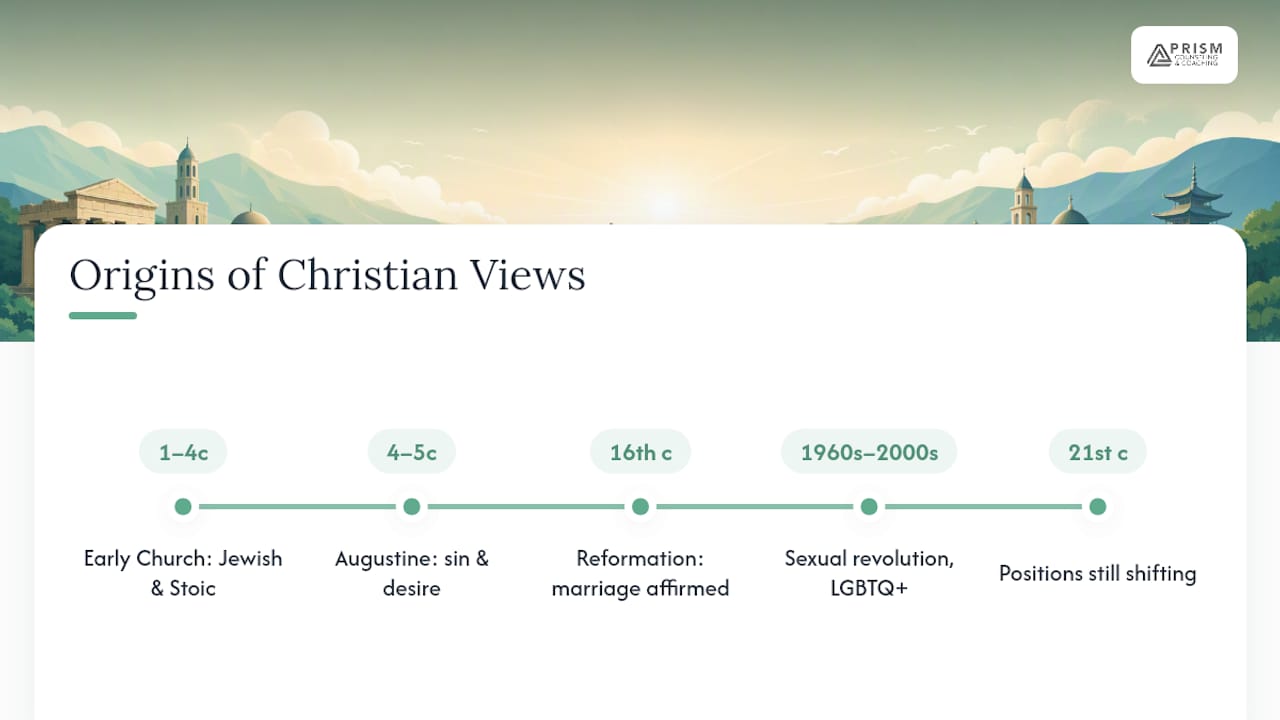
Early church writers inherited Jewish sexual ethics and layered Greco-Roman philosophy on top, particularly ideas about the body, desire, and self-control from Stoic thought. Augustine's writings on original sin and concupiscence in the 4th and 5th centuries shaped Western Christian thinking on sexuality for over a thousand years, tying sexual desire closely to human brokenness.
The Reformation shifted things again. Martin Luther and John Calvin rejected mandatory clerical celibacy and elevated marriage as a good in itself, not merely a concession to human weakness. That single change opened the door, centuries later, to Protestant traditions that would eventually diverge sharply on questions of sexuality and gender.
The 20th century compressed centuries of slow change into a few decades. The sexual revolution of the 1960s, the rise of the LGBTQ+ rights movement, and growing biblical scholarship on historical context all pushed denominations to reexamine positions many had treated as settled. Some denominations split entirely over the question. Others quietly shifted policy while keeping public statements vague enough to avoid confrontation.
What's often missed is how recent the "traditional versus affirming" framing itself is. Congregations spent far more centuries debating divorce, usury, and slavery than they've spent debating sexual orientation, which suggests today's positions are still very much in motion rather than fixed conclusions. That history is worth remembering the next time someone tells you church teaching on this subject has "always" been one clear thing.
Faith, Sexuality, and the Identities That Shape Both
Faith and sexuality never exist in isolation from race, gender, class, or culture. A Black gay man raised in a Pentecostal tradition carries a different set of pressures than a white lesbian woman raised Catholic, even if both attend affirming churches today. The church has often been both a source of survival and a source of pain within Black communities specifically, which makes leaving it a far heavier decision than it might be elsewhere.
Gender adds another layer entirely. Transgender and nonbinary Christians frequently face a double reckoning: questions about sexual orientation and separate, distinct questions about gender identity, each carrying its own theological baggage and its own set of scripture debates.
Immigrant and multigenerational families add cultural weight that Western therapy models sometimes miss. Coming out isn't just a personal disclosure in many cultures; it's treated as a family event with consequences for parents, siblings, and extended relatives. A counselor unfamiliar with that context can unintentionally push a Western individualist framework onto someone whose faith and family structure don't operate that way.
None of this means the path is harder for everyone in exactly the same way. It means a good counselor asks about your specific cultural and family context before assuming your experience matches a generic script. If your faith community, your family, and your cultural background all pull in different directions, that's not a sign something is wrong with you. It's a sign the conversation needs more than one lens.
How Do Other Faiths Approach Sexuality and LGBTQ+ Identity?
Christianity isn't alone in wrestling with these questions, and the range of positions within other traditions often surprises people raised entirely inside one faith.
Judaism spans the same theological spectrum found in Christianity. Orthodox communities generally hold to traditional prohibitions rooted in Levitical law. Conservative Judaism has moved toward greater acceptance over recent decades, ordaining LGBTQ+ rabbis in many congregations. Reform Judaism has largely embraced full inclusion, treating sexual orientation as consistent with Jewish values around dignity and covenant.
Islam presents a similarly wide range, though public discourse in many Muslim-majority countries remains more restrictive than private practice or scholarly debate might suggest. Progressive Muslim scholars have begun reexamining classical legal rulings using the same historical-critical methods that shifted Christian and Jewish thought, though this remains a minority position within most mosques.
The common thread across all three traditions: change tends to start with scholars and theologians revisiting original language and historical context, then moves slowly into congregational practice, often generations later. If you're comparing notes with a friend from a different faith tradition, you may find your two religions are having strikingly similar internal debates, just on different timelines and with different sacred texts driving the argument.
How Has Faith-Based Teaching Shaped Laws Around Sexuality?
Religious sexual ethics haven't stayed confined to pulpits. They've shaped statutes, court cases, and policy debates for as long as Christianity has held cultural influence in the West.
Sodomy laws across much of American history drew directly from religious sexual ethics, and the U.S. Supreme Court didn't strike down the remaining state laws until Lawrence v. Texas in 2003. Marriage law followed a similar arc: religious definitions of marriage as exclusively heterosexual shaped state and federal law for generations, up through the federal Defense of Marriage Act, before Obergefell v. Hodges established a nationwide right to same-sex marriage in 2015.
Debates over adoption, foster care licensing, and religious exemptions in public accommodations laws continue to play out this same tension today. Some faith-based agencies argue their religious convictions should exempt them from certain nondiscrimination requirements. LGBTQ+ advocacy groups argue that public-facing services shouldn't be allowed to discriminate regardless of the provider's faith.
None of this is abstract if you're the person caught in the middle, trying to figure out which laws affect your own family, adoption plans, or workplace protections. Faith communities remain some of the most influential voices in these policy fights precisely because sexual ethics sit so close to the center of many traditions' moral teaching. Understanding that history helps explain why these conversations often feel more charged in public than they need to feel in your own private journey of faith.
Real Stories of Faith and Sexuality
Every reconciliation story looks different, and that variety matters more than any single narrative arc. Some people leave their childhood faith entirely and find peace outside it. Others stay in the same pew their whole life while quietly redefining what certain teachings mean to them. A smaller number move toward a different Christian tradition altogether, trading a traditional congregation for an affirming one without losing their faith in the process.
What most of these stories share isn't a tidy resolution. It's a turning point where someone finally spoke the truth out loud to another person, whether that was a therapist, a pastor, a parent, or a close friend, and survived that conversation better than they expected. Fear of the conversation is almost always worse than the conversation itself, even when the response isn't perfect.
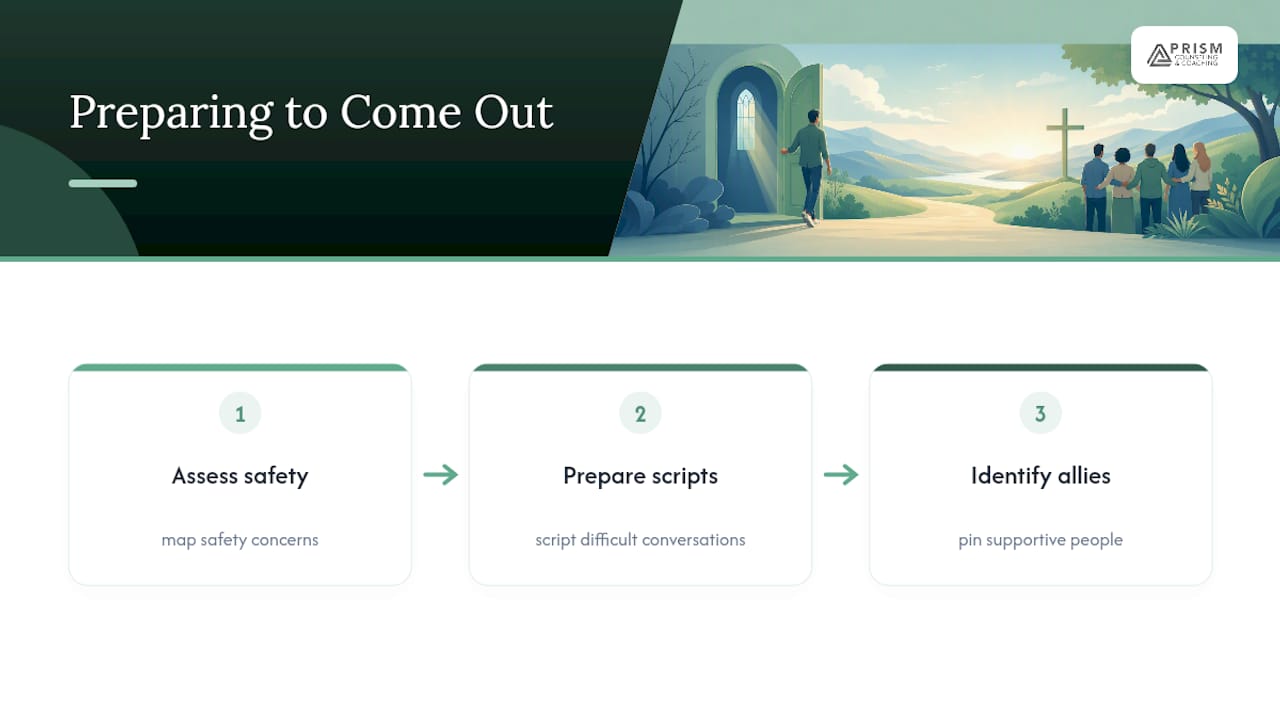
Coming out within a faith context, in particular, tends to go better with preparation rather than spontaneity. A structured approach to coming out that maps out safety concerns, scripts difficult conversations in advance, and identifies allies before the conversation happens tends to produce better outcomes than an unplanned disclosure. That's not because the truth needs to be managed. It's because the people receiving it often need a little structure to respond well.
An Editorial Take on Faith and Sexuality Today
The conventional advice in this space tends to split into two unhelpful camps: "change is possible if you try hard enough" or "faith and sexuality are simply incompatible, full stop." Both oversimplify what the RSSR research actually shows, which is that outcomes depend far more on congregational climate and identity integration than on faith itself.
What gets underestimated most is how much belonging matters compared to belief. Two people can hold nearly identical theology and end up in radically different places mentally and spiritually, purely because one found a community willing to sit with their questions and the other didn't. That's not a minor detail. It's arguably the single biggest lever available.
My honest take: readers should stop asking "which theological camp is correct" as their first question and start asking "who in my life can I trust with the whole truth." Theology matters, and it deserves real study. But a safe, informed conversation with a trained counselor will move you further, faster, than another solo debate with yourself.
— Tres
Get Support for Faith and Sexuality Questions
Prism Counseling & Coaching offers something the theology debate alone can't: a same-week appointment with someone trained to hold your faith and your questions about sexuality at the same time, without an agenda to change either one.
Our services include faith-based counseling, LGBTQ-affirming counseling, couples therapy, and online sessions for anyone outside the Phoenix area. A first session usually focuses on your story, not a checklist, and everything discussed stays private under standard confidentiality protections that apply to licensed counseling. As a small, private-pay practice, we're not bound by insurance timelines, which is part of why new clients typically get in within days rather than weeks.
If you're ready to talk to someone who won't flinch at the hard questions, find a counselor and book a first session this week.
Sources
For deeper study, the RSSR model explains the research behind resilience versus stress in religious sexual minorities. Pew Research Center's survey data offers a clear picture of religious belonging among LGBT Americans today. The USCCB's teaching on love and sexuality lays out traditional Catholic framing in full, and The Pursuit Counseling's perspective on faith and real life shows how another practice approaches this same intersection in session.
This article is general information, not a substitute for advice from a qualified doctor. Consult a qualified healthcare professional about your own circumstances before acting on anything here.
- Religion and sexual identities - PubMed