
Lament is the practice of bringing your grief directly to God, naming the loss out loud instead of burying it, and asking honestly for help while still holding on to hope. Scripture models this in the Psalms of lament, and pastoral scholars describe it as a structured way to hold sorrow rather than suppress it. Lament does not replace clinical care; if grief is disabling your daily life, that is the moment to also seek a counselor.
TL;DR:
- Lament involves bringing grief directly to God through honest naming, complaints, and requests, helping process sorrow in a structured way.
- Practicing lament regularly, via spoken prayer, journaling, or community rituals, allows grief to be expressed safely and prevents suppression.
- Professional support is necessary when grief impairs daily functioning, with signs like persistent numbness, suicidal thoughts, or worsening anxiety needing immediate help.
- Lament is cyclical and integrated into all grief stages, providing ongoing space to address emotional waves and setbacks in the healing process.
- Combining faith-based lament and clinical care offers a comprehensive approach, with counseling services specializing in both spiritual and emotional support.
Table of Contents
- What Is Lament, and How Does It Differ From Grief?
- Why Does Lament Help You Process Grief?
- How Do You Practice Lament in Daily Life?
- How Do You Write Your Own Lament?
- When Does Grief Need Professional Help?
- A Counselor's View on Lament and Grief Care
- How Have Different Cultures and Eras Practiced Lament?
- What Is the Difference Between Lament, Grief, Mourning, and Bereavement?
- What Physical and Emotional Symptoms Come With Grief?
- How Do Other Faiths and Secular Traditions Approach Grief?
- Where Does Lament Fit Into the Stages of Grief?
- What Happens When Grief and Lament Go Unaddressed?
- What Actually Works When You're Trying to Grieve Well
- Finding Support That Honors Both Faith and Grief
- Sources
What Is Lament, and How Does It Differ From Grief?
Grief is the emotional response to loss. Lament is what you do with that grief when you bring it to God on purpose. It has a shape: you name the loss plainly, you complain to God about what has happened, and you remember what God has done before, even when you cannot feel it now. That structure is what separates lament from simply venting into the void.
A significant portion of the Psalms follow this pattern, which tells you something about how central this practice was meant to be, not a fringe activity for the extra spiritual. Scholars at Working Preacher, a resource from Luther Seminary, argue that lament gives language for both protest and hope at once. You are allowed to say "Why?" and "How long?" in the same breath as "But I will trust you." Psalm 13 does exactly that in six short verses, moving from raw complaint to a decision to trust.
Private venting stops at the complaint. Lament pushes further, toward God, toward memory, toward a request. Secular grief models, useful as they are for understanding emotional stages, don't ask you to direct your sorrow anywhere in particular. Lament does. It insists your pain has an audience who has stayed present through worse.
That distinction matters if you have ever felt guilty for being angry at God during loss. Lament was never meant to be tidy. It was meant to be honest.
Why Does Lament Help You Process Grief?
Modern congregations have largely lost the practice of lament, according to the Calvin Institute of Worship, and that loss shows up in how poorly many churches respond to members in deep sorrow. Restoring lament, whether through spoken prayer, written psalms, or communal worship, rebuilds a congregation's capacity to sit with pain instead of rushing someone toward premature comfort.
There is a psychological logic here too. Naming a loss out loud, specifically and without euphemism, tends to reduce the sense that grief is unspeakable or shameful. Lament gives you permission to say the hard sentence rather than circle it.
What clinical guidance says: Grief has no fixed deadline and looks different for everyone, but clinical guidance on grief and bereavement recommends professional support when grief begins interfering with daily functioning or when anxiety and depression symptoms persist or get worse rather than gradually ease.
That threshold matters more than any calendar. Lament is not a substitute for treatment when grief has crossed into impairment. It is a companion practice for the sorrow that is heavy but still moving.
How Do You Practice Lament in Daily Life?
You do not need poetic language or a seminary background to lament well. You need honesty and a willingness to keep showing up with it.
Spoken lament is often the easiest entry point. Try a short, repeated prayer such as "God, I don't understand this, but I'm still here" said aloud each morning. Repeating a single line from a psalm, like "How long, O Lord?" from Psalm 13, can carry weight your own words can't find yet. Groaning without words counts too; the Psalms themselves include wordless cries.
Written lament works well if speaking feels too exposed. Journaling prompts help:
- What exactly did I lose, in plain terms?
- What do I want to say to God that I've been holding back?
- What has God done before that I need to remember right now?
- What am I asking for, specifically, today?
Keep a boundary around written lament: if the writing spirals into hopelessness rather than movement, stop and talk to someone rather than pushing through alone.
Liturgical and musical lament gives you borrowed language when yours runs out. Singing or reading a lament psalm, praying a written litany, or using a service like Compline lets the structure carry you on days you have nothing left to compose yourself.
Community lament matters too. Small groups that read a lament psalm together, public prayers naming specific losses in a service, and pastoral accompaniment (a counselor or clergy member sitting with you in it) all counter the isolation grief creates.

Pro Tip: Lament is cyclical, not linear. You will return to it as grief resurfaces weeks or months later, and that is not failure. Treat it as a discipline you revisit, not a task you finish.
How Do You Write Your Own Lament?
A simple scaffold, drawn from practical theology, gives you a place to start even on days when nothing poetic comes to mind. Practical theologians describe a four-part structure: turn to God, bring the complaint, ask for help, and express trust.
- Address God directly. Start with a name you use for God, not a generic opening.
- State the loss plainly. Say what happened without softening it.
- Speak the feeling. Anger, confusion, exhaustion. Name it exactly.
- Cite a memory. Recall a time God was faithful before, even in a different situation.
- Ask. Be specific about what you need right now.
- Express trust, however thin it feels in the moment.
A short example: "God, I don't understand why she's gone. I'm furious and hollow. You carried me through my father's death ten years ago. Carry me again. I don't feel your presence, but I choose to believe you're here."
If writing this brings on despair rather than release, stop and reach out to a counselor or pastor before continuing.
When Does Grief Need Professional Help?
Lament can hold enormous sorrow, but it is not a clinical intervention, and it was never meant to be one. Certain signs mean it's time to bring in a professional alongside your spiritual practice.
- Thoughts of suicide or self-harm, at any intensity.
- Inability to work, eat, sleep, or care for yourself for an extended stretch.
- Numbness or detachment that persists for weeks and is getting worse, not better.
- Anxiety or depression symptoms that intensify rather than ease over time.
Clinical threshold: Public health guidance from the National Institute on Aging recommends seeking professional support when grief symptoms persist or significantly impair daily life, and directs anyone in immediate danger toward crisis services.
If you are in the United States and having thoughts of self-harm, call or text 988 immediately. For less acute but still stuck grief, a grief counselor, a pastor trained in pastoral care, or a therapist who works with both faith and loss is a reasonable next step. Asking for help is not a failure of faith. It is often what faith looks like in practice.
A Counselor's View on Lament and Grief Care
Lament and clinical care aren't competitors. A counselor trained in pastoral counseling can hold both at once: the theological weight of a Psalm of lament and the clinical signs that suggest more support is needed. .
Counseling services that operate on a small, private-pay model can offer faster access to a counselor who understands why lament matters rather than treating it as an obstacle to "moving on."
How Have Different Cultures and Eras Practiced Lament?
Lament is ancient, not a modern coping trend. Israel's psalmists wrote entire collections of communal lament after national catastrophe, including Lamentations, written after Jerusalem's destruction, where an entire book is devoted to structured grief for a city.
Early Christian communities carried this forward through funeral liturgies built around lament psalms rather than avoidance of sorrow. Medieval monastic communities prayed the Divine Office, which included lament psalms on a rotating schedule, meaning grief had a built-in place in daily rhythm rather than being handled only in crisis.
Many cultures outside the biblical tradition developed parallel practices. Formal mourning periods, wailing rituals, and communal keening across various cultures share a common instinct: grief needs an outlet with structure, not just private feeling. What Western secular culture often lacks, compared to older traditions, is exactly that structure. Grief gets privatized, expected to resolve quietly and quickly.
The loss of communal lament practices in many modern congregations is a relatively recent development, not a historical constant. Recovering lament isn't inventing something new. It's returning to a practice nearly every era before ours took for granted.
What Is the Difference Between Lament, Grief, Mourning, and Bereavement?
These four words often get used interchangeably, but they describe different layers of the same experience.
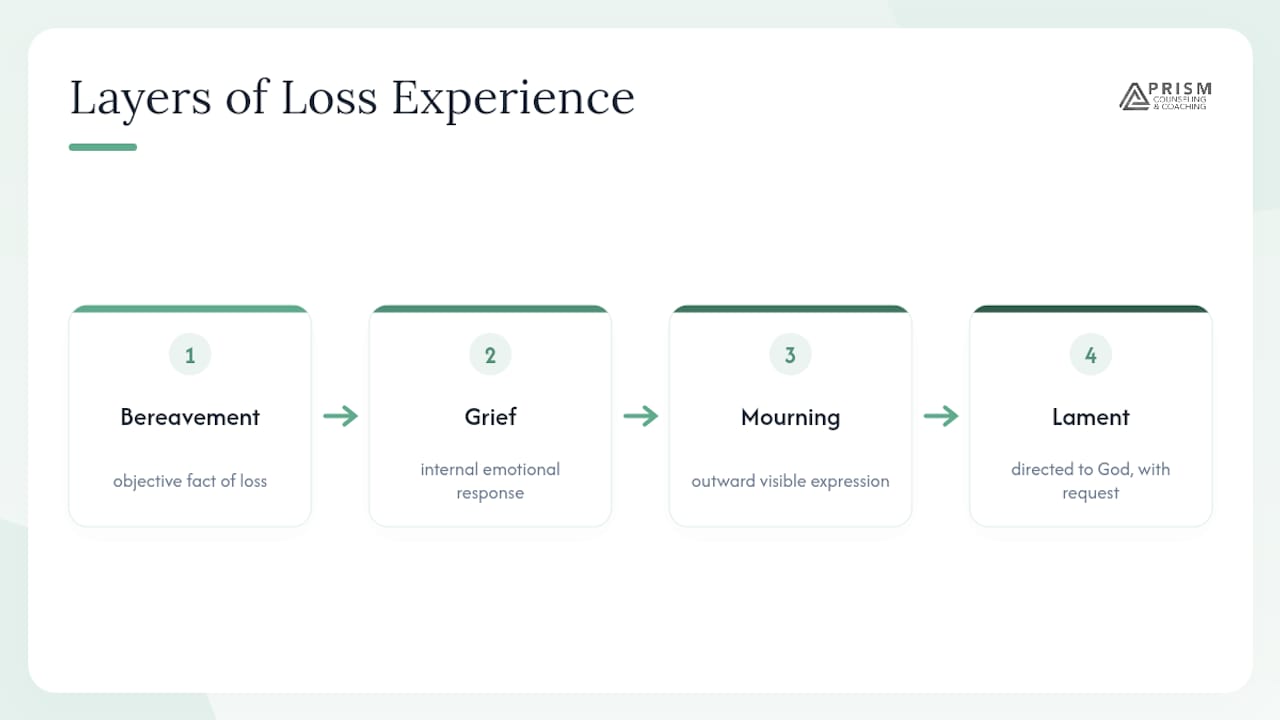
Bereavement is the objective fact of loss, the state of having lost someone or something significant. Grief is the internal emotional, psychological, and even physical response to that loss, the sadness, anger, and confusion churning inside you. Mourning is grief made visible. It's the outward expression, whatever your culture or family sanctions: wearing black, sitting with visitors, taking time off work, observing a memorial.
Lament is a specific form of mourning aimed at God. It's not just any outward expression of grief. It's a directed one, spoken or written toward a divine audience, with a request attached. You can grieve without lamenting. You can mourn publicly without ever directing that mourning toward God. Lament is the layer that makes grief a conversation instead of a solitary weight.
Understanding these distinctions matters because people sometimes feel stuck when their mourning doesn't match cultural expectations, or when their grief doesn't produce visible mourning at all. Lament offers a path that works regardless of whether your mourning looks like anyone else's.
What Physical and Emotional Symptoms Come With Grief?
Grief lives in the body as much as the mind. Exhaustion that sleep doesn't fix, appetite that disappears or spikes, chest tightness, and insomnia are common and expected, according to guidance from the NIA and similar public health resources like the UK's NHS.
Emotionally, expect waves rather than a steady descent. Numbness, disbelief, anger that surprises you with its intensity, guilt over things said or unsaid, and sudden relief followed immediately by shame for feeling relieved. None of that is abnormal.
Lament actually has room for all of it. A lament psalm can hold rage and gratitude in adjacent verses without contradiction, which is more honest than most secular scripts for grief allow. If your body is exhausted and your emotions feel contradictory, that's not a sign you're grieving wrong. It's a sign you're grieving like a human being.
How Do Other Faiths and Secular Traditions Approach Grief?
Christianity's Psalms of lament are one entry point, but the instinct to structure grief through ritual and speech appears widely.
Judaism observes shiva, a seven-day mourning period with prescribed visits and prayers, followed by longer periods of reduced mourning stretching to a year for the loss of a parent. Islam observes a specific mourning period with prescribed prayers and community support obligations. Buddhist traditions often frame grief through the lens of impermanence, using meditation and ritual to process attachment and loss without necessarily directing complaint toward a deity.
Secular grief support, including support groups and grief counseling, tends to focus on emotional processing and stage-based frameworks without a spiritual or divine dimension. That approach helps many people and shouldn't be dismissed. But it leaves out what lament offers uniquely: somewhere to direct the anger, and someone to ask.
Faith-integrated counseling doesn't require choosing one over the other. Clinical tools for processing emotion and lament's theological framework for direction and hope can work side by side, which is the core premise behind combining Psalm-based lament with clinical thresholds for professional care.
Where Does Lament Fit Into the Stages of Grief?
The commonly referenced five stages, denial, anger, bargaining, depression, and acceptance, offer a helpful map, but Harvard Health is clear that these stages aren't a fixed sequence everyone follows in order. You might skip one, cycle back through anger months after you thought you'd reached acceptance, or feel two at once.
Lament fits naturally into every stage rather than replacing any of them. During denial, lament gives you words for confusion: "I don't understand what happened." During anger, it gives that anger somewhere to go rather than nowhere. During bargaining, lament's request section, asking God directly for what you need, channels that instinct honestly instead of into magical thinking. During depression, lament's structure keeps you engaged with God even when feeling is absent. And acceptance, when it comes, often shows up in lament as the trust clause: "I don't feel your presence, but I choose to believe you're here."
Because lament is cyclical rather than linear, it matches the non-linear reality of grief better than a strict stage model does. You don't graduate from lament once you reach acceptance. You return to it whenever grief resurfaces, which it will.
What Happens When Grief and Lament Go Unaddressed?
Grief that never finds expression doesn't disappear. It tends to surface elsewhere, often as chronic irritability, unexplained physical tension, withdrawal from relationships, or a flatness that people around you start to notice even if you haven't named it yourself.
Clinical guidance is direct about the stakes: unresolved grief can develop into or worsen anxiety and depression, particularly when someone avoids processing the loss entirely rather than moving through it, however slowly. The absence of an outlet, whether emotional, verbal, or spiritual, is often what turns ordinary grief into something more entrenched.
Lament offers one outlet, but it isn't a cure for clinical depression, and it shouldn't be treated as one. What it does is prevent the specific harm caused by suppression: the sense that your pain has nowhere to go and no one listening. That sense, left unaddressed for months, is a documented risk factor for grief curdling into something heavier.
If you notice grief hardening into numbness that isn't lifting, or if lament itself starts to feel impossible to access, that shift is worth mentioning to a counselor. It may mean grief has moved past what any single practice, spiritual or otherwise, can carry alone.
What Actually Works When You're Trying to Grieve Well
Most advice on grief either leans entirely secular, stage models and coping mechanisms with no room for God, or entirely devotional, encouragement to "trust God" with no acknowledgment of clinical thresholds. Neither serves someone in real sorrow.
What the research and theology actually support is combining both without apology. The Psalms model raw complaint sitting beside declared trust in the same breath. Clinical guidance draws a clear, useful line: seek professional help when grief impairs daily functioning, regardless of how spiritually mature you think you should be by now.
Where conventional advice falls short is treating lament as either a nice devotional add-on or a replacement for treatment. It's neither. It's a discipline, and disciplines require repetition, not a single breakthrough prayer that fixes everything.
If you take one thing from this, prioritize honesty over eloquence. Use the six-step template. Repeat it when grief resurfaces, because it will. And if numbness or hopelessness starts to outweigh the moments of trust, treat that as your cue to bring in a counselor, not as evidence your faith has failed.
— Tres
Finding Support That Honors Both Faith and Grief
If lament feels like the right language for your grief but you're carrying more than any practice can hold alone, faith-integrated counseling gives you both pieces at once instead of forcing a choice between spiritual care and clinical care. Prism-counseling is a small, private-pay practice in the Phoenix area built specifically around that combination, which means you're not waiting weeks for an opening or explaining to a secular therapist why the Psalms matter to your grief.

A first visit typically starts with your story, your loss, and what you've already tried, whether that's prayer, journaling, or simply getting through the day. From there, a counselor can help you build lament into a broader plan for healing that also addresses anxiety, depression, or trauma tied to the loss. If you're ready to talk to someone who takes both your faith and your grief seriously, visit Prism's faith-based counseling page to see current openings and take the next step.
Sources
- Clinical guidance on grief and bereavement (PMC article)
- 5 stages of grief: Coping with the loss of a loved one — Harvard Health
- Preaching the language of lament — Working Preacher (Luther Seminary)
- The gift of lament — Practical Theologian
- Grief and mourning: coping with grief and loss — National Institute on Aging