

Yes, therapy is appropriate for church leaders, and it's often the wisest next step when burnout, emotional strain, or leadership pressure start to take a toll. Faith-aware therapy integrates spiritual conviction with clinical care rather than asking you to choose between them. If you recognize yourself in that description, the next right step is simple: schedule a confidential consult, in person or by telehealth, to assess what kind of support fits your season.
TL;DR:
- Most pastors and church leaders are at risk for burnout, depression, and compassion fatigue due to the intense demands and isolation of ministry work.
- Signs indicating the need for therapy include behavioral, emotional, relational, and vocational changes, with some requiring immediate intervention.
- Faith-aware therapy combines clinical techniques like CBT and EMDR with spiritual resources, respecting both clinical and faith boundaries.
- Finding a suitable therapist involves verifying licensure, experience with clergy, trauma training, and understanding their approach to faith integration.
- Regular self-care habits and addressing practical obstacles like time, cost, and confidentiality are essential complements to therapy for maintaining pastoral health.
Table of Contents
- Why Pastors and Ministry Leaders Commonly Need Therapy for Church Leaders
- What Are the Warning Signs a Church Leader Should Seek Therapy?
- What Does Faith-Aware Therapy for Clergy Actually Involve?
- How Do You Find and Choose a Faith-Aware Therapist?
- What Does the Research Say About Clergy Mental Health?
- How Does Stigma in Church Culture Affect Seeking Therapy?
- Can You Balance Religious Beliefs With Therapeutic Approaches?
- What Obstacles Do Church Leaders Face in Therapy, and How Can They Overcome Them?
- What Self-Care Strategies Complement Therapy for Pastors?
- Therapy as Stewardship of Your Calling
- Confidential, Faith-Integrated Support Through Prism Counseling & Coaching
- Sources
- FAQ
Why Pastors and Ministry Leaders Commonly Need Therapy for Church Leaders
Ministry carries a weight most congregations never see. You're expected to be present at every hospital bed, every board meeting, every crisis text at 11 p.m., while somehow also nurturing your own marriage, your own children, your own soul. That math doesn't work forever.
The pressures that build up in pastoral life tend to cluster into recognizable patterns:
- Burnout from unrelenting on-call expectations and no real off switch
- Depression and anxiety tied to isolation, criticism, or unmet expectations
- Compassion fatigue from absorbing other people's grief, addiction, and conflict week after week
- Marriage and family strain caused by a job that follows you home
- Moral and spiritual fatigue, the quiet erosion of a sense of calling
Small-church pastors face a particular kind of isolation. There's often no peer on staff to confide in, no associate to absorb overflow, and a congregation that may not distinguish between the pastor as a person and the pastor as a role. Add financial stress, common in smaller and bivocational ministries, and boundary erosion, where "available" quietly becomes "always available," and you have conditions that wear down even resilient leaders. Left unaddressed, these pressures rarely resolve on their own. They tend to compound, which is exactly why ministry burnout prevention works best as an ongoing practice, not a one-time fix.
What Are the Warning Signs a Church Leader Should Seek Therapy?
Most leaders don't wake up one day in crisis. The slide happens gradually, and that gradual pace is exactly what makes it easy to rationalize.
- Behavioral signs: withdrawing from staff or family, uncharacteristic irritability that lingers for weeks, or impulsive risk-taking that feels out of character.
- Emotional signs: a flat, numb feeling where joy used to be, or sadness that doesn't lift even after rest or vacation.
- Relational signs: growing conflict at home, avoiding people you used to enjoy, or dreading conversations you once welcomed.
- Vocational signs: a fading sense of calling, chronic absenteeism, or going through the motions of ministry without any felt connection to it.
Some of these are urgent. Thoughts of self-harm, a severe drop in your ability to function, or a sudden inability to care for basic responsibilities call for immediate intervention, not a "let's watch it" approach. Others are maintenance signs, worth a scheduled consult within the next week or two rather than a same-day crisis call.
Pro Tip: If you're debating whether what you're feeling "counts" as bad enough to seek help, that hesitation is itself a signal worth listening to.
What Does Faith-Aware Therapy for Clergy Actually Involve?
Clergy-focused therapy draws on the same clinical tools used in general practice, applied with an understanding of ministry's specific demands. Cognitive behavioral therapy helps with the anxious thought loops common in high-scrutiny roles. EMDR is often used for trauma, including the vicarious trauma pastors absorb from years of counseling others through crisis. Integrative, faith-aware approaches blend clinical technique with a client's theological framework rather than treating faith as incidental.
Good faith integration respects two boundaries at once. A therapist might use scripture, prayer, or spiritual practices as genuine resources in the healing process, the same way they'd use any other coping tool. What they should not do is spiritualize a clinical symptom, treating clinical depression as purely a faith deficiency, for instance, or dismissing trauma responses as a lack of trust in God. Scripture used well in counseling supports the work; it doesn't replace it.
A pastor doesn't need a therapist who ignores their faith, and they don't need one who uses faith to bypass real clinical work. They need both held with equal seriousness.
Confidentiality deserves special attention for clergy, since so many pastors serve in communities where everyone knows everyone. Telehealth and out-of-area clinicians solve a real problem here, letting you work with someone outside your denominational circle or town. Some clinicians can even see clients across state lines under interstate agreements like PSYPACT for psychologists, which widens your options considerably. Standard confidentiality protections under HIPAA and state licensing rules apply just as they would for any client.
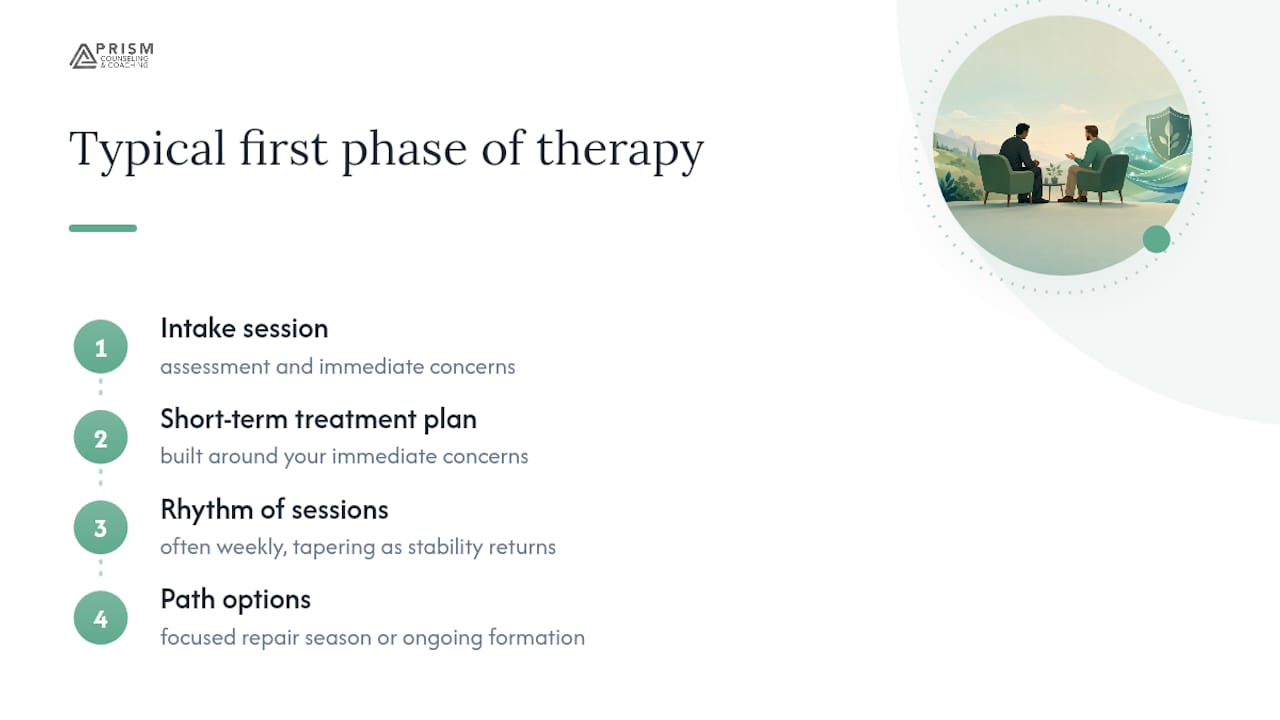
A typical first phase looks like an intake session, a short-term treatment plan built around your immediate concerns, and a rhythm of sessions, often weekly at first, tapering as stability returns. Some leaders need a focused season of repair. Others use ongoing sessions as part of long-term formation.
How Do You Find and Choose a Faith-Aware Therapist?
Start by widening your search beyond a single Google result. Good starting points include denominational care lines, trusted referrals from other pastors, established pastoral counseling resources, and telehealth directories that let you filter by faith background and clinical specialty.
Once you have a shortlist, screen for fit before you screen for schedule:
- Verified licensure in good standing with your state board.
- Experience with clergy or ministry contexts, not just general faith familiarity.
- Trauma-informed training, especially if compassion fatigue or a specific incident is part of your story.
- Theological sensitivity without doctrinal pressure in either direction.
- Clear confidentiality practices, including how they handle any overlap with your denomination or network.
A first phone call is the right place to ask direct questions:
- "How much experience do you have working with pastors or church staff?"
- "How do you typically integrate faith into sessions, and how do you avoid oversimplifying clinical issues?"
- "What are the limits of confidentiality, and do you offer telehealth?"
- "What are your fees, your cancellation policy, and how do you handle a crisis outside of session hours?"
On cost, options vary. Some clinicians take insurance; many faith-based practices operate on a private-pay or sliding-scale model that skips the paperwork trail insurance requires, which some leaders prefer for privacy reasons. Employer-sponsored EAP programs, where available through a denomination or church, can also offset cost. It's reasonable to ask about billing structure on that first call without feeling like you're overstepping.
What Does the Research Say About Clergy Mental Health?
The GuideStone Pastoral Wellness Survey figure of 22% at risk for burnout or depression isn't a one-off finding. It lines up with years of broader clergy-health research showing that ministry carries occupational risks distinct from most other professions.
<callout type="statistic"> The [Duke Clergy Health Collaborative](https://clergyhealth.duke.edu/) has spent over a decade translating statewide clergy surveys into practical resources, and its research consistently points to systemic barriers, not just personal ones, standing between pastors and flourishing. Isolation, financial precarity, and a culture that prizes self-sacrifice all show up as structural issues, not just individual failings. </callout>That's an important reframe. Individual therapy matters, but it works best alongside a broader shift in how ministry culture views help-seeking. Lifeway Research has documented that many pastors delay counseling until they hit a genuine crisis, when earlier, proactive care would have caught the erosion sooner and cost less in every sense.
The practice has experience providing faith-integrated care, operating a private-pay model designed for privacy and faster openings compared to typical insurance-based intake....
How Does Stigma in Church Culture Affect Seeking Therapy?
Stigma is often the loudest obstacle in the room, even when no one says a word against therapy directly. Congregations sometimes hold an unspoken expectation that their pastor should have it together, spiritually and emotionally, at all times. That expectation puts leaders in an impossible position: admit struggle and risk being seen as spiritually deficient, or hide it and let the strain compound.
This dynamic runs deeper in certain traditions where suffering is framed primarily as a faith test to be overcome through prayer alone, with less room for the idea that God works through licensed clinical care too. The result is that many pastors carry their hardest seasons entirely alone, worried that a counseling appointment on the calendar could become a talking point in the church parking lot.
Confidential, out-of-area, or telehealth options exist specifically to solve this. Seeing a therapist outside your congregation's network, or outside your town altogether, removes the fear of running into a client at the grocery store or having your struggles become a topic of gossip. Some pastors also find it helps to reframe the conversation internally: seeking care isn't a departure from faithful leadership, it's an expression of it. A leader who tends to their own well-being is better equipped to shepherd others, not less qualified to do so.
Churches that actively normalize care, mentioning it from the pulpit or building it into staff benefits, tend to see their leaders seek help earlier and recover faster.
Can You Balance Religious Beliefs With Therapeutic Approaches?
Balancing faith and clinical care isn't a compromise where one side loses ground. Done well, it's a partnership where each strengthens the other.
The tension usually surfaces around a specific fear: that a therapist will either dismiss your faith as irrelevant to your mental health, or lean so hard into spiritual language that real clinical issues go untreated. Both extremes fail pastors. A therapist who ignores your theological framework misses a resource you've relied on your whole life. One who spiritualizes everything, framing anxiety purely as "trust issues with God," can leave a treatable condition unaddressed for years.
The healthier middle ground treats your faith as a legitimate part of your identity and coping repertoire, alongside evidence-based clinical technique. A therapist might help you examine whether a belief is genuinely biblical or actually an inherited perfectionism you've mistaken for conviction. That kind of work requires theological humility on the therapist's part and honesty on yours.

It also helps to walk in with clarity about what you're hoping for. Do you want a counselor grounded in your specific tradition, or simply one who respects faith broadly and won't undermine it? Christian counseling approaches vary in how explicitly they draw on scripture and prayer during sessions, so naming your preference in the first call saves both of you time and sets the relationship up for honest, productive work from the start.
What Obstacles Do Church Leaders Face in Therapy, and How Can They Overcome Them?
Beyond stigma, a handful of practical obstacles keep pastors from starting or sticking with therapy.
Time scarcity tops the list. Ministry schedules rarely leave open blocks, and evening sessions compete with church programming. Telehealth solves much of this, letting you fit a session into a lunch break or a quiet hour between visits, without a commute eating into an already thin margin.
Cost concerns come next, especially in smaller churches where budgets are tight and pastors often underpay themselves. Sliding-scale fees, private-pay models built for accessibility, and denominational assistance programs all narrow this gap. It's worth asking directly what options exist rather than assuming therapy is out of reach.
Fear of exposure shows up constantly among clergy, worried that seeking help will surface in a small-town rumor mill or a denominational file. Out-of-area or telehealth clinicians address this directly by keeping your care separate from your local network entirely.
A theology of self-sufficiency trips up leaders who've internalized that needing help signals weak faith. This one responds best to reframing: even biblical figures like Elijah and Moses hit points of complete depletion and received practical, tangible support, not just spiritual encouragement, in response.
Naming which obstacle applies to you is often the fastest way past it. Most leaders find that once they've made the first call, the anticipated cost, whether financial, relational, or spiritual, turns out to be far smaller than the one they'd been paying by waiting.
What Self-Care Strategies Complement Therapy for Pastors?
Therapy works best as part of a broader rhythm, not a substitute for the daily habits that keep you steady between sessions.
Protecting a genuine sabbath, a full day with no email, no sermon prep, no pastoral visits, does more for long-term resilience than most leaders expect. So does building a peer relationship with another pastor outside your own congregation, someone who understands the role without having a stake in your specific church's politics. Physical health matters more than it gets credit for in ministry culture; sleep deprivation and chronic stress compound each other in ways that mimic depression symptoms.
Boundary practices help too: a clear policy on after-hours contact, a defined number of evening commitments per week, and permission to say no to a request without guilt. Journaling or a regular prayer practice separate from sermon preparation, since prep time and personal spiritual life are not the same thing even though they get conflated constantly, gives you space to process rather than always produce.
None of these replace therapy when clinical issues are present. They function more like the maintenance schedule on a car: skip them long enough, and the bigger repair becomes inevitable. Leaders who pair consistent self-care with periodic therapy check-ins tend to catch erosion months before it becomes a crisis.
Therapy as Stewardship of Your Calling
Seeking therapy isn't a departure from your calling. It's how you protect it. A pastor I think about often came to counseling convinced that asking for help meant he'd failed his congregation. What he found instead was clearer boundaries, a repaired marriage, and a renewed sense of why he entered ministry in the first place. That's not remediation. That's stewardship. If any part of this article felt familiar, the next faithful step is a confidential consult, not another season of carrying it alone.
— Tres
Confidential, Faith-Integrated Support Through Prism Counseling & Coaching
The practice offers faith-integrated counseling that addresses confidentiality concerns common for ministry leaders. It operates a private-pay model with sessions available by telehealth, allowing for faster appointment openings than some insurance-based practices.

A first consult typically starts with a conversation about what's bringing you in, whether that's burnout, anxiety, marriage strain, or a fading sense of call, and what kind of support fits your season, short-term focused work or a longer formation process. Your faith isn't set aside during that conversation; it's part of it. If you're ready to talk to someone who understands both the clinical and spiritual weight of pastoral life, visit Prism's faith-based counseling page to schedule a confidential first session.
Sources
- Pastoral Wellness Survey finds pastors struggle with stresses | GuideStone
- Duke Clergy Health Collaborative
- Lifeway Research — reasons pastors resist going to counseling
FAQ
Can a pastor be a therapist?
A pastor can pursue clinical licensure and practice as a therapist, but pastoral counseling and licensed clinical therapy are distinct roles with different training and legal scope. Many faith-aware therapists hold both theological background and clinical licensure, which is part of why pastoral counselors are worth seeking out specifically.
What are the four C's of church leadership?
Definitions vary across denominations and leadership frameworks, so there isn't one universally agreed list. Rather than repeat an unverified acronym, it's more useful to focus on well-documented needs: character, competence, confidentiality in care-seeking, and community support all show up consistently in clergy-health research as pillars of sustainable leadership.
How should I deal with a difficult church leader who resists getting help?
Direct, private conversation works better than public confrontation, especially when framed around specific behaviors rather than character judgments. Pointing to concrete resources, like a confidential consult or a denominational care line, often lowers resistance more than general encouragement to "get help."
How urgent is it to seek therapy if I'm just feeling tired, not in crisis?
Fatigue and early withdrawal are maintenance signs worth addressing within a week or two, not emergencies requiring same-day care. Waiting until symptoms escalate to a crisis point, however, tends to require longer and more intensive treatment than earlier, proactive care would have needed.
Does therapy for church leaders cost more than regular counseling?
Cost varies by clinician and model rather than by the fact that a client is clergy. Many faith-based practices offer private-pay and sliding-scale options specifically because they understand ministry budgets, and it's reasonable to ask about fees directly in a first call.