
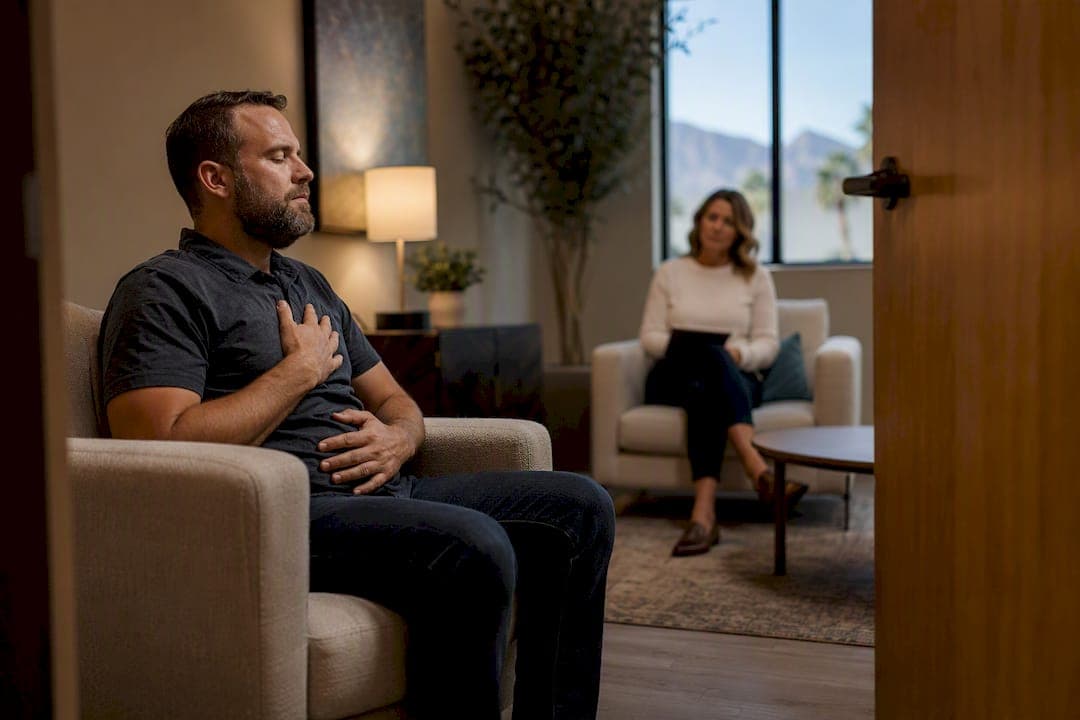
Yes, Christian counseling helps with anger, especially when it pairs Scripture with proven clinical tools instead of relying on willpower or Bible study alone. If you have hurt someone you love, or you feel your temper controlling you rather than the other way around, the next step is simple: reach out to a faith-integrated counselor this week. If there is any risk of violence or you feel unsafe, call emergency services first. Prism-counseling offers this kind of care, blending techniques like cognitive behavioral therapy with prayer and biblical reflection.
TL;DR:
- Christian anger management combines biblical reflection with clinical techniques like cognitive behavioral therapy to address triggers and underlying issues.
- Counselees often include individuals with frequent outbursts, couples, court-referred clients, and those frustrated with prayer alone, seeking structured support.
- Response-focused goals involve naming anger honestly, creating reaction gaps, and practicing patience and self-control as measurable targets.
- Effective programs typically include assessment, skill-building, scripture reflection, homework, and aftercare, with longer duration for deeper trauma or patterns.
- Immediate steps like pausing, checking HALT, grounding senses, and breathing can prevent escalation and foster lasting change over time.
Table of Contents
- What Christian Anger Management Counseling Actually Looks Like
- What The Bible Actually Says About Anger
- The Clinical Tools Counselors Pair With Scripture
- What A Counseling Program Actually Involves
- Signs You Need More Than Self-Help
- Five Minutes That Change The Outcome
- Who Is Actually Guiding This Work
- Three Misconceptions Worth Correcting
- Bringing Your Church Community Into The Work
- What Progress Actually Looks Like
- Why This Combination Works When Willpower Alone Does Not
- Getting Started With Prism-counseling
- Sources
What Christian Anger Management Counseling Actually Looks Like
Christian anger management counseling is a treatment model that pairs licensed clinical technique with Scripture, treating anger as both a psychological pattern and a spiritual matter that deserves honest attention. This is different from sitting with a pastor for a devotional talk, and it is different from a purely secular anger course that never mentions God at all. A faith-integrated approach works both sides of the problem at once: it teaches you to interrupt the thought patterns that fuel rage, and it addresses the guilt, shame, or unresolved bitterness sitting underneath the outbursts.
Who tends to walk through this door? A few common profiles show up again and again:
- Individuals who have noticed a pattern of yelling, slamming doors, or saying things they regret within minutes
- Couples where one partner's anger has become the main source of conflict in the marriage
- People who are court-referred and specifically want a program that respects their faith rather than treats it as irrelevant
- Christians who have tried "just praying harder" and are frustrated that it has not been enough on its own
If any of those sound familiar, you are not failing at faith. You may simply need a structure that combines both halves of the equation.
What The Bible Actually Says About Anger
Scripture does not tell you anger is sinful. It tells you what to do with it. "Be angry and do not sin; do not let the sun go down on your anger" (Ephesians 4:26) draws a clear line: the emotion itself is not the problem, but what you do with it, and how long you let it fester, matters enormously. James 1:19 tells believers to be "quick to hear, slow to speak, slow to anger," a sequence that essentially prescribes listening before reacting, which is exactly what a counselor will coach you to practice in session. Proverbs adds practical wisdom on top of that theology, repeatedly praising the person who is slow to anger over the one with quick reflexes for a fight.
In counseling, these passages translate into concrete goals rather than vague encouragement:
- Anger gets named honestly instead of denied or spiritualized away
- Response replaces reaction, meaning you learn to create a gap between the trigger and what you say or do
- Repentance and reconciliation become steps in a process, not abstract ideas
- The fruit of the Spirit (patience, self-control, gentleness) becomes a measurable target, not just a phrase from a sermon
Truthful lament matters here too. You are allowed to tell God the anger is real and painful before you rush to fix it.
Pro Tip: Write your anger down as a psalm before you try to resolve it. Many psalms start in raw complaint and end in trust. Giving your anger that same arc on paper, rather than skipping straight to "I should forgive," often makes forgiveness more honest and more lasting.

The Clinical Tools Counselors Pair With Scripture
Faith-integrated counselors do not throw out clinical psychology. They translate it. When Paul writes about taking "every thought captive" (2 Corinthians 10:5), a counselor will map that directly onto cognitive behavioral therapy, teaching you to catch the distorted thought ("he's disrespecting me on purpose") before it becomes an explosion. This overlap is one reason CBT-based reframing tends to land well with Christian clients: the language of Scripture and the mechanics of the therapy point the same direction.
Most sessions work through a three-part processing rhythm:
- Create space — minutes, not days, to physically remove yourself from the trigger before you say something you cannot unsay
- Process — hours to a couple of days spent naming what actually happened, what it triggered, and what you need
- Resolution — a conversation, apology, or act of forgiveness that closes the loop rather than leaving it to fester
Scripture River's guidance recommends handling smaller frustrations the same day where possible, and giving larger issues 24 to 48 hours before resolution, which prevents both the trap of premature apologies and the trap of unresolved bitterness.
Grounding techniques round this out: paced breathing, the five senses exercise, or a hard walk to burn off adrenaline all work alongside a short prayer or verse held in mind. When anger has roots in trauma, attachment wounds, or a medical contributor, trauma-informed care and EMDR become appropriate, and a counselor should recommend medical evaluation rather than trying to pray the symptom away. Research from the Biblical Counseling Center points to something counselors see constantly in practice: compassion and sustained, repeated practice matter more for lasting change than any single technique used once.
What A Counseling Program Actually Involves
Programs typically run multiple sessions, and the length usually maps to severity rather than arbitrary preference. Shorter tracks often fit someone dealing with a specific recurring conflict, while longer sessions give room to work through deeper trauma or a longer pattern of explosive anger.
- Assessment — the first one or two sessions map your triggers, history, and what has already been tried.
- Skills practice — the middle sessions build the pause, the reframing, and communication scripts you can actually use at home.
- Scripture reflection — each session ties the week's skill to a passage, so the practice is grounded rather than generic.
- Homework and accountability — short daily prompts between sessions, which Harvest House's program and similar curricula show improve retention among churchgoing clients specifically.
- Aftercare planning — a relapse-prevention conversation near the end, often with a plan for check-ins.
If a court or employer requires documentation, a faith-track program can still provide a clinician-signed completion letter that meets legal requirements. Choosing your faith is not a trade-off against credibility on paper.
Signs You Need More Than Self-Help
Some anger responds well to a book, a sermon, and some discipline. Some does not, and knowing the difference protects your family.
- Threats of violence, actual violence, or using anger as a weapon to control someone else are emergencies, not counseling-track problems. Call emergency services first.
- Repeated outbursts that damage the same relationship over and over, job consequences tied to your temper, or a pattern of regret the morning after are strong signals that counseling, not willpower, is the next step.
- Anger tangled up with a medical condition, substance use, or a trauma history usually needs a counselor who can coordinate with a physician or specialist, not a program built for garden-variety frustration alone.
A good counselor will tell you plainly if your situation needs a higher level of care than they provide, and will help you find it.
Five Minutes That Change The Outcome
The gap between a trigger and your reaction is where every real change happens. Here is what to do inside it:
- Pause before you speak. Even ten seconds of silence changes what comes out of your mouth next.
- Run the HALT check. Ask if you are Hungry, Angry, Lonely, or Tired. Half of adult anger is really exhaustion or hunger wearing an argument's clothes.
- Ground through your senses. Name five things you see, four you hear, three you can touch. It pulls your body out of fight mode fast.
- Breathe on a four-count. In for four, hold for four, out for four. Repeat until your shoulders drop.
- Anchor with one line. "Be angry and do not sin" or a one-line prayer works better in the moment than trying to recall a whole sermon.
- Use a de-escalation script. Something as simple as "I need ten minutes before we keep talking" buys the space Scripture River recommends without abandoning the conversation.
Pro Tip: If your anger comes with a surge of physical energy, do not just sit with it. A fast walk, pushups, or even scrubbing dishes hard for five minutes gives the adrenaline somewhere to go before you try to talk anything through.
Who Is Actually Guiding This Work
Faith-integrated counseling works best in the hands of someone trained in both halves of the equation, clinical technique and biblical literacy, not just one or the other. At Prism-counseling, that combination comes from more than 14 years of practice specifically in faith-integrated therapy, applied to individuals, couples, and families working through anger, trauma, and the relational damage anger leaves behind.
Because the practice runs on a private-pay model rather than an insurance queue, new clients typically get an opening within days instead of weeks. That model also protects privacy, which matters to clients who worry about anger showing up on an insurance record. Readers who want to go deeper between sessions can find podcast episodes and articles covering trauma, EMDR, and faith-based skills practice.
Three Misconceptions Worth Correcting
The first misconception is that Christian anger is automatically sin. Ephesians 4:26 says the opposite: you can be angry without sinning. The sin creeps in through what you do with the anger, how long you nurse it, and whether it turns into cruelty or control.
The second misconception is that enough prayer should make the problem disappear without any behavioral change. Prayer shapes the heart, but it rarely rewires a trigger response by itself. That is precisely where CBT-style thought-challenging and grounding skills earn their place alongside spiritual practice, not instead of it.
The third misconception is that forgiveness means the anger has to vanish immediately, or that feeling it again later means the forgiveness "did not work." Forgiveness is usually a decision made before the feeling fully catches up, and it often needs to be renewed. Scripture River's model of creating space before resolution exists precisely because premature forgiveness, offered before real processing, tends to leave resentment buried rather than healed.
A fourth, quieter misconception: that a "good Christian" never needs counseling for something as ordinary as a temper. Anger management is not a sign of spiritual failure any more than physical therapy is a sign of a broken faith. It is simply the practical work of sanctification, done with better tools.
Bringing Your Church Community Into The Work
Counseling changes the pattern in the room. Community sustains it outside the room, and that second part matters more than most people expect.
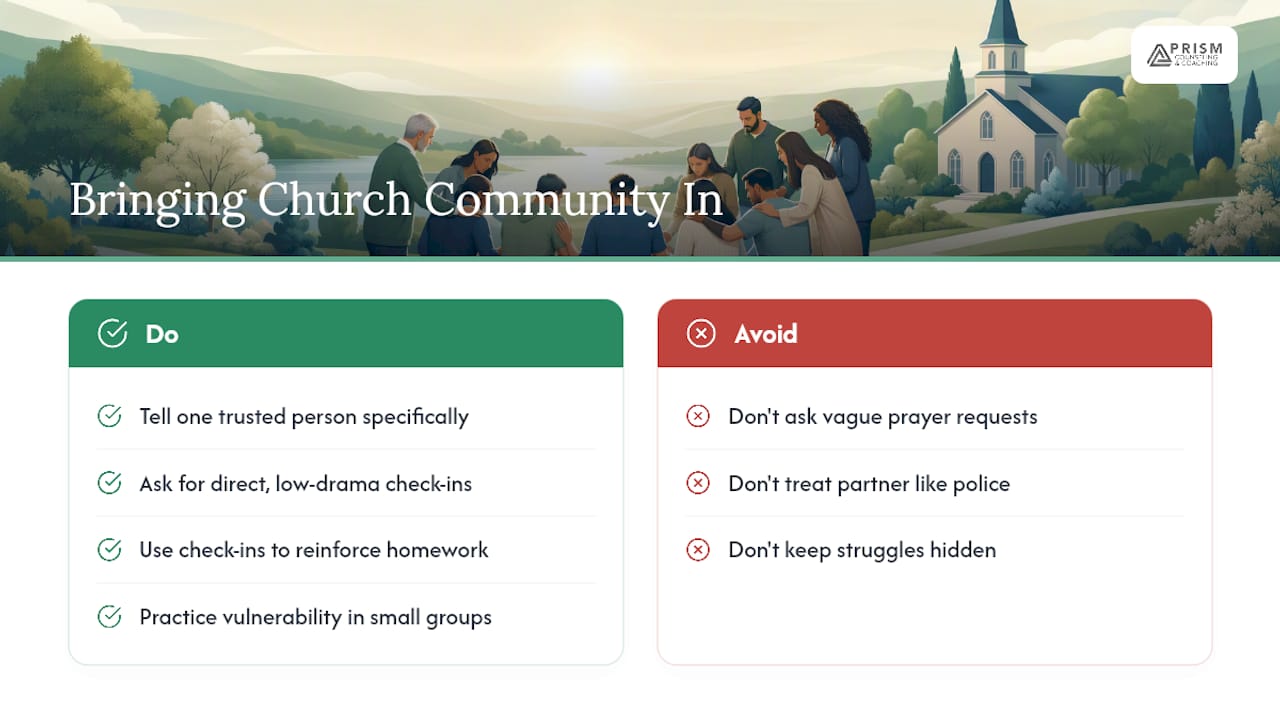
Start by telling one trusted person, a spouse, a small group leader, or a close friend, specifically what you are working on and what it looks like when you are struggling. Vague requests for prayer rarely produce useful accountability; a specific ask ("check in with me after family dinners, that's my hardest trigger") does.
An accountability partner's job is not to police you. It is to ask direct, low-drama questions on a regular rhythm: "How did the pause work this week?" or "Did you use the HALT check when things got tense?" That kind of check-in reinforces the homework and skills practice your counselor assigns between sessions, and research on faith-based programs shows that daily accountability tied to scripture practice improves how well clients retain new skills.
Small groups and men's or women's ministries can also become a safe place to practice vulnerability about anger before it becomes a crisis. If your church does not have a natural entry point for this, ask your pastor directly. Many congregations are more open to hosting or sponsoring counseling support than members assume, and a church sponsorship arrangement can sometimes make ongoing care more accessible for members who need it.
What Progress Actually Looks Like
Progress with anger rarely looks like the emotion disappearing. It looks like the gap between trigger and reaction getting wider, week by week, until a moment that used to end in shouting ends in a pause instead.
A common pattern among clients working through anger in faith-integrated counseling: the first few sessions focus almost entirely on naming triggers that had never been named out loud before, things like feeling disrespected in front of children, or specific tones of voice from a spouse. By the middle of a program, the HALT check and the pause become automatic enough to use without thinking. By the later sessions, the Scripture that once felt like a rule to obey starts to feel like a tool that actually works in the moment it is needed.
The clearest marker of success is usually reported by the people around the client, not the client alone: a spouse who says the house feels calmer, a teenager who stops flinching at a raised voice, a coworker who notices fewer slammed doors. That outside confirmation tends to matter more to clients than any internal sense of "feeling better," because it shows the change reached the relationships anger had been damaging.
None of this happens overnight, and a counselor who promises otherwise is overselling the process.
Why This Combination Works When Willpower Alone Does Not
Most advice about Christian anger management leans too hard on one side or the other. Either it is all Scripture with no practical mechanism for interrupting a triggered brain in real time, or it is all clinical technique with no room for the guilt, grace, and repentance that many Christians need addressed directly. Both versions leave a gap, and the gap is usually where relapse happens.
What the evidence and the programs built around it actually support is narrower and more useful: teach the pause, the grounding, and the thought-challenging as skills, and let Scripture supply the "why" and the accountability structure that makes those skills stick. Compassion toward yourself during the process matters more than most people expect. Clients who treat a bad week as evidence of failure tend to quit; clients who treat it as data and keep practicing tend to see the pattern actually shift.
If you take one thing from this guide, prioritize finding a counselor who can name both a clinical technique and a chapter and verse in the same sentence, without treating either as decoration for the other. That combination, not raw willpower and not one more sermon, is what tends to move the needle for people who have already tried everything else.
— Tres
Getting Started With Prism-counseling
If your anger has started costing you relationships, sleep, or peace at home, Prism-counseling gives you a faster path to real help than most traditional practices in the Phoenix area, because the private-pay model means no insurance queue standing between you and an opening this week. Individual counseling, trauma and EMDR work, and anger-focused sessions are all available through the same faith-integrated approach described throughout this guide.
Your first call is a conversation, not an intake form. A counselor will ask what triggered the outbursts, what you have already tried, and whether Scripture, clinical technique, or both feel like the right starting point for you. If documentation for a court or employer is part of your situation, that gets addressed directly on the call, not left as an unanswered question later. Visit the faith-based counseling page to see current services, or go straight to the Christian counseling for anger page to book your first session and start working through it with someone trained in both halves of the process.
Sources
- Anger Management - Harvest House Ministries
- How to Deal with Anger In A Godly Way - Scripture River
- Christian Anger Management Program — NJ, NY & PA | Faith-Based, Court-Accepted & Voluntary
- Surprising Research About Controlling Anger