

Employee Assistance Programs deliver measurable returns for employers who use them well. The details below cover implementation, measurement, and what separates a well run EAP from one that quietly collects dust in a benefits binder.
TL;DR:
- Active promotion and repeated manager encouragement can increase EAP utilization from under 5% to around 10%, significantly boosting return on investment.
- Utilizing KPIs like uptake rate and absenteeism changes helps measure short-term engagement and long-term outcome improvements effectively.
- A well-designed, confidential, faith-integrated EAP like PrismCare™ may yield higher trust, engagement, and ROI for employees valuing spiritual support.
- Smaller and mid-size employers can implement and benefit from faith-based programs more quickly due to simpler onboarding and flexible delivery options.
- Boosting awareness through consistent communication, manager training, and privacy assurances is crucial to maximize EAP usage and outcomes.
Table of Contents
- What Are the Core EAP Benefits for Employers?
- What ROI Can Employers Actually Expect From an EAP?
- What Services Does an EAP Actually Include?
- How Do You Implement an EAP That Employees Actually Use?
- How Do Employers Measure Whether an EAP Is Working?
- Why Consider a Faith-Integrated EAP Like PrismCare™?
- A Practitioner's Take on Getting This Right
- PrismCare™: A Faith-Based EAP Built for Fast, Confidential Support
- Sources
What Are the Core EAP Benefits for Employers?
An Employee Assistance Program earns its place in a benefits package through several distinct channels, not just one feel-good outcome. When someone is quietly wrestling with a family crisis, financial strain, or grief, that struggle shows up at work long before it shows up anywhere else.
- Reduced presenteeism. Employees show up physically but function at a fraction of their capacity when stress goes unaddressed.
- Lower absenteeism. Fewer unplanned sick days and shorter leaves once employees have somewhere to turn before a crisis escalates.
- Better retention. Workers who feel supported during hard seasons stay longer, which matters given how expensive turnover has become.
- Reduced claims and workers' comp exposure. Early intervention tends to prevent smaller issues from becoming costly medical or disability claims.
- Improved safety outcomes. Distracted or exhausted employees make more mistakes, particularly in physical or safety-sensitive roles, highlighting the need for environment health safety training for employees.
Statistic Callout: Studies using the Workplace Outcome Suite found a 25.3% reduction in presenteeism and a 35% improvement in overall work productivity after EAP intervention.
Beyond the measurable line items, there's a quieter benefit: morale. Employees notice when a company invests in their wellbeing rather than treating them as replaceable. That perception feeds directly into recruitment, too, since benefits packages with real mental health support are increasingly a deciding factor for job seekers comparing offers.
What ROI Can Employers Actually Expect From an EAP?
The $3 return for every $1 spent is the benchmark most employers hear first, and it holds up as a reasonable baseline. But it's an average, not a guarantee, and the range around it is wide.
EAPA's most recent reporting shows ROI figures climbing well above that baseline when a program is actively promoted, with larger employers often seeing the strongest returns because they can sustain communication campaigns over time. Utilization is the hinge everything swings on.
| Utilization level | Typical employer size | Expected ROI signal |
|---|---|---|
| Low (under 5%) | Small business, no promotion | Near break-even to modest positive |
| Moderate (around 5%) | Mid-size, basic onboarding mention | Solid positive, close to $3:$1 |
| High (around 10% with active promotion) | Larger employer, sustained communication | Well above baseline benchmark |
Statistic Callout: Systematic reviews confirm that EAPs consistently reduce absenteeism and improve worker outcomes, with utilization and program design driving how large that effect turns out to be.
Treat the $3:$1 figure as a floor to plan a budget around, not a ceiling to expect automatically. The real lever is how much effort goes into making employees aware the program exists and feels safe to use.
What Services Does an EAP Actually Include?
A typical EAP bundles several distinct supports rather than offering just one type of help:
- Short-term counseling for stress, anxiety, grief, or relationship strain, usually a set number of sessions per issue.
- Referrals to longer-term specialists when a situation needs more than brief counseling can provide.
- Crisis response, including after a workplace incident, sudden loss, or acute mental health emergency.
- Legal and financial consultations for issues like debt, divorce, or estate questions.
- Manager consultations to help supervisors handle a struggling employee without overstepping.
Delivery now spans phone, video, chat, app-based access, and in-person sessions, often with after-hours availability built in for genuine emergencies.
How Do You Implement an EAP That Employees Actually Use?
A program nobody uses returns nothing, no matter how generous its benefits look on paper. Getting utilization up follows a fairly predictable sequence.
- Define what success looks like. Absenteeism reduction, retention, safety incidents, or a mix, decided before you shop vendors.
- Set the scope. Decide which populations are covered, family members included or not, and how many sessions per issue.
- Vet vendors on fit, not just price. Ask about counselor availability, specialty areas, and whether the program matches your workforce's values and needs.
- Build in privacy safeguards. Employees need to know, concretely, that no one at the company sees who uses the program.
- Pilot before a full rollout, especially at a mid-size company, to work out communication kinks before scaling company-wide.
Promotion matters as much as the program itself. Utilization sits around 4% in many workplaces when employers just post a flyer once and move on. Manager training, repeated reminders across the year, and mentioning the EAP during onboarding all push that number meaningfully higher.
Pro Tip: Train managers to mention the EAP by name during one-on-ones when they sense someone is struggling. A direct, human referral from a trusted manager drives far more uptake than any poster in the breakroom.
How Do Employers Measure Whether an EAP Is Working?
Measurement doesn't require a data science team. A workable KPI set includes:
- Utilization rate, the percentage of eligible employees using the program each year.
- Average sessions per user, which signals whether people are getting adequate support or dropping off early.
- Absenteeism days tracked before and after rollout.
- Turnover rate, especially among employees flagged as high performers or high risk.
- Healthcare claim trends, watched over multiple quarters rather than month to month.
- Standardized outcome scores like WOS-5, where a provider offers them.
Short-term signals (a spike in utilization right after launch) tell you the promotion worked. Long-term signals (fewer claims, steadier retention over a year or two) tell you the program is actually changing outcomes. Employers wanting a rough internal estimate can model absenteeism and presenteeism changes against conservative utilization assumptions, testing low, medium, and high uptake scenarios to see the realistic financial range before committing budget.
Why Consider a Faith-Integrated EAP Like PrismCare™?
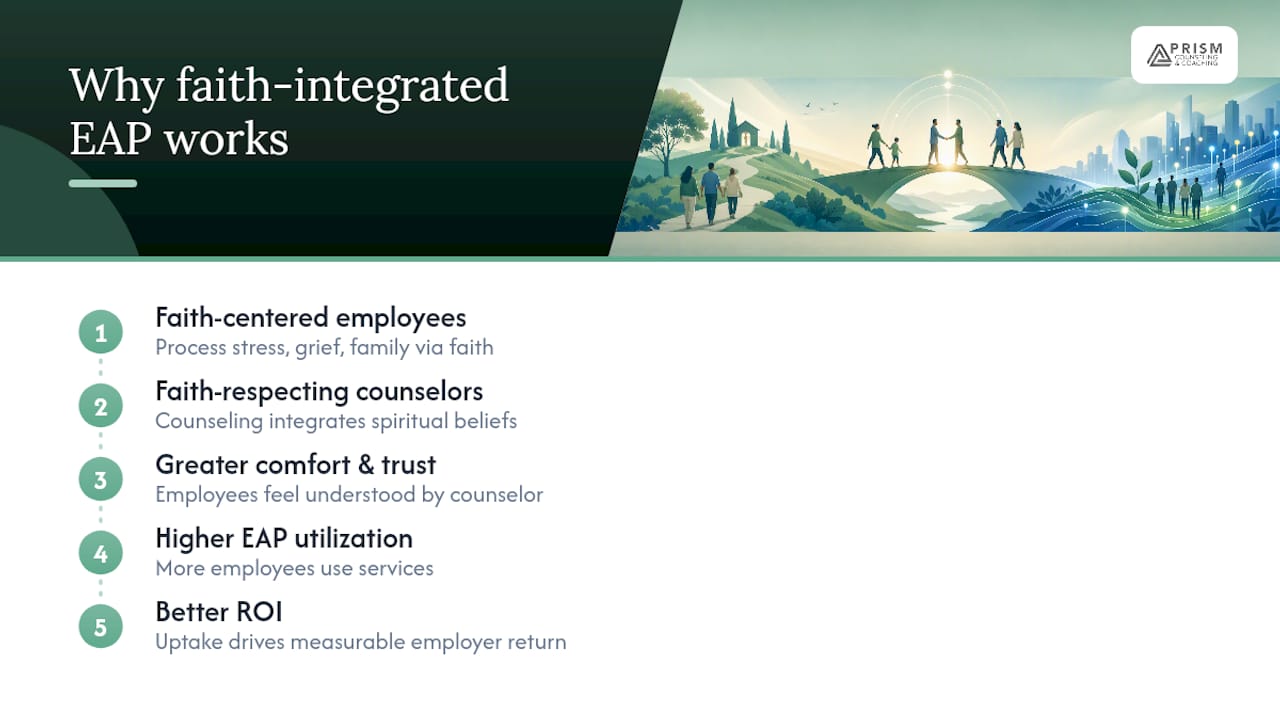
A counseling practice with extensive experience providing spiritually-integrated therapy shapes the PrismCare™ Faith-Based Employee Assistance Program. For employees whose faith is central to how they process stress, grief, or family conflict, an EAP that respects that framework tends to see stronger trust and, in turn, stronger utilization. That aligns directly with the metrics covered above: uptake drives ROI, and comfort with the counselor drives uptake.
A Practitioner's Take on Getting This Right
If you take one action from this article, make it manager training. Every metric above (absenteeism, utilization, retention) moves when supervisors know how to mention the EAP naturally instead of treating it as an HR footnote. Programs fail from silence, not from poor design.
— Tres
PrismCare™: A Faith-Based EAP Built for Fast, Confidential Support
Most EAP vendors treat confidentiality as a checkbox in a contract. PrismCare™ treats it as the whole foundation, because trust is what actually gets employees through the door. The private-pay model means no insurance paperwork trail and openings within days, not weeks, which matters when someone finally decides they're ready to talk to someone.
This program fits small to mid-size employers especially well, since a faith-integrated approach can launch quickly without the long onboarding cycles larger EAP vendors often require. It pairs naturally with the confidentiality communication your employees actually need to hear before they'll trust the program enough to use it, and with clear per-employee budgeting so finance can plan around it. If your workforce includes employees who value faith-centered support, or if you're weighing options after seeing how much utilization drives ROI, visit the PrismCare™ EAP page to request pricing or a pilot program for your team.
Sources
- WOS-5 / EAP outcome study (archived report)
- Systematic review: EAP research and practice (PMC)
- EAPA ROI report 2023
This article is general information, not a substitute for advice from a qualified doctor. Consult a qualified healthcare professional about your own circumstances before acting on anything here.