

Yes, the Bible calls Christians to forgive even serious betrayal, but infidelity forgiveness in Christian marriage is not the same as immediate reconciliation or restored trust. Forgiveness is commanded, and it's possible when there's genuine repentance. Reconciliation and trust are separate, slower processes. If you're standing in the wreckage of an affair right now, your next steps are simple to name even if they're hard to walk: seek pastoral counsel, make sure you're safe, and find a trauma-aware counselor who understands both your faith and your pain.
TL;DR:
- Forgiveness can be offered unilaterally and promptly, even if full reconciliation or trust rebuilding takes much longer and requires mutual effort.
- Complete disclosure and establishing safety are essential in the first year, with trust gradually restored through consistent behavior over time.
- Boundaries and separation may be necessary when threats, violence, or continued secrecy threaten safety or prevent genuine repentance.
- Faith-based, trauma-informed counseling helps address betrayal trauma holistically, supporting emotional, spiritual, and physical healing.
- Reconciliation depends on ongoing repentance, transparency, and patience, with no fixed timeline for when trust can fully be rebuilt.
Table of Contents
- What Does the Bible Say About Infidelity Forgiveness?
- Is Forgiveness the Same as Reconciliation?
- What Are the Practical Steps to Forgive an Unfaithful Spouse?
- How Long Does Christian Marriage Reconciliation Take?
- When Is Separation or Divorce Appropriate After Infidelity?
- Why Faith-Integrated, Trauma-Informed Counseling Helps
- A Personal Word on Grief, Betrayal, and What Comes Next
- Ready to Talk to Someone Who Understands Both Faith and Trauma?
- Sources
What Does the Bible Say About Infidelity Forgiveness?
Scripture doesn't leave forgiveness up for debate. "Be kind to one another, tenderhearted, forgiving one another, as God in Christ forgave you" (Ephesians 4:32). Jesus makes the stakes even clearer in Matthew 6:14-15, tying our willingness to forgive others to our own experience of being forgiven by God. Neither verse asks whether the offense was small. Betrayal in marriage qualifies.
Matthew 19:9 adds pastoral complexity many Christians overlook. Jesus names sexual immorality as biblical grounds for divorce, which means a betrayed spouse who cannot reconcile is not sinning by that choice. Grounds for divorce and a requirement to divorce are not the same thing, and many marriages survive infidelity when repentance is real.
Desiring God's interview on healing after adultery describes forgiveness as something close to a miracle, powered by remembering how much God has already forgiven us. That interview also draws on Hosea, where God pursues an unfaithful people with covenant love rather than abandonment. It's not a mandate to stay. It's a picture of what grace can look like when repentance is genuine.
- Ephesians 4:32 and Matthew 6:14-15 command forgiveness as a response to being forgiven.
- Matthew 19:9 permits divorce for sexual immorality without demanding it.
- Hosea's marriage to an unfaithful wife pictures God's covenant faithfulness, not a blueprint for every couple.
Pro Tip: Read Hosea 1 through 3 in one sitting before you talk with your pastor. The narrative arc, not just isolated verses, is what makes the imagery land.
Is Forgiveness the Same as Reconciliation?
No. Forgiveness releases your right to hold the offense against your spouse before God in this evidence-based forgiveness framework for Christian leaders. Reconciliation rebuilds the relationship itself, and trust is the slow currency earned through consistent behavior over time. You can forgive someone who never sets foot back in your home.
That distinction matters because church culture sometimes conflates the two, pressuring betrayed spouses toward reconciliation before safety or repentance are established. Forgiveness is something you can extend unilaterally, on your own timeline, before God. Reconciliation requires two willing people. Trust requires evidence.
- Forgiveness: an internal release of resentment, commanded regardless of the offender's response.
- Reconciliation: restored relationship, contingent on repentance and mutual willingness.
- Trust: rebuilt gradually through transparency and time, never granted on request.
Pro Tip: If your spouse says "you have to trust me now" days after disclosure, that's a script problem, not a trust problem. A simple answer works: "I can forgive you and still need to see consistency before I feel safe."
What Are the Practical Steps to Forgive an Unfaithful Spouse?
Recovery after infidelity tends to move through three phases, and rushing any of them tends to backfire.
- Stabilization. Establish physical and emotional safety first. The affair contact ends completely, with no exceptions for "closure" conversations. Grief gets permission to exist without a deadline. Pastoral support and an initial counseling referral should happen early, not delayed.
- Truth and accountability (3 to 12 months). This phase centers on full disclosure, not partial confession followed by more discovery. Focus on the Family's guidance for wounded spouses recommends professionally mediated disclosure so the offending spouse doesn't control the narrative and the betrayed spouse isn't left guessing. Individual therapy for both people, alongside couples work, is standard here.
- Rebuilding. Trust benchmarks replace vague promises. Physical intimacy returns gradually, only after safety markers are consistently met, over a period adapted to each couple's pace.
A biblical and clinical roadmap for affair recovery frames this as addressing spirit, soul, and body together, since betrayal trauma lodges in the nervous system, not just the heart.
Sample language helps when you don't know where to start:
- "I need to see your phone and location access for now. That's not punishment. It's how trust gets rebuilt."
- "I'm not ready to talk about reconciliation yet. I need six more weeks of consistent counseling first."
- "Telling me the whole truth now, even the painful parts, is less damaging than me finding out later."
Pro Tip: Write your boundary scripts down before an emotional conversation starts. Reading from a note is not weakness. It's how you stay steady when your body wants to fight or flee.
How Long Does Christian Marriage Reconciliation Take?
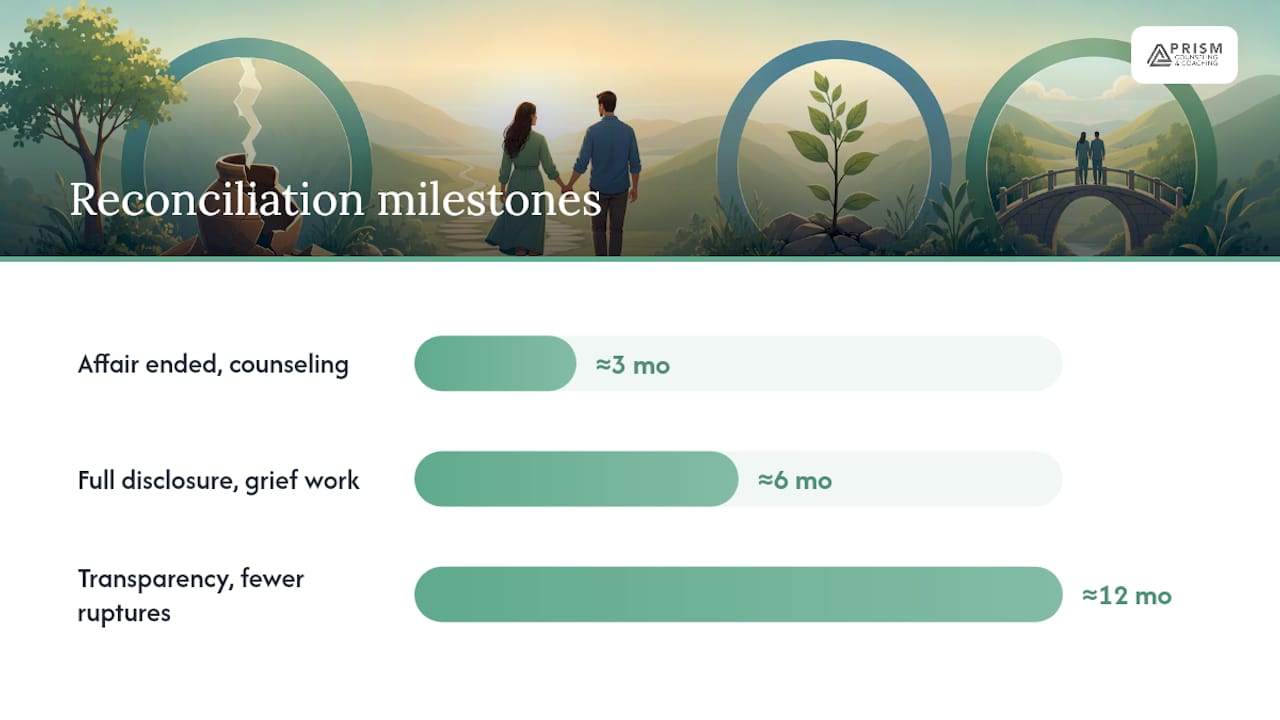
There's no fixed calendar, but patterns show up often enough to name. By three months, most couples have stopped the affair contact and started some form of counseling. By six months, disclosure is largely complete and the initial shock has given way to a longer grief. By twelve months, couples who are progressing well see consistent transparency and fewer trust ruptures, though anniversaries and unexpected triggers, a song, a hotel, a name, can reopen pain without warning.
FamilyLife's Justin and Trisha Davis describe recovery as requiring two simultaneous miracles: forgiveness from the betrayed spouse and sustained repentance from the one who broke trust. When only one miracle shows up, and repentance never becomes consistent behavior, continuing to pursue reconciliation stops being faithful patience and starts being unsafe waiting.
- Around 3 months: affair contact ended, counseling started.
- Around 6 months: full disclosure complete, grief work underway.
- Around 12 months: consistent transparency, fewer trust ruptures typically observed.
- Ongoing unrepentance or renewed secrecy: a signal to reassess, not a failure of your faith.
When Is Separation or Divorce Appropriate After Infidelity?
Boundaries protect the relationship's chance at healing. They are not a lack of faith.
- End contact with the affair partner immediately and verify it, don't just take the promise at face value.
- Change shared passwords and financial access if there's any pattern of hidden spending or communication.
- Document any threats, coercion, or intimidation in writing, with dates.
- Arrange a temporary, structured separation if staying under one roof isn't safe for your body or your children.
Watch for red flags that make reconciliation unsafe rather than merely painful: physical violence, continued secrecy after disclosure, or coercive control over your finances, movement, or contact with support people. War Room Ministries calls firm boundaries "a lavish act of love," since they protect you while creating space for real repentance to prove itself. Involve a pastor and a trauma therapist early, and involve law enforcement without hesitation if you're in danger. A simple next-step script: "I'm not able to stay under these conditions. I need us both to get outside help before anything else happens."
Why Faith-Integrated, Trauma-Informed Counseling Helps
Betrayal trauma lives in the body, not just in belief. That's why pastoral counsel alone often isn't enough, and why clinical therapy without spiritual grounding can leave a hole in a Christian's healing.
Prism Counseling & Coaching has specialized in faith-based counseling for over 14 years, serving individuals, couples, and families in the Phoenix area. The practice's private-pay model means clients typically get openings within days instead of the weeks-long waits common with insurance-based therapy.
- Individual trauma processing for the betrayed spouse.
- Couples counseling addressing both the relational rupture and the spiritual dimension.
- EMDR and other trauma-informed approaches for betrayal-specific symptoms.
- Spiritual integration that treats Scripture and clinical practice as partners, not competitors.
Healing after betrayal asks something of the whole person, spirit, mind, and body, not a single Sunday conversation or a single counseling session. Faith-integrated, trauma-informed care exists precisely because grief and grace need both room to work.
A Personal Word on Grief, Betrayal, and What Comes Next
Grief after betrayal doesn't move in a straight line, and neither does forgiveness. If you're reading this exhausted, you're not failing your faith. Forgiveness and staying in the marriage are two different decisions, and you're allowed to make them on separate timelines. Whatever you choose next, don't choose it alone. Counseling and a safe community can carry weight you were never meant to carry by yourself.
— Tres
Ready to Talk to Someone Who Understands Both Faith and Trauma?
If you're navigating the aftermath of an affair, waiting weeks for an appointment only adds to the damage already done. Some private-pay counseling services may offer quicker appointment availability and incorporate faith perspectives into clinical care.
Whether you need couples counseling to work through disclosure and rebuild trust, individual trauma therapy with EMDR for betrayal-specific symptoms, or a starting conversation about what Christian counseling even looks like for your situation, the intake process is straightforward: a phone call, a short intake form, and a first session scheduled around your timeline, not a waitlist. You can also review Prism's broader counseling resources if you're still deciding what kind of support fits. Reach out and request an appointment to take the next concrete step toward healing, whatever that healing ends up looking like for your marriage.
Sources
- How Can Couples Heal After Adultery? | Desiring God
- Marital infidelity recovery for both wounded spouses | Focus on the Family
- Christian marriage healing after an affair: a biblical and clinical roadmap