

Yes, most PPO and POS plans reimburse out-of-network therapy, but only after you meet a separate deductible, submit a superbill, and clear your insurer's medical necessity bar. You pay the therapist directly, then wait for coinsurance-based reimbursement calculated on the insurer's allowed amount, not your therapist's actual fee. That gap between the two numbers is where most people feel blind sided.
TL;DR:
- Out-of-network reimbursement depends on meeting a separate deductible, paying upfront, and submitting a detailed superbill for claims processing.
- Insurers reimburse based on their allowed amount, which may be lower than the therapist’s fee, often resulting in balance billing.
- It is essential to verify benefits, request the proper allowed amount for specific CPT codes, and keep detailed, dated records of all interactions.
- Claims generally take two to six weeks for reimbursement, with net payments averaging between half to three-quarters of the session fee.
- Denials are usually fixable with specific documentation, such as correct diagnosis codes or a therapist’s justification of medical necessity.
Table of Contents
- Understanding Out-of-Network Benefits: Your Pre-Session Checklist
- How Does Out-of-Network Reimbursement Actually Work?
- What Are the Steps to File an Out-of-Network Claim?
- What Happens if Your Out-of-Network Claim Gets Denied?
- How Much Will Out-of-Network Therapy Actually Cost You?
- How Prism Counseling Supports Clients Through the Superbill Process
- When Is Out-of-Network Reimbursement Actually Worth Pursuing?
- A Private-Pay Path That Skips the Reimbursement Guesswork
- Sources
- FAQ
Understanding Out-of-Network Benefits: Your Pre-Session Checklist
Before you book a single session, get these answers in writing or at least written down with a date and a name attached. Insurance reps change, policies get misquoted, and you want a record if a dispute comes up later.
- Ask member services directly: "Do I have out-of-network mental health benefits, and what's my out-of-network deductible?"
- Find out how much of that deductible you've already met this plan year.
- Request the allowed amount for CPT code 90837 (the 60-minute session code) and CPT 90834 (45 minutes) in your ZIP code. Asking for a dollar figure instead of a vague percentage gives you something you can actually calculate against.
- Confirm whether the APA notes many insurers require a referral from an in-network provider before out-of-network benefits kick in. It's an easy step to miss.
- Ask how to submit claims: portal, mail, fax, and whether a diagnosis code (ICD-10) is mandatory on the superbill.
- Ask your therapist how often they issue superbills and whether those include their NPI number, license type, and tax ID.
Pro Tip: Write down the representative's name, the date, and any reference or confirmation number for every call. If a claim gets denied later, that call log becomes your strongest evidence that you were told something different.
How Does Out-of-Network Reimbursement Actually Work?
The insurer doesn't reimburse a percentage of what your therapist charges. It reimburses a percentage of what it decides that service is worth, called the allowed amount. If your therapist charges $180 for a 60-minute session and your insurer's allowed amount for CPT 90837 is $120, your coinsurance percentage applies to that $120, not the full $180.
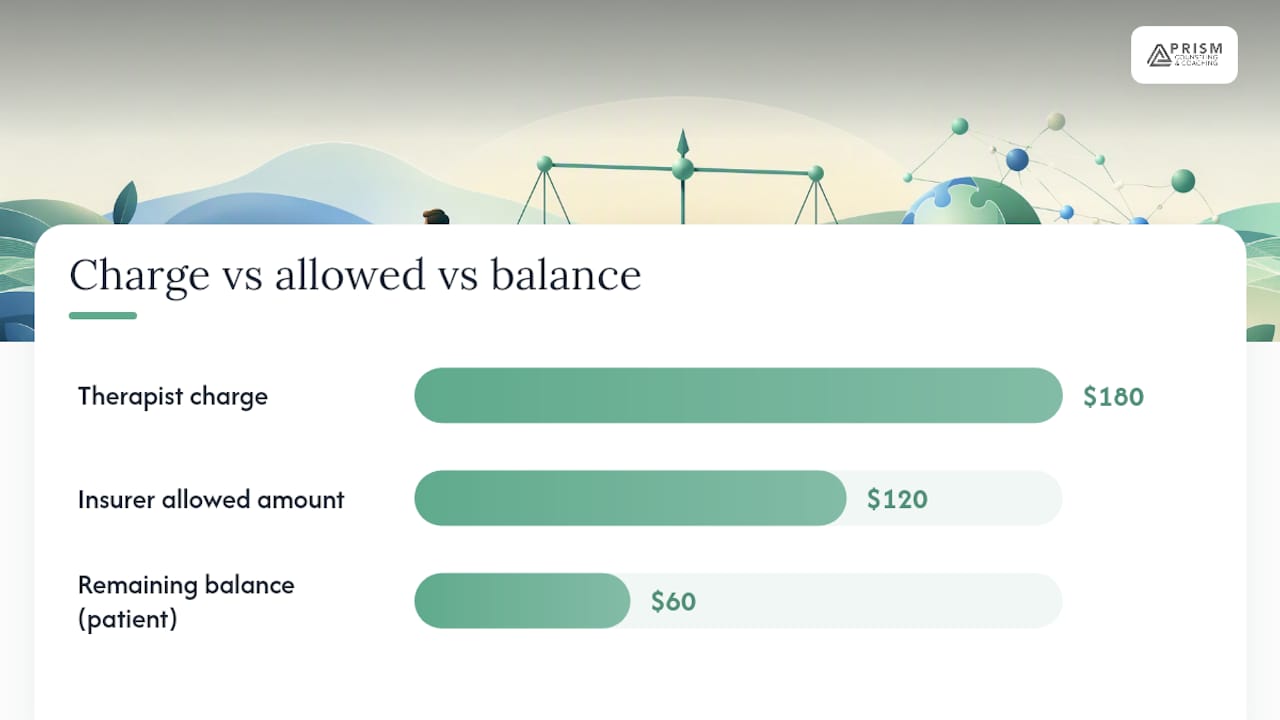
That distinction explains most of the confusion people run into. Healthcare as the share you pay after your out-of-network deductible is met, calculated against the plan's allowed amount rather than the billed charge. The remaining difference between the therapist's fee and the allowed amount often becomes your responsibility through balance billing, since out-of-network providers generally aren't bound by negotiated rates.
Your out-of-network deductible is also usually separate from your in-network deductible. Money you've already paid toward in-network care typically doesn't count toward it, which means you may be starting from zero even mid-year.
A complete superbill needs to include the CPT code, an ICD-10 diagnosis, the provider's credentials and NPI number, session dates, fees charged, and the practice's tax ID. Missing any one of these is a common reason claims bounce back.
Here's how the math typically plays out:
Reimbursement checks or direct deposits typically arrive two to six weeks after a claim is filed, depending on the insurer and whether your submission was complete on the first try. Net reimbursement often lands somewhere between about half to three-quarters of the actual session fee once the allowed amount and balance billing are factored in, though this varies significantly by plan and region.
What Are the Steps to File an Out-of-Network Claim?
- Verify your benefits first. Call the number on your insurance card, ask the checklist questions above, and record the representative's name and a reference number.
- Get proper documentation from your therapist. Request the superbill format they use and confirm it includes every field your insurer requires, especially the ICD-10 diagnosis.
- Submit through the right channel. Most insurers now accept claims through an online portal, which processes faster than mail. Keep copies of everything you send, and if you'd rather not deal with the paperwork, third-party claim-filing apps exist that submit on your behalf for a per-claim fee, a reasonable trade for people who dread admin work but not one everyone needs.
- Track it and follow up. When your Explanation of Benefits (EOB) arrives, check that the allowed amount and coinsurance calculation match what you were quoted. If four to six weeks pass with no movement, call and ask for a claim status update by reference number, not just a general inquiry.
Pro Tip: Submit superbills monthly instead of letting them pile up for a year. Insurers sometimes impose filing deadlines, often 90 days to a year from the date of service, and a stack of six months of paperwork is far easier to get wrong.
What Happens if Your Out-of-Network Claim Gets Denied?
Denials usually trace back to something fixable: a missing diagnosis code, the wrong CPT code, an incomplete superbill, or a service the plan doesn't consider medically necessary.
- Request the specific denial reason in writing, then correct that exact issue and resubmit.
- Build an appeal file: the superbill, session notes if requested, a letter from your therapist explaining medical necessity, and your original benefits verification notes.
- If your insurer's network genuinely lacks an accessible in-network therapist for your needs, you can request a network adequacy exception or a single-case agreement (SCA), essentially asking the insurer to pay in-network rates for an out-of-network provider. Document your search: names of providers contacted, wait times quoted, and specialties that weren't available in-network.
- If you believe your plan is violating mental health parity requirements, you can file a complaint with your state insurance department or reference CMS's consumer protection resources for escalation paths.
| Denial reason | Fix |
|---|---|
| Missing ICD-10 diagnosis | Request corrected superbill from therapist |
| Wrong or outdated CPT code | Confirm 90837/90834 matches session length |
| "Not medically necessary" | Submit therapist letter with clinical justification |
| Network inadequate for your need | Request single-case agreement with documentation |
NAMI's research on parity documents that network adequacy shortfalls are a real, widespread driver of these denials, not an isolated inconvenience.
How Much Will Out-of-Network Therapy Actually Cost You?
Run the numbers before you commit to a therapist. Take the session fee, subtract the insurer's allowed amount, and that difference is balance billing you'll likely absorb regardless of your coinsurance percentage. Then apply your coinsurance to the allowed amount itself to estimate your per-session cost once your deductible is met.
A few ways to bring that number down include strategies covered in special-needs and benefit planning.
- Use an HSA or FSA to pay session fees with pretax dollars, which softens the real cost even when reimbursement is partial.
- Ask if your therapist offers a sliding scale or a reduced private-pay rate for OON clients.
- Check whether your employer offers an EAP with a set number of free sessions before out-of-network billing starts.
- If a network adequacy case applies to you, an SCA can occasionally secure in-network pricing for an out-of-network provider.
- Time your start date around your deductible year. Starting in January when your deductible resets differs a lot from starting in November when it's about to reset anyway.
If insurance-based care matters more to your budget than continuity with a specific therapist, comparing your options for therapy without insurance is worth doing before you commit to an out-of-network relationship.
How Prism Counseling Supports Clients Through the Superbill Process
Prism Counseling & Coaching operates on a private-pay model, which means clients pay directly for sessions and Prism provides a superbill with the CPT code, diagnosis, and provider information clients need to submit their own claim for out-of-network reimbursement. Prism doesn't file claims on a client's behalf or guarantee any reimbursement outcome, since that decision sits entirely with each insurer. What clients do get is a straightforward paper trail and a practice that understands why that documentation matters.
When Is Out-of-Network Reimbursement Actually Worth Pursuing?
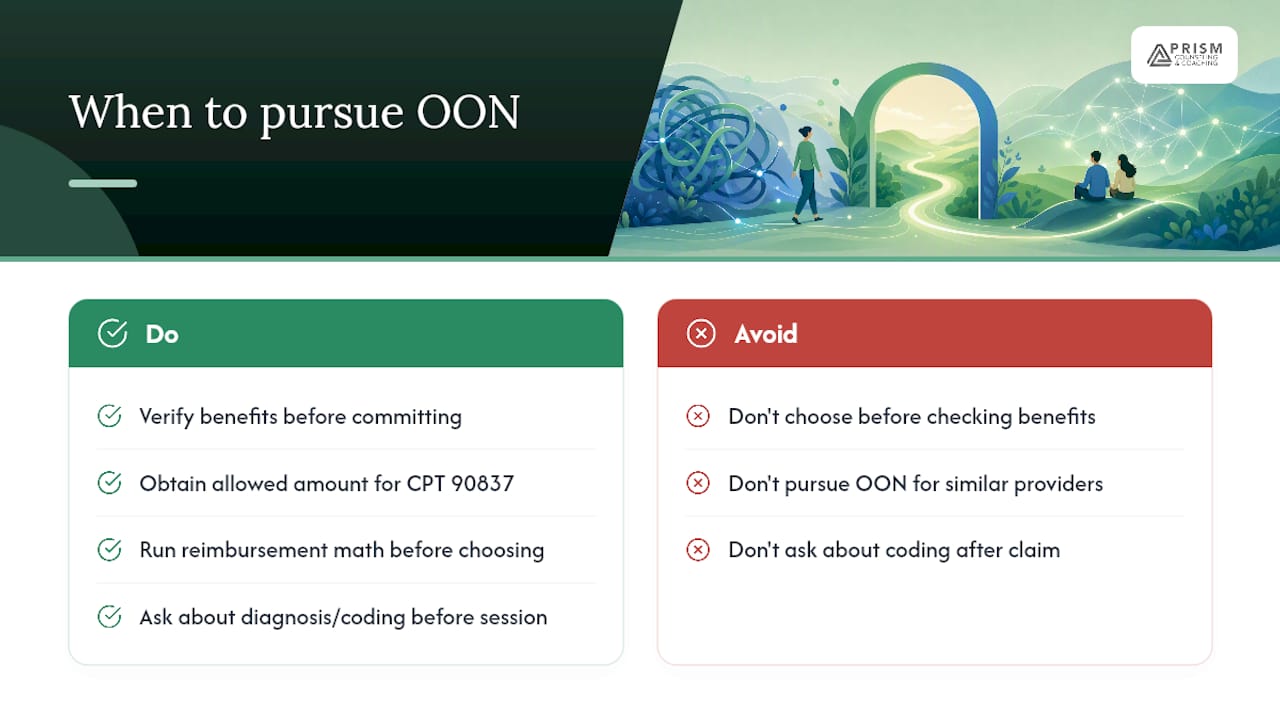
My honest read: verify benefits first, get the real allowed amount for CPT 90837, and run the math before you fall in love with a particular therapist. Reimbursement is worth chasing when the fit and specialty genuinely matter to your outcome, less so when you're choosing between two similarly qualified providers and one happens to be in-network.
One more thing worth sitting with: the diagnosis your therapist puts on that superbill becomes part of a permanent claims record. If confidentiality or coding choices concern you, ask about that before your first session, not after your first claim.
— Tres
A Private-Pay Path That Skips the Reimbursement Guesswork
This practice offers private-pay therapy as an alternative to insurance-dependent care, eliminating wait times related to claims processing and network approvals; sessions begin with private payment, aiming to provide quicker access and confidentiality.

If you'd still like to try reimbursement alongside private-pay care, check your out-of-network benefits before your first appointment so you know what to expect. Prism provides superbills with everything your insurer needs to process a claim, whether you're pursuing faith-based counseling for yourself or care for your family. Bring your insurance card to that first benefits call and ask the allowed-amount question directly. Reach out to schedule, and bring your questions with you.
This article is general information, not a substitute for advice from a qualified doctor. Consult a qualified healthcare professional about your own circumstances before acting on anything here.
Sources
- Does your insurance cover mental health services? — APA
- Healthcare
- No Surprises — CMS
- Out-of-Network, Out-of-Pocket, Out-of-Options — NAMI
FAQ
What Should You Do if Your Therapist Is Out of Network?
Ask your insurer whether you have out-of-network mental health benefits and what your allowed amount is for your therapist's CPT code. If you do have those benefits, request a superbill from your therapist and submit it directly to your insurer for reimbursement consideration.
How Do You Get Reimbursed for an Out-of-Network Provider?
Pay your therapist directly, collect a superbill containing the CPT code, ICD-10 diagnosis, and provider details, then submit it through your insurer's claims portal or by mail. Reimbursement typically arrives as coinsurance calculated against the insurer's allowed amount, not the full fee you paid.
How Does Out-of-Network Insurance Work for Therapy?
You pay upfront, then your insurer reimburses a percentage of its own allowed amount for that service after you meet a separate out-of-network deductible. Coinsurance for out-of-network care works differently from in-network cost sharing. The gap between your therapist's fee and the insurer's allowed amount usually becomes your responsibility through balance billing you're responsible for.
Is There a Two-Year Rule for Therapists and Insurance?
There's no universal "two-year rule" governing out-of-network therapy reimbursement; that phrase typically refers to unrelated licensing or state-specific supervision requirements, not insurance claims. If you've encountered that term from a specific insurer, ask them directly what it refers to in your plan documents.
Does Prism Counseling Accept Insurance for Sessions?
Prism Counseling & Coaching operates as a private-pay practice, so sessions are paid directly rather than billed to insurance. Clients who want to pursue reimbursement can request a superbill to submit to their own insurer for potential out-of-network coverage.