

Religious trauma therapy is treatment for the lasting emotional, spiritual, and relational harm caused by coercive, shaming, or abusive religious environments, and it can genuinely help you heal. The most effective path combines trauma-informed care with a therapist who understands spiritual injury, often using approaches like EMDR or religion-adapted CBT. If you are in crisis right now, please call emergency services or a crisis line before anything else. Otherwise, your next step is finding a clinician trained in both trauma and faith dynamics.
TL;DR:
- Religious trauma often damages attachment to God, requiring trauma therapy approaches that address both psychological and spiritual wounds.
- EMDR and religion-adapted CBT are among the most effective approaches, but therapists must prioritize stabilization before processing traumatic memories.
- Healing proceeds through phases of stabilization, processing, and integration, with setbacks expected and not indicating failure.
- Choosing a trauma-informed, faith-sensitive therapist involves specific questions about background, training, and how they incorporate spirituality into treatment.
- Self-care strategies like grounding techniques and boundary setting can help manage distress while arranging professional help.
Table of Contents
- What Counts as Religious Trauma or Spiritual Abuse?
- Signs That What You Experienced Was Traumatic
- Which Therapy Approaches Actually Help With Religious Trauma?
- What to Expect as Therapy Progresses
- Finding a Therapist Who Understands Spiritual Trauma
- Coping Strategies While You Arrange Professional Care
- Why Faith-Integrated Trauma Care Matters
- How Prism Counseling Can Help You Start Healing
- Where to Learn More
- Sources
- FAQ
What Counts as Religious Trauma or Spiritual Abuse?
Religious trauma happens when a faith system or its leaders use fear, control, or shame to override your sense of safety, identity, or worth. It differs from other trauma in one key way: it often damages your relationship with the divine itself, not just your relationship with people. That dual wound, psychological and spiritual, is why generic talk therapy sometimes falls short.
Concrete examples include:
- Coercive control, such as ultimatums tied to salvation or belonging.
- Public shaming or church discipline used to punish doubt or dissent.
- Leaders covering up abuse to protect an institution's reputation.
- Punitive theology that teaches you are inherently broken or deserving of suffering.
- Pressure to suppress your sexuality, identity, or personal convictions.
Clinically, this matters because the harm often lives in your attachment to God, not only in memory. An academic framework for religious and spiritual abuse treats that attachment as a primary target for treatment, alongside more familiar trauma work.
Signs That What You Experienced Was Traumatic
Religious trauma shows up differently in different people, but certain patterns repeat often enough to be worth naming.
- Emotional: chronic guilt, shame that feels disproportionate to any actual wrongdoing, anxiety, and depression.
- Spiritual and cognitive: loss of faith, a punitive or frightening image of God, intrusive religious thoughts, or confusion about what you actually believe.
- Relational: difficulty trusting authority figures, withdrawal from community, and trouble setting or recognizing healthy boundaries.
- Somatic: a racing heart during prayer, panic near church buildings, or a tightening in your chest when certain scripture comes up.
A scoping review found that religious or spiritual trauma may affect a significant number of American adults, while outcome research on how best to treat it remains limited. The review's findings suggest many clinicians are working with this population without deep specialized training, which is exactly why choosing the right therapist matters so much.
Which Therapy Approaches Actually Help With Religious Trauma?
No single method fits everyone, but several approaches have real support behind them and tend to work well together as part of a broader plan.
- EMDR (Eye Movement Desensitization and Reprocessing) helps your brain reprocess traumatic memories so they lose their emotional charge. EMDR professional resources describe it as commonly used for PTSD and complex trauma, though stabilization work usually needs to happen before reprocessing begins.
- Religion-adapted CBT (R-CBT) uses your own religious language and beliefs, rather than working around them, to challenge distorted or punitive thinking patterns. Systematic reviews and clinical trials show this integration can be both effective and ethical for religious clients.
- Trauma-focused CBT and CPT target the specific thought patterns that keep traumatic experiences feeling present and dangerous long after they have ended.
- Somatic therapies and grounding work address indoctrination that lives in the body, not just the mind. Clinical guidance on treating embodied religious trauma emphasizes building nervous system safety before any deeper narrative work.
- Narrative therapy, Internal Family Systems, and group therapy help you reclaim your story, integrate fractured parts of your identity, and find solidarity with others who understand what you have been through.
Pro Tip: Ask a prospective therapist how they sequence trauma work: stabilization first, processing second. If they want to jump straight into your worst memory in session one, that is a red flag, not efficiency.
Spiritual injury often needs its own direct attention. Purely secular cognitive work can stall when your core wound is your relationship with God, which is why some clinicians now treat attachment to God as its own clinical target rather than a side effect of trauma to be resolved later.

What to Expect as Therapy Progresses
Healing from religious trauma tends to move in phases rather than a straight line, and knowing this ahead of time can keep setbacks from feeling like failure.
- Phase 1, stabilization: building safety, learning somatic regulation, and setting boundaries with people or communities that still feel unsafe.
- Phase 2, processing: working through traumatic memories directly, often using EMDR, CPT, or narrative approaches, with your therapist pacing the work so it does not overwhelm you.
- Phase 3, integration: rebuilding a sense of identity and meaning, which may include repairing your relationship with faith or consciously deciding what you still believe.
- Expect setbacks: holidays, family gatherings, or even a familiar hymn can trigger old responses well into recovery, and that does not mean the work has failed.
This phased structure mirrors a four-phase recovery model used in trauma-informed spiritual abuse work, which many survivors find easier to follow than open-ended talk therapy.
Finding a Therapist Who Understands Spiritual Trauma
The right therapist will not minimize what happened to you, and they will not push you back toward the community that hurt you.
- Search using specific terms: "trauma-informed," "spiritually integrated," "EMDR-trained," or "faith-sensitive counseling," rather than generic therapist directories alone.
- On an initial call, ask directly whether they have worked with religious trauma before and what training they have in EMDR or R-CBT.
- Ask how they view spiritual integration: a good therapist lets you set the terms of how faith shows up in sessions, rather than imposing their own theology.
- Watch for red flags, including minimizing spiritual harm, using the session to proselytize, or pressuring you to reconcile with an abusive community.
- Consider practical fit: telehealth availability, private-pay versus insurance, and whether the practice offers LGBTQ+ affirming care if that matters to you.
Trauma-informed Christian counseling resources can help you understand what competent, faith-centered practice actually looks like before you make that first call.
Coping Strategies While You Arrange Professional Care
You do not have to wait for your first appointment to start feeling steadier.
- Try the 5-4-3-2-1 grounding technique: name five things you see, four you hear, three you feel, two you smell, one you taste.
- Practice slow, extended exhale breathing when anxiety spikes, since a longer exhale than inhale calms the nervous system.
- Use short, clear boundary phrases with family or leaders, such as "I'm not discussing that right now."
- Build a simple safety plan, including a crisis line number, in case distress becomes severe.
Pro Tip: Online survivor communities can offer real solidarity, but vet them the way you would a therapist: watch for groups that replace one rigid ideology with another.
Why Faith-Integrated Trauma Care Matters
Trauma-informed care means recognizing how trauma shows up and responding without causing further harm, a principle SAMHSA outlines for service providers. A specialized practice has applied that principle to religious trauma specifically for many years, offering EMDR, somatic methods, and a four-phase recovery approach that treats faith as something to understand, not dismiss or impose.
— Tres
How Prism Counseling Can Help You Start Healing
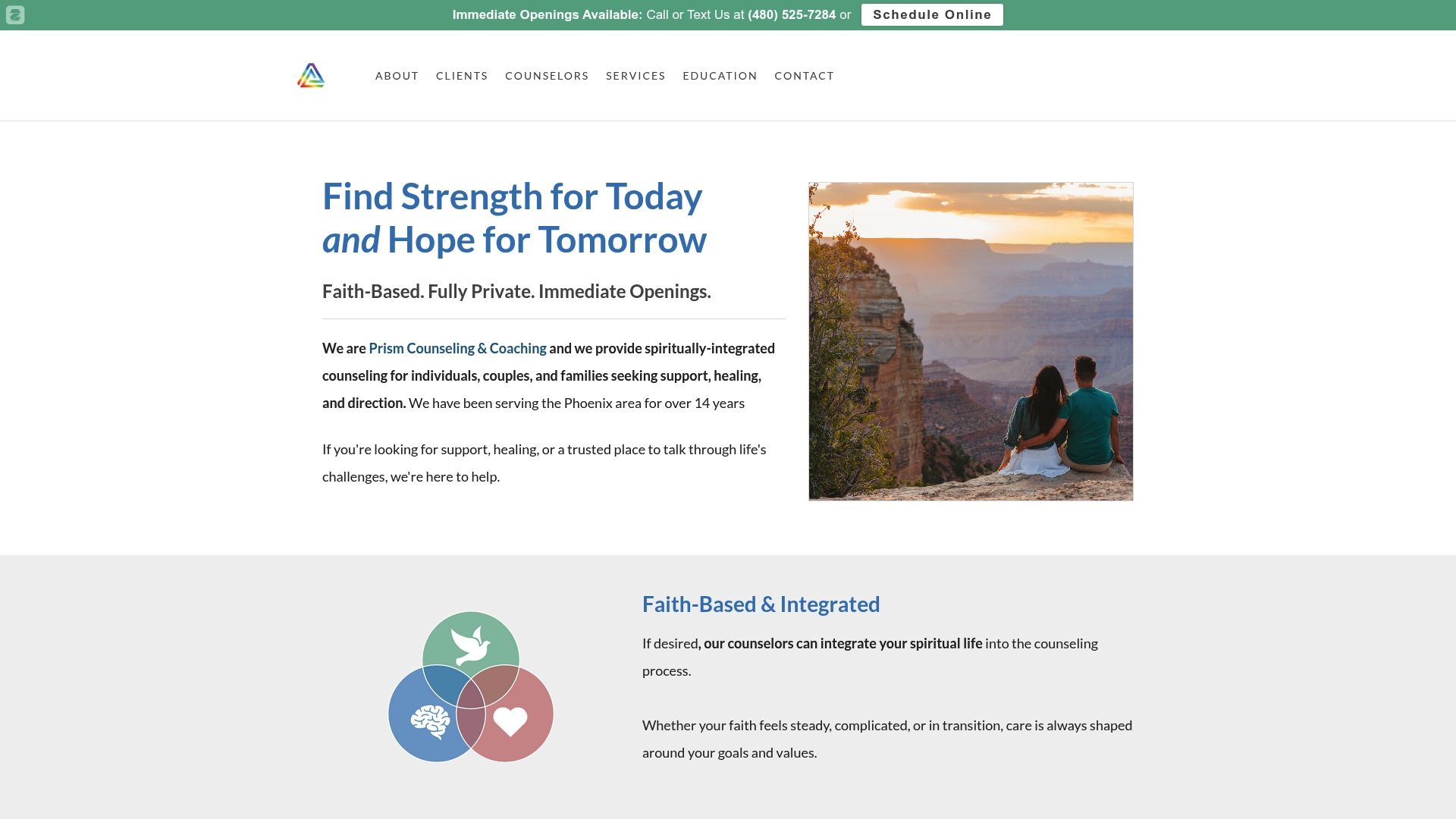
Prism Counseling & Coaching offers faith-based counseling and spiritual direction alongside trauma-focused modalities like EMDR, and every plan is shaped around your own beliefs rather than a fixed theology. Because the practice is private-pay with a small caseload, new clients often get an opening within days instead of waiting weeks through an insurance system.
What happens when you reach out:
- An initial conversation about your history, including your spiritual background and what led you to seek help.
- A discussion of your goals, whether that means processing specific memories, rebuilding trust, or figuring out what you still believe.
- A clear outline of what treatment could look like, paced to what feels manageable.
- Matching with a clinician suited to your situation, with full privacy protected throughout.
If cost is a concern, sliding scale appointments are available, and standard sessions are listed on the rates page. You can also view the full range of services, including individual counseling and LGBTQ+ affirming care, on the main site. Reach out to schedule a first appointment when you are ready.
Where to Learn More
For further reading grounded in research rather than opinion, SAMHSA's trauma-informed care framework is a strong starting point, alongside peer-reviewed work on religion-adapted CBT and broader guidance from the APA Monitor on integrating spirituality into therapy. Kin Wellness's overview of trauma-informed care offers an accessible third-party summary of the same principles.

This article is general information, not a substitute for advice from a qualified doctor. Consult a qualified healthcare professional about your own circumstances before acting on anything here.
Sources
- Trauma-Informed Care | SAMHSA
- Techniques of religion-adapted CBT (R-CBT) — PMC
- Treating the trauma in religious trauma — Psychotherapy Networker
FAQ
How do you break free from religious trauma?
Breaking free typically starts with finding safety, through grounding techniques, boundaries, and a trauma-informed therapist, before moving into deeper processing work like EMDR or trauma-focused CBT. Recovery is rarely linear, and integrating a new sense of identity and meaning is usually the final, longest phase.
What are some examples of religious trauma?
Common examples include coercive control tied to salvation, public shaming for doubt, leaders covering up abuse, and theology that teaches you are fundamentally unworthy. Pressure to suppress your sexuality or personal convictions to stay accepted in a community is another frequent pattern.
Is it okay for Christians to do EMDR?
Yes, EMDR can be used alongside a Christian faith, and many spiritually integrated therapists incorporate a client's beliefs directly into the process rather than setting them aside. EMDR's professional resources describe it as a trauma-processing method that fits within a client's own framework when stabilization is ensured first.
What is religious trauma syndrome?
Religious trauma syndrome describes the cluster of symptoms, including anxiety, shame, a punitive image of God, and relational distrust, that can follow harmful or coercive religious experiences. It is not a formal diagnosis in clinical manuals, but many trauma-informed therapists use it to describe this specific pattern of harm.
How do I know if a therapist understands spiritual abuse?
Ask directly whether they have treated religious trauma before, what training they have in approaches like EMDR or religion-adapted CBT, and how they handle spiritual content in session. A therapist who lets you define your own beliefs, rather than minimizing or redirecting them, is a strong sign of competence.