

Recovery from spiritual abuse is possible, and it begins with safety, not with sorting out theology. Effective healing blends trauma-informed therapy, body-based regulation, and a safe community around you. If you are in crisis or still inside a controlling environment right now, the first move is simple: do a safety check and reach out to a trusted clinician, crisis line, or support person today.
TL;DR:
- Safety and immediate support are crucial before engaging in deep healing or processing spiritual trauma to prevent further harm.
- Healing involves trauma-informed therapy, somatic approaches, and rebuilding boundaries, not just changing beliefs or intellectual understanding.
- Many survivors experience lasting emotional, cognitive, and physical symptoms such as shame, intrusive beliefs, muscle tension, and trust issues, often surfacing years later.
- Addressing spiritual strain is essential, as it predicts mental health outcomes and requires body-centered methods alongside belief reappraisal.
- Rebuilding a safe community and boundaries, along with choosing healing-paced therapeutic approaches, supports long-term recovery regardless of whether faith is restored or left behind.
Table of Contents
- Understanding Spiritual Abuse Recovery: What Happened to You
- Signs and Symptoms of Spiritual Abuse Survivors Often Recognize Later
- How Spiritual Abuse Affects Mental Health and Relationships
- The Phased Path Through Spiritual Abuse Recovery
- Therapies and Evidence-Based Tools for Healing From Spiritual Abuse
- Rebuilding Boundaries and a Spiritual Life That Belongs to You
- When to Seek Professional Help and How to Choose the Right Therapist
- How Prism Counseling & Coaching Supports Spiritual Abuse Recovery
- The Non-Linear Reality of Healing From Spiritual Abuse
- Get Support From Prism Counseling & Coaching
- Resources for Healing From Spiritual Abuse
- Sources
- FAQ
Understanding Spiritual Abuse Recovery: What Happened to You
Spiritual abuse is the misuse of spiritual authority, doctrine, or community power to control, shame, or harm someone under the guise of faith. It can come from a pastor, a small group leader, a family member, or an entire church culture that treats obedience as safety and questions as rebellion. Naming what happened is often the first real relief a survivor feels. Therapists who work with religious trauma report that simply labeling the experience as spiritual abuse gives survivors an immediate sense of clarity and an anchor for the identity work ahead.
There is a meaningful difference between spiritual struggle and spiritual abuse. Wrestling with doubt, feeling distant from God after a hard season, or disagreeing with a church's direction are normal parts of a lived faith. Spiritual abuse is different in kind, not just degree. It uses fear, guilt, or threats of divine punishment to keep people compliant, and it punishes independent thought as if it were sin.
A few patterns show up again and again in abusive religious systems:
- Leadership treated as beyond question or correction, with dissent framed as disloyalty to God.
- Confession, forgiveness, or obedience used as tools to extract compliance rather than support healing.
- Isolation from outside relationships, information, or perspectives that might challenge the group's authority.
- Shame used deliberately, so that a person's worth depends on their usefulness or submission to the system.
- Consequences for leaving framed as spiritual danger (damnation, demonic attack, loss of salvation) rather than a personal choice.
These dynamics don't require a cult in the dramatic, headline sense. A well-meaning church staff, a family devotion practice, or a campus ministry can produce the same injuries if power goes unchecked. What matters clinically is the pattern of control and harm, not the size or reputation of the institution behind it.
Signs and Symptoms of Spiritual Abuse Survivors Often Recognize Later
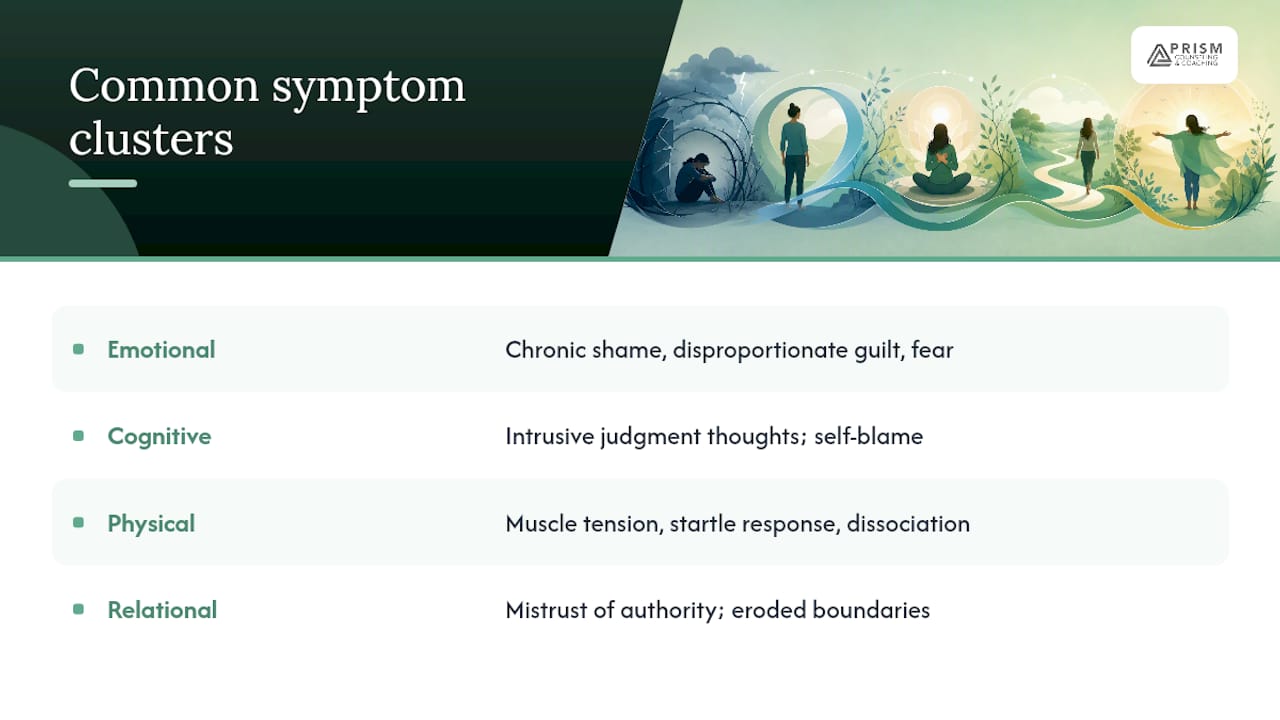
Many survivors don't identify what happened to them until years later, often when a new relationship, a health crisis, or plain exhaustion forces them to look closer. The symptoms tend to cluster into four areas, and most survivors recognize at least a few immediately.
Emotionally, survivors often carry chronic shame that outlives the situation that caused it, along with guilt that feels disproportionate to anything they actually did. A quiet, persistent fear of punishment, sometimes divine, sometimes social, often lingers long after leaving the environment.
Cognitively, intrusive beliefs can resurface at unexpected moments: a stray thought that a current struggle is God's judgment, or a reflex toward self-blame whenever something goes wrong. Many describe a loss of agency, a sense that they never learned how to trust their own judgment because someone else was always supposed to have the answer.
Physically, the body often keeps the record the mind tries to set down. Chronic muscle tension, an exaggerated startle response, and periods of dissociation, that foggy, checked-out feeling, are common. Relationally, survivors frequently struggle to trust new people, especially anyone in a position of authority, and many describe boundaries that eroded so gradually they didn't notice until they had none left.
An exploratory survey of 2,500 people by the Religious Trauma Institute found that fear, powerlessness, and shame were the three most common lasting impacts, frequently showing up as hypervigilance and ongoing relationship difficulty.
Pro Tip: If you recognize three or more of these signs, that is not proof you are "too sensitive" or "making it up." It's a strong signal that a conversation with a trauma-informed therapist is worth having soon, not eventually.
A quick self-check: do you feel a flash of dread when you think about disagreeing with a former leader? Do you monitor your own thoughts for signs of "sin" more than you examine your actual behavior? Does your body tense up in ordinary group settings that resemble your old church? If yes to any of these, your nervous system is still responding to a threat that may no longer be present, and that is treatable.
How Spiritual Abuse Affects Mental Health and Relationships
Spiritual abuse rarely stays contained to "religious feelings." It shows up in generalized anxiety, depression, and often in symptoms that overlap heavily with PTSD, including flashbacks, avoidance, and a persistent sense of danger. The National Center for PTSD describes a specific phenomenon called spiritual strain, ongoing conflict or doubt that follows trauma, and notes that this strain can predict worse mental health outcomes than any benefit gained from religious coping.
Spiritual strain, the conflict or doubt that follows a traumatic religious experience, can be more strongly linked to poor mental health outcomes than the protective benefits typically associated with religious coping. That is part of why clinical guidance increasingly recommends addressing spirituality directly within trauma treatment, rather than treating it as separate from the "real" clinical work.
This matters practically because belief change alone rarely resolves what happened in the body. Someone can decide, intellectually, that their old church was wrong about God's character, and still flinch at a raised voice, still feel their chest tighten walking past a church building, still struggle to trust a new pastor's kindness as genuine. The trauma lives in the nervous system, not just in a set of beliefs, which is exactly why somatic and body-aware treatments matter so much later in this article.
Identity disruption is another common casualty. When a system taught you that your worth depended entirely on obedience or usefulness, walking away can leave a real gap where a sense of self should be. Relational trust takes a comparable hit. If authority figures used spiritual language to manipulate you once, trusting a new authority figure, even a trustworthy one, requires the nervous system to relearn what safety actually feels like.
The Phased Path Through Spiritual Abuse Recovery
There is no single script for healing from spiritual abuse. Recovery tends to be nonlinear, individualized, and slower than most survivors expect, according to a synthesis of clinical guidance from the Center for Action and Contemplation. Still, most trauma-informed clinicians describe a similar arc with four broad phases. Think of them less as a checklist and more as a compass, since you may circle back to an earlier phase more than once.
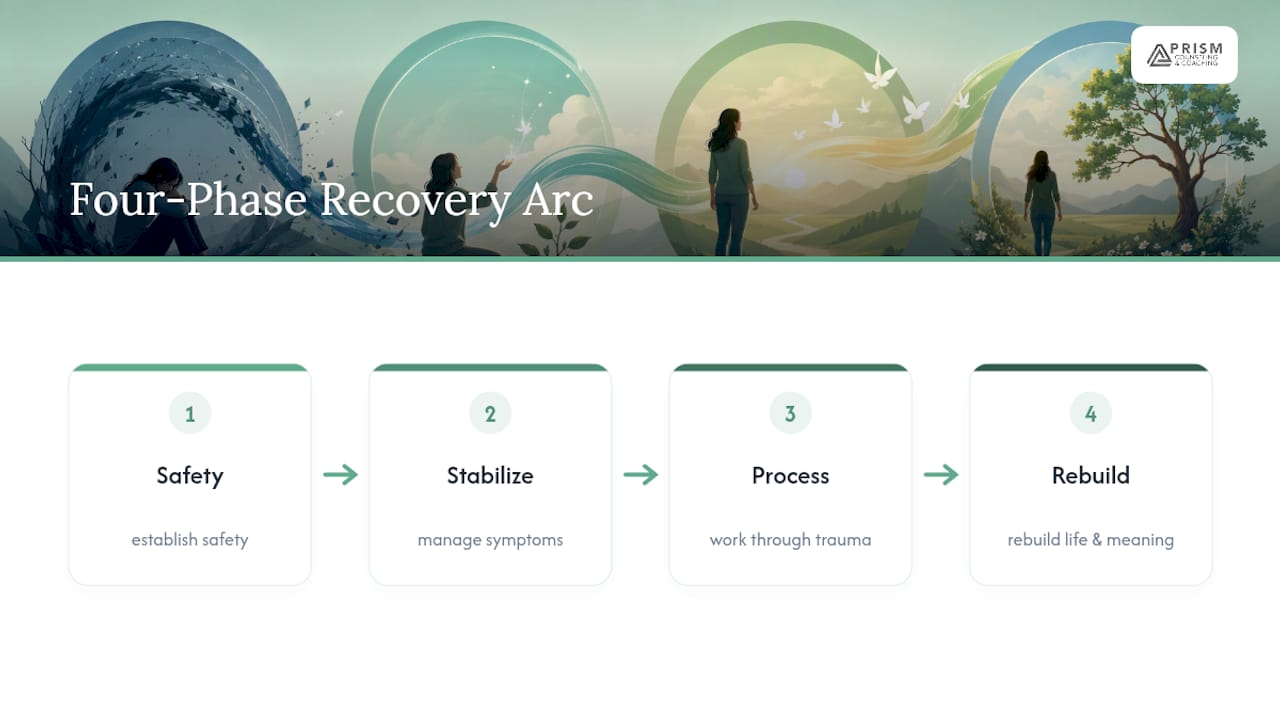
1. Safety: Stop the bleeding first
Before any deep processing work, you need physical and relational safety. This phase is about removing yourself from active harm and lining up immediate support, not about understanding or forgiving anything yet.
- If you are in immediate danger or crisis, contact the 988 Suicide and Crisis Lifeline or local emergency services right away.
- Identify at least one person outside the system, a friend, family member, or therapist, who believes you without needing convincing.
- Limit contact with active sources of manipulation while you stabilize, even if that means stepping back from family gatherings or group chats temporarily.
- Secure basic needs: a safe place to sleep, food, and a way to pay bills, since financial control is common in coercive systems and often needs practical untangling.
2. Stabilization: Teach your body it can rest
Once immediate safety exists, the work shifts to calming a nervous system that has likely been on alert for months or years. This phase focuses on the body, not the belief system.
Grounding practices, slow breathing, sleep hygiene, and simple daily routines help restore a baseline sense of predictability. Practitioners often recommend somatic titration, sometimes called pendulation: dipping briefly into a hard memory or feeling, then deliberately returning to a calming, regulating exercise before it becomes overwhelming. This lets the body process distress in small, manageable doses rather than all at once.
Pro Tip: Self-compassion is not a soft add-on here, it's clinical groundwork. Practices built on Kristin Neff's self-compassion framework are consistently linked to better adjustment after religious harm, especially for survivors whose old system equated self-kindness with pride or sin.
3. Processing: Let a trained guide walk the hard parts with you
This is the phase where therapy tools like EMDR, somatic experiencing, and IFS typically enter the picture, covered in depth in the next section. Processing means going back into painful memories with professional support, at a pace your nervous system can actually tolerate, so the past stops leaking into your present.
Expect this phase to take longer than you want. Trauma memories tied to years of religious involvement rarely resolve in a handful of sessions, and pushing too fast often backfires into shutdown or overwhelm rather than progress.
4. Rebuilding: Choose your boundaries and your community on purpose
The final phase is about constructing a life you actually chose, rather than one imposed on you. That includes setting clear boundaries with former leaders or family members, deliberately vetting new communities for safety, and deciding, without pressure either way, whether any form of spiritual practice still fits your life.
Some survivors reconstruct a faith that looks recognizable but feels fundamentally safer. Others step away from organized religion entirely. Both are legitimate outcomes of the same recovery work.
Pacing, consent, and optionality matter at every single phase. A recovery process that pressures you to move faster than you're ready, even a well-intentioned one, repeats the same coercive pattern you're trying to heal from. Every phase should feel like something you're choosing, not something being done to you.
Therapies and Evidence-Based Tools for Healing From Spiritual Abuse
Different tools target different layers of the injury, and most survivors benefit from more than one approach over time.
- EMDR (Eye Movement Desensitization and Reprocessing) targets specific traumatic memories, helping the brain reprocess them so they stop triggering the same intensity of fear or shame. A typical course runs several weeks to several months, depending on how many memories need processing, and sessions usually involve recalling a specific incident while following a guided attention exercise.
- Somatic approaches address what talk therapy alone often misses. Practitioners note that spiritual abuse is frequently stored physically as chronic tension and hypervigilance, which means body-based work, breath practices, movement, or somatic experiencing, is often essential rather than optional.
- Internal Family Systems (IFS), or parts work, treats the mind as made up of different internal "parts," some protective, some wounded, and helps a person restore internal leadership instead of staying at war with themselves. This is particularly useful for survivors whose old system taught them to distrust or suppress parts of their own personality.
- Faith-integrated therapy works directly with a survivor's spiritual language and questions instead of avoiding them, which matters because spiritual abuse often weaponizes core spiritual vocabulary like forgiveness and obedience. Reclaiming those words on your own terms is frequently part of the work.
- Group-based, spiritually integrated interventions, such as chaplain-led programs like Building Spiritual Strength, are designed to address moral injury and spiritual struggle directly, rather than treating spirituality as a side issue separate from the "real" clinical work.
No single therapy fixes everything on its own. A survivor working through betrayal by a trusted leader may need EMDR for specific memories, somatic work for the chronic tension it left behind, and faith-integrated conversations to sort out what, if anything, they still believe.
Rebuilding Boundaries and a Spiritual Life That Belongs to You
Boundaries are a skill, not a personality trait, and most survivors have to relearn them deliberately after a system that punished having any. A boundary doesn't require justification. Try language like: "I'm not available to discuss that," or "I need you to respect my decision without asking me to explain it again." You don't owe anyone a theological defense for protecting your own peace.
When evaluating a new community or leader, watch for how they handle disagreement. A healthy leader can be questioned without punishing the questioner. A healthy community tolerates members who leave without demanding an explanation or issuing warnings to others. If a group treats independent thought as a threat, that's the same pattern you're recovering from, just wearing a different name.
- Notice whether new spiritual practices are offered as invitations or presented as obligations.
- Test small boundaries first, like declining an invitation, to see how a person or group actually responds.
- Replace coercive rituals (mandatory confession, public accountability sessions) with consensual ones you choose freely, if you want spiritual practice at all.
- Prioritize sleep, movement, and time outdoors, since basic bodily care rebuilds the felt sense of safety that abuse eroded.
Pro Tip: Community doesn't need to be religious to be healing. Survivors often recover fastest in groups that demonstrate safety and belonging outside the environment that hurt them, a hiking club, a grief support group, or an online recovery community can do work that a new church never could until you're ready.
When to Seek Professional Help and How to Choose the Right Therapist
Get help immediately if you're experiencing thoughts of self-harm, are still inside an active abusive environment, or notice panic attacks that interfere with daily functioning. Those are not "wait and see" situations.
When you're ready to look for a therapist, a few questions in the first call tell you a lot:
- "Have you worked with clients recovering from religious or spiritual trauma before?" A good answer includes specific approaches, not just general trauma experience.
- "Are you trained in EMDR or somatic therapy?" Look for actual certification, not just familiarity with the terms.
- "How do you handle it if a client wants to talk about faith, or wants to avoid it entirely?" The right answer respects either choice without steering you.
- "What does a typical first few sessions look like?" You want an assessment-first approach, not immediate deep processing.
If local, faith-aware trauma therapists are scarce where you live, online counseling options have made this kind of specialized care far more reachable than it used to be.
How Prism Counseling & Coaching Supports Spiritual Abuse Recovery
A practice offers faith-integrated trauma counseling, including EMDR, for people recovering from spiritual abuse and religious trauma. The counselors understand how to hold both the clinical and spiritual dimensions of this kind of harm without minimizing either one.
The practice uses a small, private-pay model which can reduce insurance-driven delays. Appointments are typically available within days for stabilization work, trauma processing, or rebuilding a sense of spiritual identity. Initial visits typically start with a trauma-informed assessment focused on the client’s current state, without rushing to conclusions about faith.
The Non-Linear Reality of Healing From Spiritual Abuse
Healing from spiritual abuse rarely moves in a straight line, and a hard week does not erase the progress you've made. Some survivors eventually reclaim a faith that feels genuinely their own. Others walk away from organized religion for good. Both outcomes represent real healing, not a lesser or greater success. What matters most through every phase is keeping safety, consent, and your own pace at the center, not anyone else's timeline for how fast you should be "over it."
— Tres
Get Support From Prism Counseling & Coaching
If you're carrying the weight of church hurt or a controlling religious environment, you don't have to sort through it alone, and you don't have to choose between honoring your faith and getting real clinical help. Prism Counseling & Coaching is a faith-integrated alternative to a generic trauma practice, built specifically around clients who need both trauma expertise and a counselor who won't dismiss their spiritual questions.
Because Prism runs on a small, private-pay model, most new clients get an appointment within days rather than waiting weeks for an opening. Sessions are available online or in person, so distance from Phoenix isn't a barrier to starting. The recommended first step is a short intake conversation focused on a trauma-informed assessment of where you are right now. From there, care can include faith-based counseling or trauma-focused work through Christian trauma counseling and EMDR therapy. If you're ready to talk to someone who takes both your history and your faith seriously, reach out to Prism Counseling & Coaching to schedule your first session.
Resources for Healing From Spiritual Abuse
A few starting points worth bookmarking as you move through recovery:
- National Center for PTSD guidance on spirituality and trauma, for the clinical framing behind spiritual strain and integrated PTSD treatment.
- Sojourners' guide to healing from religious trauma, for survivor-centered narratives and practical recovery concepts.
- The Allender Center's reflections on reclaiming faith after spiritual abuse, for a faith-aware perspective on identity and naming harm.
- A structured course on healing from emotional trauma for self-paced, body-focused tools between therapy sessions.
- The 988 Suicide and Crisis Lifeline, available by call or text, for anyone in immediate crisis.
This article is general information, not a substitute for advice from a qualified doctor. Consult a qualified healthcare professional about your own circumstances before acting on anything here.
Sources
- Treating the trauma in religious trauma — Psychotherapy Networker
- Addressing religious or spiritual dimensions of trauma and PTSD - PTSD: National Center for PTSD
- Religious trauma: How to find healing from religious trauma — Sojourners
- Reclaiming faith, hope, and love after spiritual abuse — The Allender Center
FAQ
What is religious trauma syndrome?
Religious trauma syndrome describes the cluster of psychological and physical symptoms, including anxiety, shame, and hypervigilance, that can follow prolonged exposure to a controlling or abusive religious environment. It's not an official diagnosis in the DSM, but clinicians use the term to describe a recognizable pattern of harm.
What is the definition of spiritual trauma?
Spiritual trauma refers to lasting emotional and psychological injury caused by the misuse of spiritual authority, doctrine, or community power to control, shame, or harm someone. It often overlaps with symptoms of PTSD, including intrusive thoughts and a persistent sense of danger.
What are the signs of spiritual abuse?
Common signs include chronic shame and guilt, fear of punishment, difficulty trusting authority figures, boundary erosion, and physical symptoms like chronic tension or an exaggerated startle response. A survey of 2,500 people identified fear, powerlessness, and shame as the most common lasting impacts.
How do I heal from narcissistic or spiritually abusive leadership?
Healing typically starts with safety and distance from the harmful person, followed by trauma-informed therapy such as EMDR or somatic work to address the nervous system impacts, and community support outside the original environment. A therapist experienced in faith-integrated, trauma-informed counseling can help you rebuild boundaries and agency at a pace that fits you.
Can you recover your faith after spiritual abuse?
Some survivors do reconstruct a faith that feels safer and more genuinely their own, while others move away from organized religion entirely, and both are considered valid outcomes of real recovery work. What matters clinically is that any spiritual practice you return to is chosen freely, not driven by fear or obligation.