

Combining Scripture-centered prayer with specific daily habits, like gratitude, breath prayer, movement, and rest, brings more lasting relief than prayer alone or self-help alone. This week, try three things: a one-minute breath prayer when tension rises, naming three gratitudes before bed, and scheduling one twenty-minute walk or rest slot. If sleep, relationships, or daily functioning stay disrupted for more than a couple of weeks, that's your signal to bring in professional support alongside your faith practices.
TL;DR:
- Incorporating short breath prayers, gratitude practices, and physical movement can significantly reduce stress levels within a Christian framework.
- Applying cognitive reframing techniques rooted in Scripture helps challenge anxious thoughts and lowers cortisol, especially when combined with prayer and journaling.
- Consistent sleep, regular movement, and scheduled rest or Sabbath periods support long-term stress management and overall well-being.
- Recognizing when stress persists beyond a few weeks or affects daily functioning should prompt seeking professional mental health support.
- Forgiveness and honest emotional naming, as exemplified by Job and David, are key biblical methods for processing stress and reducing emotional burden.
Table of Contents
- Your Stress Management Christian Action Plan for This Week
- Prayer, Scripture, and Spiritual Practices That Reduce Stress
- Renewing Your Mind: Cognitive Tools That Fit Christian Belief
- Caring for Your Body: Sleep, Movement, and Breath
- Rest and Sabbath as a Discipline, Not a Luxury
- Setting Boundaries and Building a Support System
- When Stress Needs More Than Self-Care
- How Faith-Integrated Therapy Builds on These Practices
- Why Forgiveness Might Be Your Missing Stress-Reduction Tool
- Faith-Based Meditation and Contemplative Prayer
- Trusting God's Sovereignty When You Can't Control the Outcome
- What Job and David Teach Us About Real-World Stress
- A Word of Encouragement
- Getting Started With Prism Counseling & Coaching
- Sources
Your Stress Management Christian Action Plan for This Week
You don't need a complicated system. You need seven small, repeatable moves that honor both your faith and your body's need for rest and rhythm.
- Morning breath prayer (2 minutes). Inhale while praying "Be still," exhale with "and know." This slows your nervous system before the day's demands arrive.
- Name one worry, hand it over. Cast your anxiety on God "because he cares for you" (Psalm 55:22), out loud if you can.
- Write three gratitudes at lunch. Gratitude and praise appear more than 400 times across Scripture, and practicing it has been linked to lower cortisol levels, according to Denison Forum.
- Take a 15 minute walk. Movement burns off stress hormones your body has already produced.
- Set one boundary. Say no to one nonessential request this week.
- Read Matthew 11:28 before bed. Let "come to me, all you who are weary" be your closing thought.
- Protect sufficient sleep each night. Poor sleep amplifies every other stressor you're carrying.
On your busiest day, cut this down to one line: breathe, name a worry, hand it to God. That's a Christian coping strategy small enough to survive a bad week.
Prayer, Scripture, and Spiritual Practices That Reduce Stress
Philippians 4:6–7 doesn't just tell you to stop worrying. It gives you a replacement action: "in every situation, by prayer and petition, with thanksgiving, present your requests to God." That sequence matters. Worry left unaddressed tends to loop. Prayer paired with gratitude interrupts the loop and redirects attention outward, toward God rather than inward, toward the problem.
Psalm 55:22 and Matthew 11:28 add two more pieces: casting your burden on God, and coming to him when you're weary. Together, these three passages form a simple pattern many Christian counselors point to as biblical stress management in its most basic form.
A short breath prayer practice makes this concrete:
- Sit quietly and inhale slowly for four counts.
- As you exhale, silently pray a short phrase like "Jesus, I trust you."
- Repeat for two to three minutes, letting one Scripture verse anchor your attention.
- Close by naming one thing you're grateful for.
Prayer and contemplative practices appear to interrupt rumination, the mental loop of replaying a stressor, by engaging brain networks tied to emotional regulation. This isn't a cure, but it's a real mechanism worth understanding.
Pro Tip: Hold a small object, like a cross or a smooth stone, during breath prayer. The physical anchor keeps your mind from wandering back to the stressor.
Renewing Your Mind: Cognitive Tools That Fit Christian Belief
Romans 12:2 calls for transformation "by the renewing of your mind." Philippians 4:8 tells you what to fill that renewed mind with: what is true, noble, and admirable. Together, they form a Christian mindfulness technique that overlaps closely with cognitive behavioral therapy, without requiring you to set faith aside.
Try this three-step thought challenge when a stressful thought takes hold:
- Name the thought. Write down the exact sentence running through your head ("I'm going to fail this").
- Test it against truth. Ask: is this thought accurate, or is it catastrophizing? What would Philippians 4:8 have me focus on instead?
- Replace it deliberately. Write one true, God-honoring reframe and say it out loud.
Pair this with a nightly journaling prompt: What am I grateful for today? Where did I see God at work? What's one worry I need to release? This isn't busywork. Practicing gratitude has been connected to lower cortisol levels, giving your evening journal entry a real physiological payoff, not just a spiritual one, as noted by Denison Forum. For a deeper look at how faith and cognitive reframing work together against anxious thinking, see Faith and Anxiety: A Christian Path to Finding Peace.
Caring for Your Body: Sleep, Movement, and Breath
Your body was never designed to run on cortisol around the clock. Chronic sleep loss keeps stress hormones elevated, and regular movement helps clear them. Neither fact contradicts your faith. Stewarding your body well is part of stewarding the life God gave you.
A simple diaphragmatic breathing exercise you can do anywhere:
- Sit or lie down with one hand on your chest, one on your belly.
- Inhale through your nose for four counts, letting your belly rise more than your chest.
- Hold for two counts.
- Exhale slowly through your mouth for six counts.
Repeat this for five cycles when tension spikes.
Movement doesn't need to be a gym routine. A brisk 20 minute walk three times a week does real work on stress hormones. On sleep, keep it simple: consistent bedtime, no screens for 30 minutes before lights out, and a dark, cool room.
Public health tracking shows stress levels have climbed in recent years, and self-care habits like these are consistently recommended alongside community and professional support, per the APA's Stress in America report.

Rest and Sabbath as a Discipline, Not a Luxury
Jesus withdrew to quiet places to pray, even when crowds were pressing in on him. Sabbath rest isn't an ancient rule that expired. It's a rhythm built into how God designed people to function, and faith-based counselors often frame rest as obedience rather than indulgence, which takes the guilt out of resting.
If a full day off feels impossible right now, try a mini-Sabbath instead:
- Pick a three-hour block, once a week. No work, no email, no scrolling.
- Fill it with something restorative. Worship, time outdoors, a meal with people you love.
- Protect it like an appointment. Tell someone your plan so you have accountability.
When your schedule feels unmanageable, sort every task into one of four buckets: Do it now, Delegate it, Delete it, or Delay it. This framework, used by a Christian psychiatrist managing her own stress load, turns a vague "set better boundaries" into a concrete Monday morning task.
Pro Tip: Delegate one recurring task this week, even a small one. Practicing delegation on something low stakes makes it easier when the stakes are higher.
Setting Boundaries and Building a Support System
You weren't meant to carry every burden alone. Scripture calls believers to "carry each other's burdens" (Galatians 6:2), which assumes you'll actually let people in.
Boundary scripts help when saying no feels hard:
- At work: "I can take that on next week, but not this one."
- In ministry: "I need to step back from this role for a season to protect my family."
- With family: "I love you, and I can't take this call right now. Can we talk tonight?"
Build a support plan with three parts: one prayer partner you check in with weekly, a small group or church community, and one trusted friend who knows the full picture. If your stress feels tied to a specific decision or spiritual doubt, a pastor is a good first call. If it's affecting your sleep, mood, or relationships over weeks, a counselor trained in both faith and clinical care is the better next step.
When Stress Needs More Than Self-Care
Prayer and good habits carry real weight, but they aren't always enough on their own, and recognizing that isn't a failure of faith.
Watch for these signs that it's time to bring in professional support:
- Stress or anxiety lasting more than two to three weeks without relief.
- Sleep loss that persists most nights.
- Trouble functioning at work, school, or in relationships.
- Increased irritability, withdrawal, or numbness.
- Any thoughts of self-harm or suicide.
If you notice that last sign, contact the 988 Suicide and Crisis Lifeline immediately by calling or texting 988. For the others, reach out to your pastor for spiritual counsel, or contact a faith-integrated counselor who can address both the clinical and spiritual sides of what you're carrying. Seeking help is not a sign your faith has failed. It's wise stewardship of the mind and body God gave you, the same instinct that sends you to a doctor for a broken bone.
How Faith-Integrated Therapy Builds on These Practices
Prism Counseling & Coaching has spent over 14 years helping Christians in the Phoenix area move past stress that self-care alone hasn't resolved. Faith-integrated cognitive work builds directly on the reframing tools described above, adding a trained counselor who can identify patterns you can't see from inside your own stress. A typical first session focuses on understanding what's driving your stress and what's already working, not diagnosing you on the spot. For more on how this looks in practice, Prism's anxiety resources walk through common starting points.
Why Forgiveness Might Be Your Missing Stress-Reduction Tool
Resentment is expensive to carry. It keeps your body in a low-grade alert state, replaying an old wound as if it were happening now, and that replay taxes the same stress systems a current crisis would.
Forgiveness, in the biblical sense, isn't pretending you weren't hurt or rushing back into a relationship that isn't safe. It's a decision to release your claim on repayment, choosing not to let the offense keep dictating your emotional state. Jesus links forgiveness directly to freedom in the Lord's Prayer, and Colossians 3:13 frames it as something modeled on how Christ forgave you.
Practically, unresolved resentment tends to show up as physical tension, sleep disruption, or a short fuse with people who had nothing to do with the original offense. If you notice yourself rehearsing an old grievance during moments meant for rest, prayer, or connection, that's a sign resentment is doing quiet damage to your stress load.
A simple starting practice: name the person or situation you're still holding onto, write down what forgiving them would and wouldn't require of you, and bring that specific resentment to God in prayer rather than trying to will it away through sheer effort. This isn't a one-time event for most people. It's often a repeated choice, especially with deep wounds. If a particular resentment feels stuck despite genuine effort to release it, that's a strong candidate to bring into a counseling conversation, where a trained counselor can help you work through it without minimizing what happened.
Faith-Based Meditation and Contemplative Prayer
Meditation gets a mixed reputation in some Christian circles, often because it's associated with clearing the mind entirely. Biblical meditation works differently. Instead of emptying your mind, you fill it, fixing your attention on a specific truth, verse, or attribute of God until it settles into you.
Psalm 1 describes the person who meditates on God's law "day and night" as stable, like a tree planted by water. That's the goal: not blankness, but rootedness.
A simple contemplative prayer practice, sometimes called lectio divina, works well for stressed readers who want structure:
- Read a short passage slowly, two or three times.
- Reflect on one word or phrase that stands out to you.
- Respond in prayer, telling God what that phrase stirred in you.
- Rest in silence for a minute or two, without trying to produce more insight.
This practice pairs well with a physical anchor, a held cross, a specific posture, or a steady breath count, which helps ground your attention and reduce the mental drift that turns quiet time into worry time. Twenty minutes is plenty for most people starting out; five is a fine place to begin. The goal isn't a perfect emptying of your thoughts. It's a redirected focus, aimed at God rather than at the stressor.
Trusting God's Sovereignty When You Can't Control the Outcome
A lot of Christian stress comes from a mismatch: you're trying to control something that was never yours to control. Trusting God's sovereignty doesn't mean pretending the situation isn't hard. It means recognizing where your responsibility actually ends.
Job lost nearly everything he had and still declared, "The Lord gives and the Lord takes away" (Job 1:21), not because he understood why, but because he trusted who God was even without an explanation. That's a different posture than resignation. It's active trust placed in a God whose character doesn't change even when circumstances do.
Practically, this looks like separating your list of concerns into two columns: what you can act on today, and what belongs to God's timing or control. Most chronic stress lives in that second column, things like another person's choices, a diagnosis's outcome, or the economy's direction. Naming that distinction out loud, in prayer or in a journal, often does more to lower stress than any amount of additional effort spent trying to control the uncontrollable.
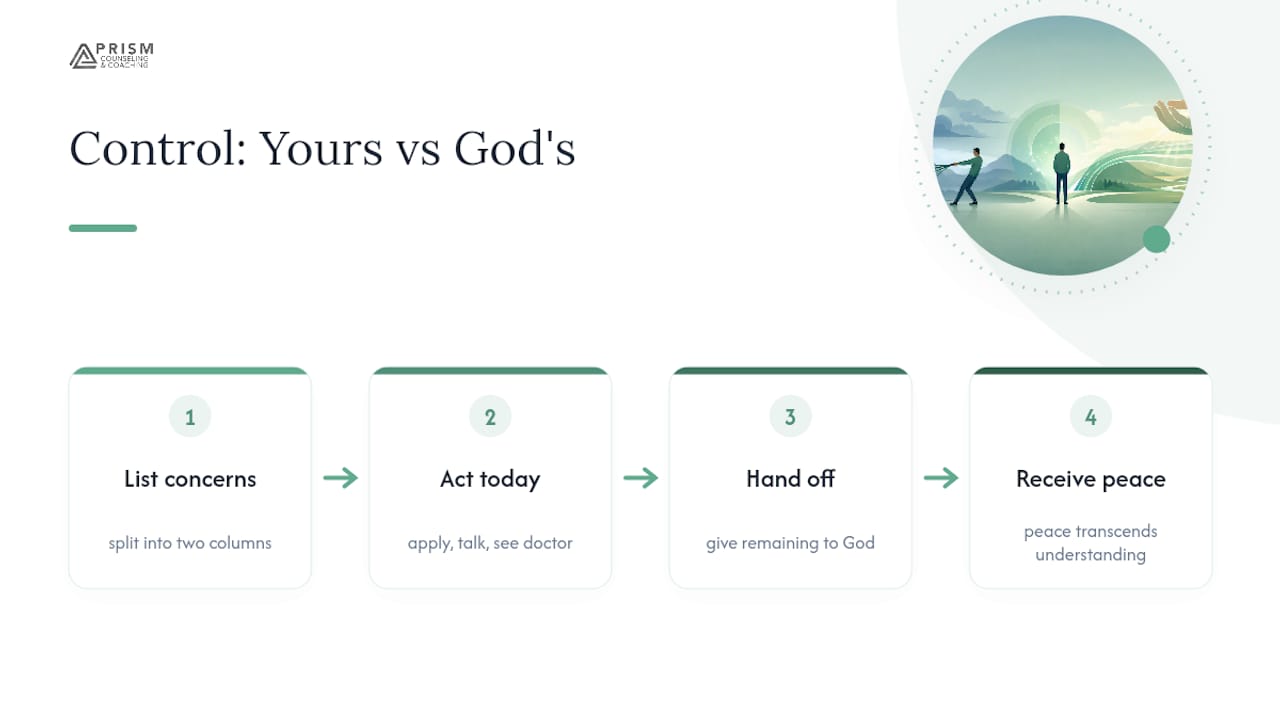
This isn't a call to passivity. Take the actions available to you: apply for the job, have the hard conversation, see the doctor. Then consciously hand off what remains. Philippians 4:6–7 models this exact sequence, presenting requests to God and receiving peace "which transcends all understanding" in return, not because the problem is solved, but because the burden of managing it alone is lifted.
What Job and David Teach Us About Real-World Stress
Job and David didn't manage stress with denial. Both named their suffering directly, and Scripture records their words without softening them.
Job's story is stress at its most extreme: loss of children, wealth, and health in rapid succession. His friends offered bad theology and worse comfort, but Job's own response is instructive. He grieved openly, questioned God honestly, and still refused to curse him. By the end, God doesn't fully explain the suffering. He reveals more of his own character instead, and that's what settles Job.
David's psalms read like a stress journal. Psalm 55, the source of "cast your cares on the Lord," opens with David describing his heart being "severely pained" and wishing he could fly away from his troubles. He names fear, exhaustion, and betrayal by a close friend. Then, in the same psalm, he pivots to trust: "But I will trust in you."
That pivot is the pattern worth noticing. Neither man skipped the hard emotion to get to faith faster. They sat in the difficulty long enough to name it accurately, then brought that named difficulty to God rather than burying it. If you're managing stress right now, that's permission to do the same: name what's actually happening before you try to reframe it, and let the honest naming be part of the process rather than a detour from it.
A Word of Encouragement
Stress isn't a sign your faith is weak. It's a sign you're carrying real weight in a broken world, and God never asked you to carry it silently or alone. Combine the practices in this article with honest prayer, and give yourself permission to seek professional care if the weight isn't lifting. That step is faithful, not a failure.
— Tres
Getting Started With Prism Counseling & Coaching
If you've tried the practices above and still feel stuck, a faith-integrated counselor who can see you within days, not weeks, may provide support beyond self-care practices.
Prism-counseling works with individuals, couples, families, and teens across the Phoenix area, addressing anxiety, stress, grief, and trauma through counseling that treats your faith as central, not incidental, to your healing. Whether you need short-term support during a specific season or ongoing care, our faith-based counseling services are built around your schedule and your beliefs, not an insurance company's timeline. If work-related stress is part of the picture, Prism also partners with employers through a faith-based EAP program. Reach out today to check current openings and take the next step toward relief that addresses both mind and spirit.
Sources
- A biblical response to the stress epidemic
- I’m a Christian psychiatrist: here’s how I manage stress
- What does the Bible say about stress?
- Stress in America report (2025)
This article is general information, not a substitute for advice from a qualified doctor. Consult a qualified healthcare professional about your own circumstances before acting on anything here.