

Yes, faith-integrated counseling can help many Christians manage and recover from anxiety when it blends licensed, evidence-based therapy with Scripture and spiritual practice. If anxiety is disrupting your sleep, work, or relationships, the next step is a real assessment, not another self-help article. Start with grounding tools like the 3-3-3 rule today, and consider a faith-integrated counselor, alongside your doctor if medication is already part of your care.
TL;DR:
- Faith-integrated counseling combines evidence-based techniques like CBT and EMDR with Scripture, addressing both physiological and spiritual aspects of anxiety.
- Recognizing when anxiety disrupts daily life, such as frequent panic attacks or thoughts of self-harm, signals the need for immediate professional treatment beyond self-help tools.
- Selecting a licensed, trained counselor who can integrate faith into treatment, discuss their approach openly, and coordinate with prescribers ensures ethical and effective care.
- Practical tools like the 3-3-3 rule, box breathing, and scripture anchors can be used immediately to manage symptoms before professional help is available.
- Combining therapy with community support and spiritual practices extends the benefits of treatment into everyday life, reinforcing coping strategies and faith-based resources.
Table of Contents
- What Is Christian Anxiety Counseling, Exactly?
- How Faith-Integrated Counseling Actually Treats Anxiety
- Coping Tools You Can Use Right Now
- Knowing When Anxiety Needs Professional Care
- Finding a Christian Counselor Who Actually Fits
- Prism Counseling & Coaching: What Faith-Integrated Care Looks Like In Practice
- What Actually Happens In A Session
- Where Prayer Fits Beyond The Coping Toolbox
- Common Concerns About Mixing Faith And Clinical Therapy
- Ethics And Boundaries Unique To This Approach
- Support Beyond The Counseling Room
- The Piece Most People Get Backwards
- Ready To Talk To Someone? Here's What Comes Next
- Sources
What Is Christian Anxiety Counseling, Exactly?
Christian anxiety counseling is licensed clinical therapy that treats anxiety using established methods while honoring your faith as part of the healing process. It is not the same as a pastor praying with you after service, and it is not the same as a support group that never touches your nervous system or your thought patterns. It sits at the intersection of both worlds, held by someone trained in both.
Three distinct layers often get confused, so it helps to separate them:
- Pastoral support offers spiritual encouragement and prayer but is not clinical treatment and is not designed to diagnose or treat an anxiety disorder.
- Biblical counseling centers Scripture as the primary framework for change, sometimes without formal clinical licensure or training in evidence-based methods.
- Licensed faith-integrated therapy combines a state license (LPC, LCSW, LMFT, or a doctoral credential) with clinical training and an intentional, respectful use of your faith and values in session.
Christians who feel torn between "just pray about it" and a secular therapist who ignores their beliefs tend to benefit most from this middle path. So do believers who want their counselor to understand why anxiety can feel like a spiritual crisis, not just a chemical one.
How Faith-Integrated Counseling Actually Treats Anxiety
Anxiety is partly a body problem, not only a thought problem. Your nervous system reacts to perceived threat with a cascade of physical changes, elevated heart rate, shallow breathing, muscle tension, and Harvard Health's explanation of the stress response shows why calming your breathing can interrupt that cycle before it spirals. That physiology matters because it explains why counseling works on more than just your thoughts.
Most Christian counselors draw from a core set of proven methods:
- Cognitive behavioral therapy (CBT) identifies distorted thought patterns and replaces them with accurate, grounded ones.
- EMDR helps the brain reprocess traumatic or anxiety-triggering memories that keep replaying under stress.
- Exposure work gradually reduces avoidance by facing feared situations in a controlled, paced way.
- Mindfulness practices train attention to stay in the present rather than spinning through worst-case scenarios.
A faith-adapted approach layers Scripture into these frameworks rather than setting it aside. A therapist practicing faith-adapted CBT might help you examine an anxious thought ("God has abandoned me") against both cognitive distortion patterns and biblical truth (Philippians 4:6–7), then assign breath-prayer as homework alongside a standard thought log. Research indexed on NCBI shows faith-adapted interventions can improve outcomes for religious clients specifically because the approach matches their existing worldview instead of fighting it.
The pandemic made this urgent. The World Health Organization documented a 25% global increase in anxiety and depression prevalence, which explains why demand for counselors who take faith seriously has climbed alongside demand for therapy in general.
Coping Tools You Can Use Right Now
You do not need to wait for a first appointment to start managing symptoms. These tools work in the moment, whether you are sitting in a parking lot before a hard conversation or lying awake at 2 a.m.
- Use the 3-3-3 rule during a spike. Name three things you see, three sounds you hear, and move three parts of your body. This pulls your brain out of the anxious loop and back into the present room.
- Try box breathing. Inhale for four counts, hold for four, exhale for four, hold for four. Repeat five times. This slows the physical stress response Harvard Health describes, lowering heart rate and easing muscle tension within minutes.
- Run through progressive muscle relaxation. Tense each muscle group for five seconds, then release, working from your feet to your face. It teaches your body what "calm" actually feels like.
- Pair breathing with a breath prayer. Inhale on a short phrase like "Be still," exhale on "and know." The rhythm gives your mind an anchor beyond counting.
- Anchor to a single verse. Keep one passage, Philippians 4:6–7 or 1 Peter 5:7, written somewhere visible so you can return to it without searching for words mid panic.
Pro Tip: Build a two-minute morning micro-routine before anxiety hits: one breath prayer, one verse read aloud, three slow breaths. Doing this daily on calm mornings makes it far easier to access under real stress, because your body has already rehearsed the pattern.
Knowing When Anxiety Needs Professional Care
Occasional worry is human. It is time to seek professional care when anxiety interferes with sleep, work performance, relationships, or your ability to leave the house. Certain signs mean you should not wait for your next quiet time to sort it out.
Watch for these red flags:
- Panic attacks occurring multiple times a week or that leave you avoiding normal activities.
- Anxiety that has lasted more than a few weeks without easing.
- Any thoughts of self-harm or suicide, which require immediate contact with a crisis line like 988 or NAMI's resources.
- Using alcohol, food, or other coping mechanisms to numb constant dread.
When medication is part of the picture, a good counselor coordinates rather than works in isolation. With your written consent, they can communicate directly with your prescriber about symptoms and progress, adjusting the therapeutic plan as medication takes effect. Taking medication is not a failure of faith. It is stewardship of the body God gave you, the same as taking insulin for diabetes. Combined treatment, therapy plus medication when clinically indicated, consistently outperforms either approach alone for moderate to severe anxiety.
Finding a Christian Counselor Who Actually Fits
Credentials matter here more than most people realize. Look for licensure such as LPC, LCSW, LMFT, or a PhD/PsyD in clinical psychology. These credentials mean the counselor has completed supervised clinical hours and passed a state licensing exam, not just a certificate program in biblical counseling.
Before booking, ask a few direct questions:
- How do you integrate Scripture into evidence-based treatment, and can you give an example?
- What is your experience treating anxiety specifically?
- What is your view on medication, and will you coordinate with a prescriber if needed?
- How do you handle confidentiality, and what are your session fees?
- Do you offer online sessions if I cannot make it in person?
Walk away from anyone who pressures a specific doctrinal stance unrelated to treatment, refuses to refer you out when a case exceeds their expertise, or promises anxiety will vanish after a set number of sessions. Real change is rarely that tidy.
Prism Counseling & Coaching: What Faith-Integrated Care Looks Like In Practice
Prism Counseling & Coaching has spent over 14 years building a private-pay, faith-integrated practice model in the Phoenix area, one built around privacy and individualized attention rather than the volume pressures of insurance-based clinics. That structure means new clients often get an opening within days instead of waiting weeks.
A first appointment usually starts with a clinical intake, current symptoms, history, goals, followed by a conversation about how much and in what way you want faith woven into your sessions. From there, most anxiety cases follow a short-term, goal-focused treatment arc rather than an open-ended commitment.
The counselors' shared strength is integrating faith into standard clinical work without diluting either side, an approach reflected across Prism's Christian counseling services and its writing on faith-integrated care for depression, which follows the same clinical-plus-Scripture model applied to anxiety.
What Actually Happens In A Session
A first session almost always starts with an assessment, not a dive straight into coping strategies. Expect questions about your anxiety history, physical symptoms, sleep, current stressors, and how your faith shapes the way you interpret what is happening to you. Some counselors use a brief screening tool to establish a baseline severity level, useful for tracking progress later.
From there, you and your counselor set concrete goals together. "Feel less anxious" is not specific enough to work toward. "Reduce panic attacks from four a week to one, and sleep through the night three times a week" gives both of you something measurable.
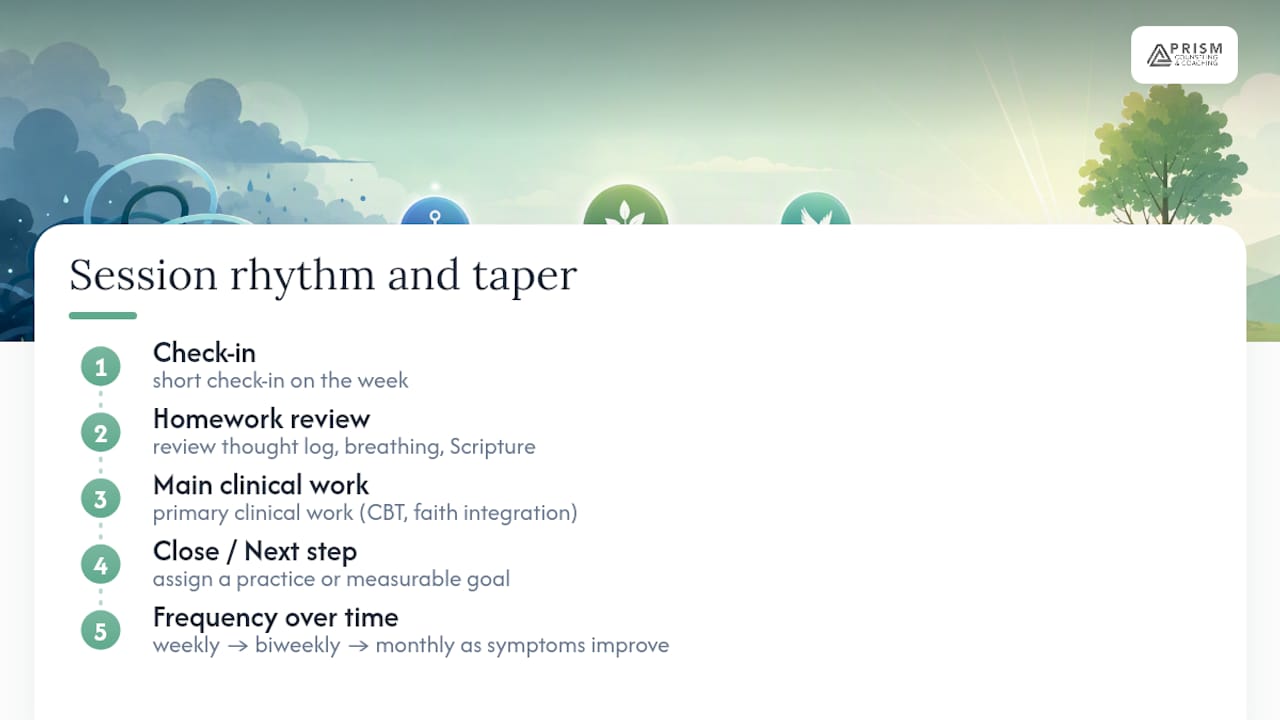
Session structure tends to follow a rhythm: a short check-in on the week, review of any homework (a thought log, a breathing practice, a Scripture reflection), the main clinical work for that session, and a close that includes a next step or practice to try before you return. Most anxiety treatment runs weekly at first, then tapers to biweekly or monthly as symptoms improve.
Confidentiality operates under the same legal and ethical standards as any licensed mental health practice. What you share stays private, with narrow legal exceptions for imminent danger to yourself or others, or suspected abuse of a child or vulnerable adult. A counselor should explain these exceptions clearly at your first session, not bury them in fine print. If faith comes up in ways that feel uncomfortable or coercive rather than supportive, that is worth naming directly. Good faith-integrated counselors welcome that conversation instead of deflecting it.
Where Prayer Fits Beyond The Coping Toolbox
Prayer and spirituality in Christian anxiety counseling go deeper than a relaxation technique bolted onto standard therapy. A skilled faith-integrated counselor treats your relationship with God as a resource woven through the entire treatment process, not a separate module tacked on at the end.
That looks different depending on the client. For some, it means opening or closing a session in brief prayer. For others, it means examining anxious thoughts against specific Scripture during the cognitive work itself, asking not just "is this thought accurate?" but "does this thought line up with what God says is true about me?" Christianity Today's writing on anxiety points to passages like Matthew 6:25–34 and 1 Peter 5:7 as recurring anchors pastors and counselors return to when anxiety surfaces as a crisis of trust rather than simple worry.
Counselors sometimes assign spiritual practices as homework the same way they would assign a thought log: a daily breath prayer, a short devotional reading tied to that week's therapeutic goal, or journaling through a specific psalm. The clinical purpose stays intact. Scripture becomes another lens for restructuring anxious thinking, not a replacement for the cognitive work.
This integration also means taking seriously that anxiety can feel, for many Christians, like a spiritual failure, as though enough faith should make the fear disappear. A counselor trained in faith integration can address that shame directly, separating the physiological reality of an anxiety disorder from any judgment about your spiritual maturity. That distinction alone often relieves a layer of suffering clients did not realize they were carrying.
Common Concerns About Mixing Faith And Clinical Therapy
Some Christians worry that clinical therapy will water down their faith, treating Scripture as a coping mechanism instead of truth. Others worry the opposite, that a counselor will use faith to bypass real clinical work, telling them to "just pray more" instead of addressing a treatable disorder. Both concerns are reasonable, and both point to the same solution: a counselor trained in both domains, who never uses one to dodge the other.
A frequent misconception is that therapy and faith compete for the same explanatory space, as if you must choose whether your anxiety is "spiritual" or "clinical." It is rarely one or the other. Anxiety can be a physiological stress response, a learned thought pattern, and a moment of spiritual struggle all at once. Good faith-integrated treatment holds all three without forcing you to pick a single cause.
Another concern involves medication. Some believers fear that taking anxiety medication signals a lack of trust in God. A faith-integrated counselor should be able to reframe this directly: using available medical treatment is consistent with stewardship, not opposed to faith, the same logic that applies to treating any other physical condition.
Finally, some worry that a Christian counselor will be less clinically rigorous than a secular one. That risk is real only when the provider lacks a genuine license and clinical training. Verifying credentials before you book, covered in the section on finding a counselor above, is the direct way to rule that out.
Ethics And Boundaries Unique To This Approach
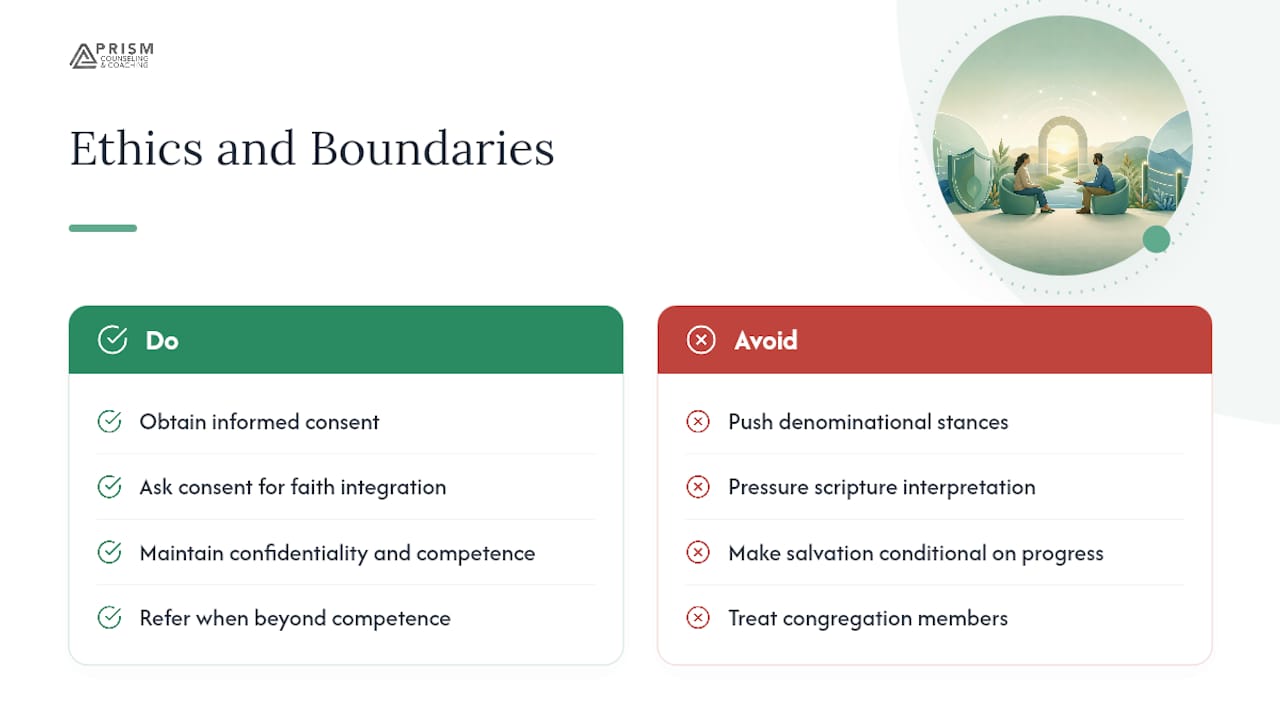
Christian anxiety counseling carries the same ethical obligations as any licensed therapy, informed consent, confidentiality, competence, and avoiding harm, plus a few boundaries specific to faith integration. A licensed counselor should never use their position to push a specific denominational stance, pressure a particular interpretation of Scripture, or make salvation or spiritual standing conditional on your progress in treatment.
Consent extends to the faith component itself. Before weaving Scripture or prayer into sessions, an ethical counselor asks how much religious integration you actually want, and adjusts based on your answer, rather than assuming every Christian client wants the same level of spiritual language in session. Some want prayer to open every meeting. Others want their faith acknowledged but prefer the clinical work to stay front and center. Both preferences deserve respect.
Boundaries around dual relationships matter too. A counselor who also serves as your pastor, small group leader, or close friend faces a genuine conflict of interest, since spiritual authority and therapeutic neutrality can pull in different directions. Many ethical faith-integrated practices intentionally avoid treating members of their own congregation for this reason, referring them elsewhere instead.
Referral itself is an ethical obligation, not an optional courtesy. If your anxiety requires a specialty outside a counselor's training, trauma work beyond their scope, or psychiatric evaluation for medication, they are ethically bound to refer you rather than attempt treatment beyond their competence. A counselor who resists referring you out, even when it is clearly warranted, is showing you a boundary problem worth taking seriously.
Support Beyond The Counseling Room
Weekly sessions are rarely the only support you need while managing anxiety. Peer-led and community resources fill the gaps between appointments, and several are built specifically for people of faith.
The Mental Health Grace Alliance runs free, peer-led support groups designed to complement professional clinical care rather than replace it, useful if cost or access limits how often you can meet with a counselor. NAMI FaithNet connects congregations with mental health resources and training, helpful if you want your own church better equipped to support members struggling with anxiety. Online Christ-centered communities, such as Holy Psych, offer ongoing teaching and group support between sessions for people who want more frequent touchpoints than weekly therapy provides.
Church involvement itself functions as a support structure when it is approached intentionally, a small group that knows your struggle, a prayer partner you check in with weekly, a pastor who understands you are also in counseling and supports both tracks. None of these replace clinical treatment for a diagnosed anxiety disorder, but they extend the work happening in session into the rest of your week. Even something as simple as creating a calmer physical space with scripture-centered decor can reinforce the anchors you practice in therapy.
The Piece Most People Get Backwards
Most advice on Christian anxiety treats faith and clinical care as competitors, pick prayer or pick therapy, trust God or trust a professional. That framing has caused real harm, delaying people from seeking help they needed for years because they read medication or therapy as spiritual failure. The research and clinical practice both point the other way: faith-adapted treatment tends to increase engagement, not undermine it, because clients stop fighting their counselor's framework and start using it.
Where conventional advice falls shortest is in specificity. Telling someone anxious to "pray more" without giving them a concrete tool, box breathing, a breath prayer, the 3-3-3 rule, leaves them with good intentions and no mechanism. Anxiety responds to practiced skills repeated under stress, not just sincerity.
If you take one thing from this, prioritize finding a counselor who treats your faith as a resource for clinical work rather than a topic to avoid or a hurdle to work around. That single decision shapes whether therapy feels like a betrayal of your beliefs or an extension of them.
— Tres
Ready To Talk To Someone? Here's What Comes Next
Reading about coping tools only goes so far. If anxiety has been running your week instead of the other way around, the next real step is talking to someone trained to treat it clinically and take your faith seriously at the same time. Prism-counseling is a private-pay practice, which means no insurance delays and no months-long waitlist, most new clients get an opening within days.
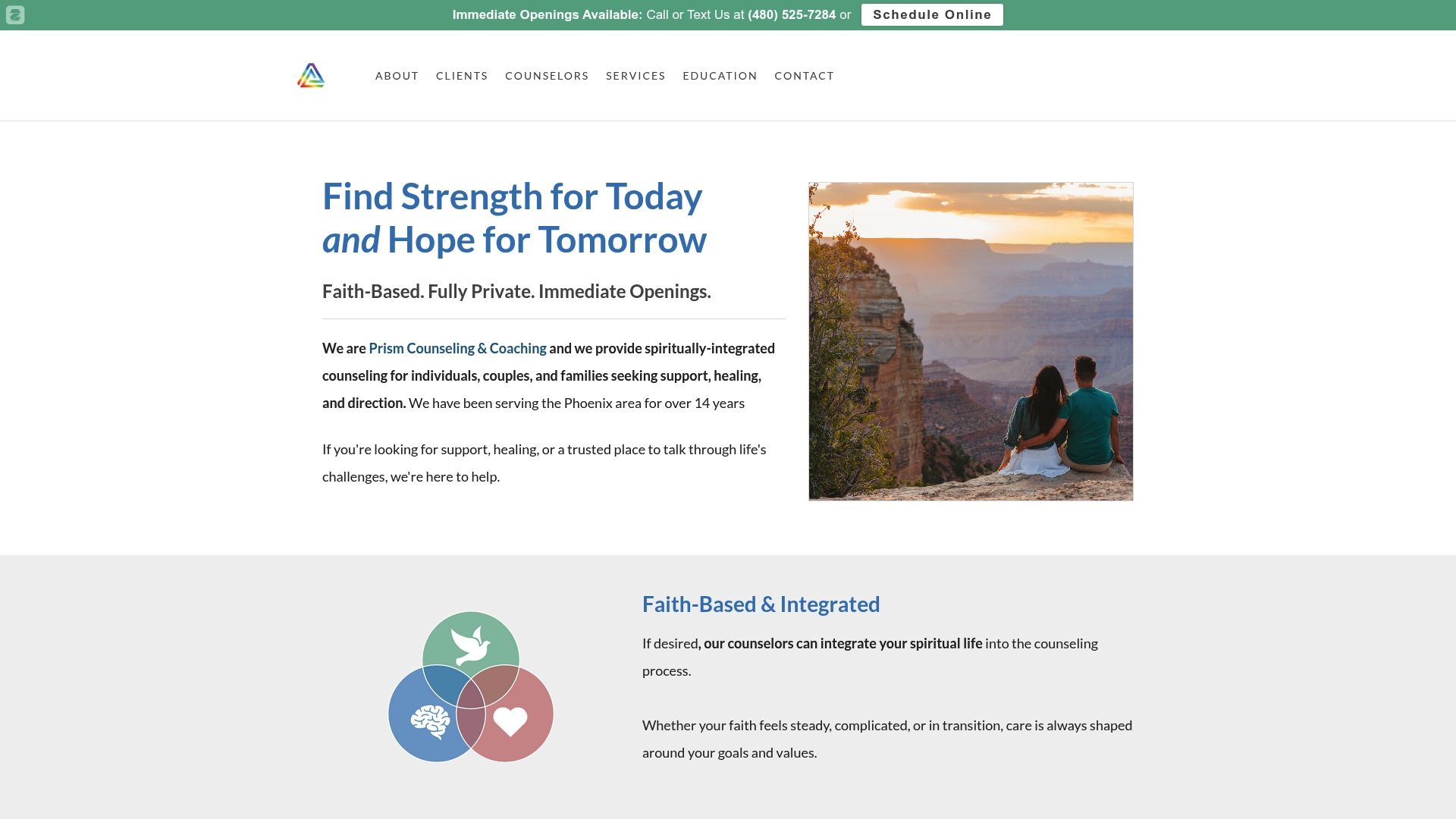
Prism-counseling's faith-based counseling services cover anxiety, depression, and stress with counselors who integrate Scripture into clinically sound treatment rather than choosing one over the other. If you want to gauge your symptoms before booking, the anxiety counseling page outlines what an assessment looks like and how sessions are structured. Before you reach out, jot down your current symptoms, how long they have lasted, and whether you are already working with a doctor or prescriber, that information speeds up your first call considerably. Reach out to schedule an initial assessment and find a counselor who fits both your clinical needs and your faith.
Sources
- Harvard Health: Understanding the stress response
- NCBI article on faith-integrated mental health interventions
- WHO: Pandemic triggers 25% increase in prevalence of anxiety and depression worldwide
- Mental Health Grace Alliance
This article is general information, not a substitute for advice from a qualified doctor. Consult a qualified healthcare professional about your own circumstances before acting on anything here.