

Faith and intimacy grow together through secure vulnerability, the willingness to be truly known by God and by another person, held safely rather than shamed. This kind of closeness deepens through shared spiritual disciplines, honest communication, and repair when trust breaks. It touches your spiritual, emotional, intellectual, and physical life all at once, and it responds to practice, not just good intentions. The sections ahead offer concrete exercises and guidance on when counseling can help.
TL;DR:
- Most couples are strong in one or two intimacy domains and often overlook others, creating silent gaps in emotional, spiritual, intellectual, or physical closeness.
- Consistent small practices like Scripture reading, prayer, and shared rituals deepen both faith and relational bonds, especially when used with intentional weekly check-ins.
- Addressing shame and silence around faith and sexuality requires honest disclosure and possibly trauma-informed therapy, rather than relying solely on willpower or repetition.
- Faith-centered counseling can effectively treat persistent issues by integrating prayer and Scripture into therapy, with early steps including noticing, sharing, checking in, and establishing rituals.
- Differences in faith traditions and individual spiritual paces mean couples should openly discuss their frameworks to foster understanding and prevent miscommunication.
Table of Contents
- What Does Faith and Intimacy Actually Mean?
- How Do You Grow Intimacy With God?
- Can Shared Faith Practices Deepen a Marriage?
- Why Do Shame and Silence Undermine Christian Intimacy?
- When Should You Seek Faith-Integrated Counseling?
- What Does a 4-Week Faith and Intimacy Plan Look Like?
- How Different Faith Traditions Approach Intimacy
- Can You Balance Your Own Faith Journey With a Relationship?
- How Do Faith Crises Affect Intimacy?
- Why Vulnerability Is the Engine of Spiritual Growth
- A Counselor's Perspective on Faith and Intimacy
- Ready to Build Deeper Intimacy? Here's Where to Start
- Sources
- FAQ
What Does Faith and Intimacy Actually Mean?
Intimacy, in clinical terms, is a cycle: you disclose something true about yourself, and another person meets that disclosure with safety instead of judgment. Researchers describe this as an interpersonal state of secure vulnerability, and it applies whether you're kneeling in prayer or sitting across from a spouse. Faith adds a dimension that secular models often miss.
Counselors working with faith-centered couples frequently use the Fourfold Intimacy Model, which names four domains: spiritual, intellectual, emotional, and physical. Spiritual intimacy means sharing beliefs, rituals, and a sense of shared meaning, praying together, discussing a sermon on the drive home, or simply naming what you believe God is doing in your life right now.
Intellectual intimacy shows up when you can debate theology without fear of rejection. Emotional intimacy is felt when you cry in front of someone and they stay. Physical intimacy, including sexual intimacy in marriage, becomes sacred when it's an extension of the other three rather than separate from them.
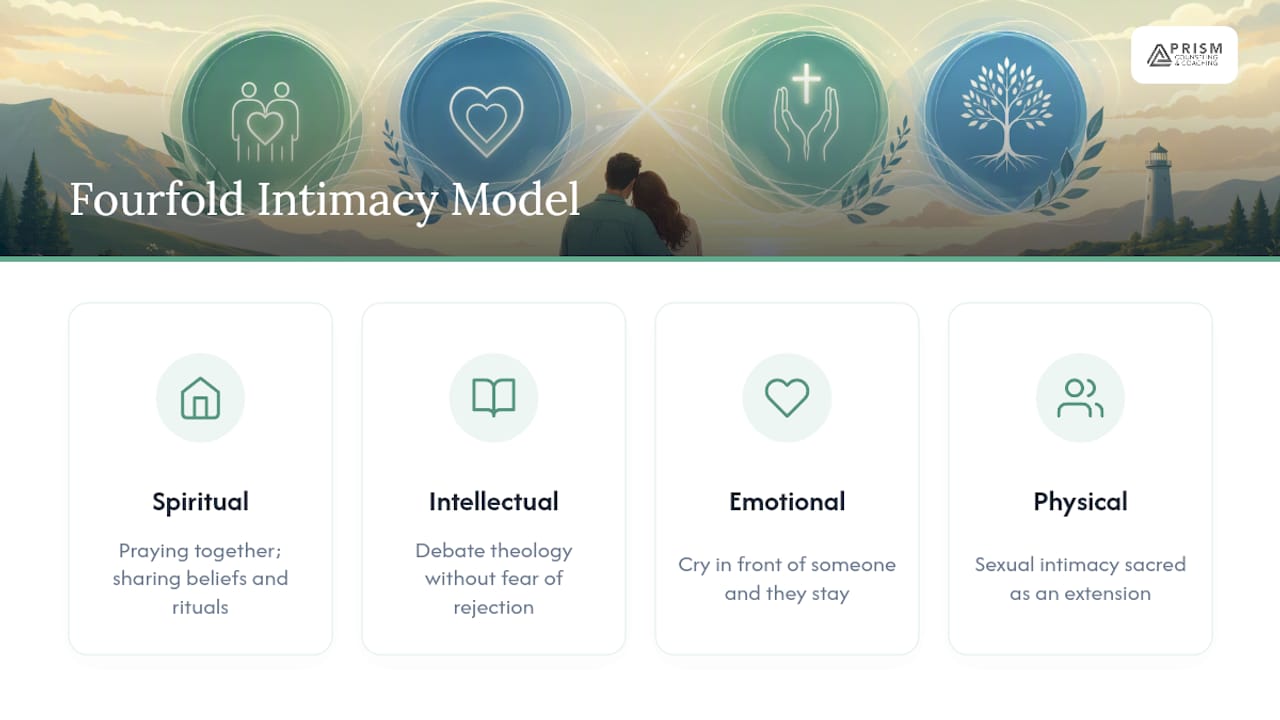
Most couples are strong in one or two domains and quietly starving in another. A husband might pray fluently in public but never say "I'm scared" to his wife. A woman might feel deeply connected to God in silence but freeze when her spouse asks what she needs. Naming the gap is the first step toward closing it.
How Do You Grow Intimacy With God?
Intimacy with God rarely deepens through willpower alone. It grows through small, repeated practices that make space for God to meet you, the same way human intimacy grows through consistent, low-stakes moments of honesty rather than one dramatic conversation.
Church and ministry resources consistently point to Scripture, prayer, and shared worship as the central paths to this kind of closeness. That's a starting framework, not a finish line. Here's how to make it practical:
- Breath prayers. Pair a short phrase, like "Be still" on the inhale and "and know" on the exhale, with your breathing for two minutes each morning.
- Lament prayer. Say the hard thing out loud to God before you try to say the hopeful thing; the Psalms model this pattern constantly.
- Lectio-style Scripture listening. Read one short passage slowly, three times, and journal whatever word or phrase kept catching your attention.
- A weekly Sabbath pause. Even 90 minutes of unhurried silence, no phone, resets your capacity for presence.
- Micro-rituals. Light a candle before dinner, or say one sentence of gratitude before sleep; small anchors matter more than long sessions you'll skip.
Pro Tip: Keep a single index card with three prompts you actually use. A drawer full of devotional plans you never open builds guilt, not intimacy.
For verse prompts to build these practices around, a curated list of Bible verses about faith can give you a rotating well of Scripture to pray through.
Can Shared Faith Practices Deepen a Marriage?
Shared spiritual disciplines correlate with stronger marital cohesion and, according to counselors who work with Christian couples on sexual intimacy, stronger sexual satisfaction too. Faith stops being a private department of your life and becomes something you build together.
Three habits tend to matter most:
- Pray together on a fixed rhythm, even briefly. Couples who pray spontaneously "when we remember" rarely sustain it; a set time, like before bed, survives busy seasons.
- Talk about Scripture like it's alive, not homework. Ask your partner what a passage stirred in them rather than quizzing them on what it means.
- Hold a weekly check-in where you each answer two questions: what felt distant this week, and what do you need more of? Curiosity-first listening, asking a follow-up question before offering a fix, keeps these conversations safe instead of tense.
Physical and sexual intimacy deserve the same intentionality. A practical guide to Catholic marital intimacy recommends naming distance out loud rather than letting it calcify into silence, then addressing it with the same seriousness you'd give a spiritual dry spell. Treating your physical relationship as sacred means paying attention to it, not assuming it will self-correct.
Why Do Shame and Silence Undermine Christian Intimacy?
Conflict between faith and sexuality is usually rooted in cultural shame and silence, not actual theological opposition. Research on purity culture shows that many adults carry rules they were never taught to question, and those rules quietly sabotage intimacy years into marriage.
The repair often starts with re-framing: separating what Scripture actually teaches from what a youth group culture implied. Honest disclosure, telling a spouse or counselor what you were taught and how it still affects you, matters more than trying to think your way out of shame alone. For trauma-impacted intimacy, paced approaches like sensate-focus help the nervous system relearn safety before physical closeness resumes.
Persistent pain during sex, panic responses to touch, or trauma symptoms that don't ease with time call for a referral to a trauma-informed counselor or physician, not more willpower.
When Should You Seek Faith-Integrated Counseling?
Some struggles respond to prayer and patience. Others need a trained third party in the room. Watch for these signs:
- Repeated withdrawal from your spouse or from God that doesn't lift after a few weeks
- Trauma triggers around touch, intimacy, or specific Scripture passages
- Shame that resurfaces every time intimacy comes up, even after you've "worked through it" before
- Conflict about faith and sexuality that keeps circling without resolution
Faith-integrated counseling differs from general therapy in one key way: it doesn't ask you to set your beliefs aside to get help. A counselor trained in this approach treats prayer, Scripture, and theology as legitimate tools alongside clinical technique, not obstacles to work around.
A small, private-pay counseling model means you may have timely access to sessions that focus on your actual situation rather than a generic protocol. In a first consultation, ask directly how the counselor integrates faith into treatment and whether they have experience with the specific issue you're facing, whether that's couples counseling or trauma recovery.
What Does a 4-Week Faith and Intimacy Plan Look Like?
You don't need a complicated program. You need something you'll actually repeat.
- Week 1: Notice. Practice a two-minute breath prayer daily and keep a gratitude journal with one line each night. No couple practice yet, just build the daily rhythm.
- Week 2: Share. Add a 10-minute Scripture share with your partner twice this week; read a short passage aloud and each say one thing it stirred.
- Week 3: Check in. Hold your first weekly check-in conversation using the two questions from earlier: what felt distant, what do you need more of.
- Week 4: Repair and ritual. Choose one shared ritual to keep long-term, a Sunday prayer, a Friday Scripture chat, and if physical intimacy has felt tense, introduce slow, non-sexual touch first (sensate-focus basics) before returning to full intimacy.
Pro Tip: If you're single, run weeks one and two solo and swap the couple's practices for a trusted friend or mentor conversation instead. The goal is still disclosure met with safety.
Long-distance couples can adapt the Scripture share and check-in to a video call; trauma survivors should slow week four considerably and loop in a counselor before attempting new physical practices.
How Different Faith Traditions Approach Intimacy
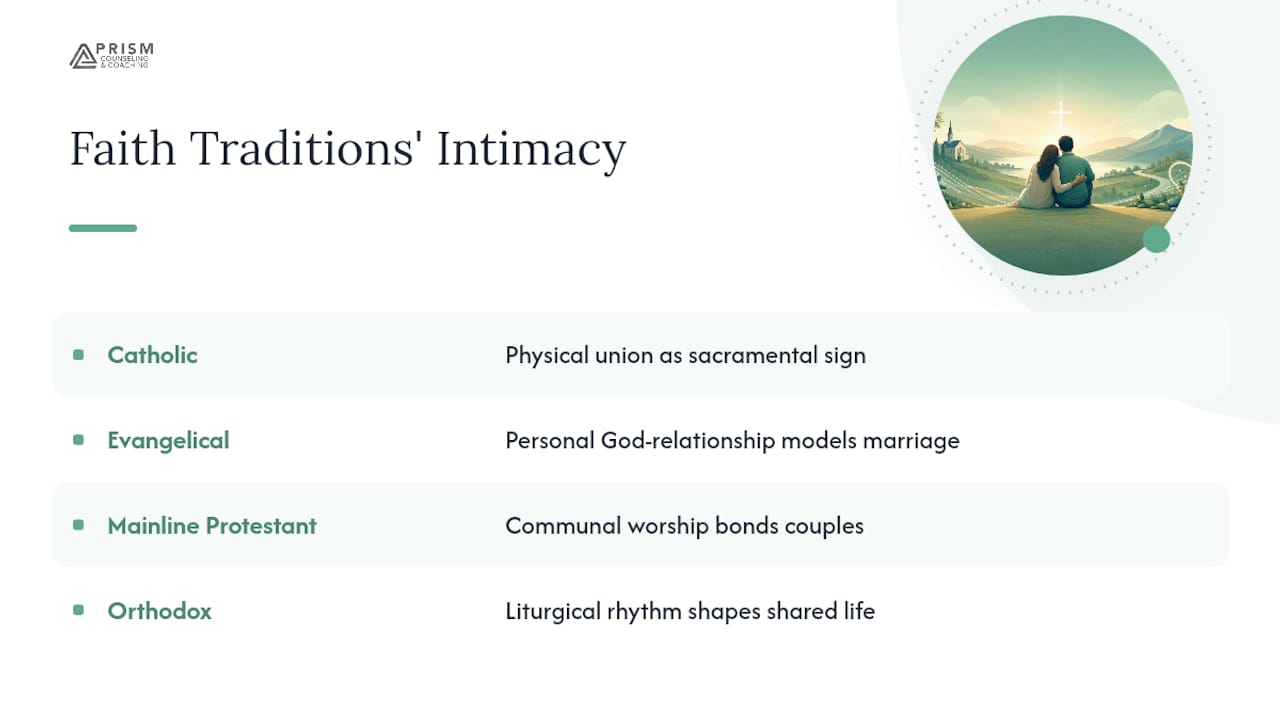
Christian traditions vary widely in how they frame intimacy, and those differences shape what couples expect from marriage and from God. Catholic teaching, for instance, ties marital intimacy closely to sacramental theology, treating the physical union itself as a sign of divine love rather than a separate, private matter. That's part of why Catholic guidance on marital intimacy so often pairs practical steps with spiritual language.
Evangelical and nondenominational traditions tend to emphasize personal relationship with God as the template for marital closeness: you learn to be known by your spouse the way you're learning to be known by God, and the two practices reinforce each other. Mainline Protestant communities often lean more on communal worship and shared service as the primary spiritual bond, with private devotion treated as a personal supplement rather than the main event.
Orthodox Christian practice frequently centers on liturgical rhythm, feast days, fasting seasons, set prayers, as the shared spiritual architecture a couple builds their life around, rather than open-ended personal devotion.
None of these approaches is more "correct" for building closeness. What matters is that both partners understand which framework they're operating from. A couple where one partner expects sacramental language and the other expects informal, conversational faith will misread each other's efforts unless they name the difference directly.
Can You Balance Your Own Faith Journey With a Relationship?
Your relationship with God and your relationship with a partner will not always move at the same pace, and that's not a crisis. One of you may be in a season of doubt while the other feels spiritually confident. One may crave silence and contemplative prayer while the other wants lively worship and community events.
The mistake is treating a partner's different pace as a threat rather than a variable to plan around. A spiritual connection between partners can feel profound, even divinely ordained, but that intensity doesn't erase the need for two separate people to keep growing individually.
Practically, this means protecting solo spiritual practice even inside a strong marriage. Don't let your partner become your only access point to God, and don't expect them to mirror your exact devotional style. A husband who journals for an hour every morning shouldn't pressure a wife who prays in short bursts throughout her day to change her rhythm; the goal is a shared destination, not identical footsteps.
Check in periodically, maybe quarterly, on where each of you is spiritually. Ask what's feeling alive and what's feeling dry. Treat those conversations as maintenance, not a crisis intervention, and the gap between two different faith paces stays manageable instead of becoming a wedge.
How Do Faith Crises Affect Intimacy?
A season of doubt rarely stays contained to your relationship with God. It bleeds into how safe you feel being known by anyone, including a spouse. If the beliefs that once anchored your identity start to wobble, vulnerability with a partner can suddenly feel riskier too, because you're not sure what you even believe about yourself anymore.
Partners often make one of two mistakes here. Some try to argue their spouse back into certainty, which tends to push the doubting partner further into isolation. Others go silent out of fear of saying the wrong thing, which reads as abandonment at the exact moment connection matters most.
The steadier response is staying present without demanding resolution. You can say, "I don't need you to have this figured out to be close to you," and mean it. Spiritual doubt often functions like any other rupture: it needs to be met with safety, not corrected on a deadline.
If a faith crisis is tangled up with past trauma, a controlling church experience, or a mental health struggle like depression, a faith-integrated counselor can help separate those threads. Doubt itself isn't the danger; isolation during doubt is.
Why Vulnerability Is the Engine of Spiritual Growth
Emotional vulnerability and spiritual growth aren't separate tracks. They're the same skill practiced in two directions. Learning to say "I'm afraid" to God in prayer builds the same muscle as saying it to a spouse at 11 p.m. after a hard day, and avoiding one usually means you're avoiding the other too.
Spiritual relationships often function as mirrors: the very challenges that surface in prayer or in marriage tend to point at the barrier you most need to address. A person who can't admit weakness to God is frequently the same person who can't admit weakness to a partner. Growth in one domain tends to unlock growth in the other, which is part of why couples who deepen their spiritual life together often report their emotional connection deepening too.
This is uncomfortable work. Vulnerability always is. But it's the actual mechanism, not a side effect, behind every practice in this article, from breath prayer to weekly check-ins.
A Counselor's Perspective on Faith and Intimacy
Most couples who struggle with intimacy aren't lacking faith. They're carrying shame they've never said out loud, to God or to each other. In counseling, the breakthrough moment is rarely dramatic; it's usually the first time someone admits a fear they've held for years and nothing bad happens. That's the whole model at work: disclosure met with safety. Start small. Say the true thing. Watch what happens.
— Tres
Ready to Build Deeper Intimacy? Here's Where to Start
Some counseling practices help individuals and couples work through issues such as persistent shame, complex faith and sexuality questions, or stalled spiritual closeness in marriage. Small, private-pay models can offer quicker openings and treatment that integrates beliefs as part of the solution rather than topics to avoid.

Sessions integrate prayer, Scripture, and theology directly into treatment for couples, individuals, and families, whether you need faith-based counseling, support specifically around faith and sexuality, or structured couples counseling. A first consultation is the place to name what's felt distant and find out whether it needs a season of counseling or just a better weekly rhythm. Reach out to schedule a consult and get a concrete next step instead of another week of wondering.
Sources
- Purity culture and sexual shame — Council for Relationships
- Defining intimacy and the Fourfold Intimacy Model — Apostolate for Marital Intimacy
- Interpersonal relations — PubMed
FAQ
What Are Keys to Growing Intimacy With God?
Consistent Scripture engagement, honest prayer (including lament), silence and Sabbath rest, worship, and small daily rituals all build felt closeness with God over time. No single key works alone; they function together, the same way multiple habits build any relationship.
What Is the 72-Hour Intimacy Rule?
This isn't a recognized theological or clinical framework, and definitions vary widely online. If you've heard the term, it's worth asking your source what evidence or tradition backs it rather than treating it as an established principle.
What Does the Bible Say About Intimacy?
Scripture frames intimacy as being fully known and still loved, a pattern reflected in passages about God's closeness to the brokenhearted and in the marital imagery used throughout both testaments. It consistently pairs vulnerability with covenant faithfulness rather than performance.
What Are the Four Types of Intimacy With God?
Faith-integrated counselors often apply the Fourfold Intimacy Model, spiritual, intellectual, emotional, and physical, to a person's relationship with God as well as to marriage, since each domain reflects a different way of being known and safe.
When Should Couples Seek Christian Counseling for Intimacy Issues?
Seek help when withdrawal, shame, or conflict around faith and sexuality persists for weeks without improvement, or when trauma symptoms surface during physical closeness. Faith-integrated counseling can address these issues without asking you to set your beliefs aside.