

Religious trauma is the lasting emotional, psychological, and physical harm that comes from indoctrination, spiritual abuse, or membership in a high-control religious group. Clinicians often describe it alongside PTSD and complex PTSD because the nervous-system effects overlap closely, even though it carries its own religion-specific wounds around identity, belonging, and belief. If shame, fear, or confusion about your faith history still follows you into daily life, this applies to you, and real, evidence-informed help exists.
TL;DR:
- Religious trauma often results from years of cumulative control, shame, and fear, especially when indoctrination begins early in childhood.
- Symptoms include decision paralysis, trust issues, social isolation, hypervigilance, and physical stress responses like panic attacks or sleep disturbances.
- Effective treatment combines trauma-focused therapy such as EMDR and somatic methods with spiritual exploration, avoiding pressure to either stay or leave faith.
- Recognizing severe signs like suicidal thoughts or inability to function requires immediate crisis intervention, such as calling the 988 Lifeline.
- Finding a trauma-informed, faith-sensitive therapist involves asking specific questions about experience, modalities used, and approach to faith issues before starting treatment.
Table of Contents
- What Is Religious Trauma, Really?
- What Are the Signs of Religious Trauma?
- How Does Religious Trauma Develop?
- What Does Religious Trauma Look Like in Real Life?
- What Treatments Actually Help With Religious Trauma?
- How Do You Find a Therapist for Religious Trauma?
- A Note on Healing Without a Prescribed Destination
- How Prism-counseling Supports Religious Trauma Recovery
- Sources
- FAQ
What Is Religious Trauma, Really?
Religious trauma describes the harm that forms when religious teachings, authority structures, or community practices become sources of fear, control, or shame rather than safety and belonging. The Religious Trauma Institute and clinicians working in this space describe it as a response to prolonged exposure to teachings or environments that suppress a person's autonomy, punish doubt, or use fear to enforce obedience.
The clinical term "Religious Trauma Syndrome" (RTS) was coined in 2011 by psychologist Marlene Winell, who noticed a consistent pattern among former members of controlling religious systems: anxiety, identity confusion, difficulty making decisions, and a grief process unlike typical loss. Winell's framework did not invent a new injury. It named something clinicians were already seeing but lacked language for.
RTS itself is not listed in the DSM-5 or the ICD. That absence trips people up, as if the lack of an official code means the pain is not real or not serious enough. It's neither. Clinicians most often conceptualize RTS as religion-induced PTSD or complex PTSD, borrowing established diagnostic frameworks while treating the religious content as central to the injury rather than incidental to it.
Practitioners use the term in a few practical ways:
- As a screening lens during intake, to ask directly about religious upbringing and any coercive or shame-based teachings.
- As a bridge to trauma-focused treatment models that already have research support, rather than treating faith wounds as a separate, unproven category.
- As validating language for survivors who've been told their distress is spiritual failure rather than a trauma response.
Naming the injury matters more than it might seem. Many survivors spend years describing their experience as "church hurt," a phrase that minimizes what happened and often keeps people from seeking targeted treatment. Calling it what it is, religious trauma with a clinical basis, opens the door to therapies that actually address it.
What Are the Signs of Religious Trauma?
Religious trauma shows up differently from person to person, but it tends to cluster in four areas: how you think, how you feel, how you relate to others, and how your body responds to stress.
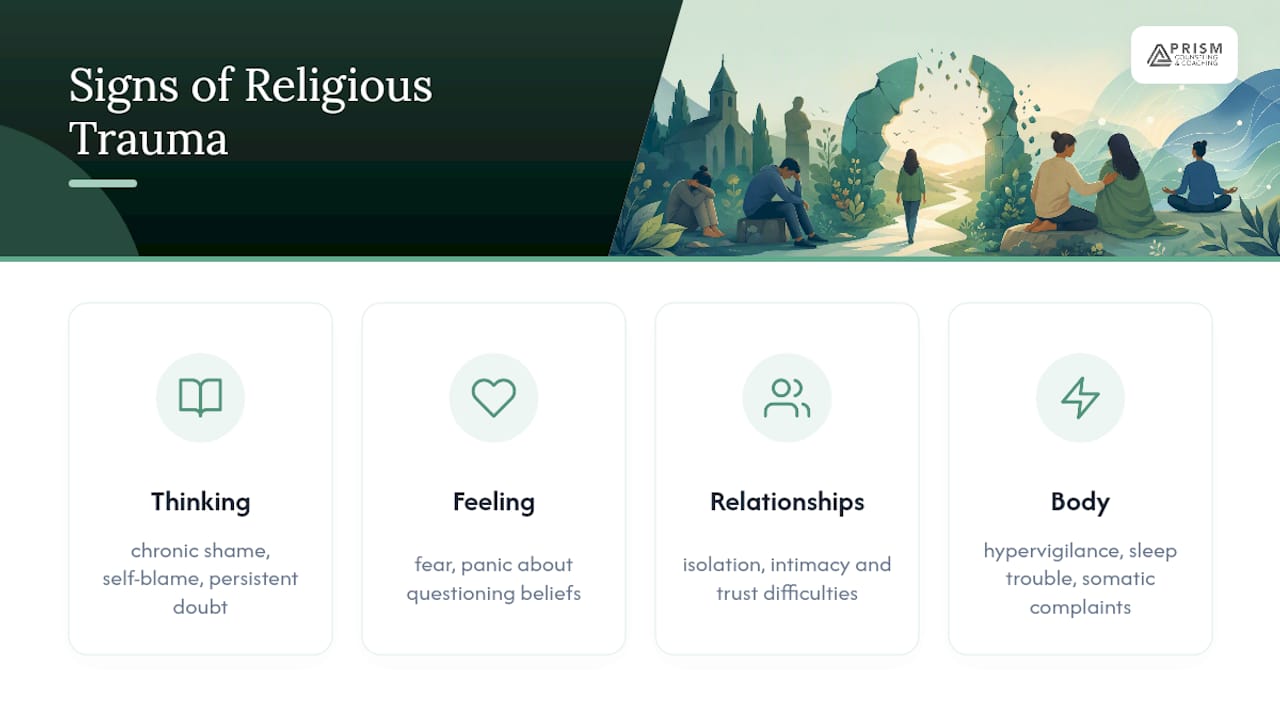
Cognitive and emotional signs often include chronic shame that has no clear trigger, an inner voice that defaults to self-blame, and persistent doubt paired with fear about that doubt itself. Many survivors describe an exhausting loop: questioning a belief, then panicking about the consequences of questioning it. Confusion about basic decisions, what to eat, who to trust, what career to pursue, can trace back to years spent deferring judgment to religious authority rather than practicing it yourself.
Behavioral and relational signs tend to show up as isolation, either self-imposed out of fear or forced through shunning, and real difficulty with intimacy or trust in new relationships. Survivors frequently describe missing typical developmental milestones: dating, higher education, financial independence, or even basic sex education, because a controlling environment delayed or blocked them. A large qualitative study of 333 participants identified delayed development and relational damage as two of nine consistent harm themes across religious trauma survivors.
Physical and nervous-system symptoms are easy to miss because they don't look "religious" at all: hypervigilance, trouble sleeping, panic responses to sounds or settings that resemble religious services, and vague somatic complaints like chronic tension or stomach issues that don't respond to typical medical treatment.
Fear, powerlessness, and shame ranked as the top lasting impacts reported by respondents in a large survey from the Religious Trauma Institute covering 2,500 people with adverse religious experiences.
That statistic matters because it confirms something therapists see constantly: the damage isn't primarily theological. It's physiological. Fear and powerlessness live in the body, not just in a person's beliefs about God.
When symptoms escalate, take it seriously. Panic attacks, suicidal thoughts, self-harm urges, or an inability to function at work or in relationships are signals that this needs professional attention now, not eventually. If you're in crisis, contact the 988 Suicide & Crisis Lifeline by calling or texting 988. Everything else in this article assumes you're stable enough to read and reflect; if you're not, that hotline comes first.
How Does Religious Trauma Develop?
Religious trauma rarely comes from a single bad sermon or one harsh conversation. It usually builds cumulatively, the way water erodes stone, through years of repeated exposure rather than one dramatic event.
High-control environments rely on a specific set of tactics: controlling information, discouraging outside relationships, punishing questions, and framing obedience as the only path to safety or salvation. Psychologists sometimes call this coercive persuasion. It works precisely because it's gradual. Nobody joins expecting to lose their autonomy; it happens one small compliance at a time.
A few patterns show up again and again in how this harm takes root:
- Cumulative harm outweighs single incidents. Years of low-grade shaming about sexuality, doubt, or worth do more lasting damage than most people expect, even without one identifiable "worst moment."
- Childhood timing changes everything. When indoctrination starts before a child's brain has developed independent reasoning skills, the religious framework becomes fused with basic safety and identity, not just belief.
- Leaving is its own trauma. Exiting a high-control group frequently causes moral injury and grief that can rival the original harm, especially when it means losing family, community, and a coherent worldview all at once.
- Betrayal trauma compounds the injury. When the harm comes from someone in a trusted role, a pastor, elder, or family member acting under religious authority, the psychological damage runs deeper than harm from a stranger.
Clinicians increasingly draw on neurosequential models of trauma treatment, which recognize that lower brain systems (regulating fear and safety) need attention before higher cognitive work can stick. This matters for religious trauma specifically because so much of the harm was delivered through fear conditioning, not through reasoned argument. You can't out-think a nervous system that has been trained to associate certain words, spaces, or rituals with danger.
Negative religious coping, the tendency to interpret suffering as punishment or personal failure, is separately linked to worse mental-health outcomes after trauma, according to VA clinical guidance. That connection helps explain why religious trauma so often intensifies rather than resolves on its own.
What Does Religious Trauma Look Like in Real Life?
Abstract definitions rarely land the way a real story does. These composite vignettes reflect common patterns clinicians describe, not any one individual's history.
-
The child who can't decide anything. Raised in a household where every choice, clothing, friendships, college majors, was filtered through a rigid interpretation of scripture, she now finds herself paralyzed by grocery store decisions in her thirties. The likely symptom cluster: chronic self-doubt, decision paralysis, and anxiety rooted in years of having autonomy suppressed. A first recovery step is practicing small, low-stakes decisions on purpose, rebuilding the muscle of self-trust one choice at a time.
-
The congregant harmed by clergy. He trusted a pastor with his deepest struggles, only to have that trust exploited through manipulation and secrecy. What surfaces afterward isn't just anger. It's a betrayal-trauma pattern: difficulty trusting any authority figure, including therapists, and a reflexive suspicion of anyone in a caregiving role. Recovery often starts with finding a therapist willing to earn trust slowly, without rushing intimacy in the therapeutic relationship itself.
-
The excommunicated sister. After questioning church doctrine publicly, she was shunned by her congregation and, eventually, most of her family. The resulting symptom cluster centers on grief and social isolation, a loss that looks like bereavement but has no funeral, no closure ritual, and no social permission to mourn. A practical early step: seeking out peer-support communities specifically for religious trauma survivors, where the isolation itself starts to lift.
Each of these pathways points toward a different emphasis in treatment, but all three share the same underlying need: nervous-system safety before deep processing work begins.
What Treatments Actually Help With Religious Trauma?
Insight alone rarely resolves religious trauma. You can understand exactly why you feel afraid and still feel afraid, because the fear response lives in the body's threat-detection system, not in your conscious reasoning. That's why the most effective approaches combine cognitive work with body-based methods.
Trauma-focused CBT helps identify and restructure the specific beliefs that keep shame and fear active, useful for the "thinking" side of recovery. EMDR (Eye Movement Desensitization and Reprocessing) targets specific traumatic memories directly, often reducing their emotional charge without requiring the survivor to narrate every detail out loud, which many religious trauma survivors find less re-traumatizing than exposure-based talk therapy alone. Somatic Experiencing and related body-based methods work directly with nervous-system dysregulation, the hypervigilance and freeze responses that talk therapy frequently misses.

Therapists specializing in this area report that survivors often stall in recovery when treatment focuses only on cognitive insight, because understanding a wound intellectually doesn't automatically calm a dysregulated nervous system. Somatic work isn't an alternative to cognitive treatment. It's frequently the missing piece that makes cognitive work stick.
Spiritually integrated therapy differs from generic trauma treatment in one important way: it treats your relationship with faith, whatever that currently looks like, as material worth exploring rather than something to avoid or something the therapist has an agenda about. VA clinical guidance recommends that therapists explicitly ask about spiritual concerns at intake and negotiate how, or whether, faith will be part of treatment going forward.
Practical recovery tasks tend to fall into three categories:
- Boundary skills. Learning to say no, set limits with family, or decline pressure without collapsing into old shame patterns.
- Community rebuilding. Finding belonging outside your original religious structure, sometimes through faith-based counseling and trauma-informed spiritual abuse recovery, sometimes through entirely non-religious activity groups.
- Meaning-making. Reconstructing a coherent worldview, whatever form that takes, rather than living in the disorientation that follows losing your original framework.
Recovery here has no single correct destination. Some survivors return to faith on their own terms; others leave entirely; most land somewhere focused on autonomy and safety rather than any prescribed outcome.
Pro Tip: Grounding techniques, naming five things you can see, feel, or hear right now, work well in the moment when a sermon, scripture verse, or religious setting triggers a panic response. It's a fast way to signal safety to your nervous system without needing to process the entire trigger on the spot.
Medication and crisis intervention become appropriate when symptoms include suicidal ideation, panic attacks that disrupt daily function, or depression severe enough to prevent basic self-care. A psychiatric evaluation alongside trauma therapy isn't a failure of the therapeutic process; it's often what makes deeper trauma work possible.
How Do You Find a Therapist for Religious Trauma?
Not every trauma therapist understands religious trauma specifically, and not every faith-friendly counselor has trauma training. You need both.
When searching, look for language like "trauma-informed," "spiritual integration," "EMDR," or "somatic therapy" in a provider's listed specialties. A therapist trained in spiritually-integrated EMDR brings both pieces together instead of treating them as separate tracks.
Before your first session, or during an initial consultation call, ask direct questions:
- "What's your experience working with clients who've left high-control religious groups?"
- "Do you use EMDR or somatic approaches, and how do you decide when to use them?"
- "How do you handle it if I want to talk about my faith, or if I don't want to talk about it at all?"
- "What's your confidentiality policy, and how does that work if I'm still connected to my former religious community?"
Watch for red flags during that conversation. A therapist who minimizes what you describe ("that doesn't sound so bad"), who pushes you toward a specific spiritual conclusion (staying in or leaving your faith), or who has no training in trauma-specific modalities is not the right fit, regardless of how warm they seem. Trauma-informed Christian counseling should feel safe precisely because it doesn't pressure you toward any predetermined spiritual outcome.
If you're in immediate distress, the 988 Suicide & Crisis Lifeline is available by call or text at any hour. Peer-support communities for religious trauma survivors also exist online and in person, often providing the kind of understanding that's hard to find elsewhere, since most people in your life probably haven't lived through what you're describing.
A Note on Healing Without a Prescribed Destination
Faith and identity are tangled together for most survivors, and untangling them takes time nobody should rush you through. You don't owe anyone a decision about whether you stay religious, return to it later, or walk away entirely. What you're owed is safety, clarity, and a nervous system that isn't running a threat response every time a certain word or memory surfaces.
Recovery from religious trauma isn't linear, and it isn't about arriving at one correct spiritual conclusion. Some people rebuild faith in a healthier form. Some don't, and that's not a failure. What matters is that the decision is finally yours, made from a place of safety rather than fear. Faith-integrated care exists precisely for people who want that option held open, without judgment either way.
— Tres
How Prism-counseling Supports Religious Trauma Recovery
Some counseling providers offer therapists trained in both clinical trauma treatment and faith-integrated care, without forcing clients to choose one lens over the other. If you've been searching for a counselor who takes your spiritual history seriously instead of treating it as background noise, that combination is the actual gap in most trauma treatment.
Sessions typically start with an intake conversation about your history, including your religious background and what role, if any, you want faith to play in treatment going forward. From there, care may include EMDR, somatic techniques, and trauma-focused talk therapy, tailored to whether you're working through childhood indoctrination, clergy betrayal, shunning, or another pathway. Some practices operate as small, private-pay models, which can mean openings are often available within days rather than the weeks-long waits common with insurance-based providers.
If you're ready to talk to someone who understands both trauma treatment and faith, start with Prism's faith-based counseling services or explore the trauma and EMDR page directly to see what a first session looks like.
Sources
For deeper research, the peer-reviewed overview on religious trauma syndrome, VA guidance on spirituality and trauma, and Psychotherapy Networker's clinical piece each offer research-grounded detail beyond this overview. For scripture-based encouragement during recovery, Bible verses about healing can be a gentle companion resource.
This article is general information, not a substitute for advice from a qualified doctor. Consult a qualified healthcare professional about your own circumstances before acting on anything here.
- Religious trauma syndrome: The futile fate of faith
- Treating the trauma in religious trauma
- Spirituality and trauma
FAQ
How Do You Know if You Have Religious Trauma?
Common indicators include chronic shame or self-blame tied to religious teachings, hypervigilance or panic near religious settings, difficulty making decisions independently, and strained relationships from shunning or forced isolation. If these patterns persist and interfere with daily life, a trauma-informed therapist can help confirm what you're experiencing.
What Are Some Examples of Religious Trauma?
Examples include childhood indoctrination that causes decision paralysis in adulthood, clergy abuse that destroys trust in authority figures, and shunning or excommunication that leads to lasting social isolation and unresolved grief.
How Is Religious Trauma Formed?
Religious trauma typically forms through cumulative exposure to coercive or shame-based teachings, especially when it begins in childhood before independent reasoning develops. Betrayal by a trusted religious authority and the loss experienced when leaving a high-control group can deepen the injury further.
Is Religious Trauma the Same as Spiritual Abuse?
Not exactly. Spiritual abuse refers to specific harmful acts, manipulation, coercion, or misuse of religious authority, while religious trauma describes the lasting psychological and physical injury that can result from those acts or from a broader high-control environment.
Can You Recover From Religious Trauma Without Leaving Your Faith?
Yes. Recovery focuses on safety and autonomy rather than a specific spiritual outcome, and many survivors rebuild a healthier relationship with faith through spiritually integrated therapy rather than abandoning it entirely.