
Scrupulosity is religious OCD, a treatable subtype of obsessive-compulsive disorder that hijacks faith rather than reflecting a spiritual failure. The obsessions feel urgent and shameful, but they respond to the same evidence-based treatment as other forms of OCD. The next right step is finding an OCD-trained clinician who understands Christian faith, because you do not have to choose between healing and belief.
TL;DR:
- Most scrupulosity sufferers experience intrusive thoughts about blasphemy, salvation doubts, and demonic influence, which lead to compulsive rituals that do not bring lasting relief.
- ERP treatment involves facing feared thoughts without performing compulsions, helping the brain learn anxiety will decrease naturally over time, with most clients seeing significant progress in months.
- Finding a therapist trained in ERP and familiar with Christian theology is crucial, as generic therapists or pastors without OCD training may unintentionally reinforce compulsions or misunderstand normal religious practices.
- Practicing uncertainty tolerance by limiting reassurance, sitting with discomfort, and setting boundaries on religious rituals can help manage symptoms daily, especially when combined with structured support.
- Long-term recovery is possible with consistent ERP, ongoing boundary maintenance, and support from faith-aware clinicians, with most individuals stabilizing their symptoms and experiencing a deeper, more genuine faith.
Table of Contents
- What Does Scrupulosity OCD Look Like in Christians?
- Where Is the Line Between Devotion and OCD?
- What Treatments Actually Work for Religious OCD?
- How Do I Find a Christian OCD Treatment Provider?
- What Coping Strategies Help With Scrupulosity Right Now?
- When Should You Seek Professional Help for Scrupulosity?
- How Do Different Christian Traditions Approach Scrupulosity?
- What Role Should Clergy and Church Community Play?
- What Are the Biggest Myths About Christian Scrupulosity?
- How Should Prayer and Rituals Be Handled During Treatment?
- What Does Long-Term Recovery From Scrupulosity Look Like?
- A Counselor's Note on Faith and OCD Recovery
- How Prism-counseling Supports Christians With Scrupulosity
- Sources
- FAQ
What Does Scrupulosity OCD Look Like in Christians?
Scrupulosity is a recognized subtype of OCD marked by intrusive, distressing thoughts about sin, blasphemy, and moral failure, paired with compulsions meant to neutralize the fear, according to the International OCD Foundation. The obsessions tend to circle a handful of themes.
- Fear of having committed blasphemy, often over a fleeting thought that felt "wrong"
- Terror of unforgivable sin or having lost salvation entirely
- Persistent doubt about whether a prayer or confession "counted"
- Fear of demonic influence or spiritual contamination
The compulsions look devout on the surface but function as anxiety relief, not worship: repeating prayers until they feel "right," confessing the same sin over and over, asking a pastor or spouse for reassurance, or avoiding church, communion, or scripture altogether because the anxiety has become unbearable. What sets this apart from ordinary faith struggles is the distress. These thoughts feel foreign and horrifying to the person having them, and the rituals eat hours out of the day, strain marriages, and keep people from the very worship they are trying to protect.
Where Is the Line Between Devotion and OCD?
Healthy religious practice feels chosen, even when it is disciplined. Prayer, fasting, and confession bring a sense of connection or conviction, and when they are done, they are done. Scrupulosity works differently. The compulsions are driven by dread, not devotion, and they rarely bring lasting relief.
- Ego-syntonic faith: the practice aligns with your values and ends when it is completed
- Ego-dystonic OCD: the ritual feels compulsory, brings only momentary relief, and starts over almost immediately
- Excessive doubt or repetition that interferes with sleep, work, or relationships signals impairment, not piety
Denominational norms matter here too. What counts as excessive confession in one tradition might be standard practice in another, which is why a clinician's understanding of your specific faith context changes everything. Clinicians treating religious OCD need both ERP training and sensitivity to religious practice, because a generic secular therapist might mistake normal liturgy for OCD, and a well-meaning pastor might mistake OCD for a faith crisis.
What Treatments Actually Work for Religious OCD?
Exposure and Response Prevention, known as ERP, is the gold-standard psychological treatment for OCD, according to the Cleveland Clinic. It works by having you face the feared thought or situation, such as sitting with an intrusive blasphemous thought, without performing the compulsion that usually follows it, whether that is confessing, praying it away, or seeking reassurance. Over repeated sessions, the brain learns the anxiety will fall on its own, without a ritual forcing it down.
How ERP for scrupulosity typically unfolds:
- You and your therapist build a list of feared thoughts or situations, ranked from mildly uncomfortable to intensely distressing.
- You start with a manageable exposure, like reading a Bible passage that triggers doubt, and practice sitting with the discomfort.
- You resist the urge to neutralize the anxiety through prayer repetition, confession, or asking someone for reassurance.
- Homework between sessions extends the exposure into daily life, gradually working up the list.
- Most people see meaningful symptom reduction over a course of weekly sessions spanning several months, though timelines vary by severity.
SSRIs are frequently used alongside ERP as an adjunct, particularly when obsessions are severe enough to make exposure work difficult to start. Medication does not replace ERP, but it can lower the baseline anxiety enough for exposures to land.
Pro Tip: If a therapist's main tool for your religious fears is telling you "you're fine, God isn't mad at you," that is reassurance, not treatment. It might soothe you for an hour. It will not treat the OCD, and it may quietly make it worse.
How Do I Find a Christian OCD Treatment Provider?
The ideal clinician for scrupulosity therapy is trained in ERP and genuinely literate in Christian theology, not just tolerant of it. That combination is rarer than it should be, so it is worth screening for directly.
Ask a prospective therapist:
- "Do you have specific training in ERP, and have you treated religious or moral OCD before?"
- "How do you tell the difference between OCD compulsions and normal religious observance in my tradition?"
- "Would you be willing to communicate with my pastor if that would help treatment?"
Watch for red flags in both clinical and pastoral settings. A counselor who spiritualizes every fear ("just pray more," "you need more faith") without addressing the compulsive pattern underneath is missing the diagnosis. A clergy member who offers repeated reassurance as the primary response to your doubts, however caring the intention, is often unknowingly feeding the OCD cycle. Well-meaning religious leaders frequently lack OCD training, and that gap can turn pastoral care into an accidental compulsion.
Faith-based counseling can complement ERP well when the counselor understands OCD specifically, but it is not a substitute for ERP and can worsen symptoms if it leans on reassurance. A conversation about CBT and Christianity working together is a useful starting point for understanding how these two approaches fit rather than compete.
What Coping Strategies Help With Scrupulosity Right Now?
Coping with scrupulosity day to day means practicing the same principle ERP teaches in the therapy room: tolerating uncertainty instead of chasing certainty you were never promised. Therapists who specialize in religious OCD describe this as living with uncertainty rather than demanding absolute proof of your standing before God, and that shift in posture is often the real turning point in recovery.
- Sit with an intrusive thought for a set time (start with two minutes) without praying it away, confessing it, or seeking reassurance.
- Replace the compulsive script with a short, faith-honoring reframe, such as "I don't need certainty right now to trust God," and stop there.
- Set a hard limit on reassurance-seeking. If you already asked your pastor or spouse once today, the second and third ask are the compulsion talking, not genuine spiritual need.
- Protect sleep and a normal daily rhythm. Anxiety disorders thrive on exhaustion and isolation.
- Cap "research time." Endless googling of theology questions to resolve doubt is a mental compulsion wearing a scholarly disguise.
Reassurance-seeking from clergy or loved one's functions as a compulsion and tends to strengthen the OCD cycle rather than calm it. Structured pastoral support, where a pastor agrees in advance to a limited, planned check-in rather than open-ended reassurance on demand, works far better. Resources that blend scripture with CBT techniques can help you build this kind of structure without abandoning your devotional life.
Pro Tip: Keep a simple log of how many times a day you seek reassurance about the same fear. Watching the number itself, without judgment, often reveals the compulsion faster than any amount of self-analysis.
When Should You Seek Professional Help for Scrupulosity?
Get help immediately if you experience suicidal thoughts, are unable to function at work, school, or home, or find that fear of sin or damnation is consuming most of your waking hours. Those are crisis-level signals, not just "a rough season."
For everyone else, the entry point is simpler than it feels. The IOCDF provider directory lists clinicians trained in ERP, and many now offer teletherapy, which widens access considerably if a specialist is not nearby. While you wait for an intake appointment, a therapist trained in general CBT can still help stabilize anxiety, and structured self-help resources on ERP basics can keep momentum going.
- Ask any prospective therapist directly about ERP experience before booking
- Bring a specific list of your obsessions and compulsions to the first appointment
- Tell clergy or family what you need ("pray with me, but please don't reassure me about this specific fear") rather than leaving the boundary unspoken
How Do Different Christian Traditions Approach Scrupulosity?
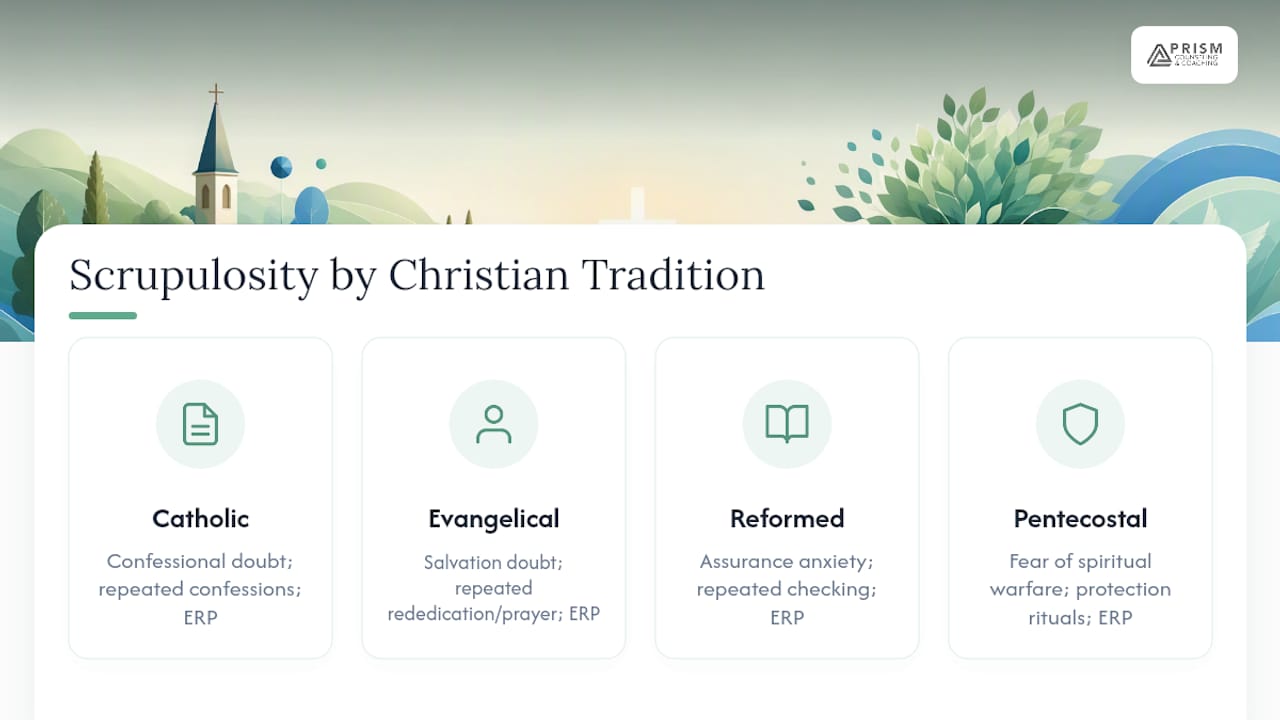
Scrupulosity shows up across every Christian tradition, but the compulsions often borrow the vocabulary of whatever tradition the person belongs to. Catholic scrupulosity frequently centers on the confessional, with sufferers confessing the same sin dozens of times or seeking a priest's reassurance that a confession "took." Historically, this pattern was documented so consistently in Catholic contexts that scrupulosity was sometimes treated as a uniquely Catholic problem, though that framing understates how common it is elsewhere.
Evangelical and non-denominational Christians more often describe obsessions about salvation certainty, the unpardonable sin, or whether a moment of doubt means they were never truly saved. The compulsion shifts from repeated confession to repeated prayers of rededication or endless scripture searching for reassurance. Reformed traditions with strong doctrines of assurance can paradoxically intensify this, since the theological expectation of certainty collides with an OCD brain that cannot tolerate any.
Pentecostal and charismatic contexts sometimes add a layer of fear around spiritual warfare or demonic influence, with compulsions built around prayers of protection or repeated renunciation rituals.
None of these variations change the underlying diagnosis or the treatment. A clinician who understands your specific tradition's theology of sin, confession, and assurance can design exposures that respect your actual beliefs rather than a generic version of "Christianity," which is exactly what the Academy of Cognitive & Behavioral Therapies recommends when working across Judeo-Christian traditions.
What Role Should Clergy and Church Community Play?
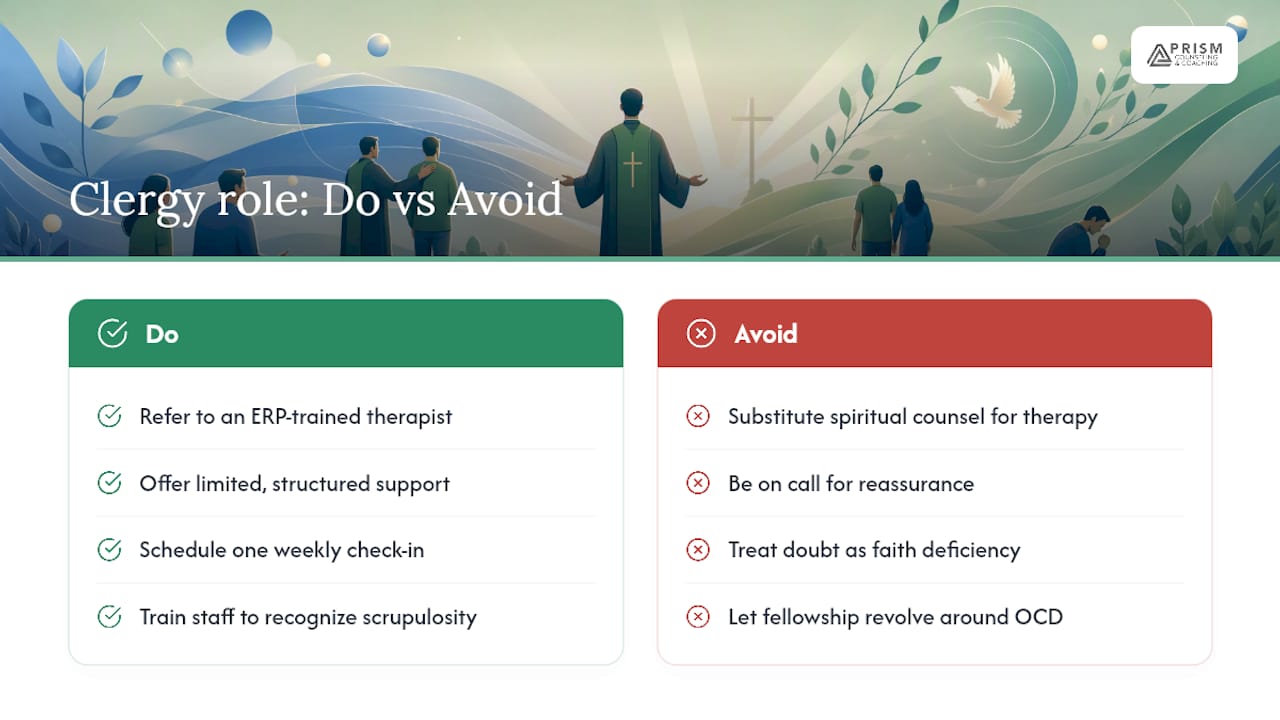
Pastors and church community can be genuine allies in recovery, but only when the role is defined clearly. A pastor is not a substitute for an ERP-trained therapist, and expecting spiritual counsel alone to resolve OCD sets everyone up for frustration. The most helpful clergy response is a warm referral paired with limited, structured spiritual support rather than unlimited availability for reassurance.
In practice, that might mean a pastor agreeing to one scheduled check-in a week instead of being on call for every anxious text. It might mean a small group leader gently redirecting a member who keeps bringing the same confession back to the group. Churches that train their staff to recognize scrupulosity, rather than treating every expression of doubt as a faith deficiency, do a real service to their congregations.
Community still matters enormously for recovery. Isolation feeds anxiety, and Christian community offers belonging that has nothing to do with performance or certainty. The healthiest church response holds both truths: refer to professional treatment for the disorder, and keep the door open for ordinary fellowship that does not revolve around the person's OCD. If you are unsure whether a need calls for pastoral care or clinical treatment, a look at spiritual direction versus counseling can help clarify which is which, and when both are useful at once.
What Are the Biggest Myths About Christian Scrupulosity?
The most damaging myth is that scrupulosity is a spiritual problem that more prayer, more discipline, or more faith will fix. It is a neuropsychiatric condition, and treating it as a faith failure often deepens shame and delays real treatment for years.
A second myth: that having intrusive blasphemous or doubting thoughts means you secretly believe them, or that God is displeased with you for having them. Scrupulosity's obsessions are ego-dystonic, meaning they clash violently with what you actually value and believe. Their presence is a symptom, not a confession.
A third myth treats scrupulosity as rare or unusual among "real" Christians, when it appears across every tradition and every level of devotion, often striking the most sincere and theologically engaged believers hardest. It is not a punishment for weak faith; if anything, it tends to target people who care most about getting their faith right.
Finally, many assume that ERP therapy is somehow anti-faith, as though facing a fear without ritual means abandoning belief. Clinicians trained in religious OCD frame ERP as a path back to value-directed faith, not opposition to it. The goal of treatment is a faith life driven by conviction again, not one driven by fear.
How Should Prayer and Rituals Be Handled During Treatment?
You do not have to give up prayer, confession, or church attendance to do ERP for scrupulosity. What changes is the function those practices serve during treatment, not necessarily their frequency in every case.
A therapist trained in religious OCD will work with you to identify which specific practices have become compulsions and which remain genuine worship. Confession done once, with peace afterward, stays confession. Confession repeated five times in an hour because the first four "didn't feel right" is a ritual serving anxiety, and that is the piece ERP targets.
Some exposures will deliberately involve sitting with a prayer that feels "incomplete" or attending church without seeking reassurance from anyone afterward about how you did. This can feel disorienting at first, even disrespectful to your faith, but the discomfort is the point. It is teaching your nervous system that faith does not require certainty to be real.
Collaborating with a pastor who understands the treatment plan helps enormously here. ERP exercises for scrupulosity work best when exposures are designed collaboratively to respect theological boundaries while still preventing the ritual response. A pastor who knows you are in treatment can support a modified practice, like limiting confession frequency, without treating it as a spiritual compromise.
What Does Long-Term Recovery From Scrupulosity Look Like?
Scrupulosity responds to the same treatments that work for other OCD subtypes, and most people who complete a full course of ERP see substantial, lasting symptom reduction. Recovery rarely means the intrusive thoughts vanish forever. It means they stop running your day.
Relapse prevention centers on catching early warning signs before they snowball: an uptick in confession frequency, a return to googling theological questions late at night, a new reluctance to attend a particular service or read a particular passage. Naming these patterns early, ideally with a therapist you can return to for a few booster sessions, keeps a bad week from becoming a bad year.
Long-term stability also depends on protecting the boundaries you built in treatment. That means continuing to limit reassurance-seeking even when life gets stressful and the old urge to ask "one more time" resurfaces. It means keeping a pastor or support person in the loop who understands your history, so they can gently redirect rather than accidentally feed a relapse.
Faith itself tends to deepen after successful treatment, not shrink. People who go through ERP for scrupulosity frequently describe a faith that finally feels chosen rather than compelled, because they know they can tolerate doubt without needing to resolve it instantly.
A Counselor's Note on Faith and OCD Recovery
Faith-integrated therapy exists precisely for moments like this, where clinical treatment and genuine belief need to work as partners, not competitors. Recovery from scrupulosity is possible, and it does not require setting your faith aside. It requires the right kind of help, applied with patience.
If any part of this article described your inner life, the next step is small: reach out for an assessment with someone trained in both ERP and Christian faith. You do not have to have it figured out before you call.
— Tres
How Prism-counseling Supports Christians With Scrupulosity
Finding a therapist who takes both your anxiety and your faith seriously shouldn't require choosing between a secular clinic that ignores your beliefs and a well-meaning pastor without clinical training. The practice offers faith-integrated counseling designed to incorporate clients' spiritual convictions within the treatment plan.
The practice operates on a private-pay model rather than insurance, which can allow new clients to book appointments relatively quickly and maintains session confidentiality. Initial sessions generally begin by exploring clients' specific obsessions, compulsions, and denominational background to tailor treatment accordingly. If you are ready to talk to someone who understands both OCD and Christian faith, visit the faith-based counseling page to book an assessment and take the first real step toward relief.
Sources
- What is OCD & Scrupulosity? | International OCD Foundation
- ERP therapy | Cleveland Clinic
- Can faith-based therapy help with scrupulosity or religious OCD? | TreatMyOCD (NOCD)
- Religiosity/Scrupulosity OCD in Judeo-Christian Contexts | Academy of CBT
FAQ
Can a Christian Have Scrupulosity OCD?
Yes. Scrupulosity is a recognized subtype of OCD, and it appears across every Christian tradition, often striking the most sincere and theologically engaged believers. Having scrupulosity is not evidence of weak faith; it is a treatable neuropsychiatric condition that latches onto whatever a person values most.
Does Scrupulosity OCD Have to Be Religious?
No. Scrupulosity is the religious and moral subtype of OCD specifically, but OCD itself attaches to many different themes, including contamination, harm, and relationships. The underlying disorder and its treatment, primarily ERP, stay the same regardless of which theme the obsessions take.
Can You Be a Christian and Have OCD?
Absolutely, and having OCD does not conflict with genuine Christian belief. Faith-integrated therapists work specifically to help clients keep their spiritual convictions intact while treating the OCD process rather than the theology underneath it.
What Is the Root Cause of Scrupulosity?
Scrupulosity develops the way other OCD subtypes do: through a combination of biological vulnerability and a brain that fixates on doubt around whatever the person values most, in this case, faith and morality. It is not caused by insufficient devotion or hidden sin, and reassurance or increased religious effort typically does not resolve it on its own.
How Do I Find Christian OCD Treatment Near Me?
Start with a clinician trained specifically in ERP who also understands Christian theology, since that combination treats both the disorder and respects your beliefs. Prism-counseling offers faith-integrated counseling in the Phoenix area with private-pay scheduling that often allows new clients to start within days.