

Spiritual direction helps you notice how God is moving in your life; counseling treats anxiety, depression, trauma, and other diagnosable struggles. Choose counseling when you're in crisis or carrying symptoms that disrupt your daily life, and choose spiritual direction when your soul feels dry or you're discerning a calling with no acute clinical need. Many people benefit from both, held together with honesty and good communication between providers. If you're having thoughts of self-harm or your symptoms feel unmanageable, counseling comes first, always.
TL;DR:
- Counseling is necessary when experiencing severe symptoms like suicidal thoughts, trauma flashbacks, or functional impairment requiring clinical diagnosis and safety protocols.
- Spiritual direction is suitable for stable individuals seeking deeper discernment, spiritual growth, or guidance during major life transitions without clinical concerns.
- Combining both approaches requires clear communication, written consent, and agreement on who leads during crises, with licensed therapists always taking priority in emergencies.
- Faith-based counseling offers integrated clinical and spiritual support, providing faster, personalized care for those who want licensed help that respects their beliefs.
- Most spiritual directors are trained laypeople or clergy without official licensing, and their fees typically range from donation to around $100 per hour, often scaled for affordability.
Table of Contents
- Spiritual Direction vs Counseling: The Quick Comparison
- What Happens in Spiritual Direction
- What Counseling Actually Treats
- How Do You Know Which One You Need?
- Can Therapy and Spiritual Direction Work Together?
- How to Find a Provider and What to Ask First
- Why I Push Back on the Either/Or Framing
- A Faith-Integrated Option for Clinical Care
- Sources
- FAQ
Spiritual Direction vs Counseling: The Quick Comparison
You don't need to read a textbook to see the fork in the road. Here's how the two disciplines line up side by side, drawn from a comparison chart used across pastoral care and ministry circles.
- Goal: Spiritual direction seeks discernment and closeness with God; counseling seeks symptom relief and psychological healing.
- Provider: Spiritual direction is offered by clergy or trained lay directors; counseling requires a state-licensed clinician.
- Frequency: Spiritual direction is usually monthly or tied to retreats; counseling is typically weekly, especially early on.
- Confidentiality: Both protect what you share, but licensed counselors carry mandated-reporting duties spelled out by state law.
- Payment: Spiritual direction often runs on donation or modest fee; counseling is billed per session, sometimes through insurance.
- Safety limit: Spiritual direction assumes you're psychologically stable already. It isn't built for crisis care, and a good director will say so.
What Happens in Spiritual Direction
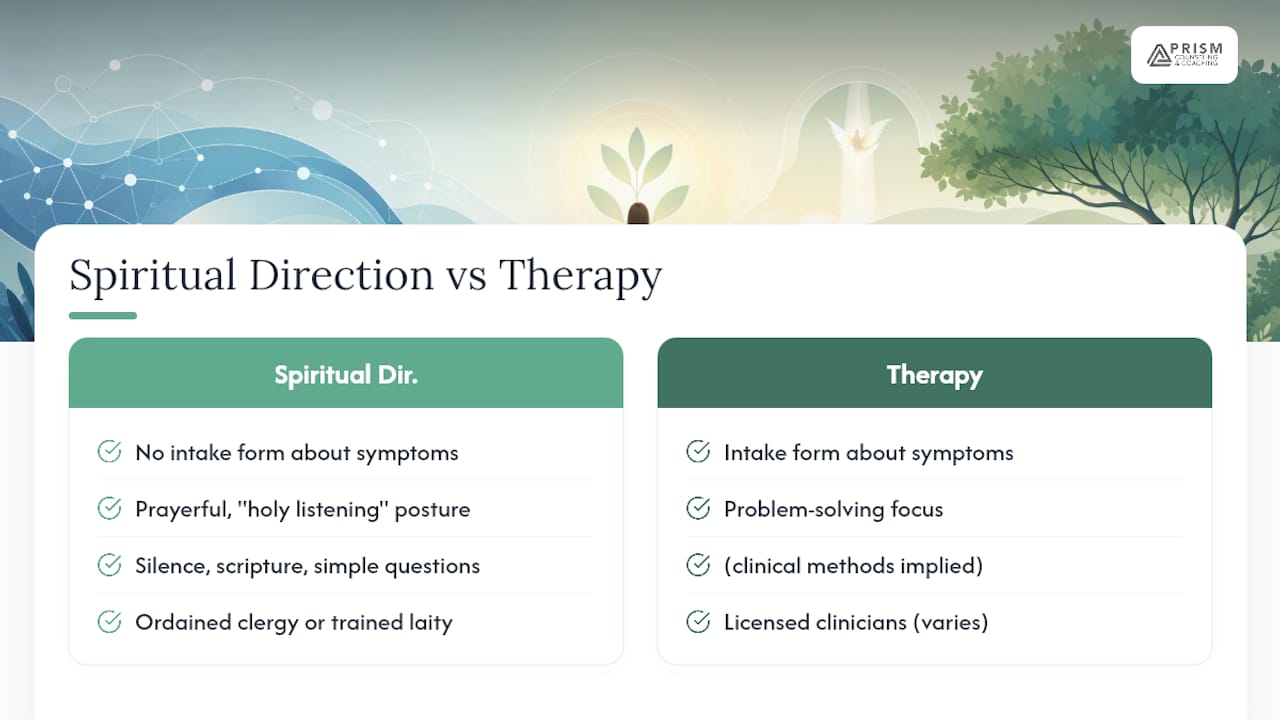
A spiritual direction session looks nothing like a therapy hour. There's no intake form asking about symptoms. Instead, you sit with someone trained in prayerful listening, and together you notice where God seems present in your recent days, your doubts, your longings. Directors describe this as "holy listening," a posture that's less about solving a problem and more about paying attention. Sessions often include silence, scripture, or simple questions meant to surface what the Spirit is already doing in you, supported by helpful methods from a topical Bible study guide that many spiritual directors recommend.
Providers range from ordained clergy to trained lay directors who've completed formation programs, though there's no single licensing body governing the field. Meetings tend to happen monthly, in a parish office, retreat center, or over coffee, and fees vary widely. Some directors work purely on donation, while others charge in the range of $50 to $100 per hour, often with a sliding scale available.
What Counseling Actually Treats
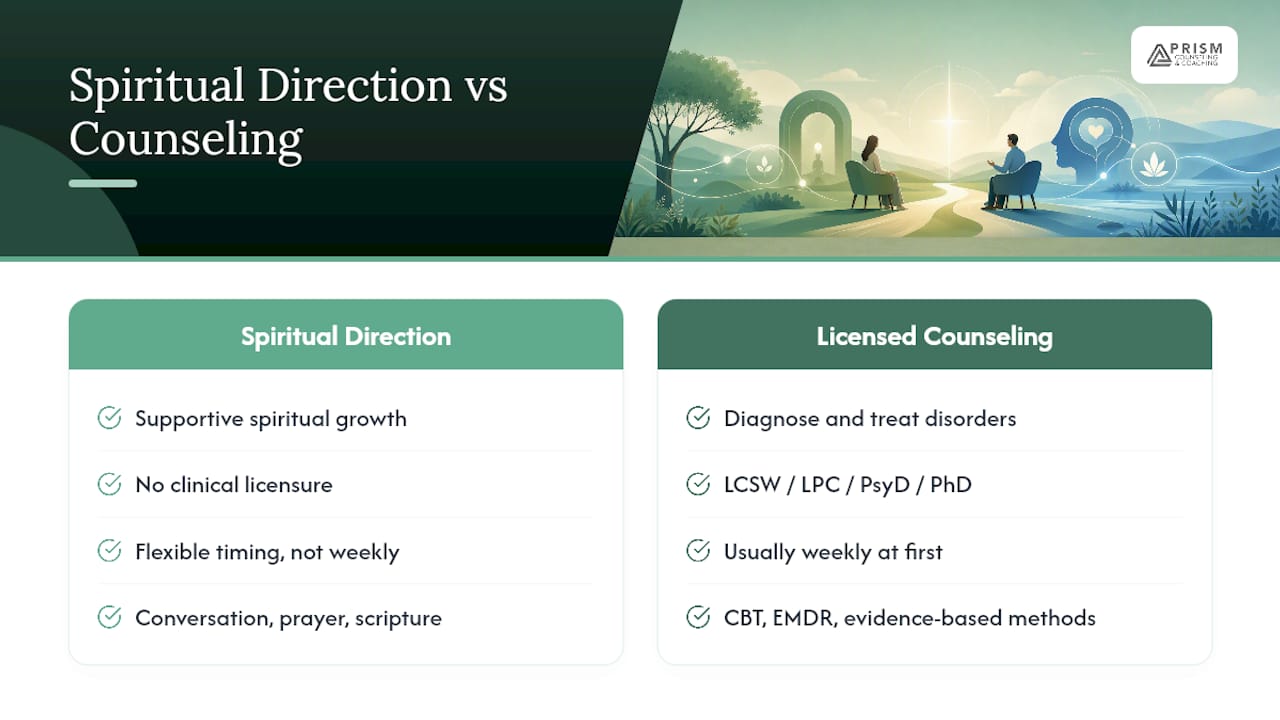
Counseling exists to diagnose and treat conditions that spiritual conversation alone can't resolve. A licensed clinician assesses your symptoms, may name a diagnosis such as generalized anxiety or PTSD, and applies methods with a research track record, like cognitive behavioral therapy or EMDR. Safety planning is part of the job when suicidal thoughts or self-harm are on the table.
Credentials matter here in a way they don't for spiritual direction. Look for an LCSW, LPC, PsyD, or PhD, all of which require graduate training, supervised hours, and state licensure. Sessions typically happen weekly, at least at the start, and many practices accept insurance while others operate private-pay with telehealth options. Faith-based practices blend this clinical rigor with religious resources: a spiritually integrated counselor can diagnose a mood disorder and still pray with you or reference scripture, if that's what you want in the room. That combination is worth understanding if you've been picturing counseling and Christian faith as separate lanes, our guide to Christian depression counseling walks through what that integration looks like in practice.
How Do You Know Which One You Need?
Some symptoms make the decision for you. If any of the following describe your week, counseling isn't optional, it's the safe next step:
- You've had thoughts of suicide or self-harm.
- Anxiety or depression keeps you from work, sleep, or relationships.
- You're experiencing flashbacks, panic attacks, or symptoms of trauma.
- Substance use has become hard to control on your own.
- You can't function through normal daily tasks.
On the other side, spiritual direction fits when you're stable but restless in your faith: a dry prayer life, a sense of God's silence, a major life transition like a career change or an empty nest, or simply a desire to discern God's direction more clearly. A comparison of the two paths notes that spiritual direction was never designed to carry clinical weight, and good directors know their limits.
Plenty of people do both at once. If you're seeing a therapist and a spiritual director simultaneously, give each written consent to talk to the other when safety is involved, and agree up front on who takes the lead if a crisis surfaces.
Pro Tip: Bring the same honesty to both rooms. A director who hears about panic attacks should point you toward counseling; a counselor who hears about a longing for deeper prayer might gently suggest direction. Neither should try to do the other's job.
Can Therapy and Spiritual Direction Work Together?
They can, and often should. Therapy handles the clinical wound; spiritual direction tends to the soul's formation, and neither replaces the other, according to guidance from Divine Mercy University. A therapist maintains clinical distance to stay objective. A director, by contrast, often prays alongside you during the session itself, a different kind of presence for a different kind of work, as one journal article on directive listening explains.
Coordinating the two well comes down to a few practical habits:
- Set written consent so your therapist and director can talk if a safety concern arises.
- Decide up front who leads if a crisis surfaces, usually the licensed clinician.
- Clarify confidentiality limits tied to mandated reporting so nothing surprises you later.
- Revisit the arrangement periodically. What you need at month one may shift by month six.
One insight worth sitting with: directors are trained to recognize when someone in front of them has moved from spiritual dryness into something clinical, and the honest ones refer out quickly rather than trying to counsel you through it themselves.
How to Find a Provider and What to Ask First
Start your search with language that matches what you actually need. For counseling, look for "licensed" plus your state, and for spiritually integrated practices, add "faith-based" or "Christian counseling." For spiritual direction, search for directors trained through a recognized formation program, since the field lacks the licensure structure clinical training requires.
Before booking, ask a few direct questions:
- What is your scope of practice, and what do you refer out?
- What training or supervision did you complete?
- What are your fees, and do you offer a sliding scale?
- Is telehealth available?
A first counseling session usually includes an intake assessment and some discussion of your history and goals. A first spiritual direction session tends to be quieter, more exploratory, and centered on your relationship with God rather than a checklist of symptoms.
Why I Push Back on the Either/Or Framing
Most guides treat this as a binary choice, and that framing undersells how these two disciplines actually interact. Clinically trained, faith-integrated therapists can hold both without confusion, because good therapy already leaves room for a client's beliefs. I've seen the pairing work best when the client picks a therapist and a director who both understand their own limits, one person doesn't try to be the whole care team, and both defer to licensed mental health care the moment safety is on the line.
— Tres
A Faith-Integrated Option for Clinical Care
If you've read this far and recognized yourself in the counseling column, faith-based counseling gives you both pieces at once: a licensed clinician trained to treat anxiety, depression, trauma, and relationship strain, who also respects and incorporates your beliefs instead of leaving them at the door.

Faith-based counseling services operating on a small, private-pay model can offer shorter wait times and personalized care, avoiding insurance-driven delays often seen in other settings. That matters if you've been putting off care because the usual path felt slow or impersonal. Our counselors integrate faith into evidence-based treatment rather than treating it as an afterthought, and that approach extends to couples work and broader spiritually integrated therapy models alike. If what you need is licensed, faith-aware clinical support, visit our faith-based counseling page to see current openings and book your first session.
Sources
- The intersection of spirituality and counseling (Cairn University blog)
- Chart comparing pastoral/spiritual care, spiritual direction, mental health counseling (UUMA)
- Spiritual direction and therapy: the glory of God is the human person fully alive (Divine Mercy University)
This article is general information, not a substitute for advice from a qualified doctor. Consult a qualified healthcare professional about your own circumstances before acting on anything here.
FAQ
What Happens in a Spiritual Direction Session?
You typically sit with a trained director in quiet reflection, discussing where you've sensed God's presence, often supported by scripture, silence, or open questions rather than clinical assessment.
What Does the Bible Say About Spiritual Direction?
Scripture doesn't outline a formal model, but it repeatedly shows mentors guiding others in discernment and prayer, a pattern many spiritual direction programs draw on directly.
Do You Pay for Spiritual Direction?
Yes, though norms vary widely: some directors work on donation alone, while others charge roughly $50 to $100 per hour, often with a sliding scale.
What Does Spiritual Direction Mean?
It means meeting regularly with a trained companion to notice and respond to God's movement in your life, distinct from counseling's focus on diagnosing and treating psychological conditions.
Can I See a Faith-Based Counselor Instead of Choosing Between the Two?
Yes. A spiritually integrated counselor holds a full clinical license and can treat diagnosable conditions while also incorporating prayer or faith at your request, which is the model Prism-counseling uses.