

Christian counseling can strengthen both your spiritual life and your mental health, especially if faith already shapes how you understand your struggles. Studies show it works comparably to standard therapy for anxiety and depression, with some clients settling into a trusting relationship with their counselor somewhat faster. It fits people who want their beliefs woven into treatment, not sidelined. It is not built to handle a crisis alone. If you are in danger or thinking about harming yourself, that calls for emergency or psychiatric care first.
TL;DR:
- Christian counseling enhances trust early in treatment, especially for highly religious clients seeking therapy that respects their faith and values.
- Evidence shows faith-integrated therapy performs as well as secular treatment for anxiety and depression, with some studies indicating faster initial progress.
- It offers targeted support for marriage, grief, and addiction recovery, particularly benefiting clients who view faith as central to understanding their struggles.
- Counselors should measure both spiritual growth and clinical progress, with urgent psychiatric care always prioritized in safety-risk situations.
- Availability of private, faith-based practices can provide quicker and more personalized care, but safety concerns always warrant referral to emergency services if needed.
Table of Contents
- What Are the Benefits of Christian Counseling?
- What the Research Shows About Outcomes and Limits
- Who Benefits Most From Faith-Based Therapy?
- How Counselors Actually Weave Faith Into Sessions
- How Prism Counseling & Coaching Puts This Into Practice
- Balancing Spiritual Growth With Measurable Progress
- Getting Faith-Integrated Help Through Prism Counseling & Coaching
- Sources
- FAQ
What Are the Benefits of Christian Counseling?
The word "benefits" covers a lot of ground here, so let us get specific about what actually changes for people who choose faith-integrated therapy over a purely secular approach.
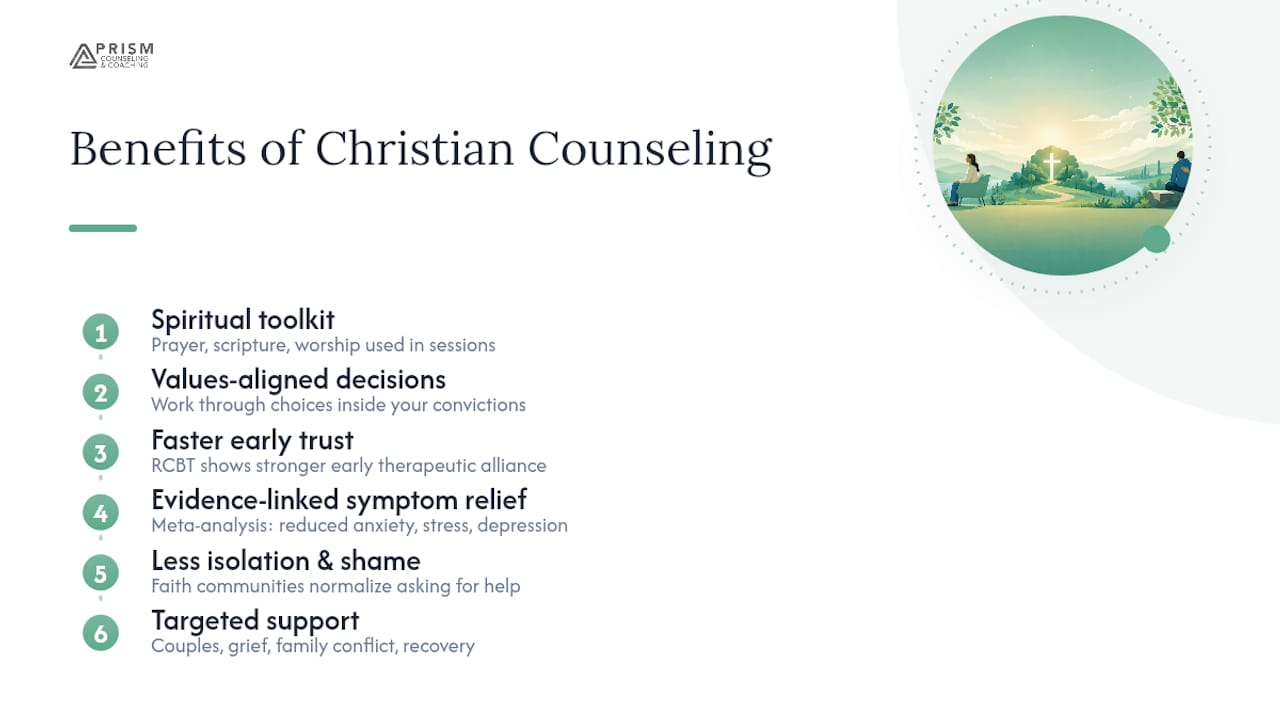
1. A spiritual toolkit for hard seasons. Prayer, scripture, and worship practices become working tools in session, not just personal habits you keep separate from therapy. A counselor might help you sit with a psalm of lament during grief instead of pushing you to "move past it" on a schedule.
2. Decisions that match your values. You are not asked to set aside your convictions to get help. Career choices, marriage struggles, and parenting questions get worked through inside the moral framework you already hold, not around it.
3. Faster early trust with your counselor. Research on religiously integrated cognitive behavioral therapy (RCBT) found a marginally stronger early therapeutic alliance when faith was part of the approach. Trust built early tends to predict better symptom improvement later, regardless of the treatment model.
4. Real, evidence-linked symptom relief. Christian counseling is not just spiritually comforting. A meta-analysis of randomized trials found significant effects on anxiety symptoms and measurable reductions in stress and depression, though results vary study to study.
5. Less isolation, less shame. Faith communities often normalize asking for help in a way that secular settings sometimes struggle to. That matters most for people who have quietly carried anxiety or depression for years, afraid that admitting it makes them look less faithful.
6. Targeted support for marriages, grief, and recovery. Faith-integrated approaches show particular promise for couples work, family conflict, and grief processing, and can support addiction recovery when paired with proper clinical treatment.
Pro Tip: Ask a prospective counselor how they'll track your progress. Spiritual growth and symptom relief are both real goals, and a good counselor measures both instead of assuming one guarantees the other.
What the Research Shows About Outcomes and Limits
The evidence is more nuanced than "faith cures everything" or "it's just a placebo," and you deserve the honest middle ground.
- Religious psychotherapy performs about as well as standard treatment across randomized studies, with some groups showing faster improvement early on but no significant difference from secular treatment by six months.
- A multi-level meta-analysis of 23 studies found moderate effect sizes for religious and spiritual treatments compared to standard care, with stronger benefits among patients who hold strong religious affiliation.
- Anxiety shows the most consistent improvement across studies, while depression results look promising but vary more from trial to trial.
The 2015 RCBT trial mentioned above is worth sitting with for a moment: the religious therapy group built trust with their counselor slightly faster, and that early trust predicted who improved most, whether they were in the religious or standard treatment arm. Faith fit may open the door faster. It does not replace the ordinary mechanics of good therapy: consistency, honesty, and a counselor who actually listens.
The practical takeaway is that Christian counseling works best as a values-congruent, complementary approach. Track your symptoms alongside your spiritual goals rather than assuming one substitutes for the other.
Who Benefits Most From Faith-Based Therapy?
Christian counseling tends to help most when your faith is not a side note in your life but a genuine lens you already use to interpret suffering, decisions, and relationships. If you have felt like secular therapy asked you to leave the most important part of yourself at the door, faith-integrated care may finally close that gap.
- Good-fit clients are usually highly religious, actively looking for therapy that respects that identity, and working through depression, anxiety, grief, or relationship strain rather than an acute psychiatric emergency.
- Red flags to watch for include a counselor who uses shame or guilt as leverage, treats doubt as sin rather than something to explore, or ignores clear safety risks in favor of "just pray about it."
- Screening questions worth asking before your first session: How do you handle it if my beliefs shift during treatment? What happens if I disclose thoughts of self-harm? Will you track clinical progress, not just spiritual growth?
- When to add clinical or psychiatric care, always, if there's active suicidality, substance intoxication, or safety risk. Faith-integrated therapy can run alongside psychiatric treatment. It was never designed to replace it, per SAMHSA guidance on coordinating faith and clinical support. A good-fit counselor will say this plainly, not dodge the question.
How Counselors Actually Weave Faith Into Sessions
Religiously integrated CBT, often called RCBT, takes the standard cognitive behavioral framework and layers scripture, prayer, and faith community directly into the exercises rather than treating them as separate from "real" treatment. Research on RCBT for depression shows it performs as well as secular CBT for religious clients, with faith serving as the engine for change rather than decoration around it.
In practice, that might look like:
- Scripture-based cognitive restructuring, where a distorted thought gets examined next to what your faith actually teaches about your worth
- Faith-motivated behavioral activation, like returning to a small group or serving at church as a structured way to fight depressive withdrawal
- Gratitude practices rooted in worship rather than generic journaling
- A spiritual coping plan you build alongside your counselor for the next hard season
Ethical practice means none of this gets forced on you. Informed consent, your right to say a particular scripture or practice does not fit right now, and standard symptom tracking should all sit alongside the CBT and Christianity work, not compete with it.
Pro Tip: A counselor who only talks about your faith and never asks about your sleep, your functioning at work, or your safety is missing half the picture. Good faith-integrated care measures both.
How Prism Counseling & Coaching Puts This Into Practice
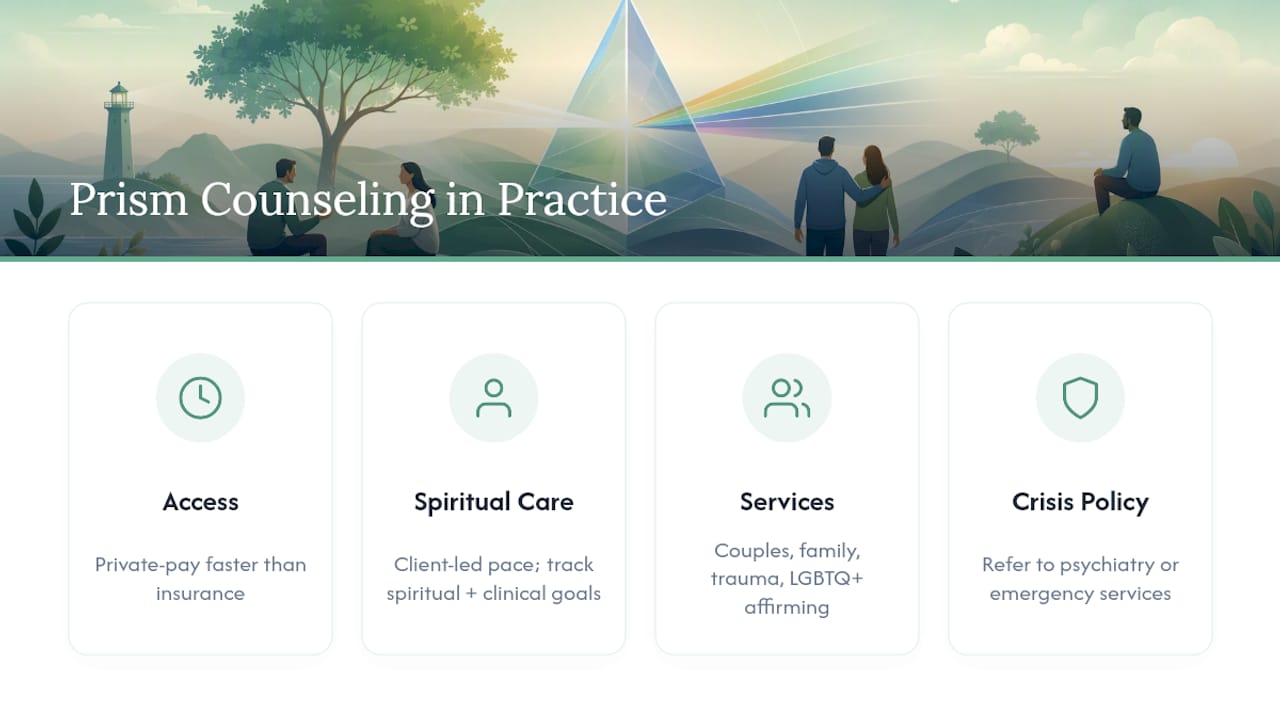
A faith-integrated practice can build care around this research rather than a generic template. Some small, private-pay practices offer more immediate openings than typical insurance-based scheduling, which can include waitlists.
Sessions can honor client autonomy by allowing beliefs to guide the pace and depth of spiritual integration, with counselors tracking clinical progress alongside spiritual goals. Services span Christian couples counseling, family work, trauma care, and LGBTQ+ affirming counseling for clients who want faith held with care rather than judgment. When a situation calls for psychiatric or emergency support, referral comes first.
Balancing Spiritual Growth With Measurable Progress
The honest takeaway from this research is that faith-integrated therapy earns its place, not as a replacement for clinical care, but as a genuine complement to it. What I'd ask any reader to hold onto is the balance: pay attention to whether you feel closer to God and to whether you're actually sleeping, functioning, and staying safe. A counselor who tracks both, and who refers out fast when safety is on the line, is doing this right.
— Tres
Getting Faith-Integrated Help Through Prism Counseling & Coaching
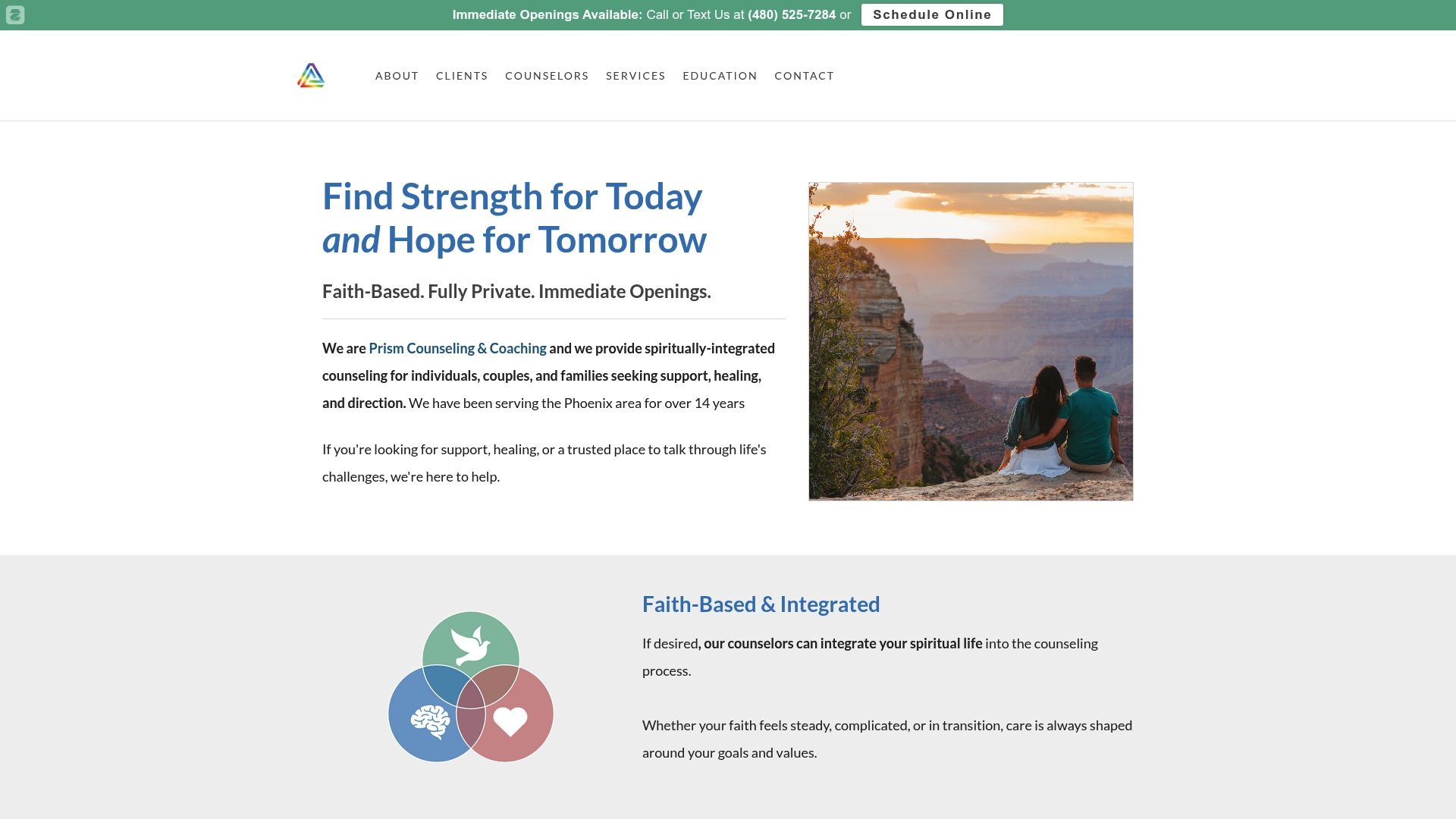
If you've read this far wondering whether counseling that respects your faith exists nearby, such services are available and may not involve long insurance-related wait times. Some private-pay counseling practices offer an alternative to the delay-heavy, insurance-driven models that many therapy practices use, possibly with openings available sooner.
A first contact typically starts with a short screening conversation about what brought you in, followed by an intake session where you and your counselor talk openly about how much faith integration you want and where your boundaries are. From there, sessions might focus on Christian depression counseling, trauma work, or marriage support depending on what you need. Explore faith-based counseling options or the Christian counseling services in Phoenix to see what fits, and reach out to schedule an intake. If you are in crisis right now, please contact emergency services or a crisis line before anything else. That comes first, always.
Sources
- Does religious psychotherapy improve anxiety and depression in religious adults: a review of randomized controlled studies - NCBI Bookshelf
- Effects of religious vs. standard cognitive behavioral therapy on therapeutic alliance: A randomized clinical trial
- Faith communities and disaster behavioral health - SAMHSA
This article is general information, not a substitute for advice from a qualified doctor. Consult a qualified healthcare professional about your own circumstances before acting on anything here.
FAQ
How Much Does a Christian Counselor Charge Per Hour?
Rates vary widely by practice, location, and whether the counselor works on a private-pay or insurance-based model. Prism Counseling & Coaching operates as private-pay, and current session pricing is listed directly on its faith-based counseling page.
What Does God Say About Counseling?
Scripture repeatedly encourages seeking wise counsel, with Proverbs describing wisdom found "in the multitude of counselors." Many Christian counselors see professional therapy as a practical extension of that biblical principle, not a departure from it.
Can I Be a Christian Counselor Without a Degree?
Licensed counseling generally requires a graduate degree and state licensure, regardless of faith integration. Some lay or pastoral counseling roles exist without formal clinical licensure, but they are not equivalent to licensed mental health treatment and typically cannot address clinical conditions like severe depression or trauma alone.
What Are the Four Types of Christian Counseling?
Definitions vary across practices, but common categories include pastoral counseling through a church, biblical or nouthetic counseling focused on scripture-centered correction, licensed Christian clinical counseling that blends clinical training with faith integration, and Christian life coaching focused on goals rather than clinical treatment. Licensed clinical counseling, like RCBT, carries the strongest research backing for treating anxiety and depression.
Does Christian Counseling Actually Work?
Randomized studies show religious psychotherapy performs about as well as standard treatment for anxiety and depression, with some clients showing faster early gains. It works best for people who are religiously committed and want their faith actively involved in treatment, not as a stand-alone response to a safety crisis.