
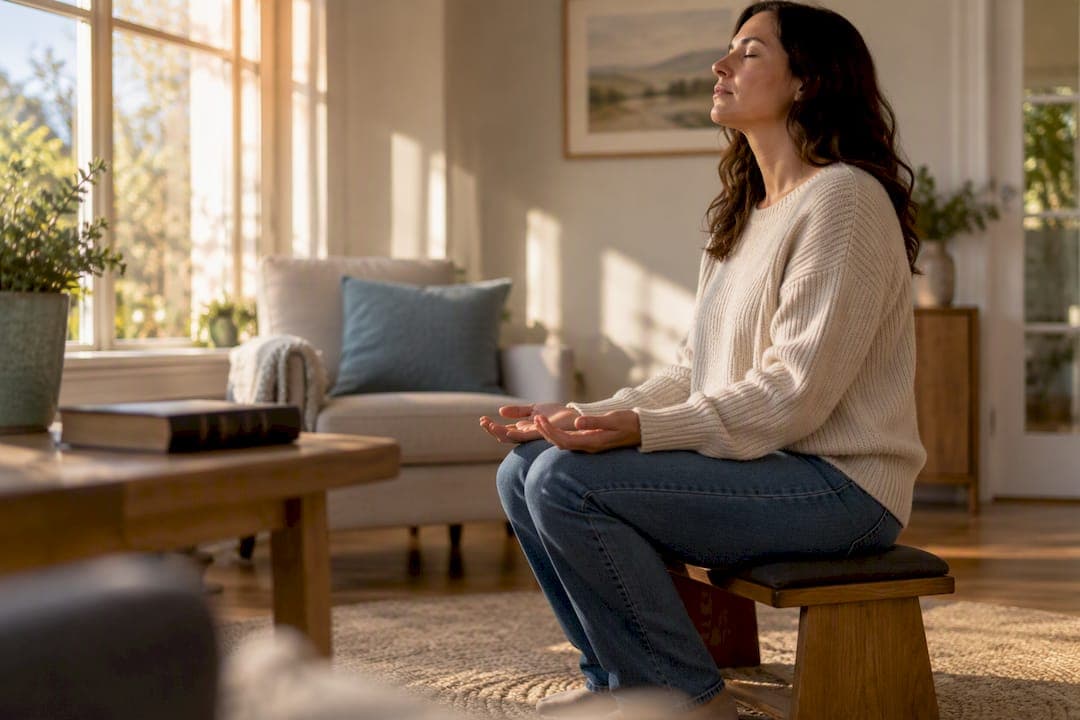
Christian meditation is a focused, often Scripture-based mode of prayer that quiets the mind toward God, while prayer is the wider, ongoing conversation with him that includes petition, praise, confession, and listening. Meditation lives inside prayer rather than beside it. What follows walks through the practices, the research behind them, and how to weave both into a daily rhythm without losing your footing.
TL;DR:
- Christian meditation, such as lectio divina or the Jesus Prayer, generally cultivates long-term spiritual growth, requiring consistent practice over weeks or months.
- Prayer functions as outward communication involving petition, praise, or listening, while meditation emphasizes inward reflection and often leads to wordless stillness.
- Practices like Centering Prayer or the Jesus Prayer are best maintained for at least two weeks to build familiarity and spiritual continuity.
- Research indicates that spiritual interventions, including Christian meditation, can lead to measurable decreases in anxiety, depression, and stress levels.
Table of Contents
- Christian Meditation vs. Prayer: A Side-by-Side Look
- The Main Styles of Christian Meditation and How to Practice Them
- Prayer's Many Forms and What Each One Is For
- What Research Says About Prayer, Meditation, and Mental Health
- How to Combine Prayer and Meditation in a Daily Routine
- How Faith-Integrated Counseling Uses Prayer and Meditation
- A Pastoral Note on Prudence and Experimentation
- Finding Support for Your Prayer and Meditation Practice
- Sources
- FAQ
Christian Meditation vs. Prayer: A Side-by-Side Look
Prayer is the relationship. Meditation is one way you enter it more deeply. That is the whole difference in a sentence, but it helps to see it laid out.
Prayer typically centers on petition, intercession, praise, and honest conversation with God. It moves outward, toward requests for a sick friend, gratitude after a hard week, or simply naming what is wrong. Christian meditation narrows the focus. It slows you down over a verse, a phrase, or a sacred word so that Scripture or God's presence has room to work on your thinking.
- Function: prayer relates and requests; meditation reflects and reshapes.
- Methods: prayer includes vocal prayer, intercession, and the Lord's Prayer; meditation includes lectio divina, Centering Prayer, and the Jesus Prayer.
- Mental stance: prayer is conversational, sometimes urgent; meditation is settled, sometimes wordless.
- Outcomes: prayer often brings immediate comfort or clarity on a decision; meditation builds formation over weeks and months, occasionally opening into contemplative stillness.
A systematic review and meta-analysis found that religious and spiritual interventions, Christian meditation among them, produced measurable drops in anxiety, depression, and general stress, with benefits still visible one to six months later. That is not a small claim. It suggests these practices are doing something real in the body and mind, not just offering a nice feeling in the moment.
The Main Styles of Christian Meditation and How to Practice Them
Christian meditation is not one technique. It is a family of practices, each with its own rhythm and its own way of pointing you toward Christ.
- Lectio Divina. You read a short Scripture passage slowly, meditate on a word or phrase that catches you, pray in response, and rest in contemplation if it comes. The sequence, read, meditate, pray, contemplate, gives you a usable template for even a ten-minute devotional block.
- Ignatian Imaginative Prayer. You place yourself inside a Gospel scene, picturing the sights, sounds, and people, then let the encounter surface questions or feelings you bring back to God in prayer. It works well for readers who process faith through story rather than abstraction.
- Centering Prayer. You choose a one or two syllable sacred word, sit quietly with it, and gently return to it whenever your mind wanders. Contemplative Outreach describes the method as preparation for contemplative prayer rather than a replacement for it, aimed at cultivating receptivity instead of analysis.
- The Jesus Prayer. Rooted in Eastern Orthodox hesychasm, this practice repeats a short phrase, commonly "Lord Jesus Christ, Son of God, have mercy on me," in rhythm with the breath. Some traditions recommend practicing a sacred word twice daily for around 25 minutes, based on guidance from the World Community for Christian Meditation, though shorter sessions still carry value for beginners.
Pro Tip: Pick one method and stay with it for two weeks before switching. Christian meditation rewards repetition more than variety, and jumping between styles too fast often feels like starting over each time.
Prayer's Many Forms and What Each One Is For

Prayer covers more ground than most people realize, and each form serves a different purpose in daily life.
Vocal prayer, spoken aloud or in your head, handles the moments that need words: asking God for help before a hard conversation, thanking him after good news, or praying over a meal. Intercessory prayer, praying on behalf of someone else, carries the weight of community, a sick parent, a struggling friend, a nation in crisis.
- Conversational or listening prayer asks you to wait after you speak, giving God room to bring a thought, a memory, or a verse to mind rather than filling every silence yourself.
- Scripture-led listening pairs a passage with quiet attention, letting the text prompt what you bring back to God.
- Contemplative prayer sits at the far end of the continuum, wordless and receptive, often reached only after meditation has done its slow work.
- Petitionary prayer remains the go-to for urgent needs, moral decisions, and requests raised on behalf of others.
Prayer functions as two-way communication with God, according to the United Methodist Church's own teaching on the subject, while meditation operates as a structured reflective process that deepens knowledge of Christ and can itself function as a form of mental prayer. Neither replaces the other. They handle different jobs.
What Research Says About Prayer, Meditation, and Mental Health
Believers have claimed spiritual and emotional benefits from prayer and meditation for centuries. Recent research gives some of that experience a measurable shape, though the picture is more mixed than headlines suggest.
The clearest signal comes from the 2015 systematic review already mentioned, which found statistically significant reductions in anxiety and depression symptoms tied to religious and spiritual interventions. A separate 2024 randomized controlled trial involving 702 participants compared religiously framed Centering Prayer against a secular version of the same technique over 28 days. The religious framing increased reported spiritual and mystical experiences, but it produced no clear long-term advantage on general well-being over the non-religious version. Framing shapes what you feel spiritually more than it shapes overall flourishing.
- Neuroscience research suggests prayer engages social cognition networks tied to attachment processing, which may explain why prayer helps regulate emotion for many people.
- A broader review of contemplative practices found mixed results across studies, with outcomes depending heavily on practice fidelity and religious context.
- Compliance measurement remains a weak point across this research; self-reported practice is not the same as verified practice.
None of this proves prayer or meditation cures anxiety on its own. It does show these practices are doing something worth taking seriously, both spiritually and physiologically.
How to Combine Prayer and Meditation in a Daily Routine
You do not need to choose one practice over the other. A workable rhythm usually braids both together.
- Open with vocal prayer. Two or three minutes of spoken prayer, gratitude, confession, a simple request, settles your attention before anything else.
- Move into lectio divina or Centering Prayer for five to fifteen minutes. Read a short passage slowly or sit with a sacred word, letting your mind settle rather than race.
- Close with prayer again. Bring whatever surfaced, a phrase, a conviction, a question, back to God in your own words.
- Use micro-practices for busy stretches. A single breath prayer ("Jesus, have mercy") or repeating one Scripture phrase while driving or waiting in line keeps the rhythm alive without a dedicated block of time.
Decide by function, not preference. If you need clarity on a decision or comfort in a crisis, pray. If you want ongoing formation, listening, and a quieter mind, meditate. Watch for one pitfall: secular mindfulness aims to empty the mind, while biblical meditation aims to fill it with Scripture, pondering, personalizing, and practicing God's Word rather than clearing thought altogether.
Pro Tip: If a meditation practice ever brings up distress, unresolved trauma, or spiritual confusion rather than peace, that is a signal to talk with a pastor or counselor, not a reason to push through alone.
How Faith-Integrated Counseling Uses Prayer and Meditation
Faith-integrated counselors do not treat prayer and meditation as decoration on top of therapy. They use them with intention, always with a client's consent, and only when clinically appropriate for the issue at hand.
That balance matters. Formation-focused practices like lectio divina support long-term spiritual growth, while symptom-focused techniques like EMDR address trauma directly. Good counseling knows which tool fits which moment.
- Sessions may open with a short prayer if a client requests it and it fits the clinical goal.
- Spiritual direction and counseling can run alongside each other for clients wanting both formation and symptom relief.
- Clients can simply say, "I'd like to include prayer or Scripture reflection in our work together," and a faith-based counselor will build from there.
A Pastoral Note on Prudence and Experimentation
Prayer and meditation are not competing disciplines. They are companions, and the tension between them is often less theological than it feels in the moment.
What strikes me most in the research and the tradition alike is how much diversity exists within orthodox Christian practice, from silent Centering Prayer to loud, spoken petition, and how little that diversity threatens sound faith. Try a method for a few weeks before judging it. If a practice ever leaves you more confused than closer to God, that is worth bringing to a trusted pastor, spiritual director, or counselor rather than sorting out alone.
— Tres
Finding Support for Your Prayer and Meditation Practice
Faith-based counseling services provide personal support to work through issues like anxiety, grief, or spiritual dryness that meditation alone may not resolve. Some private-pay practices with small caseloads offer new client openings within days, avoiding the longer waits common with insurance-based counseling.
If persistent anxiety, trauma, or a spiritual crisis is behind your struggle to pray or meditate well, that calls for more than a new technique. Prism-counseling's faith-based counseling and spiritual direction services integrate Scripture, prayer, and clinical care in the same room, and sliding-scale options keep cost from being the barrier that keeps you from starting. A Standard 50-Minute Session runs $195, with sliding-scale appointments available for clients who need them. Reach out this week and ask about the next available opening.
Sources
- Ask The UMC — What is the difference between prayer and meditation?
- PubMed — Systematic review/meta-analysis on spiritual interventions (2015)
- PubMed — RCT of Centering Prayer (2024)
- Contemplative Outreach — Method of Centering Prayer (pdf)
- Bible Gateway — What is biblical meditation?
FAQ
Did Jesus Pray or Meditate?
Jesus prayed constantly throughout the Gospels, often withdrawing to solitary places before dawn or spending nights in prayer before major decisions. Scripture does not describe him practicing meditation as a separate discipline, but his pattern of quiet withdrawal and Scripture-saturated speech reflects the same reflective posture Christian meditation aims to cultivate.
What Did Jesus Say About Meditation?
Jesus never used the word "meditation" directly, but he modeled reflective, Scripture-filled prayer and repeatedly urged private, undistracted communication with God, as in his teaching on going into a room and shutting the door to pray. His emphasis on quiet, focused attention to the Father lines up closely with what Christian meditation practices today.
Is It Better to Pray or Meditate?
Neither is better; they serve different purposes. Prayer handles conversation, petition, and urgent need, while Christian meditation deepens reflection and formation, and most mature devotional lives include both rather than choosing one over the other.
Should Christians Use Meditation?
Yes, when it stays Scripture-centered and Christ-focused rather than borrowing a secular, thought-emptying approach. Practices like lectio divina and Centering Prayer have deep roots in Christian tradition and, according to research on religious interventions, can support both spiritual formation and measurable reductions in anxiety and stress.
Can You Meditate and Pray in the Same Sitting?
Yes, and many devotional routines are built exactly this way. A common pattern opens with vocal prayer, moves into five to fifteen minutes of lectio divina or Centering Prayer, and closes with prayer again to bring whatever surfaced back to God.