
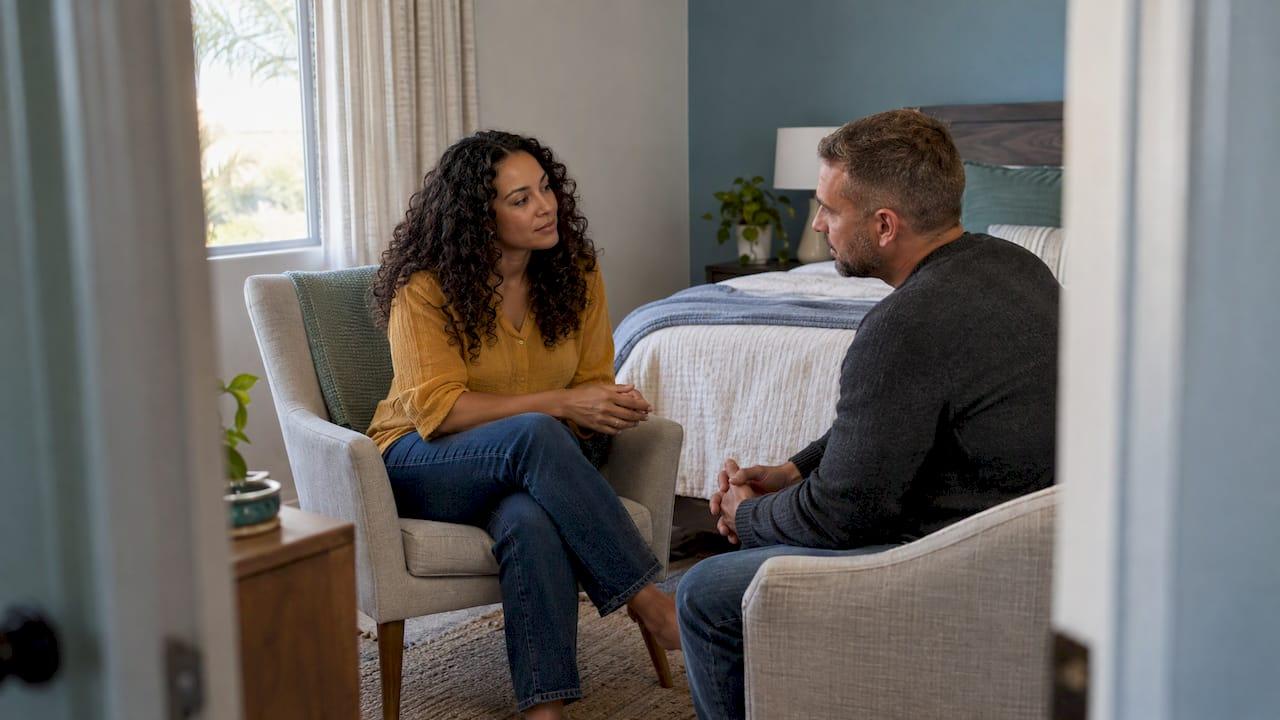
If you are in a sexless marriage and you love God, you may be carrying two kinds of pain at once: the ache of distance from your spouse, and the quiet worry that your faith should have prevented this. It did not fail, and neither did you. Most sexless marriages have a cause that can be named, whether physical, emotional, spiritual or a mix, and most couples can begin to move toward each other again once they can talk about it safely. At Prism Counseling & Coaching, we sit with Christian couples and individuals in Phoenix who are in exactly this place, and we want you to know that hope is realistic.
TL;DR
- A sexless marriage is not a verdict on your faith or your love. It is usually a signal that something physical, emotional or spiritual needs attention.
- Scripture speaks of marital intimacy as mutual care, never as pressure or a debt to be collected.
- Common contributors include pain during sex, hormonal changes, medications, depression, anxiety, stress, unresolved hurt and sexual shame.
- Talking about it with tenderness and without blame is the first step. A doctor and a faith-integrated counselor can each help with their part.
- Our practice offers private-pay counseling with openings within days, so you do not have to wait months to begin.
Table of Contents
- What a sexless marriage actually means
- What God says about sex in marriage
- Why Christian marriages go quiet
- How to talk about it without blame
- Small steps that rebuild closeness
- When to seek help, and from whom
- Our perspective
- Starting counseling with us
- FAQ
- Sources
What a sexless marriage actually means
There is no single definition. Researchers often use a rough line of sex about ten times a year or fewer, but the number matters less than the experience. A marriage feels sexless when physical intimacy is much less than one or both spouses hoped for, the gap has lasted a long time, and it has begun to hurt.
That matters because couples differ. For one pair, once a month is peaceful. For another, it is a wound. Another common pattern is a mismatch: one spouse longs for closeness and keeps reaching out, while the other feels pressured, tired, ashamed or simply absent. Over time, the one who reaches feels rejected, the one who withdraws feels guilty, and both go quiet.
If that sounds familiar, you are not alone, and you are not the first believer to feel this way. Many Christians wait years to say it aloud because it feels private, embarrassing or disloyal. Saying it is where healing begins.

What God says about sex in marriage
The passage most often quoted is 1 Corinthians 7:3-5. In the NIV translation, Paul tells spouses to fulfill their marital duty to one another and not to deprive each other, except by mutual consent and for a time, so they can devote themselves to prayer. Then they are to come together again.
Some readers hear this as a rule that leaves them feeling guilty or obligated. Others hear it as a charge against a withholding spouse. Read gently, it says something more tender. Husband and wife belong to each other in a way that is shared. The NLT wording of verse 4 says each spouse gives authority over their body to the other. That is a picture of mutual surrender and mutual care, where neither spouse takes and neither is taken from.
Three things follow from this passage:
- Intimacy is shared. It is something a couple tends together, not something one person demands or the other grants.
- Pauses are agreed on. The text allows a season of abstaining only by mutual consent, and with a purpose and an end.
- Reconnecting is the goal. Paul says to come together again. He is describing a marriage that keeps moving toward closeness.
Nothing here tells a hurting spouse to endure pain or to ignore a medical problem. It does not tell the other spouse to feel ashamed for struggling. Love in Scripture is patient and kind, and that includes the bedroom.
If you want to read more on how faith and closeness can grow together, we wrote about Christian marriage intimacy and a biblical path to real connection.
Why Christian marriages go quiet
The causes are rarely one thing. They tend to fall into four groups, and many couples have more than one.
Physical causes
Pain is a common and often unspoken reason someone pulls away. The American College of Obstetricians and Gynecologists says that pain during sex can come from gynecologic conditions such as endometriosis, ovarian cysts, skin disorders, vaginitis or pelvic inflammatory disease, and from hormonal changes such as vaginal dryness around menopause. Dryness can also follow childbirth or perimenopause, and some antidepressants can dry vaginal tissue.
Desire itself can be affected too. An expert consensus review in Mayo Clinic Proceedings describes hypoactive sexual desire disorder, distressing low desire, as affecting roughly 10% of adult women, and links it with depression, anxiety, thyroid disease and other health problems. Men can experience their own changes in desire and function, and these deserve a medical conversation as well.
If intimacy is painful, please do not treat it as a spiritual failing or something to push through. It is a health matter, and it is worth taking to a doctor.
Emotional causes
Resentment, unresolved arguments, a betrayal, a hard season of parenting, a long illness or grief can all close the door to physical closeness. Many people cannot feel desire for someone they feel unseen by. Depression and anxiety are often part of the picture, and so are exhaustion and chronic stress.
Spiritual and shame-related causes
Many of us grew up hearing very little about sex in church except warnings. When a person has absorbed years of messages that desire is dangerous or dirty, the wedding day does not switch those messages off. Shame can follow someone into marriage, and so can past experiences, including purity culture teaching, pornography use or abuse. Our article on sexual shame and faith walks through this path to healing in more detail.
For some couples, there are also deeper questions of identity or orientation inside the marriage. We address that sensitively in mixed orientation marriage counseling for Christian couples.
Relational patterns
When one spouse pursues and the other withdraws, the pattern can feed itself. The more one asks, the more the other pulls back, and the more the other pulls back, the more rejected the first feels. Neither is the villain. Both are protecting themselves.
How to talk about it without blame
The conversation is usually the hardest part, and the way you open it matters more than the words. A meta-analysis in the Journal of Family Psychology found that sexual communication is linked with both relationship satisfaction and sexual satisfaction, and that the quality of the communication showed stronger links than how often couples talked or how much they disclosed. In other words, a gentle, honest conversation helps more than many rushed ones.
Here is a pattern many couples find workable:
- Choose the moment. Not in the bedroom, not after an argument, not when one of you is exhausted. A walk or a quiet evening can work better.
- Begin with love, not a complaint. "I miss you, and I want us to be close" lands differently than "You never want me."
- Speak for yourself. Describe how you feel rather than what your spouse is doing wrong.
- Ask, then listen. "What has this been like for you?" is a question that can open a lot. Resist the urge to defend yourself.
- Name what is not the problem. Reassure your spouse that you are not asking for perfection or measuring their worth.
- Agree on one small next step. A doctor visit, a regular time to pray together, more physical affection that carries no expectation, or a first counseling session.
If conversations keep turning into fights, our guide to Christian marriage communication in three steps gives you something to try tonight. When trust has worn thin, Christian relationship boundaries can help you set expectations kindly.
A reminder for the spouse who feels they are the one wanting more: focus first on tenderness. Pressure rarely produces closeness. And for the spouse who feels they are the one pulling away: your feelings are information, not a failing. Naming them honestly is an act of love.
Compassion for one another also shapes the atmosphere in which closeness can return. Some couples find it useful to read broadly about energy healing for relationships as one way of thinking about care for the connection between two people, alongside prayer and counsel.
Small steps that rebuild closeness
Before intimacy returns, safety usually does. These steps are small on purpose.
- Pray together briefly. Even two minutes, holding hands. Many spouses feel closer after praying aloud for one another. Our article on deepening faith and intimacy in four weeks offers a gentle weekly structure.
- Bring back non-sexual touch. Hugs, a hand on the back, sitting close while watching a show. When touch is not a request, it becomes safe again.
- Ask for what you need, plainly. Many couples have never said what feels good, what hurts or what they fear.
- Take care of the body. Rest, movement and a medical check-up all affect desire.
- Be patient with timing. Trust can take weeks or months to return. That is normal.
- Forgive as you are able. Bitterness is heavy to carry into a marriage. Forgiveness does not mean the hurt did not matter. It means you are choosing not to let it rule the relationship.
When to seek help, and from whom
Different kinds of help serve different parts of the problem. Most couples benefit from more than one.
| What you notice | Who can help |
|---|---|
| Pain during sex, dryness, or other physical symptoms | A doctor or ob-gyn |
| Low mood, anxiety, trauma, or heavy stress | A counselor or therapist, with a doctor for medication questions |
| Repeated arguments, silence, or resentment | Couples counseling |
| Shame, guilt or confusion about sex and faith | Faith-integrated counseling for the individual or the couple |
| Spiritual dryness or questions about God | A pastor, spiritual director or faith-based counselor |
On the medical side, ACOG advises seeing an ob-gyn if irritation and pain during sex do not improve after two months of using moisturizers and lubricants, or sooner if there are other symptoms. If you are taking an antidepressant or another medication and notice a change in desire, please speak with the prescribing doctor before changing anything yourself.
On the emotional and spiritual side, you do not need to wait until things are at a breaking point. Counseling works best when a couple still has some goodwill left, and it also helps when goodwill feels very thin. If you feel hopeless, or if there is abuse, betrayal or thoughts of harming yourself, please reach out to a counselor, a doctor or, in an emergency, call 988 or 911 right away.
Our perspective
We have sat with many couples who believed they were the only believers in a quiet marriage. They were not, and neither are you.
What we have learned is that the best place to begin is not the bedroom. It is the story each spouse is telling themselves. One says, "I am unwanted." The other says, "I am failing." Both are hurting, and both are loyal to the marriage in their own way. Faith can hold both of those truths together.
That is why we believe in counseling that does not ask you to set your faith aside. Your beliefs about marriage, prayer, forgiveness and the body are not obstacles to therapy. They are part of what gives it meaning. When a counselor understands that, you can speak honestly about desire, shame and disappointment without fearing you will be judged.
Because we are a small, private-pay practice, we can offer openings within days instead of months, and the privacy many couples need when the subject feels so tender. For anxiety, depression, trauma and grief, which so often sit underneath intimacy struggles, our counselors also offer EMDR.
"Come to me, all you who are weary and burdened, and I will give you rest." (Matthew 11:28)
Tres
Starting counseling with us
If you are ready to talk with someone, we offer couples counseling for spouses who want to rebuild closeness, and individual counseling if you would like to begin on your own, which is often the right first step when your spouse is not yet ready. Our approach is faith-based and spiritually integrated, so your beliefs guide the work instead of being set aside. We have served the Phoenix area for over 14 years.

A standard 50-minute session is $195, and our sliding scale appointments range from $100 to $165. You can see everything on our rates page, and when you are ready, you can start here. We are private-pay, which is how we keep openings available within days.
FAQ
What does God say about a sexless marriage?
Scripture does not use that phrase, but 1 Corinthians 7:3-5 speaks directly to marital intimacy. It describes spouses belonging to one another, pausing only by mutual agreement and for a season of prayer, and then coming together again. The spirit of the passage is mutual care, not pressure or shame.
Is a sexless marriage grounds for divorce in the Bible?
This is a question that deserves personal pastoral and counseling guidance, because it touches your convictions, your church tradition and your own story. Most couples we hear from are not looking for an exit. They are looking for a way back to each other. We encourage you to seek counseling before making any decision, and to talk with a pastor you trust about your conscience.
How can a Christian couple deal with a sexless marriage?
Start with a gentle, honest conversation, and rule out physical causes with a doctor. Then address the emotional and spiritual layers, such as resentment, stress and shame, ideally with a counselor who respects your faith. Small, steady steps usually work better than a single dramatic effort.
What can I do if my spouse refuses to go to counseling?
You can still begin on your own. Individual counseling helps you understand your own feelings, communicate more calmly and decide how to invite your spouse in. Many spouses become more willing when the invitation comes without blame.
Sources
- 1 Corinthians 7:3-5 (NIV), Bible Gateway
- 1 Corinthians 7 (NLT), Bible Gateway
- When Sex Is Painful, ACOG
- Experiencing Vaginal Dryness? ACOG
- Hypoactive Sexual Desire Disorder, Mayo Clinic Proceedings
- Sexual communication meta-analysis, Journal of Family Psychology