
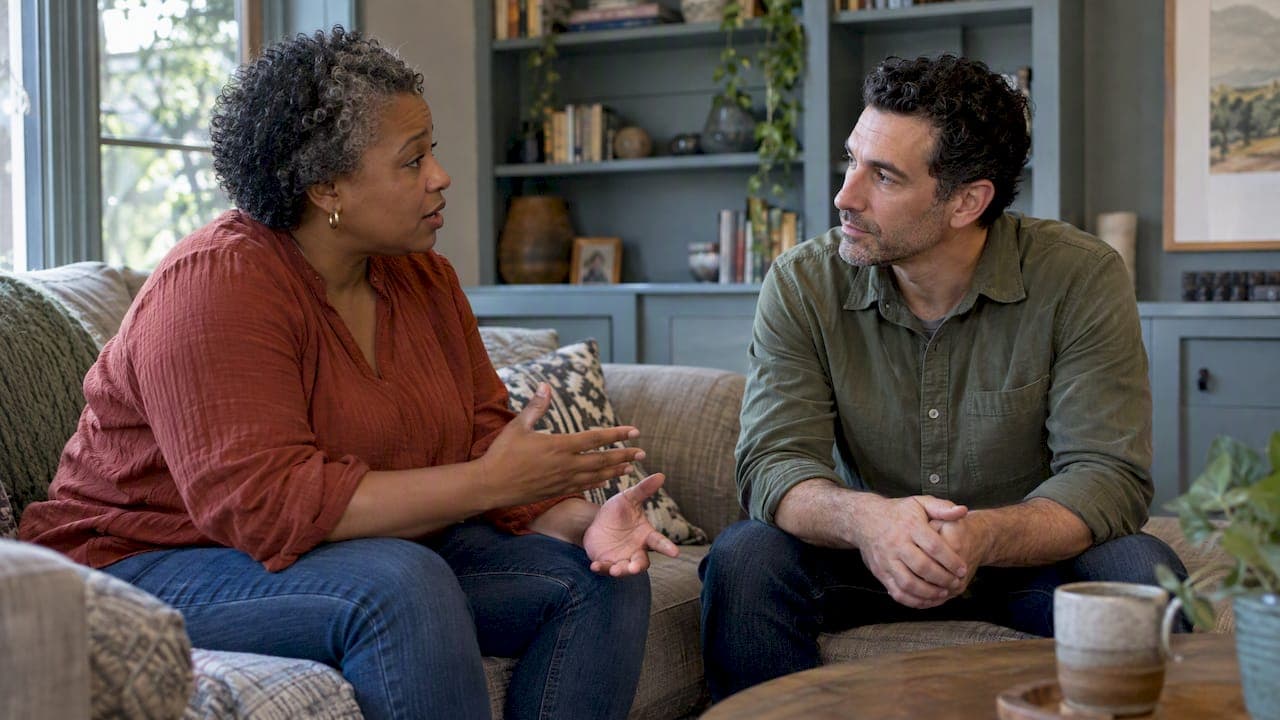
If one of you is straight and the other experiences same-sex attraction, or if one of you has far more or far less desire than the other, you are not alone, and you are not beyond help. Good mixed orientation marriage counseling gives both spouses a safe place to tell the truth, grieve what hurts, and decide together what comes next, without pressure toward any predetermined outcome. For Christian couples, the best counseling also makes room for your faith instead of asking you to set it aside.
TL;DR
- A mixed-orientation marriage is a marriage in which spouses' sexual or romantic orientations differ. A desire mismatch is a different thing, though the two can overlap.
- Counseling works best when it treats the couple as a team, protects both spouses' dignity, and does not push either of you toward a set result.
- Professional organizations have discredited efforts to change sexual orientation, so look for a counselor who supports acceptance, coping, and honest exploration.
- Look for a therapist who is both affirming and respectful of your faith. You should not have to choose.
- Our standard 50-minute session is $195, with a sliding scale of $100 to $165 available, and openings are often available within days.
Table of Contents
- What a mixed-orientation marriage is, and what it is not
- Why couples seek counseling
- What good counseling does
- A safety point: counseling should never try to change orientation
- What to look for in an affirming, faith-respecting therapist
- Approaching a desire mismatch without shame
- When couples therapy, individual therapy, or peer support fits
- Our perspective
- Counseling with us
- Frequently asked questions
- Sources
What a mixed-orientation marriage is, and what it is not
A mixed-orientation marriage, often shortened to MOM, is a legally recognized marriage between partners whose sexual or romantic orientations differ. The most common picture is a straight spouse married to a spouse who experiences same-sex attraction. It can also describe a marriage between a partner who experiences sexual attraction and a partner who is asexual, as one explainer on mixed-orientation relationships describes it.
Researchers use the terms with some care. A 2016 peer-reviewed review titled "From MOM to MORE" defines a mixed-orientation relationship as one where partners' orientations do not match. Mixed-orientation marriage is the narrower form, historically studied most often where one spouse is heterosexual and the other experiences same-sex attraction, whether or not that spouse identifies as lesbian, gay, or bisexual. A 20-year review of studies published from 1988 through 2008 shows how long this has been a subject of serious research.
How it differs from a desire mismatch
Many couples searching for help are really asking about a different question: one of us wants intimacy more often than the other. Researchers define sexual desire discrepancy as one partner experiencing more or less sexual desire than the other. That happens in nearly every long marriage, and it can exist whatever either spouse's orientation is.
The two situations can overlap. A spouse who has always felt little desire for the other may be quietly wondering why. A spouse who has just disclosed same-sex attraction may also be dealing with changes in intimacy. A good counselor helps you sort which story is yours instead of assuming. Sometimes it is one, sometimes both, and sometimes neither fully fits.
"Carry each other's burdens, and in this way you will fulfill the law of Christ." (Galatians 6:2)
Why couples seek counseling
Couples rarely arrive because everything is calm. Common starting points include a disclosure that was kept for years, a discovery that came before the conversation was ready, a long season of distance in the bedroom, or a faith community that left one spouse feeling judged and the other feeling invisible.

Researcher Amity Buxton, writing in the Journal of Bisexuality, noted that couples in these marriages tend to move through common stages of adjustment, and that effective counseling can help them move toward greater individual strength and mutual understanding. We find that a helpful framing for the people who sit on our couches. The shock, the grief, the anger, and the confusion are not signs that something is wrong with you. They are part of a process.
Here are the feelings we hear most often:
- The straight spouse may feel rejected, deceived, or unsure whether the marriage was ever "real." It was real to you, and your pain deserves to be heard.
- The spouse who experiences same-sex attraction may feel shame, fear of losing the family, and exhaustion from carrying a secret or from trying to meet expectations that never fit.
- Both spouses may feel afraid of how church friends, parents, or children will react.
- Both spouses may grieve the future they imagined.
"Be completely humble and gentle; be patient, bearing with one another in love." (Ephesians 4:2)
What good counseling does
Counseling cannot decide for you whether to stay together, restructure the marriage, or part. It can give you the room, the language, and the steadiness to make that decision well. In practice, that usually includes four kinds of work.
Making it safe to tell the truth
The first goal is a conversation where neither spouse is attacked or managed. That often means individual sessions alongside couple sessions, so each person can say what they cannot yet say with the other in the room. If you want a head start on the daily habits of talking and listening, our guide to Christian marriage communication offers three steps you can try at home.
Working on the relationship as a team
The research on desire differences is encouraging here. A 2020 study of 229 participants identified five broad ways partners respond to desire discrepancy, and strategies the partners used together were associated with higher sexual and relationship satisfaction than strategies used alone. The same study notes that desire naturally rises and falls, and that partners are unlikely always to be in sync. Talking openly about what you each do about it matters.
The European Society for Sexual Medicine's position statement, which rests mainly on expert opinion, points the same direction. It suggests normalizing variation in desire, treating it as a shared matter, promoting open sexual communication, and helping partners build sexual "scripts" that satisfy both. It also frames desire discrepancy as a relational process shaped by culture, power, and personal meaning, not an individual disorder to be fixed. For couples who carry shame about intimacy, that framing alone can lower the temperature in the room.
Exploring identity and faith together
For Christian couples, the hardest conversations are often about how orientation and belief fit together. A peer-reviewed Social Work study of 27 lesbian and gay Christians identified several qualities that helped when clients were integrating sexual orientation and Christianity: the practitioner's historical perspective, self-awareness, nonjudgment, expanded definitions, and careful attention to language. Those are good things to look for in any counselor you consider.
Psychologist Mark Yarhouse's Sexual Identity Therapy framework, described in his book Sexual Identity and Faith, aims for congruence: freely adopting an identity and living it in keeping with your own beliefs and values. The key word is freely. Congruence is something a person arrives at, not something a counselor or a spouse assigns.
If these questions are live for you, our articles on how Christians reconcile faith and sexuality and on trauma-informed affirming Christian counseling may help you think about what you want from a counselor.
Planning what comes next
Some couples recommit and rebuild with new honesty. Some redesign the shape of their marriage. Some decide to separate with care, especially when children are involved. A counselor's job is to help you reach whichever path with integrity, clear agreements, and as little cruelty as possible. The path itself belongs to you.
A safety point: counseling should never try to change orientation
This is the most important thing to check before you book anyone. The APA Dictionary of Psychology states that sexual orientation and gender identity change efforts have been discredited by professional organizations and commonly use psychosocially harmful techniques. The same entry says appropriate therapy should support acceptance, coping, social support, and identity exploration without imposing a required sexual-orientation outcome.
In practical terms, ask any prospective counselor directly:
- Do you work toward a set outcome for either spouse's orientation?
- How do you handle it if one of us wants to stay married and the other is unsure?
- How do you approach our faith, and what happens if we disagree about what it means?
A counselor who answers with curiosity, humility, and clear ethics is a safer fit than one who promises a result. If you have been through any program that promised to change orientation and it left you with shame, panic, or depression, a trauma-informed counselor can help you heal from that experience as well.
What to look for in an affirming, faith-respecting therapist
Many Christian couples fear a false choice: a therapist who shares their faith but judges, or one who is affirming but dismisses their beliefs. You can ask for both.
The National Board for Certified Counselors advises counselors working with LGBTQIA couples to develop cultural sensitivity, set aside bias, provide a safe space, and stay open and curious without being intrusive. It also reminds them that a couple's issues may or may not center on sexual or gender identity. That last point matters. Your marriage is more than a label.
The American Association for Marriage and Family Therapy says its LGBTQIA-affirming clinical guidelines are meant to describe affirming, inclusive, ethical, and competent practice, organized around intersectional, systemic, relational, liberatory, and transformative principles. You do not need to memorize the vocabulary. You only need to notice whether a counselor treats you as whole people.
A short checklist:
- They treat both spouses as clients, not one as the problem.
- They are comfortable with scripture and prayer if you want them, and equally comfortable if you do not.
- They do not promise any change in orientation.
- They are willing to see you individually as well as together.
- They can explain how they protect your privacy.
Our longer guide on finding an LGBTQ+ affirming therapist who respects your faith walks through these questions in more detail.
Approaching a desire mismatch without shame
If your main struggle is different levels of desire, here is a gentle starting point. These steps follow the shared, non-pathologizing approach in the research above.
- Name it as "ours." Say "we have different levels of desire," not "you never want me" or "I am broken."
- Separate affection from pressure. Agree on touch that has no expectation attached, so closeness does not always feel like a request.
- Talk about what intimacy means to each of you. Experts recommend focusing on the shared meaning of sexual intimacy, and some couples find it helpful to schedule time together or to build a joint sexual script.
- Expect it to change. Desire rises and falls with stress, health, grief, and seasons of life.
- Ask for help early. A counselor can help when conversations stall or turn into the same argument.
For couples who want to rebuild closeness in a faith-centered way, our four-week guide to deepening faith and intimacy as Christian couples is a gentle place to begin.
When couples therapy, individual therapy, or peer support fits
No single format suits everyone.
- Couples therapy fits when both of you are willing to be in the room and want to work on communication, trust, intimacy, or a shared decision.
- Individual therapy fits when one spouse needs to process shame, grief, or identity privately first, or when one spouse is not ready to join. It can run alongside couples work.
- Peer support can bring relief, because other people understand without explanation. Quality varies, though. Some groups are warm and steady, while others can drift into pressure or unhelpful dynamics, so notice how you feel after attending, and stop if a group leaves you feeling smaller.
If one of you is carrying a painful history, such as trauma or a past harmful experience of religion, tell your counselor early. Approaches like EMDR are among the services we offer for trauma, and your counselor can help decide whether that fits alongside couples work.
Our perspective
We have sat with couples at the most tender moment of their marriage: the night after a disclosure, the week after a discovery, the year after a long silence ended. What we have learned is that these couples do not need a verdict. They need someone who will stay steady while they find their own way.
Our practice was built on the belief that your faith and your honesty can share the same room. We do not ask a spouse to choose between being known and being loved by God. We do not promise that orientation will change, and we do not steer a couple toward staying together or parting. We help each of you speak plainly, listen well, and take the next faithful step.
Because we are a small, private-pay practice, we can often offer openings within days, and your sessions stay between you and your counselor. When a marriage feels like it is coming apart, waiting weeks for an appointment can feel unbearable. We would rather meet you where you are now.
Tres
Counseling with us
We provide couples counseling as well as individual sessions, and our work includes faith-based, Christian, and LGBTQ+ affirming counseling. Our counselors integrate your spiritual beliefs into therapy at the pace you choose, and we do not impose them.
A standard 50-minute session is $195, listed on our rates page. If cost is a barrier, our sliding scale appointments range from $100 to $165. We are private-pay and do not bill insurance, which keeps your care confidential and helps us offer openings within days. You can learn more on our Christian counseling home page or start with faith-based counseling.
Frequently asked questions
Can a mixed-orientation marriage work?
Some couples find a lasting, honest marriage, some reshape it, and some part respectfully. Research on these marriages has been collected for decades, and it shows a wide range of experiences instead of one outcome. Counseling helps you choose a path that fits both of you, without anyone being pressured.
Is a sexual desire mismatch the same as a mixed-orientation marriage?
No. A desire mismatch means one spouse wants intimacy more or less often than the other, and it is common in marriages of every kind. A mixed-orientation marriage involves different sexual or romantic orientations. The two can overlap, and a counselor can help you tell which applies.
Will a Christian counselor try to change my spouse's orientation?
A responsible one will not. Professional organizations have discredited orientation change efforts, and appropriate therapy supports acceptance, coping, and identity exploration. Ask any counselor directly before you begin, and choose someone who makes no promise about the outcome.
How much does counseling cost with Prism?
Our standard 50-minute session is $195, and sliding scale appointments run from $100 to $165. A missed or late-cancelled appointment fee is $195. Please check our rates page for current details.
Do we both have to attend every session?
Not necessarily. Many couples combine joint sessions with individual ones, especially early on, so each spouse can speak freely. Your counselor can help you plan a mix that feels safe for both of you.
Sources
- What Is a Mixed-Orientation Relationship?
- From MOM to MORE: Emerging Research on Mixed Orientation Relationships
- Spouses in mixed-orientation marriage: a 20-year review
- Strategies for Mitigating Sexual Desire Discrepancy
- Counseling Heterosexual Spouses of Bisexual Men and Women
- ESSM position statement on sexual desire discrepancy (PMC)
- ESSM position statement on sexual desire discrepancy (Sexual Medicine Open Access)
- Culturally Competent and Spiritually Sensitive Therapy with Lesbian and Gay Christians
- Sexual Identity and Faith by Mark A. Yarhouse
- APA Dictionary of Psychology: conversion therapy
- NBCC: Special Considerations for LGBTQIA Clients
- AAMFT: Clinical Guidelines for LGBTQIA-Affirming Marriage and Family Therapy