
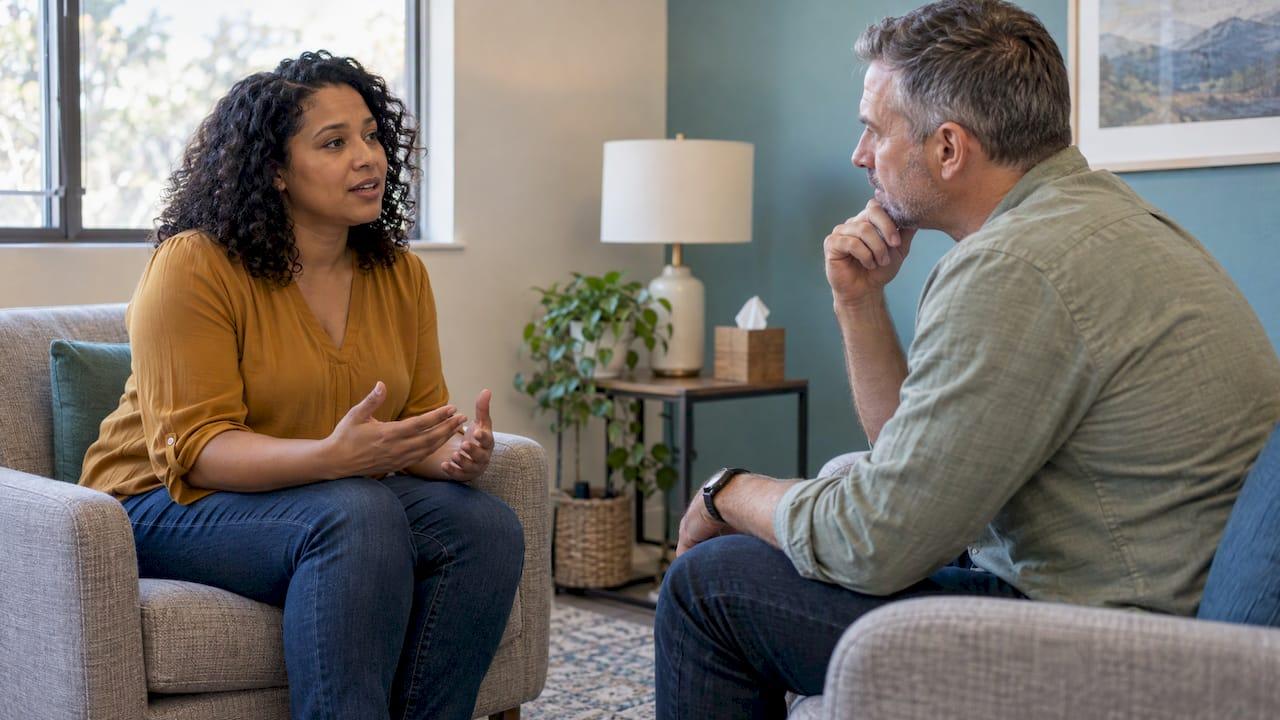
Spiritual bypassing is using spiritual beliefs or practices to avoid painful feelings instead of working through them. Counseling for it does not ask you to give up your faith. A good counselor helps you let your faith and your feelings sit in the same room, so prayer, scripture, or meditation can comfort you without covering over what still hurts.
If you have ever told yourself to "just trust God" while your chest felt tight with grief, you are not weak or faithless. Many sincere people reach for faith first because it is where they find comfort. We want to walk you through what bypassing looks like, why it happens, and what real help can look like.
TL;DR
- Spiritual bypassing means using spiritual ideas or practices to sidestep unresolved emotional pain, wounds, or unfinished developmental tasks.
- Common signs include forced positivity, avoiding anger, feeling detached, pretending all is fine, and believing suffering means you did not pray enough.
- Faith itself is not the problem. Research from the VA's National Center for PTSD links positive religious coping with better functioning after trauma.
- Counseling that respects your beliefs can help you feel your feelings and keep your faith.
- If distress lasts two weeks or more and disrupts daily life, it is time to talk with a professional.
Table of Contents
- What spiritual bypassing is
- Signs of spiritual bypassing
- Why good people end up here
- How bypassing affects healing and relationships
- How to tell comfort from avoidance
- What counseling for spiritual bypassing looks like
- Our perspective
- When to seek professional help
- Working with us in Phoenix
- FAQ
- Sources
What spiritual bypassing is
The term was coined in the early 1980s by transpersonal psychotherapist John Welwood, who described a tendency to use spiritual ideas and practices to sidestep unresolved emotional issues, psychological wounds, and unfinished developmental tasks. In his own writing he called the pattern premature transcendence: trying to rise above the raw, messy side of being human before we have fully faced and made peace with it.
The word "bypass" is a helpful picture. When we bypass something, we go around it. The road is still there, and the pain is still on it. Psychologist Ingrid Mathieu describes the pattern as spiritual practice in the service of repression, more about checking out than checking in.
Counseling researchers have studied this too. A peer-reviewed article in the journal Counseling and Values describes spiritual bypass as clients using spiritual beliefs, practices, and experiences to avoid genuine contact with their psychological unfinished business. The same authors point toward healing at the cognitive, emotional, physical, and spiritual levels together.

What it is not
Bypassing is not the same as faith. Praying through a hard season is not a problem. Neither is meditating, worshiping, or leaning on your church community. The question is what the practice is doing for you. Is it carrying you toward your pain with support, or is it a way to avoid looking at it?
The National Center for PTSD explains that when people have a positive relationship with their own beliefs and practices, that relationship can buffer the effects of trauma and bring comfort in distress. Good spiritual support and bypassing can look alike from the outside. The difference is on the inside.
Signs of spiritual bypassing
No single sign proves anything. Look for patterns that repeat over months. Verywell Mind's overview lists signs such as avoiding anger, pretending everything is fine, assuming prayer or meditation is always positive, feeling detached, and thinking you must rise above your emotions. Here are the ones we hear about most often, in plain words.
- Forced positivity. You answer every loss with "everything happens for a reason," even when you cannot feel that it is true.
- Fear of anger or sadness. You treat these feelings as sins or signs of weak faith. Scripture is honest about lament. "The Lord is close to the brokenhearted and saves those who are crushed in spirit" (Psalm 34:18).
- Using spiritual language to close a conversation. Licensed clinical social worker Diane Botta lists using spiritual jargon to dismiss personal issues and avoiding difficult conversations among the ways it shows up.
- Feeling numb or far from your body. You may feel calm on the surface and disconnected underneath.
- Weak boundaries. Sometimes forgiveness or compassion gets stretched so far that you tolerate behavior that is hurting you.
- Believing suffering is a punishment. Therapist Jamie Marich describes three main forms of bypass: toxic positivity, using spiritual teachings to justify abuse, and believing suffering comes from not praying or meditating enough.
- Feeling above others. A quiet sense of being more spiritually advanced can cover insecurity or shame.
If you recognized yourself in several of these, take a breath. Noticing is the first step, and it is a brave one.
Why good people end up here
Most people who bypass are not hiding. They are trying to survive. Pain is exhausting, and faith offers real relief. If you grew up in a church or home where sadness was treated as a lack of trust, bypassing may feel like the only safe way to be a believer.
Welwood believed this plays out most painfully in relationships. He wrote that psychological wounds are relational, formed through our early caretakers, and that bypassing often wreaks its worst havoc in relationships. In a marriage, that might look like one spouse saying "let's just pray about it" every time the other raises a hurt. Neither person is a villain, yet the hurt goes unspoken.
How bypassing affects healing and relationships
When bypassing becomes a long-term habit, the costs can build. Verywell Mind notes possible consequences including anxiety, codependency, shame, emotional confusion, excessive tolerance of unacceptable behavior, and disregard for personal responsibility.
There is also evidence on spiritual struggle after trauma. The National Center for PTSD reports that spiritual strain, also called negative religious coping, has been consistently linked to poorer mental health after trauma. If you feel abandoned by God, or believe your pain is a punishment, that deserves gentle attention rather than silence.
Welwood warned that sidestepping our emotional issues sets up a split between the divine and the human within us. Many of our clients describe exactly that: they feel one way in worship and another way alone at night, and they worry that the second self is the "real" problem. It is not. Both are you.
A note on timing
Not every instance is harmful. Clinicians do not necessarily regard bypassing as unhealthy when it is a temporary way of coping with acute stress. Leaning on prayer in the first days after a loss can be a mercy. It becomes a concern when it turns into the only way you handle pain, month after month.
How to tell comfort from avoidance
These questions can help you reflect. They are not a test, and you do not have to answer them alone.
- After I pray or meditate, do I feel more able to face the situation, or more able to stop thinking about it?
- Can I say out loud, to God or to a trusted person, "this hurts and I am angry"?
- Do I use scripture to understand my pain, or to shut down a conversation about it?
- Has my body been sending signals, such as trouble sleeping, tension, or numbness, that I keep overriding?
- Do the people closest to me say they cannot reach me?
Comfort tends to make room for feeling. Avoidance tends to make feelings disappear for a moment, then return louder.
What counseling for spiritual bypassing looks like
Spiritual bypassing counseling is simply good therapy that takes your faith seriously. The VA's National Center for PTSD describes a continuum of care: spiritually avoidant, spiritually conscious, spiritually integrated, and spiritually directive. In integrated care, treatment is tailored to help meet your own goals for spiritual meaning. That fits people who want their beliefs honored and their pain heard.
The American Psychological Association reports that by centering the patient and their existing beliefs, psychologists can help people use religious and spiritual resources as a source of strength during hard times. Jamie Marich puts the heart of it well: our emotions and our spirituality are not at odds, both can be real at the same time.
In practice, sessions often include:
- Slowing down. We start by listening to your story and your faith background without correcting it.
- Naming what is underneath. Grief, fear, anger, or shame may have been waiting a long time. We help you name them at a pace that feels safe.
- Reconnecting with the body. Bypassing often means living in the head. Grounding and body-aware approaches can help you notice what you feel.
- Reframing faith as a companion. Prayer and scripture stay, but they are used to sit with pain, not to skip it.
- Practicing honest conversations. For couples and families, this means learning to say hard things with kindness.
If you want to see how this works with deeper wounds, our articles on spiritually integrated therapy and trauma-informed Christian counseling explain our approach in more detail.
When the roots are religious hurt
Sometimes bypassing grows out of a faith environment where feelings were shamed or scripture was used to silence you. That is a different kind of wound, and it needs care. You can read about religious trauma and EMDR with faith care or recovering from spiritual abuse in four phases. If you are stepping back from your faith community and wondering where that leaves you, religious identity counseling may speak to you.
Our perspective
We have sat with many people who believed that faith and feelings could not share a chair. A grieving mother told herself she had no right to weep because she "knew where her child was." A husband smiled through every hard conversation because anger felt unholy.
What we have learned over 14 years is that the Lord does not ask us to skip the valley. He walks through it with us. Our work is to make that walk less lonely.
Because we are a small, private-pay practice, we can often offer openings within days, and your sessions stay private. Your beliefs guide the work: we do not push them aside, and we do not use them to hurry you past your pain. For clients who carry trauma, we also offer EMDR within that same faith-respecting frame.
You do not have to choose between being honest and being faithful. Healing happens when both are welcome.
Tres
When to seek professional help
Many people wait too long because they assume prayer should be enough. Please do not wait for a crisis. SAMHSA's guidance, as commonly summarized, suggests that two or more weeks of changes in thoughts, mood, or body that make it hard to manage work, school, home, or relationships is a good time to reach out. We would add some specific moments:
- You feel numb, empty, or hopeless most days, and prayer no longer reaches it.
- You are anxious or panicking and tell no one because you feel you should have more faith.
- You are in a relationship where scripture or spiritual language is used to excuse harm. In that case, a licensed counselor can help you think through safety.
- You are using alcohol or other substances to cope with feelings you will not name.
- A loss or trauma is years old and still controls your days.
If you are thinking about harming yourself or feel unsafe, call or text 988 to reach the 988 Suicide & Crisis Lifeline, or call 911 in an emergency. You deserve immediate help, and reaching out is not a failure of faith.
Who should you see? A licensed mental health professional, such as a licensed counselor, therapist, or psychologist, is the right place to start for anxiety, depression, trauma, or grief. Your pastor can be a wonderful support alongside that care.
Working with us in Phoenix
At Prism Counseling & Coaching, we provide faith-based and Christian counseling for individuals, couples, and families in the Phoenix area, including LGBTQ+ affirming care and EMDR. Our approach is spiritually integrated: your beliefs guide the pace and the tools. If your questions are about how we treat prayer in sessions, this guide to finding a therapist who respects your faith is a good place to begin.
A standard 50-minute session is $195, and sliding scale appointments are $100 to $165. You can see details on our rates page or read about sliding scale counseling. Because we are private-pay, we can often schedule you within days.
When you are ready, our start page is the easiest way to begin. Couples working on communication can learn more about couples counseling, and individuals can explore individual counseling.
FAQ
Is spiritual bypassing a sign that my faith is wrong?
No. Bypassing is about how a practice is being used, not about the belief itself. Researchers note that positive religious coping is generally related to better functioning after trauma. Counseling aims to help your faith support you more honestly, not to take it away.
Who coined the term spiritual bypassing?
Psychologist John Welwood introduced it in the early 1980s, according to Verywell Mind. Other writers have since expanded it, and counselors now use it to describe emotional avoidance wrapped in spiritual language.
Can a Christian counselor help with spiritual bypassing?
Yes, when the counselor is trained in therapy and respects your beliefs. Spiritually integrated care tailors treatment to your own goals for spiritual meaning, as the National Center for PTSD describes. At Prism, we use your faith as a resource while helping you feel what you feel.
How is spiritual bypassing different from normal coping?
The difference is whether it is temporary and supportive or a long-term way of avoiding. Clinicians do not necessarily see it as unhealthy when used briefly during acute stress. If it has become your only response to pain, it is worth talking to a counselor.
Do I need to do this work if I feel fine?
You do not need a crisis to benefit from counseling. If you recognize several signs above or feel disconnected from your emotions, a conversation with a licensed professional can offer clarity at any time.
Sources
- Spiritual Bypassing as a Defense Mechanism, Verywell Mind
- Human Nature, Buddha Nature: On Spiritual Bypassing, John Welwood
- Beware of Spiritual Bypass, Psychology Today
- The Only Way Out Is Through: The Peril of Spiritual Bypass, Counseling and Values
- Addressing Religious or Spiritual Dimensions of Trauma, National Center for PTSD
- Understanding Spiritual Bypass, Diane Botta, LCSW
- Three Blocks to Processing Trauma, Psychotherapy Networker
- On Spiritual Bypassing and Relationship, John Welwood
- Spiritual bypass, Wikipedia
- Can religion and spirituality have a place in therapy?, American Psychological Association
- 988 Suicide & Crisis Lifeline, SAMHSA