
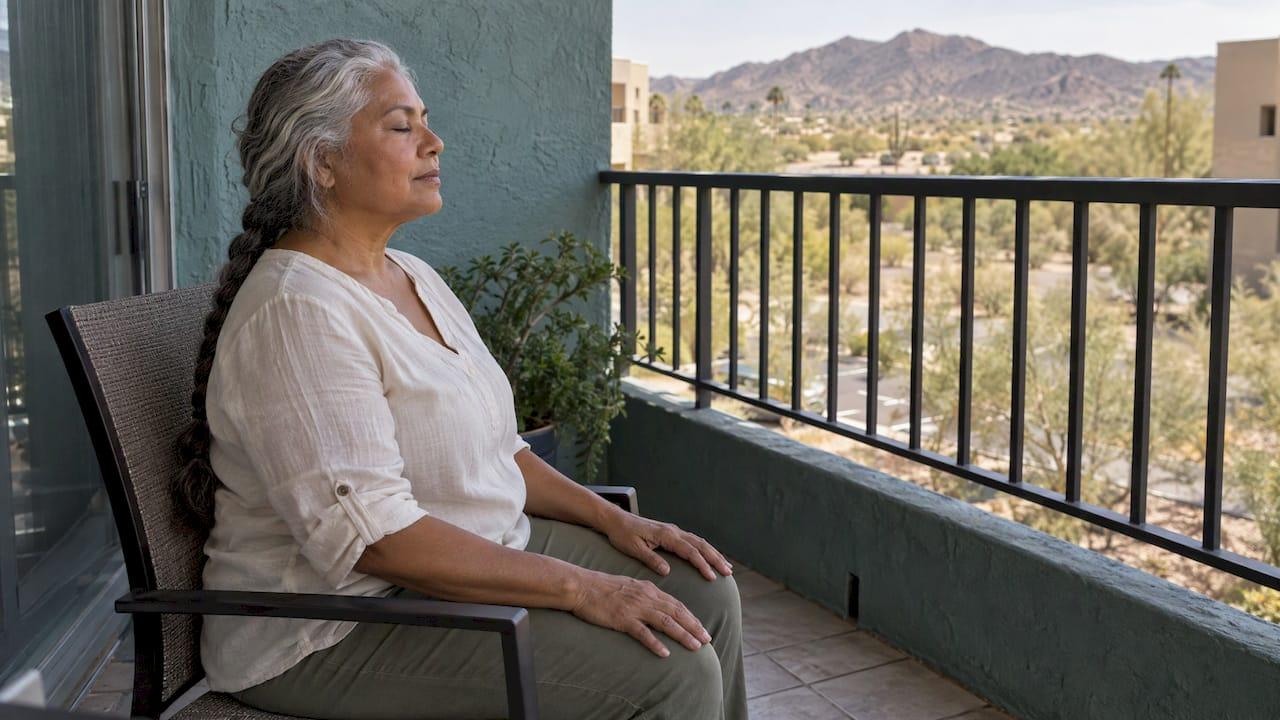
When your thoughts are racing and your chest feels tight, you do not need a lecture. You need a way back to this moment. Christian grounding techniques are short, simple practices that bring your body, mind and spirit back into the present, with the reminder that God is here with you. You can try any of them in two to five minutes, sitting at your desk, standing in the kitchen, or lying awake at 2 a.m.
TL;DR
- Grounding means anchoring your attention in the present moment. The Christian version adds prayer, Scripture and the truth that you are not facing this alone.
- Start with the easiest: a slow breath prayer (inhale for four, exhale for six) or the 5-4-3-2-1 senses exercise paired with Psalm 46:10.
- If prayer, Scripture or focusing on your body feels hard right now, there are gentler ways in. Choose the one that feels safe.
- Grounding helps you settle in the moment. It is not a substitute for treatment when anxiety, panic or trauma keeps coming back.
Table of Contents
- What Christian grounding actually is
- Technique 1: Breath prayer
- Technique 2: The 5-4-3-2-1 senses exercise with Scripture
- Technique 3: Name the fear, then name the truth
- Technique 4: Scripture memory walk
- Technique 5: Breathing a verse
- Technique 6: Picture the Shepherd
- Technique 7: A seven-minute daily routine
- When prayer, Scripture or your body feels like too much
- When to reach for more than grounding
- Support in the Phoenix area
- Frequently asked questions
- Sources
What Christian grounding actually is
Secular grounding techniques are a set of simple strategies that calm anxiety by focusing on the here and now, usually through sight, sound, touch, taste or smell. Christian grounding keeps that same practical shape and adds something deeper.
As one Christian ministry writer puts it, the practice is not only a nervous-system tool but a spiritual return to the reality that God is near and this moment is held by Him. You are not calming yourself by pretending there is no trouble. You are calming yourself by remembering you do not face trouble alone.
That difference matters. Many of us have been told, kindly or not, to "just pray about it" and then felt guilty when the panic did not leave. Grounding takes the body seriously. God made your body, your breath and your five senses, and it is no lack of faith to use them. Scripture itself says we are "fearfully and wonderfully made" (Psalm 139:14).
Technique 1: Breath prayer
Breath prayer is the easiest place to begin, because you are already breathing. It combines Scripture and prayer with meditative breathing: you inhale a name or description of God and exhale a short phrase that expresses your need. A familiar example from Psalm 23 is inhaling "Good Shepherd" and exhaling "lead me beside still waters."
The tradition goes back a long way. It is often described as an updated form of the classic Jesus Prayer: a short phrase of roughly seven to nine syllables, said again and again in rhythm with your breathing, so the prayer can replace the negative commentary running in your head. The same reflection notes that the word "breath" shares a root with the word "spirit," which is a lovely reminder that every breath can become a prayer.
Try it this way:
- Sit or stand comfortably and let your shoulders drop.
- Breathe in slowly through your nose for a count of four.
- Breathe out through your mouth for a count of six.
- As you inhale, pray "God is here." As you exhale, pray "I am not alone." This pairing is rooted in Isaiah 41:10: "Do not fear, for I am with you."
- Repeat for two to five minutes.
The longer exhale is on purpose. Slow breathing is meant to signal safety to your body, and a longer out-breath is a simple way to do it. If counting adds pressure, drop the numbers and simply let each exhale be a little slower than the inhale.
You can swap in other verses. Philippians 4:6-7 works well: breathe in "Your peace, O Lord," and breathe out "guards my heart and mind." For more prayers and breathing steps aimed at panic specifically, see our guide to short prayers and breathing steps for a panic attack.
Technique 2: The 5-4-3-2-1 senses exercise with Scripture

This is the classic grounding exercise most counselors teach, and it adapts beautifully to prayer. It walks through your senses in a descending count, which pulls your attention away from the spiral and onto what is real and present right now.
The basic pattern:
- Name five things you can see.
- Name four things you can touch or feel.
- Name three things you can hear.
- Name two things you can smell.
- Name one thing you can taste.
Now add the spiritual layer. One simple version has you slowly repeat Psalm 46:10 as you go: "Be still, and know that I am God." Another approach adds a short thanksgiving after each sense. Thank God for the light on the wall, the warmth of a mug in your hands, the sound of rain or a distant voice. Gratitude widens your attention from what threatens you to what is good and given.
If you like structure, you can match one verse to each sense. For example:
| Sense | Prompt | Verse to pair |
|---|---|---|
| Sight (5) | Name five things you see | Psalm 118:24, "This is the day the Lord has made" |
| Touch (4) | Feel four textures | Psalm 139:14, "fearfully and wonderfully made" |
| Hearing (3) | Notice three sounds | 1 Samuel 3:10, "Speak, for your servant is listening" |
| Smell (2) | Breathe in two scents | Psalm 141:2, "Let my prayer be set before you as incense" |
| Taste (1) | Notice one flavor | Psalm 34:8, "Taste and see that the Lord is good" |
This pairing is one published way to combine the exercise with Scripture. You do not need to follow it exactly. Use the verses that speak to you.
Technique 3: Name the fear, then name the truth
Vague anxiety feels enormous. Naming it makes it smaller. David did this in the Psalms: "I pour out my complaint before him; before him I tell my trouble" (Psalm 142:2). Putting each fear into words before God, and then placing it under a truth from Scripture, helps anxiety lose some of its power by becoming specific instead of vague.
A three-step version, based on Isaiah 41:10:
- Name what you feel. "I feel afraid about tomorrow's meeting."
- Speak a truth that applies. "But God says He is with me."
- End with a truth you choose to believe. "I am not alone."
The aim is to retrain your mind to engage with God's truth rather than spiral into fear or shame. Say it aloud if you can. Hearing your own voice helps.
If the fear you are naming is mixed with guilt or self-blame, our article on what to do when shame will not lift may help you sort the two apart.
Technique 4: Scripture memory walk
Some of us settle better when we move. Choose a short passage, such as Psalm 23, and walk slowly. Break it into phrases and match each step or two with a phrase, speaking it aloud or in your heart. The rhythm interrupts anxious thought loops because your mind has a job to do.

A hallway, a driveway, a trail along the canal or a few laps around the block all work. In Phoenix, early morning or after sunset is kinder than midday heat, and a short indoor loop is perfectly fine in summer.
Technique 5: Breathing a verse
This is a gentler cousin of breath prayer. You take a single verse and build it into your breathing: say the first half as you breathe in and the second half as you breathe out. Some people start with one word and add another word with each new breath until the whole verse is there. The practice slows the body and turns the mind back to God's truth.
Good verses for this: Psalm 4:8, Psalm 46:10, Isaiah 26:3, or Matthew 11:28. Pick one and keep it for a few weeks, so it becomes familiar enough to reach for when you are frightened.
Technique 6: Picture the Shepherd
Guided imagery can be grounding when it keeps you connected to the present rather than pulling you away from it. A popular Christian version uses Psalm 23. You picture Jesus as your shepherd, see yourself in green pastures beside quiet waters, and take three deep breaths, imagining you are breathing in the breath and life of the Holy Spirit.
Keep your feet on the floor while you do it and notice the chair beneath you. If a picture in your mind makes you more anxious, not less, let it go and return to your senses or your breath.
Technique 7: A seven-minute daily routine
Grounding works best when you have practiced it on calm days. Here is a simple routine you can build into a morning or an evening:
- Minute one: Check your posture, feet on the floor, and take one slow exhale.
- Minutes two to four: Breathe in for four and out for six, praying a short promise such as "You are with me."
- Minutes five to seven: Name three small gifts from today and thank God for each, out loud.
This follows a faith-based regulation routine that also suggests carrying a single verse on a card. A card in your wallet or a note on your phone lock screen is enough. Romans 12:2 reminds us that renewal of the mind is ongoing. Each time you practice, you are building a path your mind can follow when it counts. If you want a wider set of habits, read our post on Christian stress management practices backed by Scripture and science.
When prayer, Scripture or your body feels like too much
Not everyone can start with breath or with the body. If you have experienced trauma, panic, chronic illness or spiritual hurt, these practices can feel unsafe. That is not failure. It means you need a different door in.
Here are options, from gentle to gentler:
- Look outward. If focusing on the body stirs up uncomfortable sensations, stay with sight and sound only. Open your eyes, look around the room, and feel your feet or the chair under you.
- Choose a different anchor. If the breath itself feels difficult, guidance from a mindfulness training organization suggests directing attention to another part of the body, the contact of your body with a chair, or a walking practice. Their key advice is to approach your anchor with curiosity and kindness, not force.
- Use a spoken prayer. Read a psalm aloud instead of silently meditating. Psalm 23, Psalm 121 and Psalm 91 are well loved for good reason.
- Limit the input. On days when everything feels too loud, dim the lights, lower the sound, and hold one reliable object, such as a smooth stone or a warm cup.
- Adjust for your body. If movement is limited, you can picture colors and textures instead of touching things. The 5-4-3-2-1 count still works sitting, standing or lying in bed.
- Try other routes. If meditation itself is tied to painful religious experiences, time in nature, creative outlets or gentle movement can be softer ways to feel present.
If an exercise leaves you more distressed, stop, open your eyes, and tell a counselor or a trusted pastor. You do not have to push through.
What we have seen in our counseling room
Over more than 14 years of walking with people through anxiety, grief and trauma, we have noticed that most people do not struggle to believe God is near. They struggle to feel it when their heart is pounding. Grounding is a bridge between those two places.
We do not see the body and the spirit as competing. A slow breath, a named fear and a spoken verse work together, and we are glad to teach them side by side. Our approach is to let each person's own beliefs guide the work, so we never hand you a script that does not fit your faith or your story.
We also know that grounding is a first step, not the whole road. When the same fears return week after week, a counselor can help you understand where they come from, and prayer and Scripture can be part of that healing rather than a replacement for it.
Tres
When to reach for more than grounding
Grounding techniques can bring your focus back to the present moment, but they are not a substitute for treatment. That source advises seeing a trained mental health professional if you are experiencing symptoms of a condition like anxiety or PTSD.
Consider booking an appointment with a licensed counselor if:
- Panic or worry shows up most days, or keeps you from work, sleep or relationships.
- You avoid places, people or situations because of fear.
- Memories of a past event keep intruding, and grounding only helps for a few minutes.
- You feel hopeless, numb or exhausted for weeks at a time.
- Your physical symptoms are new or frightening. A physical check-up matters too, and it can be hard when you feel unheard. Advice on what to do when a doctor dismisses anxiety can help you prepare for that conversation.
If you are in immediate danger or thinking about harming yourself, call 911 or go to the nearest emergency room right away. You are loved, and help is available tonight.
For a closer look at how faith and professional care fit together, read our guide to Christian anxiety counseling with Scripture and CBT and our overview of how Christian counseling can match therapy for anxiety and depression.
Support in the Phoenix area
At Prism Counseling & Coaching, we offer Christian counseling for individuals, couples, families and teens in the Phoenix area. We are a small, private-pay practice, which means no insurance waiting game, and we often have openings within days. Our counselors can teach you grounding skills in session, and help you work on what is driving the anxiety underneath.
A standard 50-minute session is $195, and we also offer sliding scale appointments at $100-$165. You can see the details on our rates page or read about our sliding scale counseling. When you are ready, explore counseling with us and take the first step.
Frequently asked questions
Is grounding biblical?
Scripture does not use the word "grounding," but it repeatedly points us to the practices inside it: stillness before God (Psalm 46:10), bringing our fears to Him in prayer (Philippians 4:6-7), giving thanks, and remembering His presence. Grounding techniques simply give those commands a practical shape. If a particular method troubles your conscience, choose the prayer or Scripture practices that fit your convictions.
How long should a Christian grounding exercise take?
Most take two to five minutes. A breath prayer can be as short as one minute, and a seven-minute routine is plenty for daily practice. The goal is not a perfect feeling of calm. It is to notice that you are here, you are breathing, and God is with you, so you can take the next small step.
Can I use grounding during a panic attack?
Yes, many people find that a simple tool is easiest in panic: one slow exhale, one verse repeated for a couple of minutes, or the 5-4-3-2-1 count. If panic attacks are frequent, or you fear the next one, see a licensed counselor or your doctor, because lasting relief usually comes from treating the cause as well as the moment.
What if I feel nothing when I pray or read Scripture while anxious?
That is common, and it does not mean God is absent or that you are doing it wrong. Anxiety makes it harder to feel anything gently. Lean on the body-first or outward-looking options, like noticing your feet on the floor, and keep the verse simple. A counselor can also help if your spiritual life feels tangled up with fear or past hurt.
Sources
- 13 Grounding Techniques for When You Feel Overwhelmed, Cleveland Clinic
- Biblical Grounding Techniques for Anxiety, Testimonio
- What Is Breath Prayer? Cru
- Breath, Spirit, and Peace, Oblates of St. Francis de Sales
- Scripture-Based Grounding Techniques for Anxiety, Church and Mental Health
- 5-4-3-2-1 Grounding Technique Step by Step, Christian Peace Guide
- Faith-Based Nervous System Regulation, Christian Peace Guide
- Calm Your Mind, Body, and Spirit with God's Truth, Dwell Differently
- How to Meditate When the Breath Feels Difficult, Breathworks
- Healing from Spiritual Abuse, Marie LePage
- Grounding Techniques for Coping With PTSD and Anxiety, Verywell Mind
- Doctor Says "Just Anxiety"? 5 Signs and Scripts for U.S. Patients