
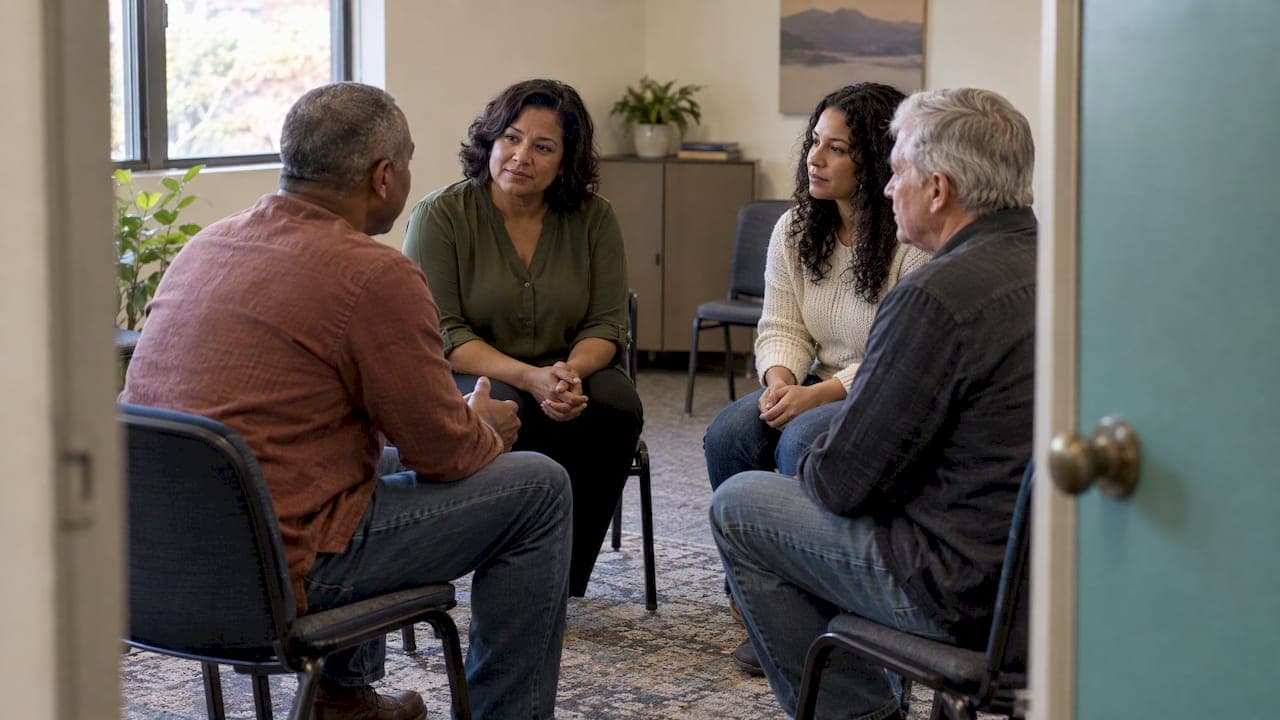
If you are grieving and searching for a group in Phoenix, you have real options: free drop-in groups run by a local hospice, 13-week faith-based programs hosted at churches across the Valley, virtual meetings, and specialized groups for particular losses. The harder question is which one will feel safe for you. This guide walks through what is available, what to ask before your first visit, and when a group alone may not be enough.
"The Lord is close to the brokenhearted and saves those who are crushed in spirit." (Psalm 34:18)
Whatever brought you here, a loss of a spouse, a parent, a child, a friend, or something harder to name, you do not have to carry it by yourself.
TL;DR
- Phoenix has no-cost, drop-in grief groups for adults 18 and older, plus virtual sessions and a group for the LGBTQ community.
- Faith-based GriefShare groups meet at many Phoenix churches on a 13-week cycle, and you are usually welcome to join partway through. Expect a small fee for the workbook.
- Ask each facilitator about the group's culture: some are openly Christian, others are non-sectarian. Pick the one that matches the comfort you need.
- Research suggests group formats can be especially helpful for grief, while a mix of individual and group support may help more with depression.
- If grief feels stuck or unsafe, private counseling can sit alongside a group. We offer faith-integrated sessions with openings within days.
Table of Contents
- What a grief support group actually is
- Does a group help? What the research says
- Free and low-cost groups in Phoenix
- A quick comparison
- Choosing a group that feels safe
- When a group is not enough
- Our perspective: group and private care can walk together
- Private grief counseling at Prism
- Practical tips for your first night
- FAQ
- Sources
What a grief support group actually is
A grief support group is a regular gathering of people who have lost someone, led by a trained facilitator or a trained peer. You are not there to be fixed. You are there to say what is true out loud, hear others say the same, and notice that you are not strange for feeling what you feel.
Grief is not linear. It tends to move in cycles: a good week, then a Tuesday in the grocery store that undoes you. A group gives those cycles a place to land. People who are further along remember where you are standing, and people who are newer remind you how far you have come.
"Rejoice with those who rejoice; mourn with those who mourn." (Romans 12:15)
Groups look different from one another. Some are structured, with a video or a topic each week. Others are open conversation. Some are for any loss through death, and others are for one kind of loss, such as a child, a spouse, or a pet. Knowing which style helps you is half the work of choosing.
Does a group help? What the research says
A 2020 meta-analysis of 19 randomized controlled trials looked at bereavement support for family caregivers in palliative care. It found significant reductions in grief, depression and anxiety symptoms overall. Group formats appeared more effective for grief itself, and combined individual-and-group models did better for depression.
Two honest cautions. The effects were modest, and the people studied were family caregivers, so the findings do not map perfectly onto every kind of loss. Still, the pattern fits what we see: shared experience steadies people, and some people also need one-on-one attention.
If you want a gentle starting point from home before you walk into a room, there are online grief resources that gather support options, memorial ideas and writing helpers in one place. Many people use them alongside a local group, not in place of one.
Free and low-cost groups in Phoenix
Hospice-run groups open to the whole community
A local not-for-profit hospice offers in-person grief support groups to anyone in the community who has lost someone to death, and there is no fee. The groups are for adults 18 and older. In-person groups are drop-in, so you do not need to register first.
As of the organization's current listing, the central Phoenix in-person group meets at 1510 E. Flower St., Phoenix, AZ 85014, on the 2nd and 4th Tuesday of each month from 5:30 to 7:00 p.m. A Spanish-language group meets there on the 1st and 3rd Wednesday evenings. There is also a virtual group on the 1st and 3rd Thursday of each month. For a link to a virtual session, call the group line listed on the hospice's support group page.
Schedules shift around holidays and facilitator availability, so call ahead before you drive across town.
GriefShare: faith-based and 13 weeks long
GriefShare is a video-and-discussion program hosted by churches, and Phoenix has many of them. You can search current Phoenix groups by date and location. Groups typically run in 13-week cycles, often offered each spring and fall, and many welcome newcomers to join at any point. One central Phoenix church, for example, lists its fall cycle starting September 6, 2026 and says you are welcome to join at any time.
Some groups ask for a small fee, often around $20, to cover the participant workbook. If that is a barrier, ask about scholarships. Most hosts would much rather help than turn someone away.
Specialized groups
Some losses need a room where everyone already understands. The hospice network lists a virtual group called Healing Rainbows for the LGBTQ community, which meets twice a month. For children and families, its New Song Center for Grieving Children offers support for families grieving a death, and there are resources for Spanish-speaking families. Pet loss is real grief too, and Maricopa County Animal Care and Control publishes a sheet of free pet loss support resources.
To browse more by neighborhood, the 211 Arizona directory of bereavement groups lists general groups across the Phoenix area.
A quick comparison
| Option | Cost | Faith content | Format | Best for |
|---|---|---|---|---|
| Community hospice group | No fee | Non-sectarian | Drop-in, in person or virtual | Anyone 18+ who wants a secular, low-pressure start |
| GriefShare at a church | Often about $20 for the workbook | Christian | 13 weeks, video plus discussion | People who want scripture and structure |
| Loss-specific group | Varies | Varies | Often monthly or twice monthly | Pet loss, LGBTQ, child loss |
| Private counseling | See below | Your choice | One-on-one | Complicated grief, privacy, or a group that does not fit |
Choosing a group that feels safe
The best group is not the one with the best reviews. It is the one where you can cry, or say nothing, and still feel held. A few things help you tell.
- Ask about the culture. Is the group openly Christian, interfaith, or non-sectarian? Neither is better. If you need prayer and scripture, say so. If you need room to doubt God right now, say that instead.
- Ask who leads it. A trained facilitator, a clergy member, or a peer who has been through loss all bring different strengths.
- Ask whether it is open or closed. Drop-in groups let you test the water. Closed cycles offer deeper trust but a firmer commitment.
- Ask about the type of loss. Groups work especially well when members share a similar kind of loss or stage of life, because it helps normalize the experience.
- Try it twice. The first night is often awkward for everyone. Give it a second visit before you decide.
"Blessed are those who mourn, for they will be comforted." (Matthew 5:4)
If faith feels complicated right now
Many Phoenix-area grievers tell us the same thing: they are angry, or numb, or unsure God is listening. That is not failure. Lament has a long place in scripture. If you want to explore it, our six-step lament for grief includes clinical warning signs to watch for. Veterans can also ask about chaplain services at the Phoenix VA, which exist for spiritual care across beliefs.
When a group is not enough
Groups are powerful, but they are not for everyone and not for every season. Consider adding one-on-one support if:
- You cannot function at work or at home for weeks at a time.
- Your grief is tangled with trauma, such as a sudden, violent or traumatic death.
- You feel guilt or anger that you cannot say in a room of people.
- Sleep, appetite or concentration have not eased with time.
- You have thoughts of not wanting to live. In that case, call or text 988, the Suicide & Crisis Lifeline, right now, or go to the nearest emergency room.
Speak with your primary care provider or a licensed counselor if any of these sound familiar. Grief is not a disorder, but it can sit on top of depression or trauma that deserves proper care. Our guide to Christian depression counseling and our overview of trauma healing with a faith-based approach explain what that care can look like.
Our perspective: group and private care can walk together
We have counseled grieving people in the Phoenix area for over 14 years, and the pattern is steady. Most people do not need to choose between a group and a counselor. A group says, "you are not alone." A counselor says, "let's look at your story, in your own words, at your own pace." Both are true, and both matter.
We also see how often people postpone help because they think grief should have an end date. It does not. It moves in cycles, and anniversaries, holidays and ordinary Tuesdays can bring it back. That is not regression. It is love still looking for somewhere to go.
When clients come to us, we do not hurry them toward a lesson. We let your beliefs guide the work. For some that means prayer, scripture and questions about where God is in the loss. For others it means simply space to be honest, with faith respected and never forced. We are private-pay, which means we are not bound by insurance timelines, and we can usually offer openings within days. That matters when the first weeks are the hardest.

If you are in a group already, keep going. Tell your counselor about it. Tell your group that you are seeing someone. Support works best when the people holding you know about each other.
"He heals the brokenhearted and binds up their wounds." (Psalm 147:3)
— Tres
Private grief counseling at Prism
If you want a quieter, more personal place to grieve, we offer faith-based counseling for individuals, couples and families in the Phoenix area. You can read how we approach it in our guide to evidence-based Christian grief counseling in 12 to 16 sessions, or see our Phoenix Christian counseling page.
Cost matters, so here it is plainly. A standard 50-minute session is $195, listed on our rates page. A sliding scale of $100-$165 per appointment is also available, and you can see how our sliding scale works. A missed or late-canceled appointment is billed at $195. If you would like to understand what to ask about fees anywhere, our article on asking for a good faith estimate walks through it.
When you are ready, start here to explore counseling and tell us a little about your loss. There is no need to have the words ready.

Practical tips for your first night
A few small things make walking into a grief group easier.
- Call first. Confirm the time, the room and whether the meeting is still on.
- Plan an exit. You are allowed to leave early. Many people sit in the car for ten minutes the first time, and that is fine.
- Bring something small. A photo, a name to say aloud, or simply a tissue. You do not have to share.
- Eat something before. Grief takes more out of the body than most people expect.
- Plan the hour after. Do not rush straight into a work email. Take a walk or call a friend.
- Know your couple needs. If you and your spouse are grieving differently, a joint conversation may help. See our guide to Christian couples counseling.
And remember: "There is a time to weep and a time to laugh, a time to mourn and a time to dance." (Ecclesiastes 3:4) Both the weeping and the laughing belong to your healing.
FAQ
Are grief support groups in Phoenix free?
Many are. A local hospice organization runs no-fee, drop-in groups for adults who have lost someone to death. Church-hosted GriefShare groups may ask for about $20 for the workbook, and scholarships are often available if you ask.
Do I have to attend all 13 weeks of GriefShare?
Not necessarily. Many groups let you join at any time, and the cycle repeats each season. Still, call the host church first, because policies differ by location.
What if I am not religious, or I am angry at God?
Choose a non-sectarian group, or tell a faith-based group your honest place. Ask the facilitator about the group's culture before you go. In private counseling, we follow your lead on how much faith belongs in the room.
Can I see a counselor and attend a group at the same time?
Yes, and research suggests combined individual and group support may help with depression. Let each know about the other so your care fits together.
How soon after a loss should I join a group?
There is no right date. Some people go within weeks, and others wait a year or more. If you are asking the question, you may already be ready for a first visit.
Sources
- Hospice of the Valley: Grief Support Groups
- Hospice of the Valley: Grief Support
- GriefShare: Groups in Phoenix, Arizona
- GriefShare at FCCPHX
- Effectiveness of Bereavement Support for Adult Family Caregivers: Meta-Analysis
- Maricopa County: Free Pet Loss Support
- 211 Arizona: General Bereavement and Grief Support Groups
- VA Phoenix Health Care: Chaplain Services