
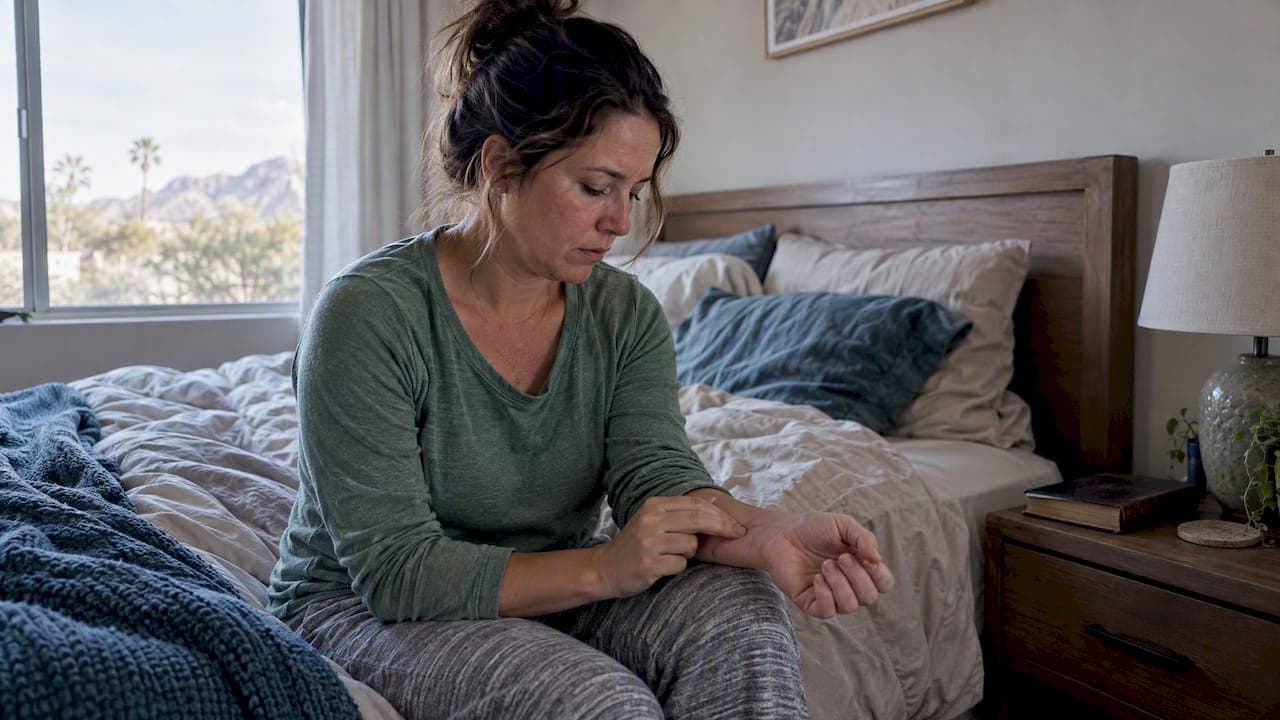
If you are a Christian who lies awake over a symptom, rereads test results, or searches your body for signs of illness, you are not failing God. Health anxiety is a real and treatable struggle, and the fear is not proof that your faith is weak. The way forward usually combines three things: honest prayer, good medical care, and counseling that treats your faith as part of the healing rather than something to set aside.
We wrote this guide for the person who is tired of being told to "just trust God" and equally tired of advice that ignores their faith. We will look at what health anxiety is, why it so often carries shame for believers, what actually keeps it going, and what you can start doing this week.
TL;DR
- Health anxiety (also called illness anxiety disorder) is persistent worry about being or becoming seriously ill, even when symptoms are absent or minor. It is a human struggle, not a verdict on your faith.
- Constant checking, Googling and doctor visits for reassurance tend to feed the cycle. Setting gentle limits on them is one of the most useful steps.
- Prayer, Scripture and church community can sit alongside medical care and therapy. They do not compete with them.
- If a symptom is new, severe or changing, see a medical professional. If you are in crisis, call or text 988.
- Our practice in Phoenix is private-pay, with openings often available within days.
Table of Contents
- What health anxiety actually is
- Why it hurts differently when you are a believer
- The reassurance trap
- What helps: faith and clinical care together
- Why long-term practice matters
- If your worry is about your body's appearance
- Our perspective
- Talking with someone in Phoenix
- What about anxiety during pregnancy and after birth?
- FAQ
- Sources
What health anxiety actually is
The NHS describes health anxiety as spending so much time worrying that you are ill, or will become ill, that it starts to take over your life. It is related to obsessive compulsive disorder, which helps explain why the thoughts feel so hard to switch off. The APA Dictionary of Psychology defines it as excessive anxiety about one's health based on misreading bodily sensations, such as pain or stomach upset, as signs of something serious.
The Biblical Counseling Coalition notes that the DSM-5 calls this illness anxiety disorder, and that it has also been known as hypochondriasis. Whatever the label, it often looks like this:
- Checking your body repeatedly for lumps, changes in your skin, your pulse or your breathing.
- Seeking reassurance again and again, from doctors, family, friends or search engines.
- Avoiding anything that reminds you of illness: hospital visits, news stories, even a friend's diagnosis.
- Reading every sensation as a warning, so a headache becomes a tumor in your mind within minutes.
None of this means you are "making it up." The physical sensations are real. The fear is real. What has gone wrong is the interpretation, and the fear's power over your days.
Why it hurts differently when you are a believer
Many Christians carry a second burden on top of the first. They believe God condemns anxiety, so they conclude God must be disappointed in them. The worry then multiplies: now you are afraid of illness and ashamed of being afraid.
Practitioners who work with faith-centered clients see this often. The Biblical Counseling Coalition describes how people feel significant guilt for their anxiety, mistakenly believing it shows a lack of faith, while counselors understand it as a mix of physical, emotional and spiritual vulnerability. A grace-centered resource from BibleLum makes a similar point: health anxiety is a human response to uncertainty and mortality, not a failure of faith, and it can be brought into the light without shame.
Think about the psalmists. They did not hide their racing minds from God. One of them wrote, "In the multitude of my thoughts within me thy comforts delight my soul" (Psalm 94:19, KJV). That is a person with a crowded, anxious mind who still turned toward God, and who was met with comfort rather than rebuke.
When a good desire becomes a heavy one
Wanting to be healthy is not sinful. As Biblical Counselling UK points out, health is a good gift from God, and John even prays for it (3 John 1:2). The trouble starts when a good desire quietly turns into an need for control. The Biblical Counseling Coalition describes this as something that can happen "under the radar," until the desire for health has become an idol or an obsessive need to be certain.
We would add a gentle word here. Noticing this is not a reason for self-punishment. It is an invitation. Most people find it a relief to hear that the fear makes sense, and that there is a way to loosen its grip.
The reassurance trap
The most common thing that keeps health anxiety alive is also the most understandable: seeking certainty. You feel a twinge, you search the symptom, you feel worse, you book an appointment, the doctor says it looks fine, and you feel relief for a few hours. Then the doubt returns: what if they missed something?
Biblical Counselling UK describes this as a trap. Repeated checking and reassurance-seeking reinforce the anxiety cycle rather than breaking it. Each time you check, your mind learns that the sensation was dangerous enough to deserve checking.
Breaking out of it can feel irresponsible, even unfaithful to your body, which is why it takes courage. Here is what that usually looks like in practice:
- Name your checking habits. Write down what you do: body scans, symptom searches, asking your spouse "do I look pale?" Awareness comes first.
- Delay, then reduce. Rather than banning a behavior overnight, try waiting 15 minutes before you check. Then 30. Then an hour. Urges tend to crest and fall if you do not feed them.
- Agree on a plan with your doctor. One trusted primary care provider and scheduled visits can replace a scattered pattern of urgent-care trips and late-night searches.
- Ask loved ones to stop answering the same question. They can say, kindly, "I love you, and I think we have talked about this already. Would you like to pray together instead?"
Do not ignore real symptoms
Learning to tolerate uncertainty does not mean ignoring your body. The BibleLum guide is clear that a new, severe or changing symptom deserves medical attention. If you have chest pain, sudden weakness, trouble breathing or anything that feels like an emergency, call your doctor or emergency services right away. Anxiety can coexist with real illness, and a counselor is not a substitute for a physician.
What helps: faith and clinical care together
There is no need to choose between the church and the clinic. Cognitive behavioral therapy (CBT) is widely regarded as one of the most effective approaches to anxiety. In an NIMH-funded study, 12 months after treatment began, 63.6% of people who received coordinated, CBT-based anxiety care had responded, compared with 44.7% of those in usual care. That study looked at anxiety disorders broadly in primary care, not health anxiety specifically, but it shows how structured, skills-based care can help.

CBT works by helping you notice catastrophic thoughts, test them against evidence, gradually reduce checking and return to the activities fear has taken from you. For a Christian, those same skills can be paired with prayer, Scripture and the support of a spiritual community. If you want to see how those pieces fit together, our article Can CBT and Christianity Work Together for Healing? goes into it in more detail.
A simple pattern for a anxious moment
When a wave of fear hits, you might try this sequence:
- Pause and name it. "I am having a health fear right now." Naming a thought as a thought takes away some of its authority.
- Breathe slowly and ground yourself. Notice five things you can see, four you can touch, three you can hear. Our blog describes a short skills practice in Use 3 3 3 Now: Christian Anxiety Counseling With Scripture and CBT.
- Pray honestly. You do not need polished words. "God, I am afraid. I cannot control this. Help me stay present today." Philippians 4:6 invites us to make our requests known to God "with thanksgiving," and that includes the requests that feel embarrassing.
- Do not check yet. Set a timer. If the urge is still strong when it ends, set another.
- Return to something life-giving. Walk the dog, call a friend, cook dinner.
Start small and take the next step
Biblical Counselling UK offers an encouraging idea: pick one life-giving activity you have been avoiding because of fear, and prayerfully take a small step back toward it. Maybe it is going to a friend's house where someone has been sick, or exercising again after months of worrying about your heart rate. The goal, in their words, is moving from preoccupation with health toward a full, purposeful life. Health matters. It was never meant to be the center of your life.

About prayer
People often ask whether praying for healing and seeing a counselor are in conflict. We do not think so. Prayer is a way of bringing the fear to God rather than carrying it alone. Counseling gives you practical tools to walk differently with that fear. If you would like a short written prayer to begin with, Crosswalk's devotional on health anxiety is one gentle place to start. Over time, many people find their own words.
Why long-term practice matters
A brief calm after one good week is not the same as lasting change. NIH researchers found that children with anxiety disorders showed overactivation in several brain regions, including the amygdala, and that CBT was linked to changes in that activity. That research involved children, so we do not want to overstate what it means for every adult. But it supports something we see in practice: anxious patterns have deep roots, and steady, repeated practice matters more than a single breakthrough.
Grief is not linear and often moves in cycles, and so does anxiety. A hard week does not erase the progress you made. It simply tells you where more care is needed.
If your worry is about your body's appearance
Sometimes what looks like health worry is actually distress about how the body looks, and that is a different struggle with different treatment. If that sounds closer to your experience, particularly if you are a man wrestling with it, this article on body dysmorphic disorder in men and mental health explains how clinicians approach it. Talk with a licensed professional before making any treatment decision.
Our perspective
In our counseling work in Phoenix, we have sat with people who were quietly sure that their anxiety was a spiritual failure. They had prayed harder, memorized more verses, and still the fear came back at 3 a.m. What they needed first was not another verse but permission: permission to say the fear out loud and to hear that it did not disqualify them.
We do not see faith and therapy as rivals. Our practice has been offering spiritually-integrated counseling for over 14 years, and we let each person's beliefs guide the work rather than sitting off to one side. For someone with health anxiety, that can mean exploring where the need for certainty came from, praying through the fear of loss, and building habits that loosen checking. It can also mean working alongside your physician, not around them.
We also keep our practice small and private-pay. That means your counseling is not routed through an insurance company, and we can often offer openings within days. When fear is loud, waiting weeks for a first appointment can feel unbearable, so access matters to us.
If you take one thing from this article, let it be this: you can be afraid and still be held. Scripture never asks you to pretend otherwise.
— Tres
Talking with someone in Phoenix
If your health worries are taking up more of your day than you want to give them, you do not have to wait until they are unmanageable. We offer faith-based counseling and individual counseling and coaching for adults in the Phoenix area. Our standard 50-minute session is $195, and we also offer sliding scale appointments at $100 to $165 for those who need them. You can see details on our rates page and our sliding scale page.
If you are comparing options, our guides on what to ask about prayer before booking a therapist who respects your faith and asking for a good faith estimate before Christian counseling in Phoenix may help you choose with confidence.
Anxiety and low mood often travel together. If you have also noticed heaviness or loss of interest, our Christian depression counseling guide may be useful. Families supporting an anxious teenager may find Teen Anxiety and Faith helpful.
If you are in crisis
If you feel unsafe or are in a mental health crisis, call or text 988, the Suicide & Crisis Lifeline, at any hour. The University of Arizona College of Medicine – Phoenix lists 988 and local support such as MIND 24-7 among Phoenix-area crisis resources. For a medical emergency, call 911.
What about anxiety during pregnancy and after birth?
Some readers search for Christian support with perinatal anxiety, where worries about the baby's health, or your own, can feel relentless. The same principles apply: fear is not faithlessness, reassurance-seeking can feed the cycle, and both medical care and counseling belong in your support team. Please tell your OB-GYN or midwife about persistent anxiety, because they can screen for it and coordinate care. Counseling can run alongside that care, and a faith-integrated counselor can help you bring the fear to God without shame.
FAQ
Is health anxiety a sin?
No. Health anxiety is a human response to uncertainty and vulnerability, not proof of weak faith or a particular sin. Jesus spoke tenderly about worry (Matthew 6:25-34), and we read those words as an invitation to trust, not a rebuke for struggling. If shame is part of your experience, a faith-integrated counselor can help you sort through it gently.
What Bible verses help with health anxiety?
Many people turn to Philippians 4:6-7, Psalm 94:19, Matthew 6:25-34 and 1 Peter 5:7. Read them slowly, and pray them rather than treating them as a quick fix. Verses are most helpful alongside practical steps like limiting checking and seeing your doctor on a regular schedule.
Should I see a doctor or a counselor first?
If a symptom is new, severe or changing, see a medical professional first. If your doctor has examined you and found nothing serious but the worry persists, counseling is a sensible next step. The two are not in competition, and your doctor can know that you are also getting support.
Can prayer alone cure health anxiety?
Prayer can bring real comfort and a sense of being accompanied, and we encourage it. But anxiety patterns such as checking and reassurance-seeking usually need practical tools as well. Many people find that prayer, skills-based counseling and community support work best together.
How quickly can I start counseling with you?
Because we are a small, private-pay practice, we can often offer openings within days. Availability changes, so the best step is to contact us through our website to see what is open now.
Sources
- Health anxiety, NHS
- Health anxiety, APA Dictionary of Psychology
- Overcoming Health Anxiety, Part One, Biblical Counseling Coalition
- Health Anxiety as a Christian: Bible Help and Care, BibleLum
- Health anxiety, Biblical Counselling UK
- Coordinated Treatment Approach Improves Anxiety Symptoms, NIMH
- Cognitive Behavioral Therapy Alters Brain Activity in Children With Anxiety, NIMH
- A Prayer for When You're Struggling with Health Anxiety, Crosswalk
- Student & Resident Health and Wellness, University of Arizona College of Medicine – Phoenix