
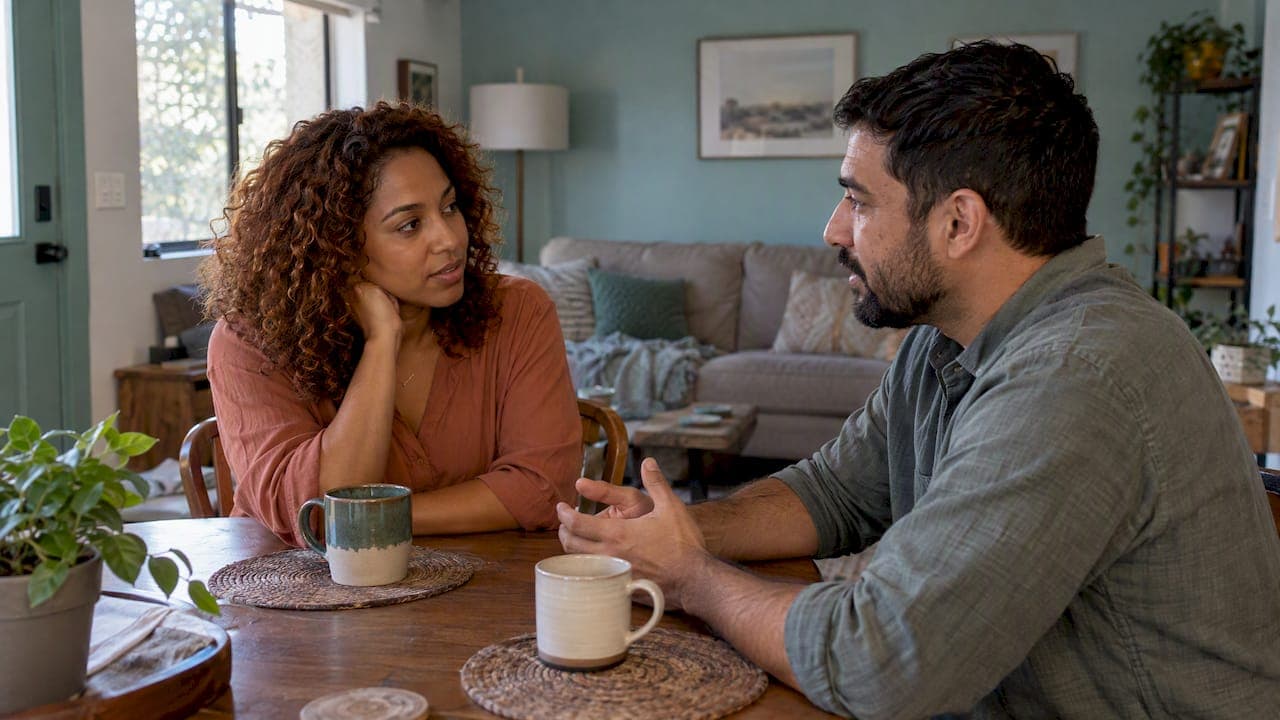
Interfaith premarital counseling is a set of guided conversations, held before the wedding, in which two people from different religious backgrounds (or one who practices and one who does not) talk honestly about faith, family, holidays, money, children and conflict, with a counselor who respects both of them. The goal is not to settle which religion is right. It is to help you understand each other deeply enough that your differences become something you navigate together rather than something that surprises you in year three.
If you are engaged, or thinking about it, and you feel both joy and a quiet worry about what your faiths will mean for your home, that mixture is common. Nothing is wrong with you. Below we walk through what these sessions look like, what to talk about, when to start, how to find the right counselor, and what to consider if this is a second marriage.
TL;DR
- Interfaith premarital counseling gives you a safe, structured place to talk about faith, traditions, family expectations and children before you marry.
- University extension research links disagreement over religious issues with higher marital conflict, and open communication about faith with lower relationship distress. Early conversation helps.
- Start several months before the wedding, and sooner if you are also planning a religious ceremony that has its own preparation requirements.
- Look for a counselor who treats both partners' beliefs with respect, asks how you want faith included, and will consult or refer when needed.
- Second marriages bring their own questions, including children, past hurts and old religious experiences, and deserve a conversation of their own.
Table of Contents
- What interfaith premarital counseling is
- Why talking early matters
- What you will talk about in sessions
- How counselors help you handle religious differences
- How to choose a counselor who respects both of you
- When to start
- Second marriages and interfaith questions
- Our perspective
- Working with us
- Preparing for your first session
- FAQ
- Sources
What interfaith premarital counseling is
An interfaith couple is, in the simple words of the University of Georgia Extension, two religions brought together in one marriage. That can mean a Christian and a Jewish partner, a Catholic and a Muslim, or a devout believer and someone who is spiritual but not religious. It can also mean two people who are both Christian but from traditions that practice quite differently.
Premarital counseling for these couples looks much like good premarital counseling for anyone: communication, conflict, finances, intimacy, family. The difference is that faith is named openly instead of being left as the thing you both avoid. Many couples tell us they have talked around it for months because neither wants to hurt the other. A counselor can hold that conversation gently so it does not fall on one of you alone.
It is also different from clergy-led preparation. A priest, pastor, rabbi or imam prepares you for marriage within a particular tradition. A counselor helps you look at the relationship itself. Many couples do both, and the two fit together well.
Why talking early matters
The evidence here is modest but consistent. UGA Extension reports that interfaith couples who disagree on religious issues tend to have higher marital conflict, and that conflict predicts lower marital stability. The disagreement itself is not the danger. Unspoken disagreement is.
There is encouraging news too. Research summarized by UF/IFAS Extension found that open communication about culture and faith, and support for a partner's culture and faith, were related to lower relationship distress. In plain terms, couples who talk about it and honor each other's practice tend to struggle less.
Premarital education in general has a track record worth knowing. A 2016 paper in the Journal of Consulting and Clinical Psychology notes that research-based premarital programs usually focus on communication and problem-solving skills and are effective, yet are often underused by couples at higher risk. If you are reading this, you are already doing the harder part, which is asking.
Scripture speaks to the value of this kind of care:
"Two are better than one, because they have a good return for their labor." (Ecclesiastes 4:9)
A good marriage is labor, and it goes better when you have help at the start.
What you will talk about in sessions
No two couples have the same list, but these are the areas that come up most. The UGA Extension guide names many of them, including religious practices at home, holidays and dietary guidelines, extended-family expectations, and children's upbringing.
1. Your own faith story
Each of you tells the other where your faith came from, what it means to you on an ordinary Tuesday, and what hurts or helps. This is not a debate. It is listening. Partners are often surprised by how much they have never heard.
2. Daily and weekly practice
Will you pray together, separately, or both? Does one of you attend services weekly while the other attends rarely? What happens on the Sabbath? How does each of you feel about the other attending, or not attending, your place of worship? Small rhythms shape a home more than big decisions do.
3. Holidays, food and traditions
Christmas and Hanukkah, Easter and Passover, Ramadan and Eid: calendars collide. Dietary practices may affect what is cooked, bought or served. Decide together what you will keep, what you will blend and what you will each do on your own, rather than leaving it for the first December.

4. The wedding itself
Who officiates? Is one ceremony enough, or are two needed? Will family members of each faith feel welcome? If one tradition has its own preparation process, plan for it early. The U.S. Conference of Catholic Bishops, for example, advises couples marrying in the Church to contact their parish priest six to nine months before the wedding, and describes preparation that may take the form of a retreat, a sponsor couple, or parish or diocesan classes.
5. Extended family
Parents and grandparents may carry real grief or fear about a marriage across faiths, sometimes spoken, often not. Talk about how you will respond together when a relative says something painful, and agree that you will protect each other first.
6. Children
This is usually the heart of it. Will children be baptized, dedicated, or given another rite of passage? What religious education, if any, will they receive? What will you say when they ask why Mom and Dad believe different things? UGA Extension lists children's religious education and rites of passage among the topics to settle ahead of time. Revisit the answer as your hearts and circumstances change, because it is common for convictions to deepen after a child is born.
7. Conflict, communication and intimacy
Faith differences rarely cause friction by themselves. They show up as the same old patterns: one withdraws, one pursues, both feel unheard. Practicing healthier ways to speak and listen matters more than any single agreement. Our article on communication in a Christian marriage offers steps you can try the same evening, and many of them work for couples of any faith background.
How counselors help you handle religious differences
The approach that research supports is practical. UGA Extension suggests that couples learn about each other's practices, holidays, traditions and rituals, then use healthy communication to reach agreement and compromise. It also says interfaith marriages can be enriching and that partners do best when they are open-minded and willing to compromise.
In a session, that can look like:
- Slowing the conversation down. One partner speaks while the other repeats back what they heard before responding.
- Separating the belief from the preference. Some things are matters of conscience and cannot be traded. Others are preferences, and there is room to give. Naming which is which prevents many fights.
- Planning for the first year. Concrete decisions about holidays, worship and family visits, written down and reviewed later.
- Naming what you fear. Fear of losing a partner's faith, of being pressured to convert, or of disappointing parents is easier to carry when it is spoken.
What a good counselor does not do is steer you toward a conclusion about which faith should win, or whether you should marry. That decision is yours.
How to choose a counselor who respects both of you
This is the question we hear most. An academic review of couple therapy with religious couples, published through Western Kentucky University, suggests you look for someone who creates respect, safety and trust, discusses how the couple wants faith included, and is willing to consult or refer when needed. The same article says clinicians should respect each client's religious affiliation, recognize religious differences, work to set aside bias, and may consult religious leaders or knowledgeable colleagues.
Use that as a checklist when you make your first call:
- Ask how faith would be included. A good counselor asks you and your partner, rather than assuming. Some couples want prayer and Scripture in sessions. Others want faith discussed but not practiced aloud. Both are legitimate.
- Ask about experience with couples across traditions. You are not looking for someone who knows everything about every religion. You are looking for someone curious, humble and willing to learn from you.
- Notice who gets listened to. If you leave feeling that one partner's beliefs were treated as the default, keep looking.
- Ask what happens when your questions go beyond counseling. Questions about doctrine, conversion or ceremony may belong with a clergy member from your tradition. A good counselor will say so.
- Ask about timing and availability. Wedding dates do not wait. Many insurance-based practices have long waits, which is one reason couples seek private-pay care.
If this is the question on your mind, our article on asking about prayer before booking a therapist who respects your faith walks through what to ask on that first call.
When to start
Starting about six months before the wedding gives you room to talk, pause, pray and revisit. A shorter timeline can still help, but a few things deserve extra lead time: any religious ceremony with its own preparation requirements, conversations with parents, and decisions about children's upbringing.
If you are already engaged and the date is close, do not wait for the perfect moment. A few sessions focused on the highest-stakes topics, usually children, holidays and family, are better than none. And if you are only dating seriously and wondering whether your differences are workable, counseling is open to you at that stage too.
Second marriages and interfaith questions
Many people reach us after a divorce or the death of a spouse, now planning a second marriage, and wondering whether Christian premarital counseling still fits. It can, and it often needs a different focus than a first-time engagement.
What tends to matter in a remarriage:
- Your history with faith. Some people feel shame or distance from their church after a divorce. Others found their faith deepened by loss. Your partner may not know which, and it affects how you pray, worship and choose a congregation together.
- Children from before. Children may already have a faith identity, a custody schedule and a lot of feelings. Plans for religious upbringing now involve former spouses and the children's own voices.
- Old patterns. The habits that strained your first marriage can travel with you. Premarital counseling is a good place to notice them kindly.
- Grief. A new marriage after loss can hold gladness and sorrow together. Grief is not linear and often moves in cycles, and it is okay to say so aloud.
We explore how blended households can build well in our article on Christian blended families, which is worth reading together if children are part of your plan.
Our perspective
We have worked with couples in the Phoenix area for over 14 years, and we have noticed one thing about couples across faiths: the ones who worry most about their differences are often the ones who care most about honoring each other. That care is a strength to build on.
We also believe a counselor should not ask you to set your faith aside to be helped. At Prism, a client's spiritual beliefs guide the work, whether you are Christian, from another tradition, or somewhere in between, and whether you want prayer in the room or not. We are a Christian counseling practice, and we say so plainly. We do not treat that as permission to pressure anyone, and we will not tell you what to believe. Our role is to help you hear each other.
We also keep our practice small and private-pay. For engaged couples that means openings within days instead of months, and conversations that stay between you and us. Wedding timelines are real, and so is the anxiety that comes with them.
If you want to read more about how we think about preparing for marriage, our complete faith-based guide to Christian premarital counseling and our overview of interfaith marriage counseling are good next steps. For a list to bring to your first session, see our Christian premarital counseling questions.
— Tres
Working with us
Premarital and couples sessions at Prism are private-pay, with no insurance involved and no diagnosis needed to begin. A standard 50-minute session is $195, and a sliding scale appointment of $100 to $165 is available. You can see the details on our rates page or read about the sliding scale option. Sessions are held for couples in the Phoenix area, and you can learn what to expect on our couples counseling page.
If you are not sure whether your situation is "interfaith" enough, or whether you should start now or wait, reach out anyway. A first conversation can help you decide. Our faith-based counseling page explains how we weave your beliefs into the work.
Preparing for your first session
You do not need to arrive with answers. A little preparation helps, though:
- Each write down three things your faith gives you. Share them before you come.
- List the decisions you suspect are coming. Wedding ceremony, holidays, children, where you will worship.
- Note one thing you are afraid to say. You do not have to say it first. Just know it.
- Ask each other what would make a session feel safe. For some, it is no surprises. For others, it is that no one will be asked to defend their beliefs.
- Pray or reflect, in whatever way is yours. Ask for patience with each other.
If you want to grow closer spiritually while you prepare, our four-week guide on deepening faith and intimacy for Christian couples offers gentle daily practices.
And a word for the partner who feels outnumbered: whether you are the only one in the room who does not share your future spouse's faith, or the one whose faith community has been wary, you belong in this process fully. A good counselor will make sure of that.
FAQ
Is interfaith premarital counseling only for couples of two different religions?
No. It also helps couples where one partner is religious and the other is not, and couples from different branches of the same faith. If your beliefs, practices or family expectations differ in ways that worry you, it is worth a conversation.
How many sessions do most couples need?
It depends on your timeline and how many topics you want to cover. Some couples come for a handful of sessions focused on children, holidays and family, while others meet over several months. We will talk through a plan with you at the start, and you can adjust it as you go.
Can we do premarital counseling if we are also meeting with a priest, pastor or rabbi?
Yes, and many couples do both. Clergy prepare you for marriage within a tradition, such as the Catholic preparation described by the U.S. bishops. Counseling looks at how the two of you communicate, handle conflict and make decisions together.
Is Christian premarital counseling appropriate for a second marriage?
It can be. A second marriage usually involves past hurts, children and a changed relationship with faith, so the sessions focus on those things as well as the basics. Tell your counselor about your history at the start so the work fits you.
Will a Christian counselor try to convert my partner?
No. Our work is to help each of you be heard and to help you decide together how to live your faith in one home. Your beliefs guide the work, and we do not pressure anyone toward a conclusion.
Sources
- One Marriage, Two Religions, University of Georgia Extension
- Are You Marrying Someone from a Different Culture or Faith?, UF/IFAS Extension
- Journal of Consulting and Clinical Psychology, 2016 premarital intervention study
- Couple Therapy with Religious Couples, Western Kentucky University
- Marriage Preparation, U.S. Conference of Catholic Bishops