
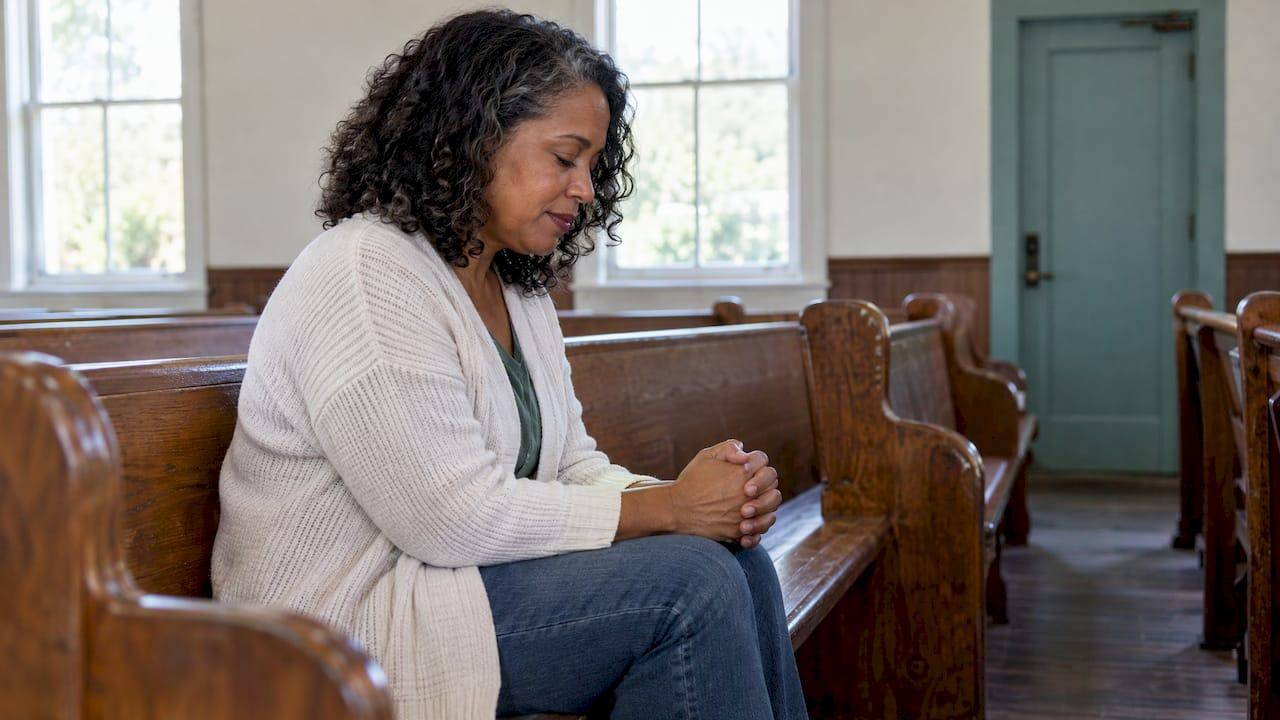
If you are a Christian in your forties or fifties and everything that once felt settled now feels uncertain, you are not failing in your faith. A midlife crisis for a believer is usually a season of upheaval in which identity, purpose, and your relationship with God are all questioned at once. It is painful, and it is also common and workable. With honest support from people who respect your faith, many people come out the other side with a deeper and more grounded trust.
This guide explains what is happening, how to tell a spiritual struggle from a mental health concern, and what practical steps help.
TL;DR
- A midlife crisis is not a diagnosis. It is a period of intense questioning, often between ages 40 and 60, and it can touch your faith as well as your work, marriage, and sense of self.
- Research suggests that a dip in happiness in midlife is nearly universal, while a full-blown crisis is less common and is often tied to a specific life event.
- Spiritual dryness and depression can overlap. Persistent low mood, panic, or trouble functioning at work or home is a reason to see someone with mental health training.
- Counseling, spiritual direction, and church community each do different work, and many people benefit from more than one.
- At Prism Counseling & Coaching, sessions are private-pay and openings are often available within days.
Table of Contents
- What a midlife crisis means for a Christian
- What the research says about midlife
- Signs you may be in a midlife and faith transition
- Spiritual struggle, mental health concern, or both?
- Counseling, spiritual direction, and church: what each does
- Practical steps that respect your faith
- Our perspective
- Support in the Phoenix area
- FAQ
- Sources
What a midlife crisis means for a Christian
The phrase goes back to 1965, when psychoanalyst Elliott Jaques used it in a paper on creative figures. He described the central feature of this phase as the reality and inevitability of one's own eventual death entering the picture. Most of us do not need a paper to know the feeling. One day you notice that more of life is behind you than ahead, and you start asking what it has all been for.
For a Christian, those questions rarely stay in the career or marriage box. They move quickly to deeper ones. Did I follow God or just follow expectations? Why does prayer feel quiet? Is the faith I inherited really mine?
One seminary writer describes a midlife crisis as an intense emotional upheaval, typically between 40 and 60, with a profound yearning for change. He notes it can pull a person's relationship with God in two opposite directions: feeling so self-reliant that you stop seeking God's guidance, or believing that not even God can bring comfort. Both reactions are human, and both can be met with care.

Midlife crisis or crisis of faith?
They overlap, but they are not the same thing. A midlife crisis is about life stage and meaning. A crisis of faith is about belief and trust. Often one feeds the other.
Author Barbara Bradley Hagerty, writing in Christianity Today, observes that the spiritual journey follows a curve much like the psychological one: a vivid honeymoon, a flat middle stretch, then a more centered, seasoned faith. She ties that flat middle stretch to spiritual maturity rather than to age on the calendar. In other words, the dry season you are in may not mean something has gone wrong. It may be a passage.
What the research says about midlife
It helps to know that you are not an exception, and that you are also not doomed.
Psychologists who study midlife report that the classic, crippling crisis is the minority experience. Hagerty notes that only about 10 percent of people in midlife suffer the stereotypical crisis, while a quieter ennui is almost universal, and that Americans tend to hit their happiness low point around age 45. Estimates vary by study. Scientific American reports figures of 10 percent and 26 percent from different research, and that most people in one study blamed upsetting events, such as losing a job or a parent, rather than age itself.
Two things follow from that:
- Triggers matter. If your unrest began after a layoff, a loss, a health scare, a child leaving home, or a marriage strain, treat that event as part of the story. Naming it often takes away some of the fear that something is wrong with you at the core.
- A dip is not a verdict. In a Sojourners interview, Hagerty describes the dip as more a time of pivoting that almost everyone makes than a crisis.
It is also worth knowing that, according to Healthline, a midlife crisis is not a mental health diagnosis. The same article notes that the CDC reports this age group has the highest rates of depression. That is why the line between a hard season and a treatable condition deserves attention, which we come to below.
Signs you may be in a midlife and faith transition
People describe this season in many ways. Common signs include:
- Pulling away from your church community or attending less often
- Questioning beliefs you once held without a second thought
- Disappointment with church leaders or institutions
- A sense of being ungrounded, with doubt, anxiety, burnout, or low mood
These signs appear in a description of faith-stage transition from the Centre for Christian Formation and Discipleship, which also frames such seasons as a normal part of growth rather than a failure.
Sister Rosemarie Carfagna, writing about contemplation and midlife, notes that people in crisis often report that their sense of identity seems to change, that they see their own weaknesses vividly, and that disturbing emotions arise, including anxiety. If that sounds like you, it is not a sign that God has left. Scripture speaks to exactly this place:
"The Lord is near to the brokenhearted and saves the crushed in spirit." (Psalm 34:18, ESV)
Spiritual struggle, mental health concern, or both?
This is the question we hear most often, and the honest answer is that it can be both. Prayer feeling empty and depression can look alike from the inside, but they are not identical.
A few questions can help you sort through it:
- Is it narrow or wide? Dryness in prayer, doubts about doctrine, or weariness with church can sit alongside a normal ability to work, sleep, eat, and enjoy people. Depression and anxiety tend to spread into sleep, appetite, concentration, energy, and relationships.
- How long has it lasted, and is it getting worse? A rough season that is slowly shifting is different from weeks of heaviness that keep deepening.
- Is it affecting your functioning? Trouble at work, conflict at home, or panic that you cannot reason your way through are signals to get help beyond prayer and reading.
- Are you having thoughts of harming yourself? Please do not wait. In the U.S., you can call or text 988 at any hour, or call 911 in an emergency.
Harvard Health quotes Dr. Malkah Notman of Harvard Medical School saying that if you feel depressed, panicky, or anxious, have a problem you cannot solve, or are getting into trouble at work or in relationships, a consultation with someone with mental health training is useful. She adds that serious conditions such as major depression, panic disorder, and anxiety disorders often need professional help. Seeking that help is not a lack of faith. It is stewardship of the life you have been given.
If anxiety is a large part of what you are carrying, you may also be reading about natural remedies for anxiety alongside counseling. Talk with your doctor about anything you consider taking, especially if you already use medication.
Counseling, spiritual direction, and church: what each does
Many Christians in midlife ask whether they need a pastor, a therapist, or a spiritual director. Each serves a different purpose.
The U.S. Conference of Catholic Bishops, in a newsletter for older adults, describes the differences this way: psychotherapy is a long-term relationship that helps with a major pathology, counseling is usually short-term and aimed at a crisis, and spiritual direction is a long-term relationship that helps a person listen to the voice of God. The same source stresses that spiritual direction centers on listening and is not a quick fix or crisis management.
In practice:
- Counseling helps with anxiety, depression, grief, relationship strain, and the practical questions of change.
- Spiritual direction gives you a patient companion for your walk with God, including the dry stretches.
- Your church or a small group gives you belonging, prayer, and people who know your story.
They work well together. If you want to go deeper on how they fit, we wrote about spiritual direction versus counseling. If your questions about belief feel especially heavy, our piece on faith deconstruction support explains how peer groups and therapy can support one another.
"In the multitude of counselors there is safety." (Proverbs 11:14, NKJV)
Practical steps that respect your faith
Nothing here is a quick fix. These are small, steady practices that many people find grounding.
- Name what you are grieving. Midlife often brings losses nobody mentions: dreams that did not happen, roles that ended, parents who are aging, years that cannot be recovered. Grief is not linear and often moves in cycles. Write the losses down and bring them to God honestly, as the psalmists did.
- Keep the simple rhythms. Healthline suggests journaling, gratitude, learning something new, reconnecting socially, staying active, and considering therapy as part of a midlife refresh. Many believers find these fit naturally with prayer and Scripture reading.
- Let prayer be quieter. Hagerty says the rich feelings during prayer ebb for most people, and she believes that is part of the plan, as she told Sojourners. Showing up when you feel nothing is still faithfulness.
- Pause before big decisions. Quitting a job, ending a marriage, or leaving your church in the heat of the moment can add new losses to old ones. Talk the decision through with a counselor and someone you trust first.
- Ask what is being invited. The Arab Baptist Theological Seminary piece suggests a crisis can be an opportunity to reassess your life in line with Christian discipleship. Isaiah 43:19 puts it this way: "Behold, I am doing a new thing" (ESV).
- Tell one person the truth. Shame grows in secret. A friend, pastor, spiritual director, or counselor can carry some of the weight with you.
- Include your marriage. A midlife crisis rarely stays with one person. If it is straining your relationship, Christian couples counseling can help you speak honestly without blame.
Our perspective
We meet many people in midlife who arrive quietly embarrassed. They have served faithfully, raised children, built careers, and now feel empty or afraid. They often assume the problem is weak faith. Almost always, it is a hard season that deserves care, not condemnation.
We believe your spiritual life should not be set aside in counseling. It should guide it. Our approach is designed to let your beliefs shape the work, whether that means exploring doubts, grieving losses, treating anxiety or depression, or simply having a safe place to say what you cannot say at church.
Because we are a small, private-pay practice, you get privacy and individual attention, and openings are often available within days. When you are in the middle of a crisis, waiting months is its own burden. We would rather you have someone to talk with this week.
You do not have to choose between your faith and good mental health care. God can meet you in both, and often does.
Tres
Support in the Phoenix area
Prism Counseling & Coaching provides faith-based counseling for individuals, couples, and families in Phoenix and Peoria, drawing on more than 14 years of experience. We work with anxiety, depression, grief, trauma, and stress, and we offer Christian counseling and EMDR as well as faith-based counseling and spiritual direction.

A standard 50-minute session is $195, and sliding scale appointments are $100-$165. You can see current details on our rates page and our sliding scale page. If you are ready to talk, you can start here. If you would like to understand what Christian counseling looks like before you book, read what it is and how to choose.
FAQ
Is a midlife crisis a sin or a sign of weak faith?
No. Doubt, grief, and restlessness appear throughout Scripture, and psalmists brought them honestly to God. Researchers describe a dip in happiness in midlife as nearly universal, and many people of faith pass through a similar dry season in prayer. It is a season to be tended, not a moral failure.
How long does a midlife crisis last?
There is no fixed timeline. Some people feel a transition ease within months, while others work through it over years, especially when it follows a major loss. One faith-formation source describes a deeper faith deconstruction as lasting roughly five to seven years for some, which is a reminder to be patient with yourself. Support usually shortens the loneliness, even if it does not rush the process.
Should I see a pastor or a therapist?
If your main struggle is about belief, prayer, or calling, a pastor or spiritual director is a natural start. If you are dealing with persistent low mood, anxiety, panic, or trouble functioning, see someone with mental health training. Many people do both, and a faith-integrated counselor can bridge the two.
Can Christian counseling help with a midlife crisis?
Yes. Counseling gives you a confidential place to sort out grief, identity, relationship strain, and anxiety, with your faith treated as a resource rather than a problem. Our guide to Christian counseling benefits explains how this approach compares with conventional therapy for anxiety and depression.
Sources
- Surviving the Wasteland of Faith, Christianity Today
- Midlife Crisis and Our Walk with God, Arab Baptist Theological Seminary
- Spiritual Crisis: Find Out Why It's Good News, Centre for Christian Formation and Discipleship
- A Christian Woman's Midlife Crisis, Christianity Today
- Science Debunks Midlife Myths, Scientific American
- The Myth of the Midlife Crisis, Sojourners
- Midlife Crisis in Men: What's Actually Happening, The Meaning Movement
- Engaging Aging, USCCB
- How to Turn a Midlife Crisis into a Fresh Start, Healthline
- Psychotherapy at midlife, Harvard Health
- Natural Remedies for Anxiety: What Actually Works