
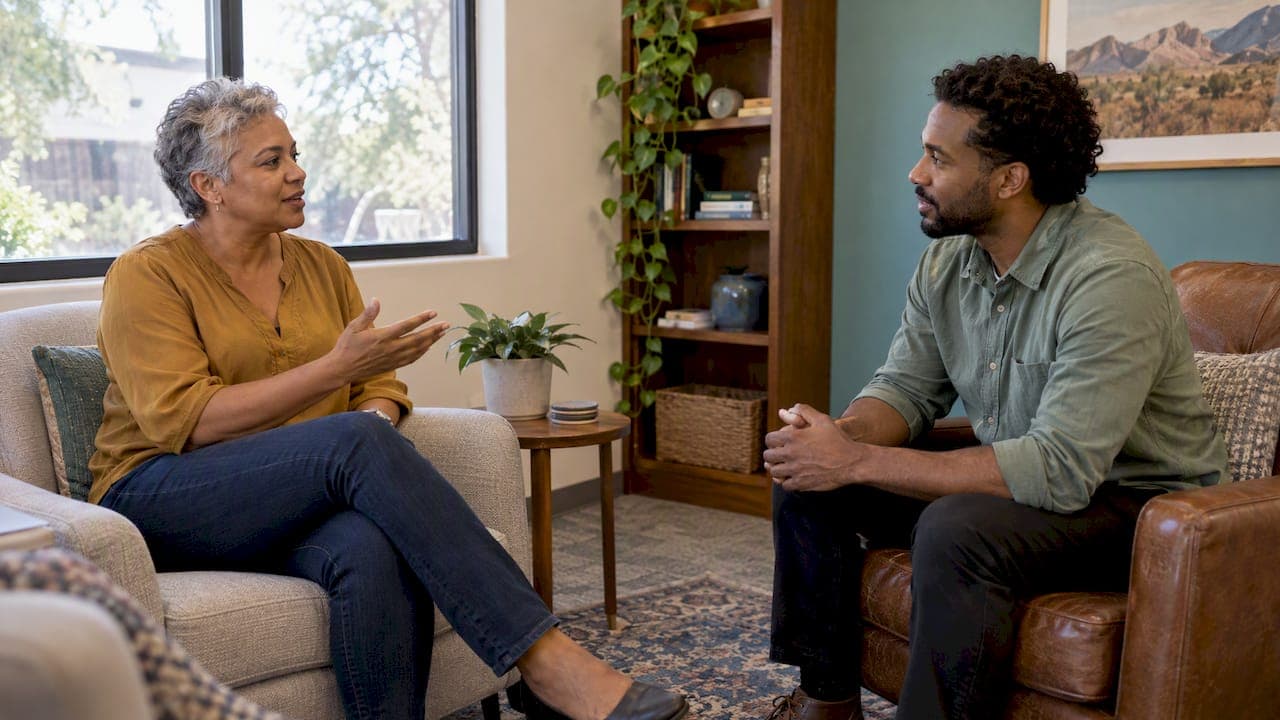
Christian counseling is professional emotional and relational support that draws on Christian faith. You bring anxiety, grief, a struggling marriage or a season of doubt, and your counselor helps you work through it in a way that respects what you believe. If you are hurting and wondering whether you can talk about God and your pain in the same room, the answer is yes. This guide explains how it works, how it differs from pastoral and Bible-based counseling, what to verify before you book, and what it costs.
TL;DR
- Clinical Christian counseling is licensed therapy that integrates faith, which is different from pastoral care given by clergy.
- It can help with anxiety, depression, grief, marriage difficulties, parenting, life transitions and questions of meaning.
- Before you book, verify the counselor's license, ask how faith is used in sessions, and notice whether you feel trust and comfort.
- In Arizona, you can check a license through the state's behavioral health board. Our standard 50-minute session at Prism is $195, with a sliding scale of $100 to $165.
- Insurance coverage depends on your plan and provider. We are private-pay, which is why we can often offer openings within days.
Table of Contents
- What Christian counseling actually is
- What happens in a session
- Concerns Christian counseling can help with
- Teens and couples: special considerations
- How to choose a Christian counselor
- Perspective: why we integrate faith, and who it is for
- What Christian counseling costs, and the insurance question
- Faith-based EAP for Arizona employers
- Booking with Prism Counseling & Coaching
- FAQ
- Sources
What Christian counseling actually is
The phrase covers more than one thing, and that confuses people. At its core, Christian counseling is a broad category of support that uses the principles of Christianity alongside counseling skills. What differs from one practice to the next is who is doing the work and how much weight each side carries.
Three common models:
- Pastoral care. Usually offered by clergy, focused on spiritual guidance, prayer and congregational support. It is valuable, but it is not the same as clinical treatment.
- Biblical counseling. This approach treats Scripture as the final authority and generally holds that the Bible is superior to psychological science. Researchers who have compared these camps contrast it with integration.
- Integrated (clinical) Christian counseling. Licensed professionals use recognized therapeutic methods and bring Christian faith into the process where the client wants it. This is the model we practice.
None of these is a lesser form of care. They answer different needs. If you are grieving a loss and also struggling with panic attacks, you may want a licensed clinician. If you want to talk through a calling or a church conflict, a pastor may be exactly right. Many people use both.
What happens in a session
A first session is mostly listening. Your counselor asks what brought you in, what you hope will change, and what role faith plays in your life. Some clients want prayer and Scripture in every session. Others want clinical tools and only occasional spiritual conversation. Both are welcome.
Over time, you and your counselor work on the concern itself. Clients typically come for anxiety, depression, grief and relationship problems, and the methods are clinical ones that may incorporate faith. We have written about how CBT and Christianity can work together, and about what Scripture in counseling means when it is used with care rather than as a quick fix.
Good counseling is also collaborative. The American Association of Christian Counselors-affiliated guidance from ACCFS says you should set goals, help shape your treatment plan, ask about techniques and alternatives, and decide who may receive information about you. If you do not believe you are getting the help you need, you can ask for a referral. A good counselor will not take offense.
Does faith-integrated care work?
There is a research base behind it. One 2024 academic article describing spiritually integrated psychotherapy training cites research indicating that bringing religion and spirituality into counseling improves outcomes across a wide variety of mental health issues. That fits what many of our clients tell us: they are more willing to be honest when they do not have to leave their faith at the door. If you are curious about the wider role of spiritual practice in healing, this piece on sacred rituals in healing mind and soul explores it from another angle.
Our own overview of how this plays out for common concerns is in Christian counseling for anxiety and depression.
Concerns Christian counseling can help with
People come to us carrying very different weights. Common ones include:
- Anxiety and stress. Racing thoughts, worry that will not quiet, a body that never feels at rest. See our approach in Christian anxiety counseling with Scripture and CBT.
- Depression. Heaviness, numbness, guilt that someone of faith "should" feel better. Our faith-integrated guide to depression speaks to this directly.
- Grief and loss. Grief is not linear and often moves in cycles. We describe a structured path in Christian grief counseling.
- Trauma. At Prism we also offer EMDR for clients who need a trauma-focused method.
- Marriage and premarital concerns. Communication, intimacy, trust and the pressures of building a faith-centered home. Read more on Christian couples counseling.
- Parenting, life transitions and questions of meaning. These are all commonly named reasons people seek this kind of help.
Teens and couples: special considerations
Teens. A teenager is more likely to engage when they feel they are not being lectured. Ask whether the counselor will talk with your teen about faith only as far as your teen is comfortable, how privacy between teen and counselor works, and when parents are brought in. Teens facing identity questions need to know the room is safe before they say anything real. Our article on Christian teen counseling for families walks through what to ask.
Couples. Couples often arrive when one partner is ready to leave and the other is ready to fight. Ask how the counselor handles disagreement about faith itself, since spouses do not always hold the same beliefs or the same intensity. Ask also whether the counselor is willing to meet each of you individually when it helps. Our couples counseling work includes communication, intimacy and premarital preparation.
LGBTQ+ clients. Many people assume Christian counseling cannot be affirming. That is not true of every practice, but it is true that practices differ widely, so ask plainly and early. We offer LGBTQ+ affirming counseling, and we believe you should never have to wonder whether your counselor sees you with respect.
How to choose a Christian counselor
Choosing a counselor is part credentials, part fit. Work through these steps.
- Verify the license. For clinical work, look for an LPC, LCSW, LMFT or psychologist who integrates Christian faith. ACCFS notes that you will almost always want someone licensed in your state or supervised by someone who is.
- Ask about training and experience. Degree, licensure, certifications, specialties and training for your particular concern are all fair questions. Some licensed clinicians also complete specialized programs such as ACPE's spiritually integrated psychotherapy training.
- Ask how faith is used. Will the counselor pray with you if you want that? Use Scripture? Respect your tradition if it differs from theirs? Our article on asking about prayer before booking offers wording.
- Ask about affirmation and boundaries. If you or a family member is LGBTQ+, ask how the counselor approaches identity before the first session.
- Notice how you feel. Trust and comfort are part of the evidence. If after a few sessions you feel judged or unheard, it is reasonable to look elsewhere.
For a longer checklist, see how to find a Christian counselor who fits your faith.
Checking a license in Phoenix and Arizona
In Arizona, the Board of Behavioral Health Examiners issues licenses, including the Licensed Professional Counselor (LPC). The Board also runs a public directory and verification search drawn from its public database, so you can confirm a name and license status in a few minutes. Licensees must also keep client records in line with A.R.S. § 12-2297, which is one reason to ask a practice how it protects your file.

Perspective: why we integrate faith, and who it is for
We have practiced for more than 14 years in the Phoenix area, and the pattern we see most is this: people do not come asking for "integration." They come saying, "I do not know how to hold my faith and my pain at the same time." Some have been told to pray harder. Others have been told their faith is the problem. Neither answer helps.
We believe your spiritual beliefs should guide your therapy, not be an obstacle to it. That means we follow your lead. If Scripture steadies you, we use it. If you are angry at God, we make room for that too, because honest lament has always had a place in faith. The Psalms themselves say, "My soul is cast down within me." (Psalm 42:6)
We also made a deliberate choice to stay small and private-pay. It keeps your information outside insurance paperwork, it keeps our attention on you, and it lets us offer appointments within days instead of weeks. That matters when someone is in the worst stretch of their life. It is not the right model for everyone, and we will say so honestly if another kind of care fits you better.
— Tres
What Christian counseling costs, and the insurance question
Whether insurance covers Christian counseling depends on your plan and on the provider. Insurance generally covers treatment delivered by licensed clinicians who are in network, not the faith component as such. If you want to use benefits, call your insurer and ask whether the specific counselor is in network and what your copay or deductible is. Keep in mind that insurance-based care can come with waiting lists and requires a diagnosis on your record.
We are private-pay, so we do not bill insurance. Our published rates:
| Option | Price |
|---|---|
| Standard 50-minute session | $195 |
| Sliding scale appointment | $100 to $165 |
| Missed or late-cancellation fee | $195 |
Current details are on our rates page, and you can read how the sliding scale works if the standard rate is out of reach. Some clients choose private pay precisely because it means no insurance claim and no diagnosis code attached to their record.
Faith-based EAP for Arizona employers
If you run an organization in Arizona, you may be asking whether a faith-based employee assistance program is possible. We offer one, and it deserves the same scrutiny as any EAP. SAMHSA advises employers to look at professional-association membership, CEAP credentials, staff education, references, session limits, accessibility, referrals, fees and whether the vendor can train supervisors. It also suggests giving vendors your benefit structure, policies, budget, worksites and employee characteristics so proposals reflect your real needs.
A faith-based EAP should also be voluntary and respectful: employees must feel free to use it without any expectation about their beliefs. Ask any vendor, including us, how that is protected.
Booking with Prism Counseling & Coaching
If you are ready to talk to someone, we can help. We see individuals, couples, families and teens in the Phoenix area, with Christian counseling, LGBTQ+ affirming care and EMDR available. Our faith-based counseling and spiritual direction page explains how sessions work, and individual counseling and coaching covers one-on-one care. Because we are small, openings are often available within days.
FAQ
What does Christian counseling do?
It helps you work through emotional and relational struggles with a counselor who respects and incorporates your faith. In clinical settings, that means licensed professionals using recognized methods for concerns like anxiety, depression, grief and marriage problems, with prayer or Scripture added when you want them.
What are the types of Christian counseling?
People often describe three: pastoral care from clergy, biblical counseling centered on Scripture, and integrated counseling by licensed clinicians who combine psychology and faith. Each has a different purpose, so the right one depends on what you need.
Is Christian counseling covered by insurance?
Sometimes. Coverage depends on your plan and on whether the counselor is licensed and in network. Call your insurer to ask. At Prism we are private-pay and do not bill insurance, with a standard session at $195 and a sliding scale of $100 to $165.
How do I find a good Christian counselor?
Start with a license you can verify, such as an LPC, LCSW, LMFT or psychologist. In Arizona you can use the state board's verification search. Then ask how faith is used in sessions and whether you feel comfortable and trusting after the first meeting.
Sources
- Christian Counseling: What It Is & How to Find a Counselor
- Just What Is Christian Counseling Anyway?
- What To Expect From Counseling (ACCFS)
- ACPE's Spiritually Integrated Psychotherapy Training
- Arizona Board of Behavioral Health Examiners FAQ
- Arizona Board directory and verifications search
- Provide Support | SAMHSA
- The Role of Sacred Rituals in Healing Mind and Soul