
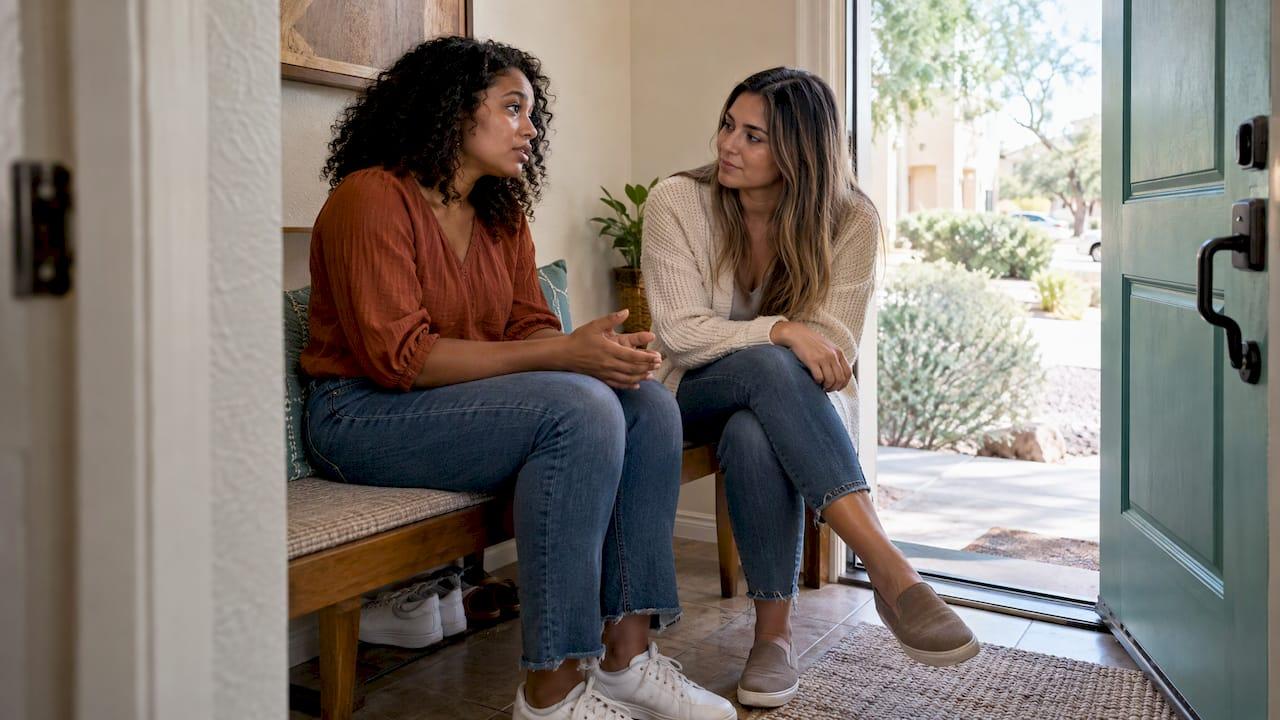
If you are hurting yourself, or you love someone who is, you are not beyond help and you are not beyond God's care. The first step is safety: if you are in danger right now, call or text 988 or call 911. The second step is a licensed counselor who will not shame you and who welcomes your faith into the room. That is the kind of care we offer at Prism Counseling & Coaching in the Phoenix area, often with openings within days.
TL;DR
- If you feel unsafe now, call or text 988 (or chat at 988lifeline.org) for free, confidential support, and call 911 in a life-threatening emergency.
- Self-harm is most often an attempt to survive emotional pain, not rebellion. Shame makes it worse, and grace opens the door to healing.
- Parents of a teen who self-harms should stay calm, listen without judgment, make the home safer, and bring in the pediatrician and a mental health professional.
- Christian counseling combines proven therapeutic tools with prayer, Scripture and spiritual direction, so you never have to choose between your faith and your healing.
Table of Contents
- If you are in danger right now
- What to do if you just cut yourself
- Why Christians struggle with self-harm too
- What does the Bible say about self-harm?
- How to talk about it without shame
- Helping a teen who self-harms
- When to seek professional help
- How can a Christian cope with trauma without self-harm?
- Why Christian counseling can fit self-harm recovery
- What a first session is like
- Perspective
- Getting started at Prism Counseling
- FAQ
- Sources
If you are in danger right now
Before anything else, please read this part slowly.
The National Institute of Mental Health says that if you are having thoughts of suicide or urges to hurt yourself, you should get immediate help by calling or texting 988, the 24-hour confidential line, or chatting at 988lifeline.org. In a life-threatening situation, call 911.
If the urge is strong but you have not acted, these steps can help you get through the next few minutes:
- Make the space safer. The mental health charity Mind advises removing anything you could use to harm yourself, moving to a safer place, or being around other people if you are alone.
- Aim for five minutes, not forever. Mind suggests focusing on getting through the next five minutes. The charity Rethink describes the same idea for self-harm: set a concrete delay such as "I'm going to wait five minutes," and use that time to distract yourself or contact someone.
- Reach a person. Text a friend, call your pastor, or call 988. You do not have to explain everything. "I'm struggling and I need someone with me" is enough.
- Pray the honest prayer. You do not need polished words. "The Lord is close to the brokenhearted" (Psalm 34:18) was written for exactly this kind of night.
We are a counseling practice, not a crisis line or an emergency service. When your safety is at stake, 988 and 911 come first, and we are here for the healing work that follows.
What to do if you just cut yourself
Many people reading this have already hurt themselves tonight and are afraid or ashamed. Caring for the wound is not an admission of failure. It is looking after a body God made.
For a minor cut, the Mayo Clinic's first-aid guidance says to wash your hands, stop the bleeding with gentle pressure from a clean cloth, raise the area, rinse the wound with water, and cover it with a bandage, changing the bandage at least daily or when it gets wet or dirty. Mayo also says to seek medical care for signs of infection, and to get a tetanus shot if the wound is deep or dirty and you have not had one in the past five years.
The American Academy of Dermatology says to get medical attention if a cut is more than three-quarters of an inch long, more than a quarter inch deep, or will not stop bleeding. If any of those apply, go to urgent care or an emergency room. Tell the nurse or doctor the truth if you can. They have seen this before, and they are there to help rather than to judge.
Then tell one safe person. Wounds heal faster when we stop carrying the secret alone.
Why Christians struggle with self-harm too
Many Christians quietly wonder whether they are the only believers who do this. You are not. Pain does not check your church attendance.
Self-harm is usually an attempt to manage feelings that seem unbearable: anxiety, grief, numbness, anger, shame, trauma. The relief is real and short, and the cycle that follows (relief, guilt, more pain, another urge) can feel like a trap. For believers, a second layer is often added: the fear that God is disappointed, or that struggling this way means faith is weak.
In our work with people of faith, we see it differently. A person who self-harms is rarely rebelling. They are usually in pain and have reached for the nearest tool. Pastoral care guidance from the National Association for Christian Recovery points the same direction: it counsels staying calm, listening, making room for emotional pain, and avoiding moralizing that increases shame, while encouraging professional help and several safe places to talk.
That matters because shame feeds secrecy, and secrecy feeds the cycle. Grace breaks it.
What does the Bible say about self-harm?
The Bible does not use the modern phrase "self-harm," and it is worth being honest about that. What it does give us is a picture of a God who values the body and draws near to the hurting.
The body matters to God. Paul writes that your body is a temple of the Holy Spirit (1 Corinthians 6:19-20). That verse is not a charge to feel guilty. It tells us the body is precious and worth protecting, including from you on your worst days.
Old Testament cutting passages are about grief and false worship. Leviticus 19:28 forbids making cuts on the body for the dead, and Deuteronomy 14:1 says something similar about mourning. In 1 Kings 18, the prophets of Baal cut themselves while pleading with a god who did not answer. The contrast is striking: our God does answer, and he does not ask us to bleed for his attention.
God draws near to people in pain. "The Lord is close to the brokenhearted and saves those who are crushed in spirit" (Psalm 34:18). "God is our refuge and strength, an ever-present help in trouble" (Psalm 46:1). Those verses were written for people in anguish. They do not wait for you to stop hurting before they apply.
You can hold truth and compassion together. Scripture invites us toward healing and away from harm. It never asks you to heal by being ashamed. Jesus spent his ministry moving toward wounded people, not away from them.
If you are asking, "Is self-harm a sin?", we would gently reframe the question: what is the pain underneath, and who can walk with you through it? That is the question a good counselor and a good pastor will ask.
How to talk about it without shame
Whether you are the one struggling or the one listening, a few principles help.
If you are struggling:
- Choose one person who is calm and kind: a counselor, a mature friend, a pastor who handles hard things well.
- Say it simply. "I've been hurting myself when I feel overwhelmed, and I want help."
- Ask for what you need: someone to pray with you, someone to sit with you, someone to help you find a counselor.
If you are listening:
- Stay calm. Your reaction sets the tone.
- Listen more than you speak, and thank them for trusting you.
- Skip the spiritual clichés ("just pray more," "have more faith"). They tend to deepen shame.
- Encourage professional help and offer to help make the first call.
The pastoral care guidance cited above recommends exactly this combination: calm listening, no judgment, and a push toward professional care rather than a church-only solution.
Helping a teen who self-harms
The search for "teen self-harm Christian" usually comes from a parent who found something on a wrist or in a bathroom drawer and has no idea what to do next. First: take a breath. Many teens who self-harm recover with the right support.
The American Academy of Pediatrics' parent site, HealthyChildren.org, advises a non-judgmental conversation, asking directly whether your teen is hurting themselves, and relying on the pediatrician to build a care plan, which may include talk therapy, stress reduction techniques, medication and other steps. It also recommends making the home safer by removing sharp objects, keeping firearms inaccessible, locking away medications, and talking with the pediatrician or a mental health provider about a suicide prevention safety plan.
A practical order for parents:
- Start with calm. "I love you. I found something that worries me. I'm not angry. Can you tell me what's been going on?"
- Ask directly about safety. Asking about self-harm or suicidal thoughts does not plant the idea. If your teen mentions wanting to die, call or text 988, or call 911 if danger is immediate.
- Remove the means. Secure blades, medications and firearms today.
- Call the pediatrician. This rules out and addresses medical needs and starts the care plan.
- Find a counselor. Choose someone your teen can talk to, ideally someone who treats their faith as part of who they are rather than a problem to be bypassed.
- Keep the relationship warm. Shared meals, normal routines and prayer you offer rather than demand all tell your teen they are still loved.
Parents who want to understand how counseling works for adolescents can read our guide on adolescent therapy for parents and our overview of Christian teen counseling for families. Many teens who self-harm are also carrying anxiety, and our 3-3-3 skills for Christian families give parents and teens a calm, simple tool to use at home. If your teen is wrestling with questions about God at the same time, responding to faith doubts with care can keep the conversation open.
When a teen may be in immediate danger
If you believe your teen may be in danger of suicide, do not wait for the next appointment. Call 988 or 911, contact the family physician right away, or take your teen to the nearest emergency room. Do not leave your teen alone while you wait for an evaluation. Families also face crises in other seasons of life, and learning the signs of postpartum mental health struggles shows why acting early on warning signs, and knowing who to call, protects the people we love.
Coping skills a teen can practice
Once your teen is safe and connected to care, practice replacements together. One simple method is to help your teen name three things to do when the urge comes: journaling, texting a friend, a brisk walk or run, or praying a short verse aloud. Choose one and practice it for a week. This does not replace therapy. It gives your teen something to reach for between sessions.

When to seek professional help
Self-harm can be hard to stop alone. Self-injury can become habitual, cause serious damage and sometimes become life-threatening, which is why a licensed mental health professional is the right first step for ongoing care.
The NIMH advises talking with a health care provider if your symptoms do not improve or if they get worse, and notes that common treatments include therapy and medication. Seek help soon if:
- The urges are becoming more frequent or more intense
- The injuries are deeper or harder to hide
- You are also feeling hopeless, numb or panicked
- You have thoughts of suicide (call or text 988 now)
- Prayer and church support are comforting but the urges are not changing
Seeking help is not a lack of faith. We pray, and we also see doctors for broken bones. Both are ways of receiving care God provides.
How can a Christian cope with trauma without self-harm?
For many people, self-harm began with something that happened to them: abuse, loss, a frightening event, years of criticism. Healing trauma takes more than willpower, and it takes more than reading a verse alone at midnight.
Here is what we encourage:
- Name what happened, with someone safe. Trauma shrinks when it is spoken in a place of safety.
- Build a toolbox of replacements. Cold water on the hands, a walk, music, journaling, a lament psalm read aloud. Psalm 13 begins with "How long, Lord?" and ends in trust. God can handle your honesty.
- Pair spiritual practice with skills. Prayer, Scripture and worship are real sources of comfort. They work best alongside coping skills such as grounding, breathing and thought-challenging. Our post on Christian anxiety counseling with Scripture and CBT shows how this looks in practice.
- Get trauma-focused treatment. Our practice offers EMDR, a therapy used for trauma, as one of our services. Talk with a counselor about whether it fits your story.
- Care for the whole body. Sleep, food, movement and daily stress habits matter. Our guide to Christian stress management practices is a place to start.
Why Christian counseling can fit self-harm recovery
Good therapy for self-harm addresses the feelings and situations behind it and builds new ways of coping. Christian counseling does this while treating your faith as a source of strength rather than a side issue. For someone who fears judgment from God and from church, that matters a great deal.
What that looks like with us:
- Your beliefs guide the work. We follow your lead on how much prayer, Scripture and spiritual direction you want in sessions.
- Privacy. We are a small, private-pay practice, so your care does not run through an insurance claim.
- Speed. Because we are private-pay, we often have openings within days rather than weeks.
- Affirming care. We provide LGBTQ+ affirming counseling, so no one has to hide part of themselves to receive help.
- Experience. We have more than 14 years of experience serving individuals, couples, families and teens in the Phoenix area.
If you want to understand how this compares with secular therapy, read why Christian counseling matches therapy for anxiety and depression. If anger or shame is part of the picture, see how we blend Scripture and CBT for explosive anger.
What a first session is like
Many people tell us the hardest part is making the call. A first session is a conversation, not an interrogation. You will not be asked to defend your faith, and you do not have to disclose everything at once. We will ask what brought you in, what you most need right now, and what safety looks like for you this week. Together we begin a plan, and you decide the pace.
For teens, we usually begin with the teen's own voice, while keeping parents informed in ways that protect trust and safety. Parents are welcome to ask questions about how that works when they call.
Perspective
We have sat with many people who believed God was angry with them because of what they did to their bodies in the dark. Almost always, what we find is not defiance. It is exhaustion, grief, trauma, or a fear of being a burden.
That is why we do not begin with a verdict. We begin with presence. The same Scripture that cares about your body also says God is near to the brokenhearted, and we want our counseling rooms to reflect that nearness.
Faith and therapy are not rivals. We bring both: practical skills for the next hard moment, and a spiritual home for the long road. Because we are private-pay and keep our practice small, we can often see people within days, and that speed can matter when someone has finally found the courage to ask.
If you are reading this on a hard night, you are not too much, and you are not too late. Take the next safe step.
Tres
Getting started at Prism Counseling
If you or your teen would like faith-integrated counseling in the Phoenix area, we would be honored to walk with you. Our standard 50-minute session is $195, and our sliding scale appointments range from $100 to $165. You can see current details on our rates page and on our sliding scale counseling page. To learn how we integrate faith and therapy, visit our faith-based counseling page.
We also work with individuals through individual counseling and coaching and with couples through couples counseling, because self-harm often touches the whole family. A late-cancellation or missed appointment fee of $195 applies, as listed on our rates page.
FAQ
Is self-harm a sin?
The Bible does not use the phrase "self-harm," and it does speak against cutting in connection with mourning and false worship. It also says God is close to the brokenhearted. We treat self-harm as a sign of pain that deserves compassion and care, and we would encourage you to bring the question to a counselor or pastor who will answer with grace.
What should I do if I just cut myself?
Stop the bleeding with gentle pressure from a clean cloth, rinse the wound, and cover it with a bandage. Seek medical care if it is deep, long, will not stop bleeding or looks infected. If you are thinking about suicide, call or text 988, or call 911 in an emergency.
How can I help my teen who is self-harming?
Stay calm, listen without judgment, ask directly about safety, and remove sharp objects, medications and firearms from easy access. Call your pediatrician and connect your teen with a mental health professional. If you think your teen is in immediate danger, call 988 or 911, or go to the nearest emergency room.
Can Christian counseling help with self-harm?
Christian counseling can help you work through the emotions and experiences behind self-harm while keeping your faith involved in the process. At Prism, your spiritual beliefs guide the work, and our private-pay model often allows openings within days. For immediate danger, call 988 or 911 first.
Sources
- My Mental Health: Do I Need Help? (National Institute of Mental Health)
- Tips for coping with suicidal thoughts (Mind)
- Self-harm: causes, support, treatment and how to get help (Rethink)
- Cuts and scrapes: First aid (Mayo Clinic)
- How to treat minor cuts (American Academy of Dermatology)
- Self Harm (National Association for Christian Recovery)
- When Children and Teens Self-Harm (HealthyChildren.org)
- Postpartum Mental Health Signs: What to Watch For